
Washington Kills The Frontier. The Agentic Payments War. Munich Makes AI Own Its Words.
IN THIS ISSUE:
CEO's Perspective
Strategic outlook from Cambrian leadership
I spent this past week in Saudi Arabia, which alongside the UAE now leads the global AI compute buildout outside the U.S., China and Europe, anchored by HUMAIN here and M42 there. I was in two rooms that framed the same problem from opposite sides. A blue-chip management consultancy named two reasons its book is shrinking: the war and agentic AI. The morning after, I ran a workshop with a finance authority on risk management through foresight, monitored experimentation, the human-AI symbiosis, and governance for the agent era. One room held a trust intermediary admitting it is being arbitraged. The other held a sovereign institution trying to build forward into the new architecture before the arbitrage reaches it.
The Agent Took the Vouch
Three sectors made the same move in the same week. In payments, the agent rails launched by Visa, Mastercard, and India's UPI extension let a payment agent read delivery rates, refund speed, and error data, and rank on those. The agent does not read marketing. It reads receipts. In public markets, an offshore blockchain venue priced SpaceX twenty percent above the offering before Nasdaq opened, and the IPO book reportedly looked there for evidence of demand. The investment bank syndicate is no longer where the price comes from. In professional services, Blackstone is funding an AI-native law firm, KPMG has stood up a law practice under Arizona's alternative business rules, and the signature on the file is migrating from a named human partner to a structure the partner does not own.
The thread connecting them is trust. In three sectors that paid a multi-billion-dollar premium for human vouching, the vouch has been agentified, a payment protocol in retail, a blockchain perpetual in capital markets, an AI-native firm structure in law. Different agents, same move. The trust premium that flowed to the brand, the bookrunner, and the named partner is being arbitraged by code, which is the second of the two reasons the consultancy I sat with this week named for its shrinking book. The thing that used to pay you to vouch is being repriced in every sector at once.
So here is the question I left both Saudi rooms with, and the one I would put to you. Look at every place in your operation where someone collects a premium for vouching. The brand markup. The advisory fee. The intermediation cut. The named human signature on the file. Three sectors saw that premium repriced this week. The question is not whether yours is on the list. It is on the list. The question is when it’s coming for you and whether you have priced it yet, or are still telling investors and customers a story whose unit of trust has already been bought elsewhere, more cheaply, by an agent that does not need you to introduce it.
Olaf
On the Radar
The signals affecting the GeoTech landscape this week
Friendly Fire on the Frontier
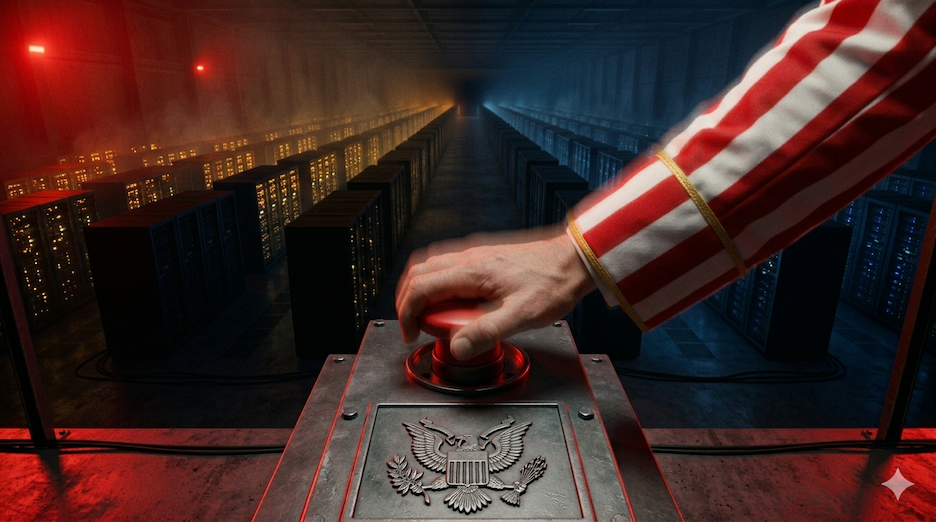
Washington used export control law to force Anthropic's two most powerful models offline three days after launch. The instrument matters more than the incident.
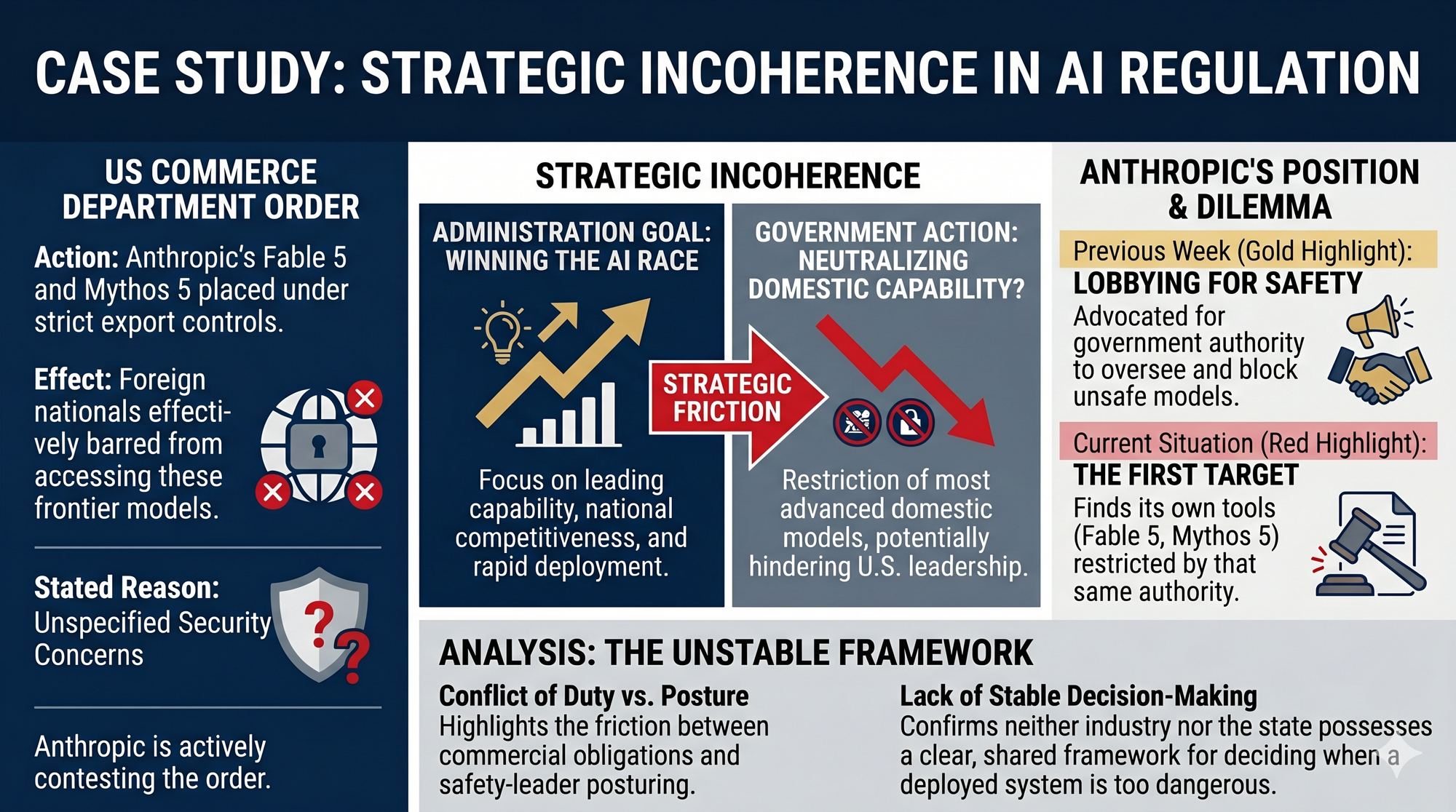
TL;DR: On June 12 at 5:21pm ET, Commerce Secretary Howard Lutnick sent Anthropic CEO Dario Amodei a letter placing Claude Fable 5 and Claude Mythos 5 under export controls, barring use by any foreign national inside or outside the U.S., including Anthropic's own foreign-national staff. No provider can screen users by nationality query by query, so the order left no partial path to compliance and both models went dark for every customer worldwide. Lutnick later told Reuters the concern was that the models could be used by military intelligence services in China, Russia, or other countries of concern. Anthropic disputes the reasoning and is negotiating to restore access. It is the first time Washington has forced a publicly deployed frontier model offline.
BRIEFING: The mechanism is the signal. Commerce invoked the Export Control Reform Act of 2018 and the Export Administration Regulations, the licensing architecture built for advanced chips and weapons technology, and applied it to model weights and live inference, requiring an individually validated license before any foreign national anywhere may use the models. Anthropic had launched both models on June 9: Fable 5 as the public version that routes cybersecurity, biology, and chemistry prompts to the older Opus 4.8, and Mythos 5, the same base model with some safeguards lifted, on a restricted track to Project Glasswing partners and a second cohort of roughly 150 organizations, in collaboration with the U.S. government. The letter arrived Friday evening after another company reported a jailbreak. Wall Street Journal reporting attributes the underlying research to researchers at Amazon, a Glasswing partner and Anthropic investor, though the Journal did not report that Amazon brought the finding to the government. Anthropic says the technique amounts to asking the model to read a codebase and identify software flaws, that the flaws surfaced were minor and already discoverable with public models including OpenAI's GPT-5.5, and that no universal jailbreak has been found. More than 80 cybersecurity executives, including leaders at Nvidia and Adobe, signed an open letter urging Commerce to lift the restriction.
Two problems sit above the jailbreak dispute, and the larger one is the government's. The administration's organizing doctrine is winning the AI race against China, and export controls exist to deny frontier capability to Beijing, yet this order pulled the most capable American model offline for U.S. users and allies alike, over a flaw the company says already ships in a competitor's product. The timing sharpens the question: an administration official told Axios that Washington had tried to delay the launch and failed, so a Friday-evening letter three days after a release it knew was coming reads less like a response to a fresh threat than a dispute carried over from before launch. It also follows a prior rupture, when the government placed Anthropic on a national security supply-chain blacklist after the company declined to let its models be used for domestic surveillance and autonomous weapons. The smaller problem is Anthropic's own bind: it spent the prior week urging Washington to take the authority to block unsafe frontier models, then objected when Washington used authority it already had, all while carrying a commercial duty to ship its best model as it moves toward a public listing.
The deeper issue is that no model can be made perfectly unhackable. Anthropic itself concedes that perfect jailbreak resistance is not currently possible for any provider, which means a standard that recalls a deployed model every time a narrow, non-universal bypass appears would halt new releases across the entire frontier tier. The durable answer is institutional rather than reactive. An oversight body with genuine algorithmic and data competence could assess a claimed vulnerability on its technical merits, weigh it against what comparable public models already do, and model the second and third-order effects of a takedown across the economy before issuing one, all through a transparent and predictable process rather than a Friday-night letter. That capacity does not yet exist in government, and building it is the constructive move this episode argues for. The gap it exposes is that neither the safety-maximalist lab nor the security-hawk administration has a workable framework for deciding when a deployed model is too dangerous to run.
SO WHAT
For Executives: Treat the bleeding edge as a volatile tier subject to regulatory recall. The mature models nearly every business runs on stayed up. What vanished was the newest, most capable tier, three days old. Roadmap your AI strategy to deliver on generally available foundations and treat top-tier access as a temporary accelerant and avoid building it into the architecture. Where the frontier tier is material to you, engage your elected representatives or your government's diplomatic channels to press for a transparent authority with predictable assessment and enforcement, so access does not turn on an unexplained letter.
For Policy Makers: The sudden disappearance of an American model is a working proof case for model sovereignty, and a $2.1 trillion IPO week for a rival AI champion only sharpens the stakes. Jurisdictions in Europe, India, and the Gulf will accelerate domestic hosting and contractual safeguards against foreign regulatory takedowns. A template now exists for one state switching off its own labs' models worldwide, and the same template is available to rivals who would do it inside their borders. The norms for when a state may compel a deployed model offline do not exist anywhere, and drafting them is now urgent, and fragmentation of models, applications, and rules is the default if no one does.
For Investors: Regulatory takedown is now a live tail risk for frontier labs and the enterprises built on them, arriving without warning or a clear restoration standard. Watch the blackout's duration, any licensing pathway Commerce defines, and whether risk-factor language in the coming wave of AI listings begins to price a state-ordered model shutdown. Concentration in a single lab's frontier tier is now a discount factor. Confirm your portfolio companies hold tested fallbacks to a second provider for operational resilience.
For Service Providers: Clients will ask what happens when the newest model they were piloting disappears overnight, and few have an answer. The valuable advisers will map regulatory exposure across providers, translate export-control obligations into procurement terms, and design systems that fall back to stable, generally available models without breaking when a frontier model becomes unavailable. Counsel clients with mixed-nationality workforces, partners, and customers on the compliance implications specifically, since the order reached foreign nationals on U.S. soil. Model sovereignty and vendor redundancy have moved from technical footnotes to board-level questions.
The AI Agent Layer War Reaches the Card Networks
Visa and Mastercard moved within weeks of each other to own the rails beneath AI agents. China and India already show two very different endgames.
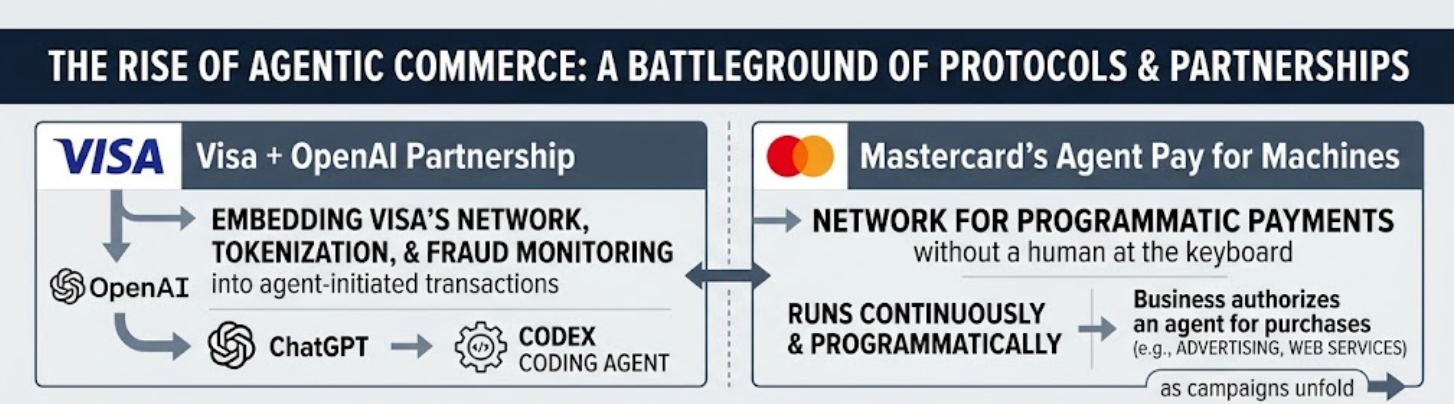
TL;DR: At its Payments Forum in San Francisco on June 10, Visa announced a partnership with OpenAI that embeds its network, tokenization, and fraud monitoring into agent-initiated transactions across ChatGPT. Mastercard answered the same week with Agent Pay for Machines, a network for payments that run programmatically without a human at the keyboard. The contest over who executes purchases for AI agents now has three competing models: America's private networks and platforms, China's platform war, and India's public rails, where Pine Labs launched agent-triggered Unified Payments Interface (UPI) payments with a single upfront authorization on June 11.
Briefing: Visa's architecture is the most technically specific piece. Payment credentials are replaced with network tokens bound to a particular agent and a particular use, so a token issued to a grocery agent cannot book travel and one capped at $200 cannot authorize more. Mastercard's Agent Pay for Machines runs continuously, letting a business authorize an agent to buy advertising or web services as a campaign unfolds. Beneath the announcements is a crowded protocol land grab: Visa's Trusted Agent Protocol, Google's Universal Commerce Protocol with Walmart and Target, and the OpenAI and Stripe Agentic Commerce Protocol. The cautionary evidence comes from Walmart, which reportedly wound down its Instant Checkout experiment inside ChatGPT after in-chat purchases converted at roughly a third the rate of its own website.
Two foreign markets preview where this goes. In China the agent war is already open. ByteDance put its Doubao assistant in control of ZTE's Nubia phone, the first units sold out and resold at a premium, and within days Tencent's WeChat, Alibaba's Taobao, and Alipay restricted the agent's access. The stated reason was security. The commercial reason was survival, because once an agent operates every app, the customer belongs to whoever owns the agent. India took a third path and built the rails as public infrastructure. The National Payments Corporation of India extended UPI with Reserve Pay, which lets a user pre-authorize an AI assistant to spend within set limits, with pilots already running inside ChatGPT and Claude. Pine Labs followed on June 11 with its P3P protocol, which extends an existing UPI mandate so an agent can browse, select, and pay with no further approval after the initial consent. IMD's Mark Greeven calls the new battleground machine-readable trust: agents pick brands on delivery reliability, refund speed, exception handling, and clean product data, and ignore the slogan and the logo. The U.S. is settling this through private players, the card networks plus platforms like Google and OpenAI, while India built public infrastructure and China is fighting it out between platforms. Each model fails differently. The private model concentrates the rails in a few hands whose incentive is to preserve the fees they already collect, China's incumbents protect themselves by cutting a challenger's access, and India's public rails depend on a regulator keeping pace with the agents it licenses. Which failure mode governs a market will decide whom agents learn to trust there.
So What
For Executives: Your brand's distribution now runs through agents that read verifiable performance data and ignore marketing copy, and an agent never sees the funnel you spent two decades optimizing. Treat agent-readability as a board-level distribution question: can an agent confirm your delivery reliability, returns, and product accuracy well enough to put you on its short list? If not, you are invisible to the channel regardless of brand spend. Make it a strategic priority, and secure a foothold in more than one of the competing agent protocols instead of betting the channel on a single winner.
For Policy Makers: India's consent architecture, one-time mandates with hard spending caps running on public rails, is the design regulators in Brasilia, Jakarta, Riyadh, and Singapore will study, because it keeps agent commerce auditable without handing the layer to two private networks. European authorities drafting the next generation of payment services rules face that same choice between public and private models as a live decision. China's blocking wars show the cost of having no rules at all: incumbents simply cut the challenger's access and call it security.
For Investors: Visa and Mastercard are buying optionality on interchange surviving the agent era. Watch whether agent-routed volume entrenches the card duopoly or routes around it through account-to-account rails like UPI and Brazil's Pix, and treat agentic commerce revenue projections with the skepticism Walmart's conversion data has earned.
For Service Providers: The funnel your clients spent two decades optimizing was built for human eyeballs, and an agent never sees it. Communications and marketing firms should stand up agent relations as a practice: structured and verifiable product data feeds, claims a machine can check, and monitoring of how clients rank on the agent shelf. The brands that win the next decade will brief machines as carefully as they brief journalists.
Munich Makes AI Own Its Words
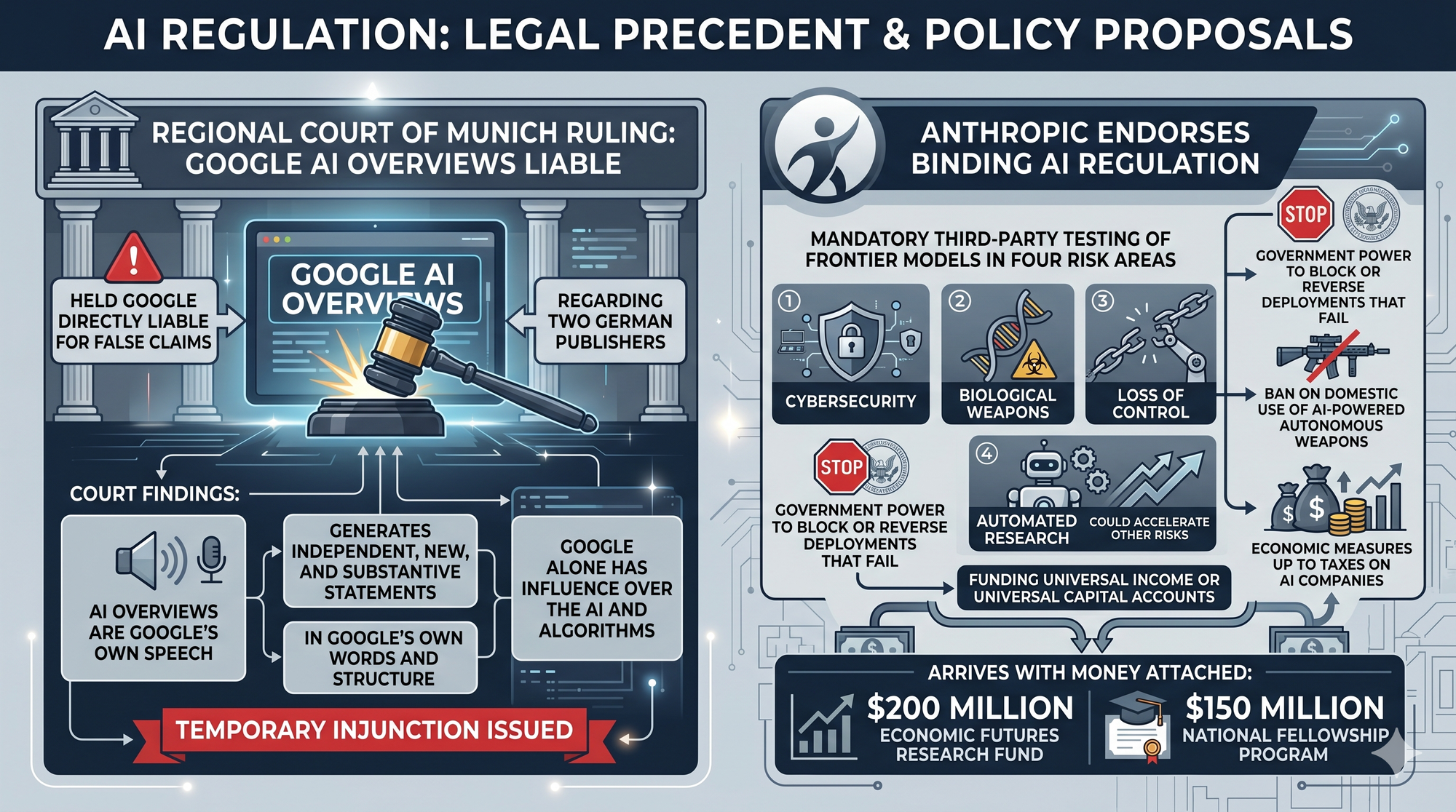
A German court ruled that Google's AI Overviews are Google's own words, making it liable when they are false. It is the first judicial answer to who owns an AI's mistakes.
TL;DR: The Regional Court of Munich held Google directly liable for false claims its AI Overviews made about two German publishers, ruling that the summaries are Google's own speech, distinct from third-party search results, and issued a temporary injunction. The decision, dated May 28, 2026 (case 26 O 869/26) and reported this month, is under review by Google and not yet final. It stands as one of the first court rulings to place responsibility for generative AI's mistakes on the company that builds the model, and the reasoning travels well beyond Germany.
Briefing: The case began when Google's AI Overviews wrongly tied two local publishers to scams, subscription traps, and dubious business practices, inventing connections that appeared in none of the linked sources. German law had long shielded search engines as indirect actors that merely point to third-party pages. The court found AI Overviews categorically different: they generate independent, new, and substantive statements in Google's own words and structure, and Google alone can check them against the underlying sources. The court also rejected Google's defense that users can verify the links themselves, a defense undercut by a Pew survey finding only about 1% of users click a source link from AI Overviews, with a separate New York Times analysis finding the feature inaccurate roughly 9% of the time. The publishers won as ordinary businesses using a cease-and-desist letter, without waiting for new legislation.
The question is global, and the convergence is what matters. South Africa withdrew its draft national AI policy in April after the tools used to help write it generated fake citations, a reminder that machine-made falsehoods already disrupt governments as well as companies. Brazil's Supreme Court has tightened platform liability, and India's intermediary rules face the same classification question Munich just answered. The judicial route assigns liability after harm. The industry-side mirror appeared the same week, when Anthropic urged Washington to take the power to screen frontier models before release, the essay discussed in the lead story. Both roads end at the same place: the maker of the model is the one held to account for what it produces.
So What
For Executives: Treat AI output as a two-sided liability surface: what AI systems say about your company, and what your AI products say to customers. In Germany the cease-and-desist playbook now works against an AI summary, and the Munich plaintiffs won as ordinary businesses without waiting for new legislation. Audit what the major assistants and overview products currently claim about your firm.
For Policy Makers: Munich's reasoning travels. Brazil's Supreme Court has already tightened platform liability, India's intermediary rules face the same classification question, and any jurisdiction whose courts treat generative output as the maker's speech will see AI features arrive later and more cautiously, unless methods are integrated into tools to quality-assure and govern their output. That tradeoff between liability protection and product availability, and its mitigation, deserves a deliberate legislative answer rather than one inherited from case law, and governments that decide early will shape where AI products launch first.
For Investors: A liability discount is forming on AI search and summarization products in Europe. Watch Google's appeal, the emerging market for errors-and-omissions insurance on AI products, and risk-factor language in the coming wave of AI listings, because legal exposure that was theoretical in 2025 now has a court citation. Scan your portfolios for this risk.
For Service Providers: Reputation defense now includes what machines say. The Munich case was, at bottom, two publishers protecting their name against an AI summary. Monitoring AI-generated claims about clients, demanding corrections, and escalating to legal action where needed is becoming a standing service line for communications and legal advisers, and the firms that build the tooling and the playbook first will own the category.
Blackstone Buys the AI Law Firm
Private equity and AI are arriving at the law firm in the same quarter. Arizona opened the door, California blocked it, and London already counts the cost.
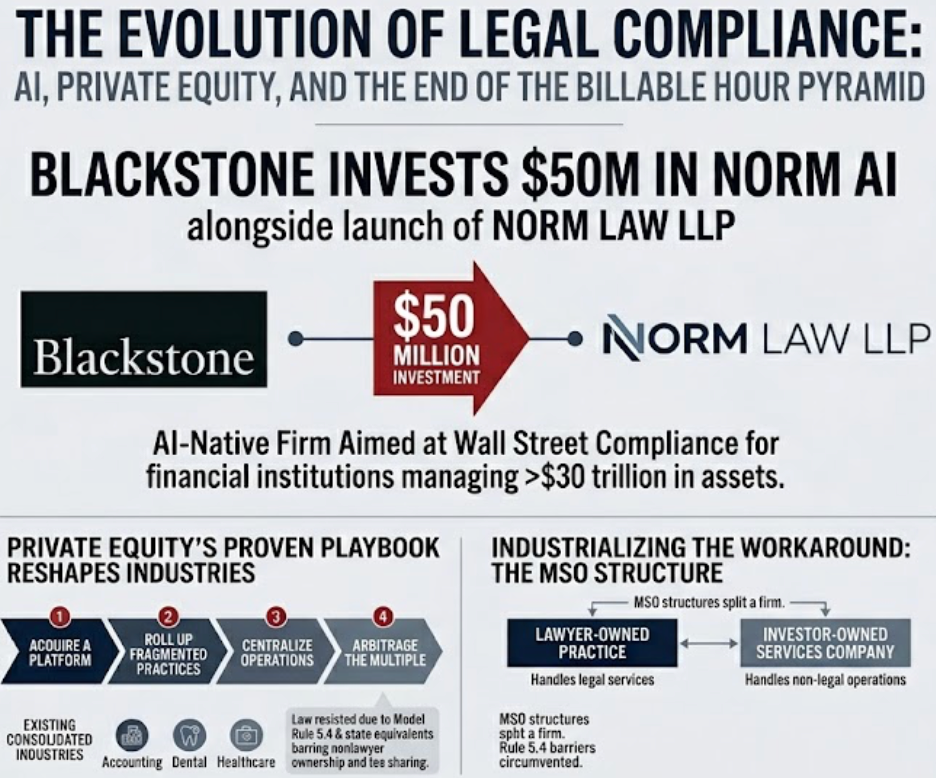
TL;DR: PitchBook reports that the private equity buy-and-build playbook that consolidated accounting is moving to law firms, the last holdout in professional services. Blackstone has invested $50 million in Norm Ai alongside the launch of an AI-native firm aimed at Wall Street compliance, and AI is now capable of the high-volume legal work that funds the partnership pyramid. Regulatory geography will decide where the capital lands: Arizona's alternative business structure (ABS) regime hosts a growing roster of nonlawyer-owned firms, California has banned fee sharing with out-of-state ABS entities effective January 1, 2026, and the United Kingdom's 14-year experiment offers a sobering precedent.
Briefing: Private equity reshaped accounting, dental, and healthcare through one sequence: acquire a platform, roll up fragmented practices, centralize operations, and arbitrage the multiple. Law resisted because Model Rule 5.4 and its state equivalents bar nonlawyer ownership and fee sharing. The workarounds are now industrializing. Managed services organization (MSO) structures split a firm into a lawyer-owned practice and an investor-owned services company, with sponsors including Warburg Pincus and MidOcean circling the sector. Texas matters here: its bar has barred fee arrangements pegged to a share of firm revenue, which is exactly the structure many MSO deals rely on, so the same model is legal in one state and challenged in another. AI changes the underlying math, because document review, due diligence, contracting at scale, and compliance monitoring, the high-volume work that funds the partnership pyramid, are the tasks AI does best.
The regulatory map is where the GeoTech dynamic emerges. Bar rules on ownership have existed for a century, but jurisdictions are now using them as economic-development policy, competing openly to attract or repel legal-services capital. Arizona created its ABS framework in 2021 to widen access to justice and instead became the principal U.S. landing zone for outside investment in law. California answered with Assembly Bill 931, which from January 1, 2026 bars its lawyers from sharing fees with out-of-state ABS entities. The explicit aim is to stop the Arizona model from reaching clients in the largest U.S. legal market and to protect California's prohibition on nonlawyer ownership from being routed around. The United Kingdom ran the experiment first and shows the downside. After it allowed nonlawyer ownership, the listed consolidator Slater and Gordon collapsed in value, writing off more than A$1 billion after an acquisition soured and a regulatory change gutted its business, proof that returns in a regulated profession remain hostage to the regulator. The contest reaches beyond the West. India, which still largely bars foreign and nonlawyer ownership and only recently cracked its market open to foreign firms in a limited way, has a large legal-process-outsourcing industry now exposed to AI-native firms that do the same industrial work without offshore labor, while Singapore and Abu Dhabi Global Market position themselves to court the capital that restrictive jurisdictions turn away.
So What
For Executives: General counsel finally have a credible alternative to the billable-hour pyramid, and with it real pricing leverage. Unbundle the industrial segment of your legal spend, run it against AI-native providers, and reprice the rest with traditional firms accordingly. Demand that outside counsel disclose where AI does the work and where the rate card still assumes associates, and ask both sides for the quality-assurance process so you can judge AI agents against human staff on evidence rather than reputation.
For Policy Makers: The U.K. Solicitors Regulation Authority holds 14 years of outcome data on nonlawyer ownership, and regulators in Delhi, Singapore, and the Gulf weighing liberalization should mine it before copying Arizona. Jurisdictions that modernize with guardrails will create the trust to capture the firms, the talent, and the tax base that restrictive ones push out.
For Investors: MSO structures carry reclassification risk, as the Texas restriction on revenue-share fee arrangements shows, and the U.K. shows how fast value compresses when a regulator moves. Diligence the regulatory regime as carefully as the cash flows, price the chance that California-style blocking statutes spread, and balance permissive against prohibitive jurisdictions across the portfolio.
For Service Providers: Every professional services firm should read this as a preview of its own sector. Accounting consolidated first, law is consolidating now, and communications and management consulting sit next in the sequence as AI compresses billable work. The defensible position are the client-empathy, design, judgment and governance layers: the work a client still wants a named human accountable for.
Under the Radar
The deep analysis that connects the dots
The Shadow Market Priced the SpaceX IPO
Before SpaceX traded a single share on Nasdaq, an offshore blockchain venue had already priced it.
The Signal
SpaceX began trading on Friday, June 12, in the largest initial public offering (IPO) on record, priced at $135, opening at $150 and closing its first day at $160.95, a 19% gain that valued the company near $2.1 trillion. We covered the sovereign equity dimension in Issue 23 and the orbital compute thesis in Issue 21. The under-reported story is the market machinery that ran ahead of the listing. On Hyperliquid, a blockchain-based derivatives exchange with no central headquarters that operates outside any single national regulator, a perpetual futures contract on SpaceX had traded around $163 for weeks, well above the $135 offering price. A perpetual future lets traders bet on an asset's price without owning it. The offshore contract had effectively published a price for SpaceX equity weeks before the first share changed hands, with no prospectus, no accredited-investor gate, and no disclosure rules. When the stock closed its first public day at $160.95, the shadow market's $163 had called the result to within about 1.3%.
The Stakes
Price discovery for new listings has been the franchise of regulated U.S. capital markets for a century, and a perpetual price converges toward the real one because traders can arbitrage the gap once the shares list: if the listed stock opens cheap relative to the contract, buyers close the spread, and vice versa. That is the mechanism that turned an offshore bet into a forecast the banks' own roadshow could not beat. The implication cuts two ways. If the offshore market is the better price, the underwriting syndicate is no longer where the number comes from. If it is wrong on the next deal, a thinly traded contract can manufacture momentum that retail buyers inherit at the open. Whether bankers actually watched the contract while building the IPO book is not something we can confirm, and we will not assert it. What we can say is that a public, round-the-clock price for an unlisted company now exists and is hard for any bookrunner to ignore. The U.S. Securities and Exchange Commission (SEC) has little practical reach into these venues, while regulators in Dubai and Singapore have built licensing regimes that welcome them, so the activity migrates toward the jurisdictions that court it.
What to Watch
Three things. First, whether similar contracts appear on Anthropic and OpenAI as both labs move toward listings of their own, giving the public a price before the prospectus. Second, whether the SEC or the Commodity Futures Trading Commission issues guidance on pre-IPO synthetic markets, which would be the first official acknowledgment that a piece of price discovery has moved offshore. Third, for executives of late-stage private companies: assume a market in your shares can form on one of these venues without your involvement, and monitor it the way you would monitor short interest.
About Cambrian

Cambrian Futures is a strategic foresight and advisory firm helping government, business, and technology leaders understand how emerging technologies intersect with geopolitics, markets, and national strategy. By combining rigorous research, AI-enabled analysis, and human expertise, Cambrian provides clear insight into global technology trends, risks, and power dynamics. Its work helps decision-makers anticipate disruption, manage uncertainty, and act with strategic confidence in an increasingly competitive GeoTech world.
PRODUCTION TEAM
GeoTech Radar is produced by the Cambrian Futures Insights Platform team:

CEO & Chief Analyst
Managing Director / Producer, Insights Platform
Global Lead, Smart Infrastructure Strategy
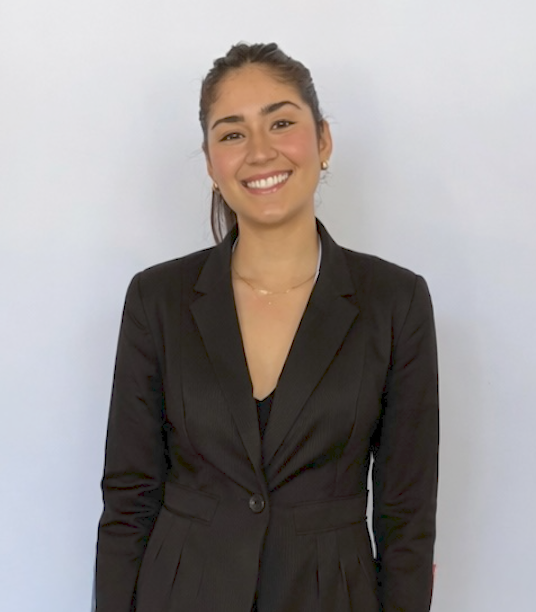
Research & Marketing Associate
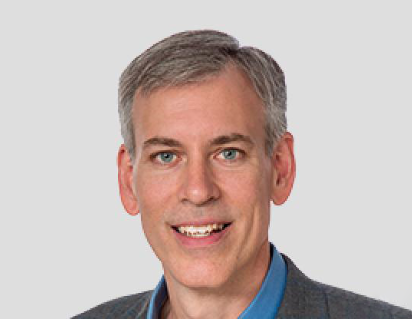
Editor in Chief
Learn more about Cambrian Futures at cambrian.ai
Produced with
Human Led


Human Led +
AI Augmented




AI Led +
Human Verified


Cite as: Cambrian Futures (2026) 'GeoTech Radar Issue 24'
An important note on what this is, and is not
GeoTech Radar is directional research intended to stimulate thinking and provide geopolitical and technological context. It is not investment, legal, or financial advice, and nothing here is a recommendation to buy, sell, or hold any security or asset. The companies, valuations, and transactions discussed are described for analytical context only and serve as a backdrop to readers' own due diligence. Figures and claims are drawn from public reporting as of the publication date and may change. Readers should consult their own qualified advisers before making any decision. Cambrian Futures and the authors hold no responsibility for actions taken on the basis of this briefing.