
![[UPDATE]: America's Robot Ban, the Fight for Orbit in Shanghai, and Pathways to an Open-Weight Future](https://storage.ghost.io/c/5a/9b/5a9b6512-ff32-41b8-9ec6-89cfb1354327/content/images/2026/08/Gemini_Generated_Image_70d9mf70d9mf70d9.png)
[UPDATE]: America's Robot Ban, the Fight for Orbit in Shanghai, and Pathways to an Open-Weight Future
A Note to Our Readers
Based on overwhelming positive feedback about the value of our signal analysis, after the August 13 issue, GeoTech Radar will move to a subscription model. Paid subscribers will receive expanded newsletter coverage and a new GTR live-signal dashboard, with more tools to follow.
As a current subscriber, you will be grandfathered in at no cost through the end of 2026. No action needed on your part. Thanks for reading the GTR.
IN THIS ISSUE:
CEO's Perspective
Strategic outlook from Cambrian leadership
[This section has been edited to clarify Ben Franklin's role in both the creation and occasional undermining of American institutions, as well as the parallel of his actions to current event.]

Walking back from the Special Competitive Studies Project's AI+ Discovery summit in Washington last week, I stopped in front of the Ben Franklin statue at the Old Post Office. It held my attention longer than it should have. Franklin is often flattened into a genial polymath, but the more holistic view of this Founding Father works better for the AI age. In reality, Franklin was a man of tensions, someone whose gifts pulled in opposing directions and who lived comfortably in the contradiction. Four of those contradictions map onto this issue with uncomfortable precision.
The Builder Who Also Broke In
Franklin invented the lightning rod and gave the design away for free, declining a patent because, he said, "As we enjoy great advantages from the inventions of others, we should be glad of an opportunity to serve others by any invention of ours." He treated safety infrastructure as a public good. That argument lives on within the open-weight debate this week. Domestically, 230 American companies signed a letter demanding that weights stay open, while Anthropic insisted on mandatory safety testing above a capability line. Overseas, Delhi’s high court said this week that AI training on copyrighted news was fair game, while Munich called it infringement. Franklin would have recognized the fight. He was on both sides of it, simultaneously.
He built the colonial postal system, the Library Company, the American Philosophical Society, a university, and a press empire – the institutional plumbing of an information society. But he occasionally undermined some of the most important foundations of the emerging nation, as well. In 1782, he published a fake supplement to the Boston Independent Chronicle, alleging British atrocities at a time such news could influence peace negotiations. The father of American media literacy was also the father of American "fake news."
This week, we saw similar disruptions of national infrastructure, often through the actions (or inaction) of the agencies and people responsible for it. The FCC converted equipment authorization into a ban on foreign robots and inverters, building a new piece of infrastructure plumbing for the AI age. Seven states lost control of their water pumps through controllers with factory passwords, exposing the oldest plumbing of all.
Franklin’s Paris mission converted scientific celebrity into diplomatic capital for what was an up and coming power at the time. That is the same approach Beijing often uses as an up and coming science powerhouse. At the International Telecommunication Union (ITU) this week, China flooded the spectrum queue with satellite filings while building a coalition of Global South votes for Shanghai's World Radiocommunication Conference. The tensions and contradictions that made Franklin such an intriguing character run through each of these GeoTech debates today. The man who made lightning safe, gave the fix away, and built alliances in support of freedom is the same man who forged a newspaper when statecraft demanded it. Every story in this issue carries the same double nature. The open weights that democratize science are the open weights a PLA-linked institution distills for military systems. The robot that automates a warehouse is the robot the FCC now treats as a national security threat. The water controller that runs a treatment plant is the water controller an adversary hijacks with a factory password. The same talent that builds the public good can run the influence operation, and the same technology will do both. Franklin is not a clean hero for the AI age. He is an honest precursor of it.
Olaf
On the Radar
The signals affecting the GeoTech landscape this week
The U.S. Bans Foreign Robots as China's Humanoid Industry Scales
Washington reruns its Chinese EV playbook, this time for robots, and China already dominates the field.
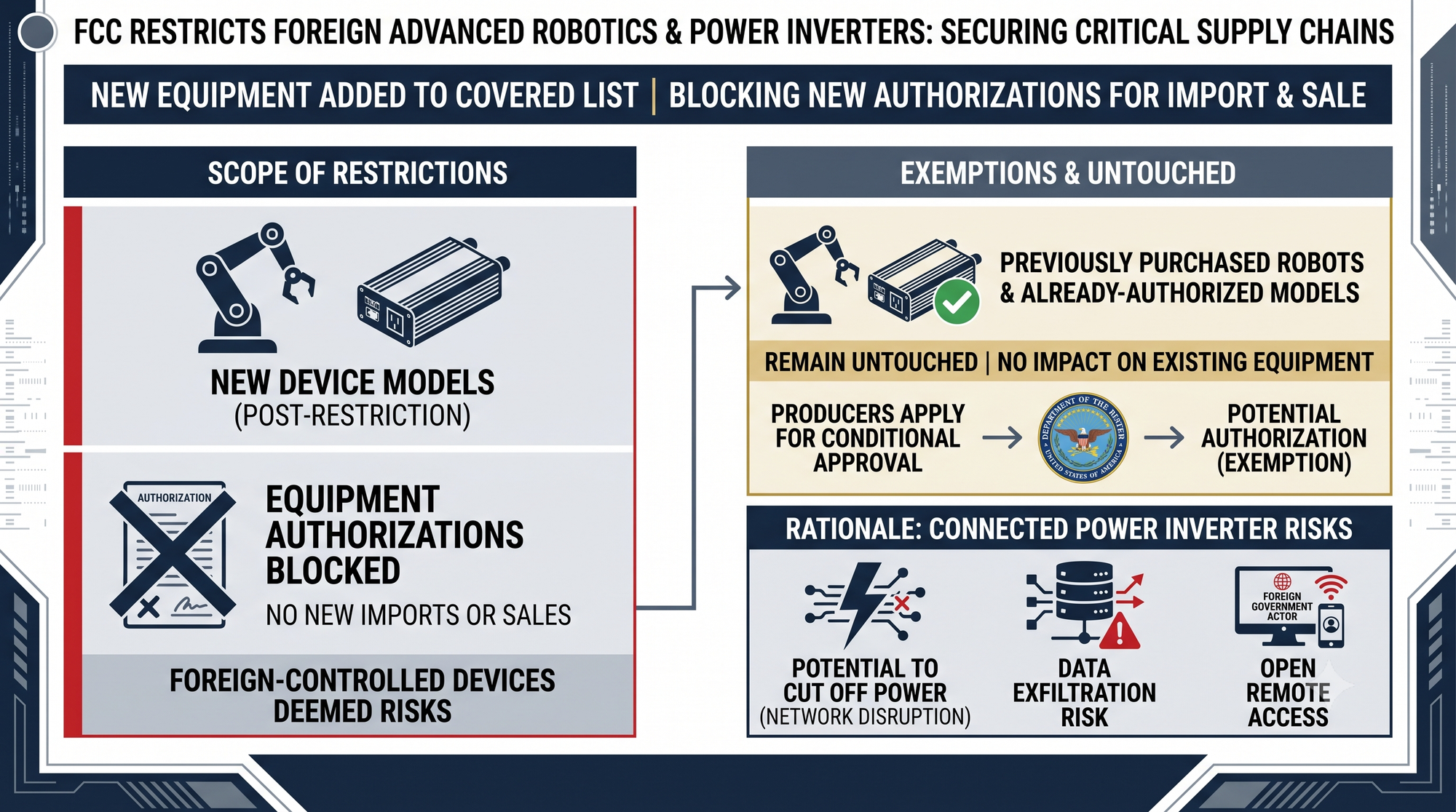
TL;DR: The FCC updated its Covered List this week to block imports and sales of new foreign-made humanoid and quadruped robots and connected power inverters, citing national security risks. The determination covers any new ground-based, software-controlled wireless robot over 4.4 pounds, sweeping in robot vacuums alongside warehouse quadrupeds. Chairman Brendan Carr said the agency is acting in lock step with national security agencies. China has more than 140 companies building humanoid robots at scale, backed by more than $26 billion in funds.
BRIEFING: The Federal Communications Commission added foreign-made advanced robotic devices and connected power inverters to its Covered List, blocking new equipment authorizations and, by extension, new imports and sales. The restrictions apply to new device models only, leaving previously purchased robots and already-authorized models untouched. Producers can seek a Conditional Approval exemption routed through the Department of War. On the inverter side, regulators said foreign-controlled devices could be exploited to cut off power, exfiltrate data, or open remote access for foreign government actors. Carr framed the action as securing America's critical supply chains. Beijing's Foreign Ministry accused the U.S. of invoking security as cover for targeting Chinese companies.
This is the third time equipment-authorization policy has been converted into industrial policy, following a pattern similar to the 2022 telecom-gear bans and the 2025 connected-vehicle rule. However, this is the first time a restriction on equipment authorizations has targeted embodied AI, and it comes as China is scaling up production. Unitree and its peers have driven humanoid and quadruped prices below $20,000 while Xi Jinping publicly pushed for more defense applications of autonomous and AI technologies. The U.S. has no domestic supply base at Chinese volumes or prices, so the near-term effect of the ban amounts to an adoption tax on American warehouses and homes, rather than a boost to American robot makers. Also, the exemption authority sits with the Department of War rather than with Commerce, which makes robot import policy a defense decision and gives every future authorization a security test to pass. The inverter portion of the order reaches quietly into the grid, where Chinese manufacturers dominate the installed base of solar and battery inverters. The decision suggests the Covered List will keep expanding along the software-defined edge of physical infrastructure.
SO WHAT
For Executives: Audit your automation fleet and procurement pipeline for covered devices before Q4 budgets lock. Look particularly at warehouse robots, service and inspection quadrupeds, robot vacuums in hospitality portfolios, and every connected inverter on your facilities. Existing units are grandfathered in, but new models are blocked, so any roadmap that assumes Chinese-class pricing needs reconsideration. Domestic or allied alternatives from Boston Dynamics, Agility, or ANYbotics carry multiples of the price and long backlogs. Facilities teams should inventory inverters now, because replacements and expansions will need FCC-authorized alternatives that are scarcer and costlier. Hedge: The Conditional Approval channel exists, grandfathering means no forced rip-and-replace, and the immediate cost is optionality on future purchases rather than capex on installed equipment. The right first move is an inventory, a vendor query on authorization status, and a pause on new covered orders rather than a fleet swap.
For Policy Makers: The FCC has extended equipment authorization into industrial policy without new legislation, and the precedent will travel. Allies will face pressure to mirror the ban. Define reciprocity and shared authorization standards with Japan, South Korea, and the E.U., allies whose robotics programs are the only near-term alternative supply. Not doing so will cede other markets to Chinese vendors who keep the volume advantage. Watch the exemption process for capture, because a Department of War gate with case-by-case discretion creates more volatility through opportunistic political lobbying. And pair the restriction with demand-side support for domestic manufacturing, since a protected market without a supply response is just a price increase.
For Investors: Reprice the robotics stack in both directions. U.S. and allied humanoid makers gain a protected home market, but component exposure cuts both ways because Chinese actuators, sensors, and rare-earth motor magnets feed Western bills of materials. Beijing's most obvious retaliation runs through the magnet supply it controls. Inverter incumbents gain share against blocked imports. The second-order trade is in the exemption queue, where firms that win Conditional Approval will carry a scarcity premium. Hedge: Protection can slow cost curves, and if U.S. humanoid unit economics hold at multiples of Chinese levels the addressable market shrinks with the protection, so weight vendors on manufacturing scale-up plans rather than on the policy tailwind alone.
For Service Providers: Clients with automation roadmaps need a covered-device exposure audit spanning robotics fleets, facility inverters, and vendor contracts, with authorization status verified rather than assumed. For European multinationals, a robot deployable in Rotterdam might now be barred in Houston, so global standardization strategies break and procurement has to go jurisdiction by jurisdiction. The billable product is an automation procurement map with a grandfathering inventory and an exemption-pathway brief, delivered before Q4 capital planning. In addition, prepare board language for clients who must explain to investors why their automation timelines just moved.
China Floods the Satellite Spectrum Queue Ahead of a Home-Turf Rewrite of the Rules of Orbit in Shanghai
Radio spectrum cannot be owned, but whoever controls the queue controls the sky.
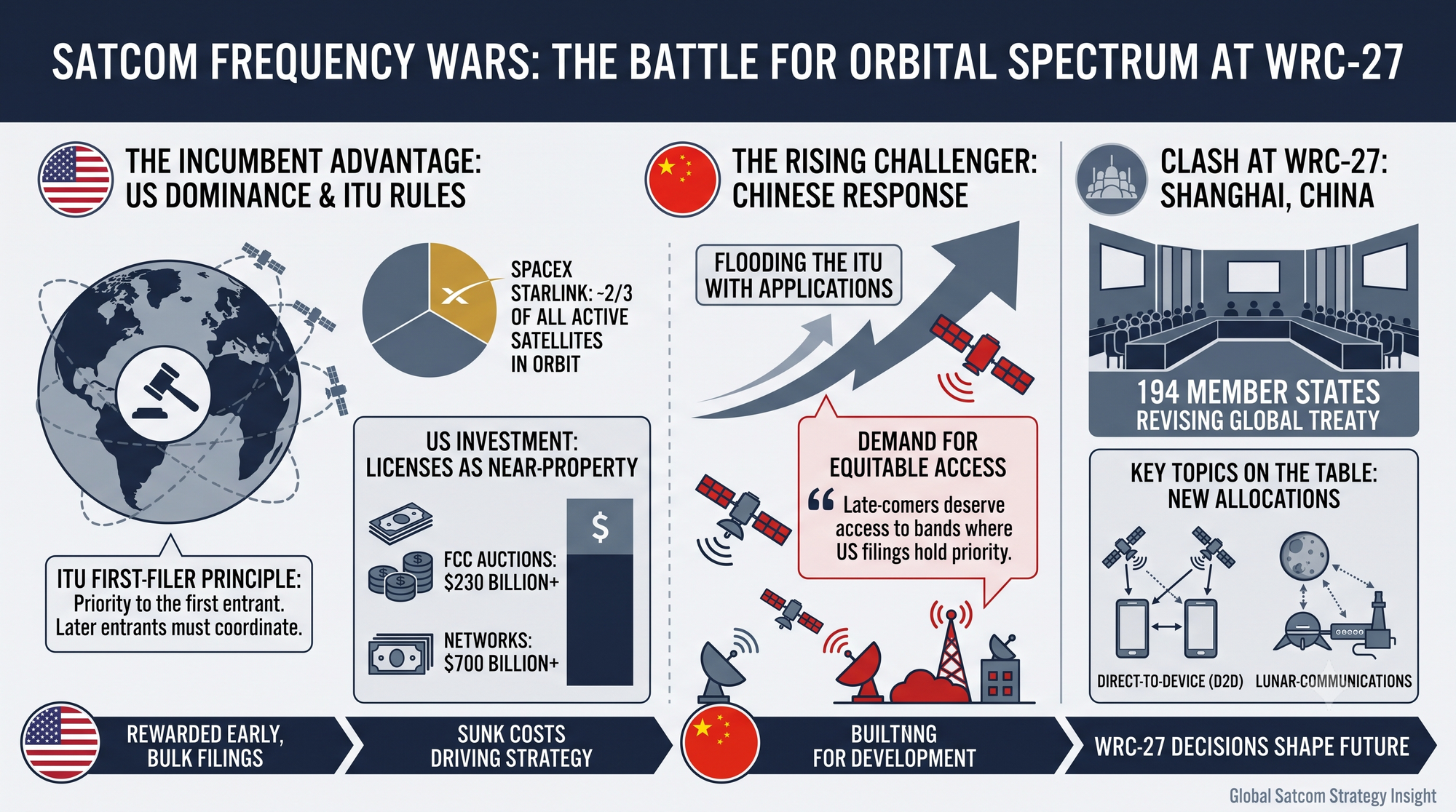
TL;DR: The next World Radiocommunication Conference convenes October 11 to November 12, 2027, in Shanghai. With roughly 80% of the agenda touching space, the maneuvering has begun. Chinese operators have flooded the International Telecommunication Union (ITU) with satellite frequency filings while pressing for equitable access to bands where earlier U.S. filings hold priority. SpaceX's IPO prospectus names protectionist licensing as a risk factor, and the E.U.'s proposed Space Act would burden large non-European operators.
Briefing: Under ITU rules, priority in a satellite frequency band goes to the first filer, and later entrants must coordinate around the incumbent. That system rewarded American operators who filed early and in bulk. SpaceX's Starlink alone accounts for about two-thirds of all active satellites in orbit. On the ground, the U.S. industry has treated licenses as near-property, telling a federal court it sank more than $230 billion into FCC auctions and $700 billion into networks on that assumption. Late-coming Chinese companies have responded by flooding the ITU with applications while insisting on equitable access to bands where U.S. filings hold priority, and the argument lands at WRC-27 in Shanghai, where 194 member states will revise the treaty that governs spectrum and orbits, with new direct-to-device and lunar-communications allocations on the table. SpaceX's IPO prospectus, filed at a $1.8 trillion valuation, warns that some countries could weigh whether an applicant is homegrown when granting landing rights, and the E.U.'s proposed Space Act would impose requirements that appear designed to burden large non-European operators. Similar instincts are surfacing in Canada, Brazil, Japan, and India.
The ITU struggles with enforcement because it cannot inspect satellites and relies on self-reporting against its use-it-or-lose-it deadlines. Furthermore, low-Earth-orbit satellite constellations broke the old system of assigned geostationary slots, leaving priority-by-filing as the only rule that still binds. The push for equitable access reflects the interests of certain geopolitical coalitions. China supplies the filings and the diplomatic energy, and much of the Global South supplies the votes – the same alignment Beijing institutionalized through WAICO on the AI side. U.S. operators are already warning about home-turf advantage because WRC outcomes run on consensus-building, over which the host holds considerable influence. Meanwhile facts in the sky accumulate faster than treaty language, and by the time delegates convene, the practical question might be whether the ITU still allocates orbits or merely records who took them.
So What
For Executives: If your operations depend on satellite connectivity – and logistics telematics, maritime tracking, aviation Wi-Fi, and remote-site operations all do – map which operator's spectrum priority underwrites your service contracts and what happens to coverage if national landing rights fragment. Multinationals should expect country-by-country divergence in which constellations are licensed, since Brazil, India, and the E.U. are all weighing homegrown preference. Build dual-constellation clauses into connectivity renewals rather than assuming a single global provider. Hedge: Treaty revisions adopted at WRC-27 would take effect years later and incumbents keep priority under current rules, so continuity of service is not the near-term risk. Renewal pricing and country-specific coverage gaps are, which makes this a contracting problem to solve in 2026 rather than a crisis to manage in 2028.
For Policy Makers: The U.S. position, which favors modernized sharing rules and first-mover priority, needs a coalition broader than its usual partners before Shanghai, and the offer to middle powers has to beat Beijing's equitable-access framing on its merits. Consider more leeway on technology transfer, hosted payloads, and guaranteed capacity, or the votes go the other way. The transatlantic split is the exploitable seam, because the Space Act reads in the U.S. as protectionism aimed at American operators. If Brussels and the FCC arrive in Shanghai at odds, there is no Western position at all. Fund ITU verification capacity as well, since a regime that cannot check orbital use invites squatting by every filer, including allies.
For Investors: Spectrum priority is becoming a balance-sheet asset. SpaceX's filing history is arguably worth as much as its launch cadence, and its own prospectus says so in risk-factor language. Terrestrial telcos face dilution from the other direction, because direct-to-device allocations at WRC-27 could hand satellite operators access adjacent to bands the telcos paid $230 billion to license. Watch Chinese constellation operators Guowang and Qianfan, whose ITU filings will mature into deployment deadlines that force launch cadence. Hedge: A hostile WRC outcome for U.S. operators would surface in licensing-cost guidance and country-coverage disclosures well before revenue, so track the 2027 national-filing season and E.U. Space Act markups rather than trading the conference headlines.
For Service Providers: Most clients cannot name the constellation on which their operations ride. The billable product is a connectivity-sovereignty audit – which services run on which operator, which national licenses stand behind them, and which WRC-27 agenda items would change the answer. European clients need a parallel brief on what the Space Act would actually require of them before positions harden, and clients with Global South operations need scenario language for a world where landing rights become bilateral bargaining chips the way payment rails did in the Pix dispute.
Someone Else's Hands on the Pumps: Water Utilities in Seven U.S. States Lose Control as Suspicion Falls on Iran
The cheapest way into American infrastructure is a controller with a factory password, and someone is walking through it.
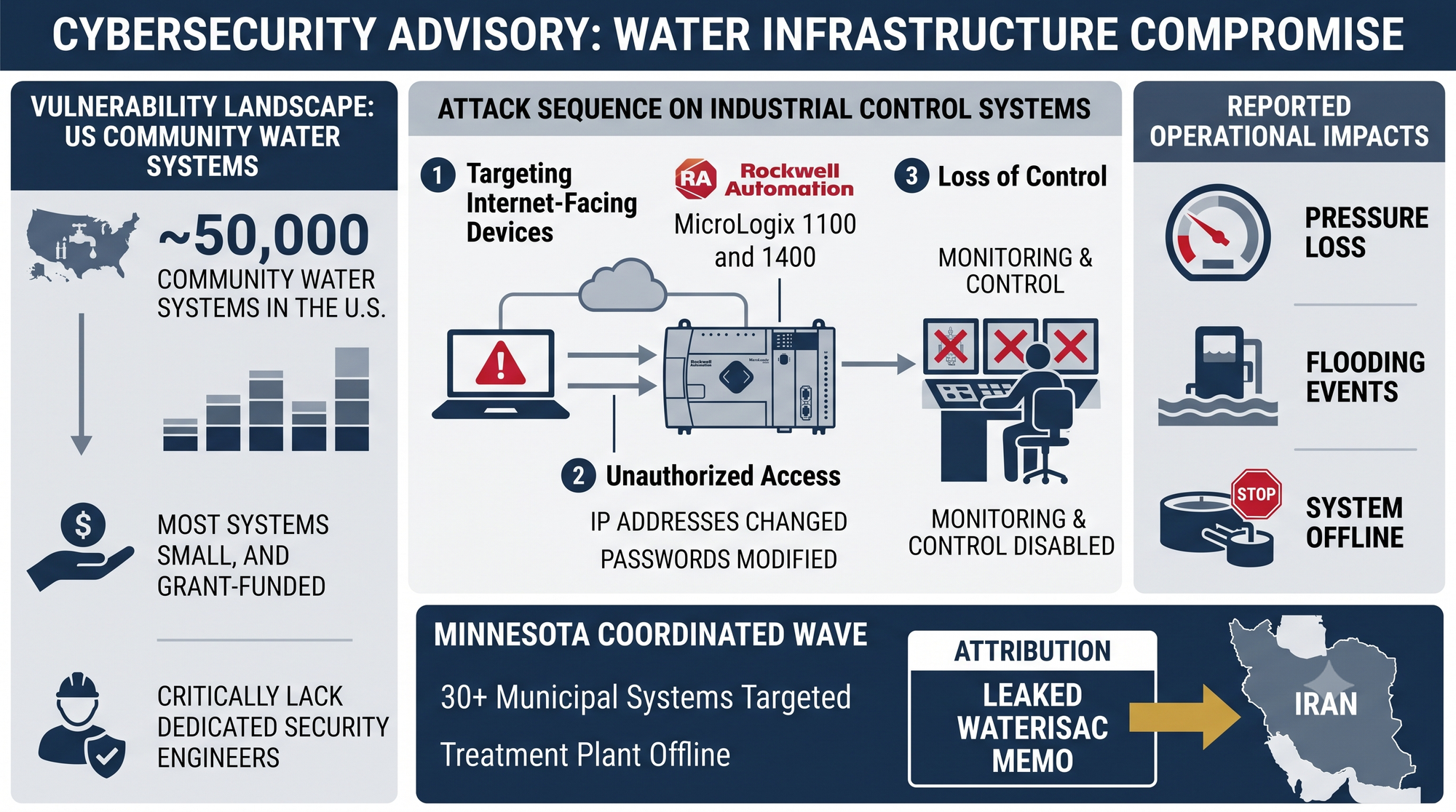
TL;DR: The FBI and EPA on July 30 warned that water and wastewater utilities in at least seven states reported cyber incidents since July 27, some of which degraded operations with loss of pressure and flooding. U.S. intelligence agencies preliminarily assessed that Iran-affiliated actors were likely behind a coordinated attack on more than 30 Minnesota water systems. President Trump publicly rejected that assessment and blamed the state instead.
Briefing: The joint advisory describes attackers reaching internet-facing Rockwell Automation MicroLogix 1100 and 1400 controllers, changing device IP addresses and passwords, and knocking out operators' monitoring and control. Reported effects included pressure loss and flooding. In Minnesota, more than 30 municipal systems were hit in a coordinated wave that took at least one treatment plant offline, and a leaked WaterISAC memo linked dozens of the attacks to Iran. The attribution remains preliminary, and the president rejected it from Camp David, saying he blamed Minnesota's incompetence rather than Tehran, hours after federal investigators said the opposite.
The U.S. runs roughly 50,000 community water systems, most of them small, grant-funded, and without a security engineer. The fact that the 2023 CyberAv3ngers wave against Unitronics water controllers went materially unpunished taught adversaries that American water is a low-cost pressure valve during confrontation. However, the public split between the intelligence assessment and the president is new, especially since it occurred mid-incident. That means an adversary reading the response sees no attribution consensus and no promised cost. Deterrence in cyberspace is a communications discipline as much as a technical one, and this week the communications failed.
So What
For Executives: The failure to protect water systems was an operational technology (OT) problem, a weakness in the industrial control systems that run physical equipment rather than in corporate IT. The entry vector – internet-exposed controllers with vendor-default credentials – exists in manufacturing, buildings, and energy portfolios, too. Mandate an OT asset inventory and confirm that nothing answers directly to the public internet, then rotate credentials on anything that ever did. The deeper weakness is that legacy controllers cannot recognize abnormal patterns in their own operations, so AI-enabled monitoring that flags anomalous cycling and automates shut-off or islanding decisions is the logical next investment. Dumb infrastructure that cannot see a pattern cannot defend against one. Facilities dependent on municipal water, including cooling, food processing, and pharmaceutical operations, should add utility-failure scenarios to continuity plans for affected regions, and expect insurers to reprice OT cyber exposure after a named-state campaign on U.S. soil. Hedge: The attacks so far degrade rather than destroy, and the fix is cheap and fast, measured in days of network hygiene rather than years of hardware. This is one of the rare risk headlines where the remediation is fully within your control before the next wave.
For Policy Makers: Mandatory cybersecurity minimums for the water sector have failed in Congress twice. A seven-state attack that resulted in flooding should force the issue, and the choice now is standards before a casualty or after one. The dispute over attribution for the attack is itself a vulnerability, because deterrence requires the adversary to believe a response is coming, and this week Tehran learned it is not. Two fixes are relatively cheap. First, fund the EPA-CISA seam, since the agency with the sector mandate lacks cyber capacity and the agency with capacity lacks water authority, Second, subsidize the controller replacement and segmentation that 50,000 small systems cannot fund from ratepayers. Allies should note the pattern, because the same programmable logic controllers (PLCs) run municipal systems worldwide. Small, underfunded utilities with internet-reachable controllers are the norm well beyond America, and Europe's NIS2 rules supply the mandate the U.S. lacks without supplying its municipalities the engineers.
For Investors: OT security vendors get a demand shock in the least-digitized sector. Detection specialists such as Claroty, Dragos, and Nozomi benefit first, followed by the systems integrators who do the hands-on work of securing municipal plants. Watch Rockwell, since water-sector hardware refresh cycles run decades, and any mandated modernization becomes a multi-year revenue stream. Also watch municipal debt in affected states for risk premiums if incidents recur. The adjacent play is AI-driven anomaly detection for OT networks, since tools that learn a plant's normal rhythms and flag deviations in real time shorten the response cycle this week's victims lacked. Hedge: Municipal buyers are slow, grant-dependent, and procurement-bound, so revenue lags the headlines by quarters at best. A quiet August could deflate the trade, a possibility that argues for positioning through the appropriations cycle rather than the news cycle.
For Service Providers: Crisis-communication playbooks for critical-infrastructure clients need a scenario that considers the possibility that government voices contradict one another mid-incident and the client must communicate anyway. European clients operating U.S. facilities need the regulatory contrast briefed plainly, since NIS2 mandates at home remain voluntary in the U.S., and boards will ask why the standards differ across their own footprint. The billable product pairs an OT exposure review with a board-level incident-communications drill. There is also a second product in helping utility-adjacent clients document their upstream water dependence before insurers ask first.
AI Training on Copyrighted News Is Legal in New Delhi and Infringement in Munich, One Week Apart
Two courts read the same technology in the same week and drew a map of where AI will be built.
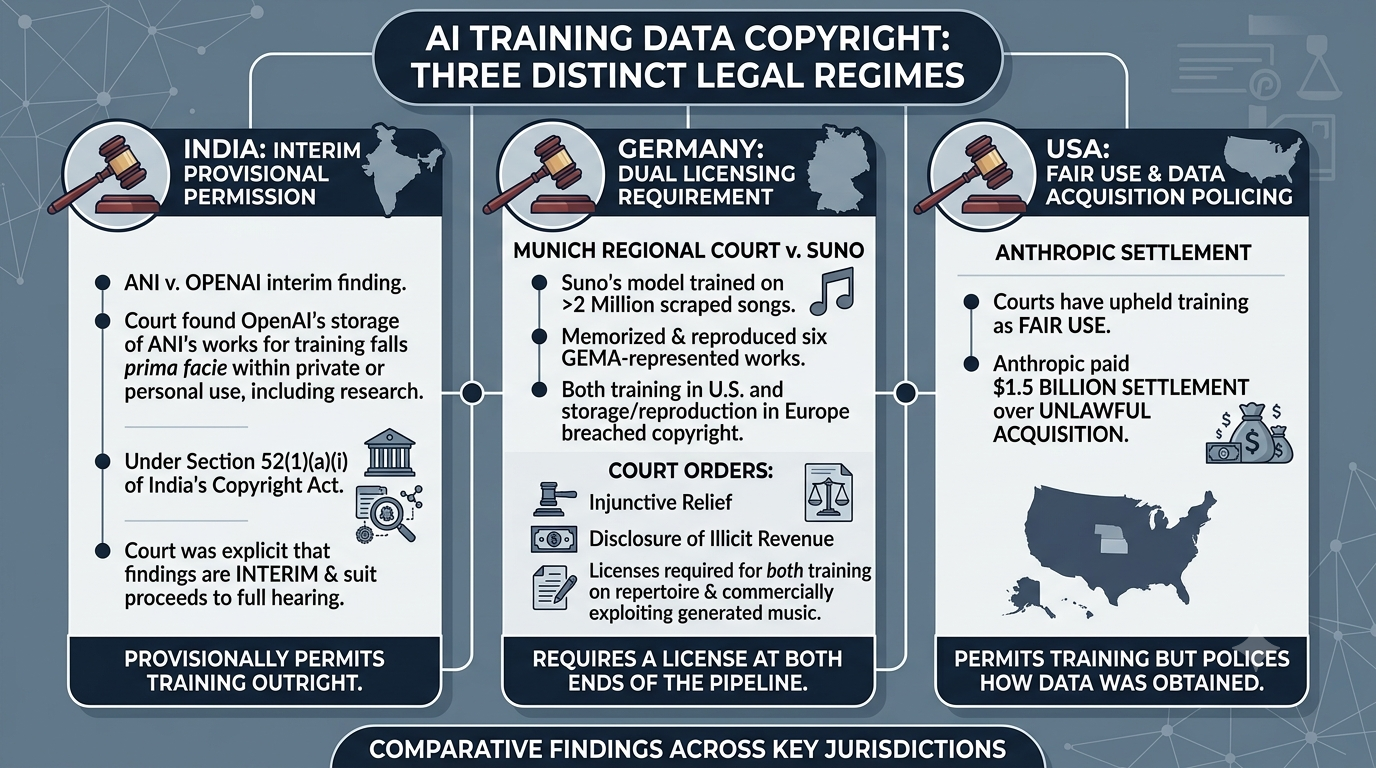
TL;DR: On July 24 the Delhi High Court refused ANI's injunction against OpenAI, holding in a 135-page interim order that training on copyrighted news content is prima facie fair dealing under India's Copyright Act. On July 31 the Munich Regional Court ruled that Suno infringed GEMA-represented works in both training and output, ordering injunctive relief, disclosure of illicit revenue, and damages and requiring licenses for training and commercial exploitation. The Delhi suit continues, but the arbitrage geography is already legible.
Briefing: Justice Amit Bansal's order, issued after 32 hearings, found that OpenAI's storage of ANI's works for training falls prima facie within private or personal use, including research, under Section 52(1)(a)(i) of India's Copyright Act. While noting that data is the oil for large language models, Bansal was explicit that the findings are interim and the suit proceeds to full hearing. Seven days later and 6,000 kilometers away, the Munich Regional Court found that Suno's model, trained on more than 2 million scraped songs, had memorized and reproduced six GEMA-represented works, and held that both the training in the U.S. and the storage and reproduction in Europe breached copyright. The court granted injunctive relief, ordered disclosure of illicit revenue, and required licenses both for training on the repertoire and for commercially exploiting music generated from it.
Add the U.S. settlement layer, where courts upheld training on lawfully obtained data as fair use even as Anthropic paid $1.5 billion for the pirated books in its corpus. The two outcomes are consistent rather than contradictory, because American law blesses the training itself while punishing how the data was acquired. Three distinct regimes now govern the same process. The U.S. permits training but polices acquisition. India, provisionally, permits training outright. Germany requires a license at both ends of the pipeline. That makes training-data law a siting variable, like tax treatment or energy price. Where a model is trained, where its corpus is stored, and where its outputs are sold now carry materially different copyright exposure. Delhi's reading arrives as the IndiaAI Mission courts model developers with subsidized compute, and Munich's arrives in a jurisdiction with Europe's most organized rights-holder economy, two days before the AI Act's transparency obligations went into effect on August 2. Neither court will have the last word, but capital allocates on interim signals, and this week produced two pointing in opposite directions.
So What
For Executives: Map where your AI vendors train, store, and serve, because copyright exposure now varies by jurisdiction the way data-residency exposure already did – and your indemnification clauses probably do not name training-jurisdiction risk. Content-owning businesses should move on Europe first, where the Munich ruling converts catalogs into licensable AI inputs with a court-backed revenue claim, and they should register opt-outs where E.U. law provides them. Buyers of generative music, video, and text services should ask vendors directly which repertoires their training touched and in which jurisdictions. Hedge: Delhi is an interim order and the full hearing could narrow or reverse it, so treat India's permissive reading as provisional, and price contracts on the assumption the spread between regimes tightens rather than widens.
For Policy Makers: Jurisdictions are now openly competing on training-law permissiveness, and both templates are on the table. A capital-seeking economy can copy Delhi's reading and advertise it, while a rights-holding economy can copy Munich's and monetize enforcement. The missing instrument is a workable cross-border licensing framework, and whoever builds collective licensing at GEMA scale priced for AI training will set the standard in much the same way mechanical royalties once did for recorded music. For Global South regulators, the Indian precedent will travel further than the German one, because it pairs legal permission with an investment pitch. That is the reading WAICO's model-governance templates are likely to carry.
For Investors: European rights-holder revenue just became underwriteable. The Munich ruling covers training and outputs, which gives music and publishing catalogs an AI-licensing income stream in the E.U. and gives litigation finance a live docket. Model developers now carry a compliance-cost map rather than a single legal risk. A comparison of licensed training in Europe with unlicensed training in India will influence where training capacity gets sited, to India's benefit. Hedge: Court appeals run for years in both jurisdictions, and the full hearing in Delhi could converge on Munich's position. The arbitrage trade carries headline risk in both directions, and catalog valuations should assume E.U. licensing income begins small and litigated rather than large and immediate.
For Service Providers: Multinational clients need a training-jurisdiction exposure matrix across their AI vendor stack, built from vendor disclosures rather than marketing claims. In addition, European clients holding content catalogs need a licensing-readiness assessment now that Munich created the revenue claim. The billable product is a copyright-arbitrage brief a board can act upon before contracts renew, with a decision tree for where the client trains, buys, and sells. There is communications work here, too, because content clients will want to claim the Munich win publicly without conceding their own AI usage elsewhere. That needle will need professional threading.
Under the Radar
The deep analysis that connects the dots
The Open-Weight Future Arrives Ahead of Schedule as Pathways Fork in Beijing, Abu Dhabi, and Brussels
The Signal
China has led on open weights for two years, so the trend itself is not new. What changed in the past 10 days is convergence, with four developments that together move open weights from a release strategy to a contest over who runs the world's AI. The Open Weights and American AI Leadership letter, which encourages U.S. policymakers to keep open-weight models available, grew from 25 launch signatories on July 24 to more than 230 less than a week later. Anthropic was the only frontier lab that refused to sign, with CEO Dario Amodei explaining that the company opposes bans but believes mandatory safety testing for sufficiently capable models is crucial. The EO 14409 early-access framework came due August 1, giving the federal government voluntary pre-release access of up to 30 days to covered frontier models, with the benchmarks that define coverage remaining classified. The framework included OpenAI, Anthropic, and Google – notably excluding Meta – with the treatment of open-weight models remaining unresolved.
In China, Moonshot released the weights of Kimi K3 on July 27, a 2.8 trillion-parameter model claiming near-parity with the closed frontier. Within days, the open-source WASTE inference engine had it running on a 64 GB MacBook. Meanwhile, DeepSeek's V4 Flash matched flagship benchmark scores at roughly one-hundredth of frontier token prices. And a Reuters review of more than 80 papers and patents discovered thatPLA-linked institutions used model distillation of U.S. models to build military systems that run inside China's own networks.
Beneath the headlines, OpenEuroLLM passed its July 31 target with reference models but no flagship. The smaller research models shipped, but the large model meant to compete near the frontier did not, leaving Europe's €37.4 million sovereign-model effort behind schedule just as the E.U.'s Article 50 obligations, the AI Act rules requiring AI-generated content to be labeled, took effect August 2. India's Sarvam-105B open-weight models moved into Aadhaar services and an 80 million customer insurance deployment. Chile's LatamGPT shipped as regional infrastructure on a Llama base for roughly $550,000 in total development cost. Among all of these efforts, the UAE's Falcon program remains the only one outside China in which a government funds the training of its own frontier-adjacent open-weight models from scratch rather than building on someone else's, now formally aligned with the U.S. industry's open camp through G42's alliance membership. Independent benchmarking in regulated domains reported open models performing within one standard deviation of top closed models at a third of the cost.
THE STAKES
The U.S. argument, mapped in the coalition letter, is about who governs distribution and how. China ships frontier-scale weights without conditions. The Gulf funds open models as sovereign infrastructure and sells the surrounding cloud. India and Latin America build national services on other people's weights and keep the data at home. Europe regulates both ends while its own build runs late. The U.S. is choosing, in the framework negotiations that began this week, whether its open models remain the distribution arm of American leadership or become a controlled substance above a certain capability threshold. Whichever weights end up running the everyday systems of the next billion users, in government services, banking, and hospitals, will confer influence no API contract can match. A self-hosted model cannot be switched off from abroad, and every government procuring one knows it.
THE PATHWAYS
Watch whether corporate venture deal count rises while deal value falls, which would be the first genuine sign of normalization rather than continued concentration. Track the climate technology Series B gap specifically, since it is the earliest visible failure point in the pipeline: climate technology has the most public commitments attached to it, including Paris targets, E.U. Green Deal objectives, and corporate net-zero pledges due in the early 2030s, and the most measurable gap between committed spending and actual funding. The Series B stage is where capital-intensive hardware companies need to move from prototype to pilot production, requiring $20 million to $50 million per round, exactly the range that has migrated to AI deals. Follow whether any sovereign or development institution steps deliberately into the non-AI gap, as European and Japanese programs have the mandate to do but have not done so far at scale. Watch Nvidia's disclosed carrying values on its laboratory positions as those companies approach public listing, because the first mark-to-market against a public price will show whether strategic and financial valuations were ever describing the same thing. And follow the corporate venture investor count rather than the dollar totals, since a contracting number of participants writing larger checks is a different market from a stable number concentrating its bets.
Four scenarios could plausibly follow from here. The first three can unfold in parallel across different markets, while the fourth would override them all. The signposts under each pathway are the indicators we are tracking.
Commoditization below the frontier. Open models hold a six- to 12-month lag behind closed flagships, token prices keep collapsing, and closed labs retreat up-market to the work that justifies premium pricing: complex agentic tasks, regulated industries where accountability is contractual, and government contracts. The volume market runs on open weights, and increasingly on local hardware sold by Dell, Apple, and Nvidia. Much of this pathway is already priced – OpenAI's 80% cut to GPT-5.6 Luna landed days after V4 Flash's benchmarks. Signposts: Enterprise workloads moving from metered APIs to self-hosted open-weight deployments, parity results spreading from clinical and regulatory benchmarks into finance and law, sovereign rule-making requiring independence from proprietary U.S. and Chinese models, local-inference hardware becoming a named line in PC and server vendor guidance, and Moonshot's reported $50 billion IPO, the first test of open weights as a funded business model rather than a loss leader.
The conditional-open regime. The EO 14409 framework and subsequent Commerce rulemaking attach conditions to high-capability open releases, including safety testing, audit obligations aimed at unauthorized model-to-model training, and chip-access terms. American open supply starts to scale and becomes licensed, while the world's open-weight market bifurcates into conditional U.S. weights and unconditional Chinese ones. Buyers shift supply based on use-case sensitivity and risk ratings. Signposts: Whether the framework's covered-model definition sweeps in open weights of comparable capability, the first federal enforcement action over model exfiltration, open-weight use-case risk ratings market by market, bilateral or multilateral cross-border open weight safeguard accords, WAICO and GPAI summit statements, and whether Meta signs the framework or fights it.
Sovereign open stacks as the Global South default. The institutional layer Beijing built through WAICO combines with free frontier-scale models from China and the Gulf and with national AI programs modeled on the IndiaAI Mission. National services on self-hosted open models emerge, with procurement norms written around them and certification curricula that assume them. This pathway compounds quietly through deployments rather than announcements, and it is the one the Delhi ruling accelerates because permissive training law plus subsidized compute plus free weights is a complete package for any government building national AI capacity. Signposts: Open-weight models named in government procurement documents as requirements rather than options, new national missions announced on open-weight foundations, academic and other “upstream institutions” focusing on open weight / source model safety and security, and Gulf capital flows tracking the alliance alignment.
The trust break. A self-hosted open-weight model is implicated in a major incident, on the pattern of the recent agent breaches or this week's water-utility campaign, and emergency restrictions follow. The pacing-letter constituency covered in last week’s issue gets its verifiable coordination infrastructure sooner than anyone planned, and open distribution survives below a capability line drawn in law rather than in the market. This is the low-probability, high-impact scenario, and it rewrites the other three, because every pathway above assumes the absence of a catalyzing failure. Signposts: Attribution of a critical-infrastructure incident to a self-hosted open model, insurance carve-outs for self-hosted frontier deployments, and the E.U. Article 50 taskforce outputs hardening from labeling into capability review.
THE BOTTOM LINE
One decision this quarter can move all four pathways at once: the covered-model definition now being drafted under the EO 14409 framework. If the definition reaches open weights of comparable capability, the conditional-open regime is live and American open supply becomes licensed. If it exempts them, commoditization runs on and the contest moves to the procurement desk. Everything else, from Europe's late flagship to Moonshot's IPO and the Alibaba compute arrangements behind it, adjusts the speed rather than the direction. Our read: the open-weight question is settled in one respect and open in another. Settled, that the volume market below the frontier will run on open weights, most of them Chinese today, with the Gulf funding the alternative. Open, whether American models compete in that market as its second supplier or are conditioned out of it above a capability line. That is the choice the definition makes, and it is why the driest document of the quarter deserves the closest read.
About Cambrian

Cambrian Futures is a strategic foresight and advisory firm helping government, business, and technology leaders understand how emerging technologies intersect with geopolitics, markets, and national strategy. By combining rigorous research, AI-enabled analysis, and human expertise, Cambrian provides clear insight into global technology trends, risks, and power dynamics. Its work helps decision-makers anticipate disruption, manage uncertainty, and act with strategic confidence in an increasingly competitive GeoTech world.
PRODUCTION TEAM
GeoTech Radar is produced by the Cambrian Futures Insights Platform team:

CEO & Chief Analyst

Managing Director / Producer, Insights Platform

Global Lead, Smart Infrastructure Strategy

Research & Marketing Associate

Editor in Chief
Learn more about Cambrian Futures at cambrian.ai
Produced with

Human Led



Human Led +
AI Augmented




AI Led +
Human Verified


Cite as: Cambrian Futures (2026) 'GeoTech Radar Issue 31'
An important note on what this is, and is not
GeoTech Radar is directional research intended to stimulate thinking and provide geopolitical and technological context. It is not investment, legal, or financial advice, and nothing here is a recommendation to buy, sell, or hold any security or asset. The companies, valuations, and transactions discussed are described for analytical context only and serve as a backdrop to readers' own due diligence. Figures and claims are drawn from public reporting as of the publication date and may change. Readers should consult their own qualified advisers before making any decision. Cambrian Futures and the authors hold no responsibility for actions taken on the basis of this briefing.