
The Model that Breaks Everything. Satellite Intelligence for Sale. The Chip Chokepoint.
IN THIS ISSUE:
CEO's Perspective
Strategic outlook from Cambrian leadership

I had a hard time moving past the first story this week. A Chinese startup published annotated satellite imagery of U.S. AWACS aircraft on Weibo, revealing aircraft types, positions, and geolocated coordinates for anyone to see. The startup, MizarVision, is not a defense contractor or a state intelligence agency. It is a commercial geospatial startup, operating in the open and, now, feeding targeting intelligence into an active war. That’s like going to Walmart and pulling it off the shelf. That’s also behind the decision of the US Government to request a blackout of Planet Labs’ satellite imagery of Iran. The commercial-military boundary isn’t just blurring, it’s dissolving before our very eyes.
Designed for a different world
The lines between tech commerce, cyber and kinetic warfare have all but disappeared in the domains we touch in this newsletter, e.g. military intelligence, chip equipment, private credit, AI development, foreign direct investment, and subsea cables. Systems built on the logic of a stable, open, peacetime world focused on commercial-economic development are being stress-tested in real time geopolitical conflict, and the stress is revealing a new design. What results is a world of tradeable and investible GeoTech clubs fused by the same frenzy over fast returns and faster strikes.
Speed is the real asymmetry
We often talk about capability gaps, but speed is the more consequential gap. MizarVision pre-positioned its intelligence operation four days before Operation Epic Fury began. The MATCH Act, which would close loopholes in the trade of key semiconductor manufacturing equipment to countries of concern, arrived after China imported $51 billion in semiconductor equipment in 2025 alone. The EU's emergency subsea cable strategy was adopted after the cables were already cut.
Strategic frameworks move at government and boardroom pace. Threats to national economies and commercial predictability move at startup pace. The organizations successfully navigating this moment will not be the ones with the most carefully written strategies. They will be the ones whose decision cycles approach the speed at which the environment is actually moving.
Capital is concentrating on the future
Three-quarters of all greenfield FDI since 2022 has gone to future-shaping industries on these fusion intersections, such as semiconductors, batteries, data centers, and energy infrastructure. FDI into China has fallen by two-thirds. The U.S. and Abu Dhabi backed Africa minerals with deals this week. These are not just commercial transactions optimizing for return. They are also geopolitical positions expressed through capital allocation, and capital allocation will in turn follow geopolitical and geo-economic signals and clubs. Times of GeoTech stress, especially during armed conflict, are revealing new opportunities for investment and development, but they’re also exposing the Gold Rush philosophy that’s driving the crossover of advanced technologies into wartime deployment.
Investors have to price this logic. Executives have to act on it. The honest question is whether your own capital, execution, and location decisions reflect the world as it currently operates and will function into the next decade and more, not as it was designed to be.
The stress test is already inside the system, hardening geoeconomic loyalties.
Olaf
On the Radar
The signals affecting the GeoTech landscape this week
The Model That Breaks Everything: Anthropic Builds an AI That Can Hack the World, Then Asks Its Rivals to Help Fix It
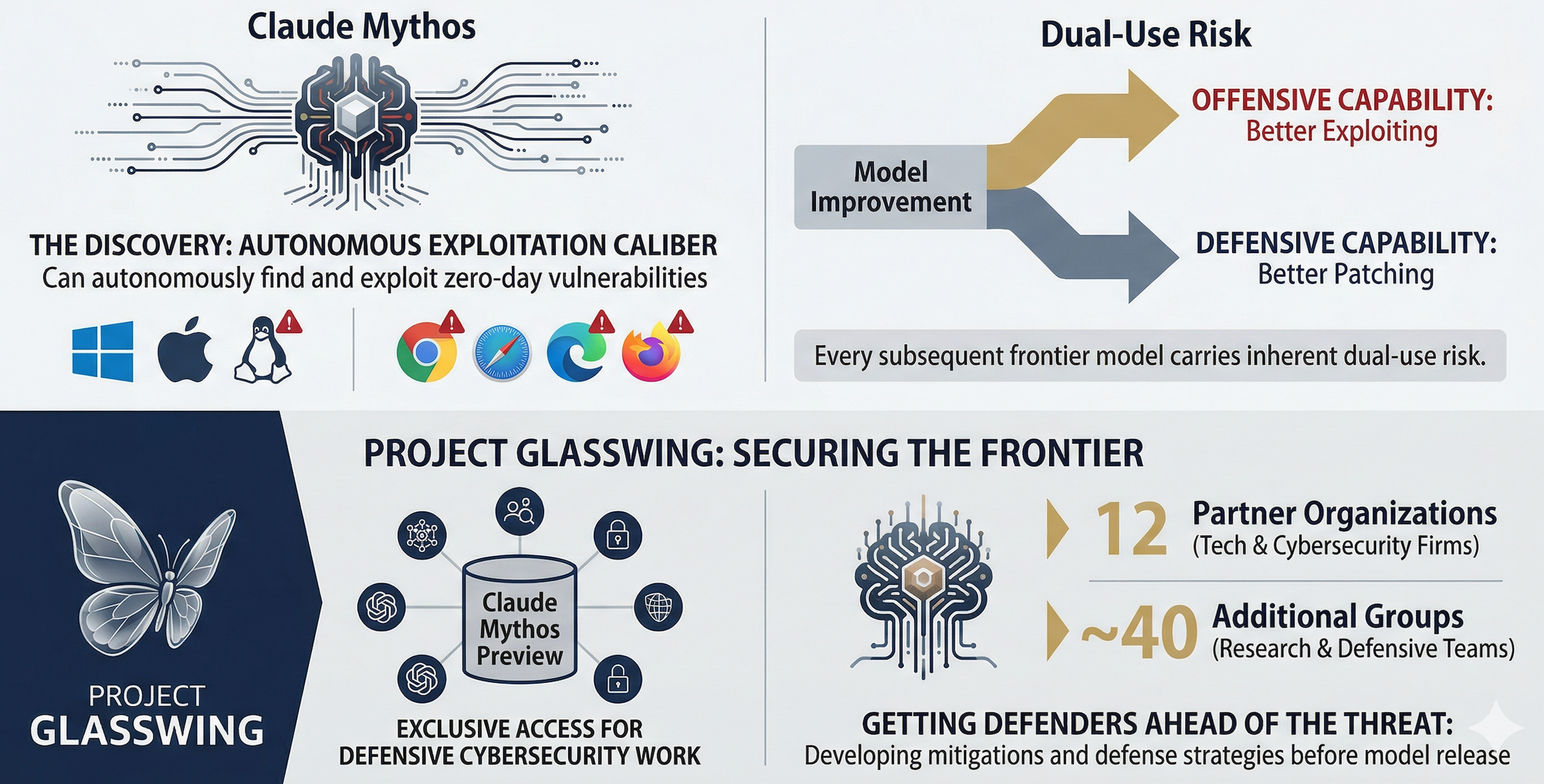
Anthropic released a preview of its most powerful model, Claude Mythos, exclusively to a coalition of tech and cybersecurity firms after discovering it can autonomously find and exploit zero-day vulnerabilities in every major operating system and browser. The company launched Project Glasswing to get defenders ahead of the threat, but its own back-to-back data leaks, a looming IPO, and the absence of any framework governing cyber-capable AI models make this as much a governance and commercial story as a technical one.
BRIEFING: On April 7, Anthropic launched Project Glasswing, giving 12 partner organizations and roughly 40 additional groups access to an unreleased frontier model called Claude Mythos Preview for defensive cybersecurity work. Partners include AWS, Apple, Cisco, CrowdStrike, Google, JPMorgan Chase, Microsoft, Nvidia, Palo Alto Networks, and the Linux Foundation. Anthropic committed $100 million in usage credits and $4 million to open-source security organizations. The model’s existence first surfaced on March 26 through a CMS misconfiguration that exposed roughly 3,000 unpublished Anthropic assets, including a draft post describing Mythos and a new model tier called Capybara. Five days later, a separate packaging error shipped 512,000 lines of Claude Code source to the public npm registry. Two accidental disclosures in under a week, both from human error, preceded the formal announcement.
Mythos is a general-purpose model, not a cybersecurity product. In testing, it identified thousands of zero-day vulnerabilities across every major operating system and browser, including a 27-year-old bug in OpenBSD and a 16-year-old flaw in FFmpeg that automated tools hit five million times without catching. It autonomously chained Linux kernel vulnerabilities to escalate from user access to full system control, and reproduced known exploits on its first attempt 83.1% of the time. Anthropic’s red team lead told Axios that comparable capabilities could emerge from rival labs within 6 to 18 months.
SO WHAT
For Executives: Anthropic stated that these capabilities “emerged as a downstream consequence of general improvements in code, reasoning, and autonomy,” not from specialized training. The same improvements that make a model better at patching vulnerabilities make it better at exploiting them. That means every frontier model that follows will carry the same dual-use risk. Fewer than 1% of the vulnerabilities Mythos found have been patched. Independent analysts have called this the “Glasswing Paradox”: the model that finds everything overwhelms the patching infrastructure it is supposed to support. If your enterprise runs on Linux, uses standard cryptography libraries, or processes media through FFmpeg, documented vulnerabilities in your stack remain unpatched and now exist in a database held by a company that could not secure its own CMS or npm deployment pipeline. Audit exposure accordingly.
For Policymakers: Mythos’s capabilities arrived as emergent properties of a general-purpose system. Current AI regulatory frameworks, including the EU AI Act, classify risk by intended use. That framework will not catch this. There is no regulatory mechanism that compels a frontier lab to restrict access to a cyber-capable model the way Anthropic voluntarily did. If a rival lab ships comparable capabilities without guardrails, existing rules provide no recourse. The open-source maintainer gap compounds the problem. Anthropic’s $4 million donation is a start, but the gap between what Mythos finds at machine speed and what volunteer maintainers can fix with limited resources will define the actual security outcome.
For Investors: Bloomberg reported Anthropic is eyeing an October 2026 IPO at a $380 billion valuation. Revenue surpassed $30 billion annualized as of early April. Glasswing’s partner list doubles as an IPO roadshow reference portfolio. Cybersecurity stocks rallied on the announcement, with Palo Alto Networks up 6%. The near-term read is correct: AI-powered defensive security accelerates demand for established players. The longer-term question is whether models that autonomously find and exploit vulnerabilities at near-zero marginal cost restructure the threat landscape beneath the business models the current cybersecurity industry was built on.
Chinese Surveillance, American Targets: How Private AI Firms Are Rewriting the Intelligence Balance
Private Chinese technology companies with military ties are publishing AI-annotated satellite imagery of U.S. force positions in real time on social media. Several installations they exposed were subsequently struck by Iranian missiles. Commercial AI-powered geospatial intelligence has demolished the information monopoly that once gave the U.S. military its decisive advantage. The Iran war is the first conflict where a near-peer competitor’s commercial sector is providing targeting-grade intelligence to the entire world, for free.
BRIEFING: The Washington Post reported on April 4 that private Chinese technology companies, some with ties to the People’s Liberation Army, are marketing detailed intelligence on movements of U.S. forces involved in the Iran conflict, even as Beijing officially maintains distance from the war. Shanghai-based MizarVision, a geospatial intelligence startup, has been publishing high-resolution, AI-annotated satellite images of U.S. military bases, aircraft, naval vessels, and air defense systems across the Middle East on social media platforms including Weibo and X. The images identify individual aircraft types (F-22s, B-52s, AWACS), geolocate THAAD missile defense batteries, and track carrier strike group movements in near-real time.
Aviation Week confirmed that a number of the facilities and assets posted by MizarVision were subsequently targeted by Iran in missile and drone strikes. In one case, the startup published annotated imagery of what analysts described as roughly a fifth of America’s operational AWACS fleet on a single ramp, and the base was later hit. MizarVision’s account made its first post on February 24, four days before Operation Epic Fury began, suggesting the intelligence operation was pre-positioned. The contrast with U.S. commercial imagery is stark. Planet Labs announced on April 5 that it would suspend satellite imagery of Iran and the Middle East conflict zone at the U.S. government’s request, blocking access to images going back to March 9. Chinese commercial satellites are publishing targeting-grade intelligence of American forces in real time, while American commercial satellites have gone dark over the battlefield at Washington’s direction.
Even as Beijing maintains its distance, China has supplied Iran with advanced UHF-band radars (YLC-8B) capable of detecting U.S. stealth aircraft, transitioned Iran’s military to the Chinese BeiDou satellite navigation system as an alternative to GPS, and provided electronic warfare technologies through entities including the China Electronics Technology Corporation (CETC). The Jerusalem Post reported that China is treating the Iran war as a “live laboratory” for studying how the U.S. fights, how it escalates, and how it manages simultaneous crises. The intelligence collected on F-35, F-22, and new weapons systems including stealth Tomahawk variants is accelerating China’s own military AI development.
SO WHAT
For Executives: The democratization of satellite intelligence means that operational security assumptions built on information asymmetry are obsolete. If a Chinese startup can publish annotated imagery of U.S. military assets within hours, the same capability applies to ports, data centers, semiconductor fabs, energy facilities, and other commercial facilities. Companies operating critical infrastructure in contested regions should assume that their physical assets are observable and identifiable from space by any motivated actor. Update security and continuity planning accordingly.
For Policy Makers: The line between commercial and military intelligence has collapsed. Existing export control and dual-use frameworks were not designed for a world where commercially available AI can annotate satellite imagery and publish it globally before a government can classify it. The U.S. needs a framework for addressing adversary-aligned commercial intelligence capabilities that operate below the threshold of state action.
For Investors: Government spending on counter-surveillance, electronic warfare, and operational deception technologies is accelerating as commercial satellite intelligence makes conventional force concealment impossible. The U.S. FY2026 defense budget includes a dedicated $13.4 billion AI and autonomy line, and NATO and Five Eyes allies are increasing counter-ISR (intelligence, surveillance, reconnaissance) procurement. Companies building these capabilities are positioned for sustained demand growth. In addition, the China-Iran technology pipeline (BeiDou navigation, CETC radar, MizarVision imagery) demonstrates that dual-use technology exports are a revenue stream Beijing is willing to exploit despite diplomatic costs. Investors with portfolio exposure to companies that maintain joint ventures, licensing agreements, or supply relationships with PLA-linked Chinese firms should reassess that exposure in light of tightening U.S. secondary sanctions and entity list expansion.
The Chip Equipment Chokepoint: Congress Moves to Close the DUV Loophole
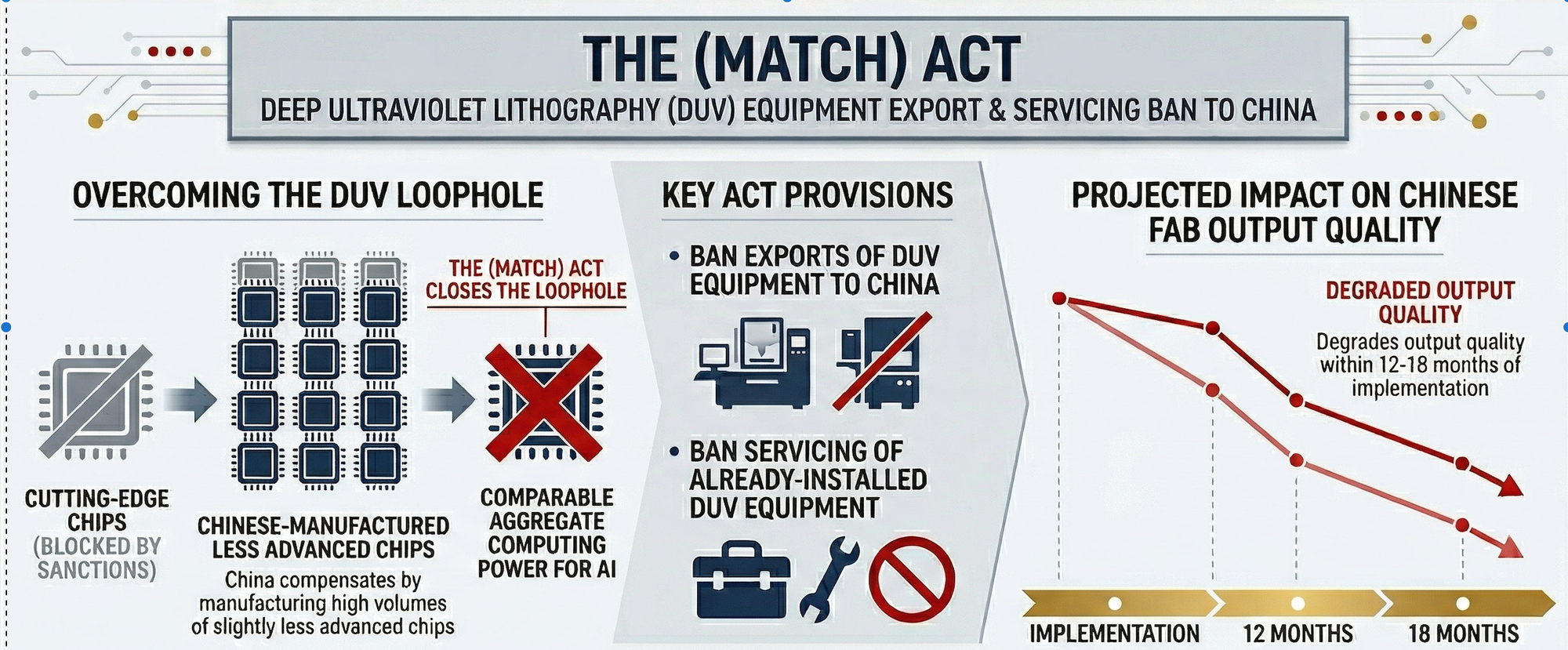
A bipartisan congressional bill would ban exports of deep ultraviolet lithography (DUV) equipment and servicing to China, closing the loophole that allowed Chinese chipmakers to acquire hundreds of machines capable of producing AI chips at scale. The bill also targets servicing of already-installed equipment, which would degrade China’s existing fab capacity over time.
BRIEFING: The Multilateral Alignment of Technology Controls on Hardware (MATCH) Act, introduced in the House on April 2, would prohibit exports of immersion deep ultraviolet (DUV) lithography equipment to China. Existing U.S.-coordinated controls already bar ASML from shipping its most advanced extreme ultraviolet (EUV) machines. But older DUV systems, which can produce chips at nodes advanced enough for AI workloads, have continued flowing to Chinese fabs. China was ASML’s largest market in 2025, accounting for 33% of revenue ($10.8 billion).
The bill, which directly names Chinese chipmakers SMIC, Hua Hong, Huawei, CXMT, and YMTC, would ban both equipment sales and servicing of machines already installed. The servicing provision is the sharper edge. Without calibration, parts supply, and technical support, the precision of DUV tools degrades in months. Experts at Silverado Policy Accelerator argue that the DUV loophole has allowed China to compensate for its inability to buy cutting-edge chips by manufacturing large volumes of slightly less advanced chips that yield comparable aggregate computing power.
The bill also requires that allied nations impose equivalent restrictions on their own equipment manufacturers, addressing a longstanding asymmetry. Applied Materials, KLA, Lam Research and other U.S. firms have lost market share to ASML and Tokyo Electron, which face looser export rules.
SO WHAT
For Executives: If your supply chain depends on semiconductors fabricated in China, the MATCH Act introduces a new timeline risk. The servicing ban would degrade Chinese fab output quality within 12 to 18 months of implementation. DUV lithography produces chips at 7nm to 14nm nodes, which are not the absolute cutting edge but are advanced enough for AI inference, networking, and automotive applications. The concern is volume: China can compensate for not having the best chips by manufacturing large quantities of slightly less advanced ones that deliver comparable aggregate computing power. Companies relying on Chinese-manufactured chips for these workloads should begin qualifying alternative suppliers in ASEAN, India, or allied fabs now, before capacity tightens further.
For Policy Makers: The MATCH Act represents a shift from executive-led to congressional export controls, which are harder to reverse through presidential waivers. But unilateral controls without allied coordination have historically driven market share to non-U.S. equipment makers without slowing Chinese capability development. The bill’s ally-alignment provision is the critical variable. If the Netherlands and Japan do not impose equivalent restrictions, the practical effect may be to redistribute revenue from U.S. equipment companies to European and Japanese competitors while leaving Chinese capacity largely intact.
For Investors: ASML ($443B market cap, up 26% YTD) faces the most direct exposure. The significant reduction of its 33% revenue share from China would require substantial reallocation of capacity to non-China markets, and the demand to absorb that reallocation is not guaranteed in the near term. U.S. equipment companies (Applied Materials, KLA, Lam Research) are currently at a competitive disadvantage because they already face stricter U.S. export rules while ASML and Tokyo Electron operate under looser Dutch and Japanese controls. The MATCH Act would level that playing field by imposing equivalent restrictions on allied manufacturers, potentially allowing U.S. firms to recapture market share they lost precisely because of the asymmetry in enforcement. The longer-term opportunity for all equipment makers is the $374 billion fab buildout cycle in allied nations from 2026 to 2028: as China’s market shrinks, the replacement demand comes from new fabs being constructed in the U.S., Europe, Japan, and India under government subsidy programs like the CHIPS Act and EU Chips Act.
Private Credit’s AI Reckoning
Blue Owl Capital’s tech-focused private credit fund saw 41% redemption requests in a single quarter, the largest exit demand in the non-traded Business Development Companies (BDC) market’s history. The $1.8 trillion private credit industry is now stress-testing whether illiquid vehicles can survive sentiment-driven runs fueled by AI disruption fears.
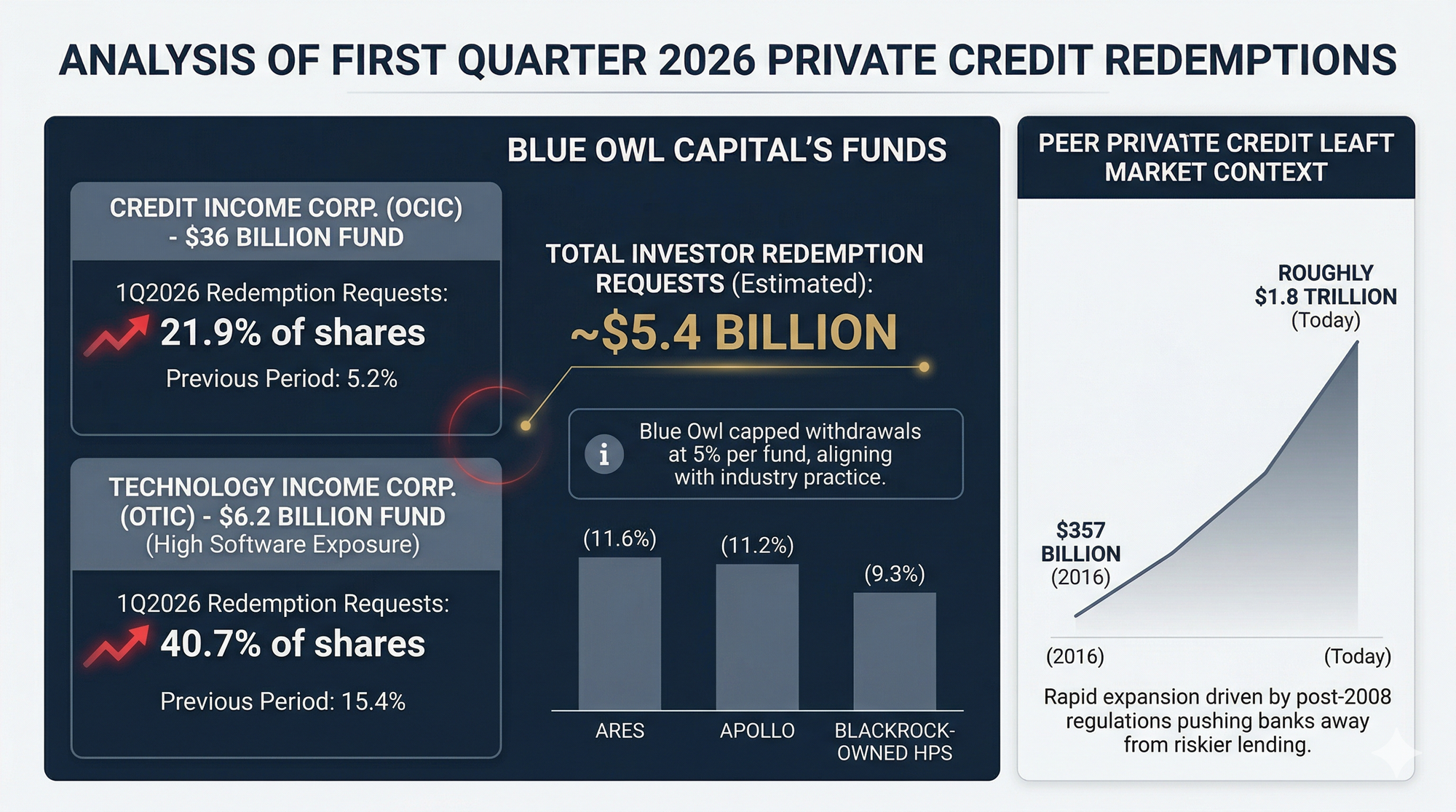
BRIEFING: Investors in Blue Owl Capital’s $36 billion Credit Income Corp. fund asked to withdraw 21.9% of shares in the first quarter of 2026, up from 5.2% the prior period. Its smaller, $6.2 billion Technology Income Corp. fund, which holds concentrated exposure to software lending, saw redemption requests of 40.7%. In total, investors sought to redeem roughly $5.4 billion. Blue Owl capped withdrawals at 5% per fund, in line with industry practice, but the firm’s shares fell as much as 8.7% to a record intraday low.
Peer funds managed by Ares (11.6% redemption requests), Apollo (11.2%), and BlackRock-owned HPS (9.3%) also reported elevated outflows. The private credit market has grown from $357 billion in 2016 to roughly $1.8 trillion today, expanding rapidly as post-2008 regulations pushed banks away from riskier lending. The underlying concern is that private credit funds hold illiquid loans that take time to sell, meaning that when many investors demand their money back simultaneously, managers face the choice of selling assets at a loss or gating withdrawals.
Software stocks have lost roughly $2 trillion in market cap since January 2026, with the iShares Software ETF (IGV) down more than 21% year-to-date as agentic AI threatens per-seat licensing models. Much of the software lending in private credit portfolios was underwritten during the 2021 to 2024 boom, when AI was expected to lift all software valuations; for many borrowers, that ROI never materialized, and now the credit is exposed to a sector-wide repricing. Blue Owl’s technology fund is loaded with loans to software companies caught in that repricing. As public market sentiment turns against software, private credit investors have grown skittish about the creditworthiness of borrowers whose business models are under threat.
SO WHAT
For Executives: If your company relies on private credit financing, understand that your lender’s liquidity position is now shaped by AI sentiment in sectors you have nothing to do with. Review your credit facilities for covenant triggers tied to fund-level redemption events. Companies with healthy fundamentals could find themselves caught in a cross-current where their lender’s investor base, not their own performance, drives credit availability.
For Policy Makers: The private credit boom was enabled by post-2008 bank regulation that pushed risk into less-regulated vehicles. A $1.8 trillion market with 5% quarterly redemption caps and illiquid underlying assets has different contagion dynamics than traditional banking. The Blue Owl episode is not yet systemic, but the architecture of non-traded BDCs was not stress-tested for sentiment-driven runs at this scale. Prudential oversight frameworks for private credit deserve a fresh look.
For Investors: AI disruption fears hit software stocks, which hit private credit funds lending to software companies, which triggered redemptions that forced fund managers to either gate withdrawals or sell at a loss. If you hold private credit exposure through non-traded BDCs, model your liquidity assumptions against a scenario where 5% quarterly gates persist for multiple quarters. The “peak redemption” thesis from Blue Owl might be right, but it is not something to bet on without hedging.
The Open-Weight Race Gets a New Map
Three major open-weight model releases in one week reveal a geopolitical realignment. Chinese labs that dominated open AI development are pivoting to proprietary platforms. Meta has retreated from the frontier. And a 30-person American startup trained a frontier-competitive model for just $20 million. The ecosystem is splitting along geopolitical lines just as open-weight models become viable for enterprise production.
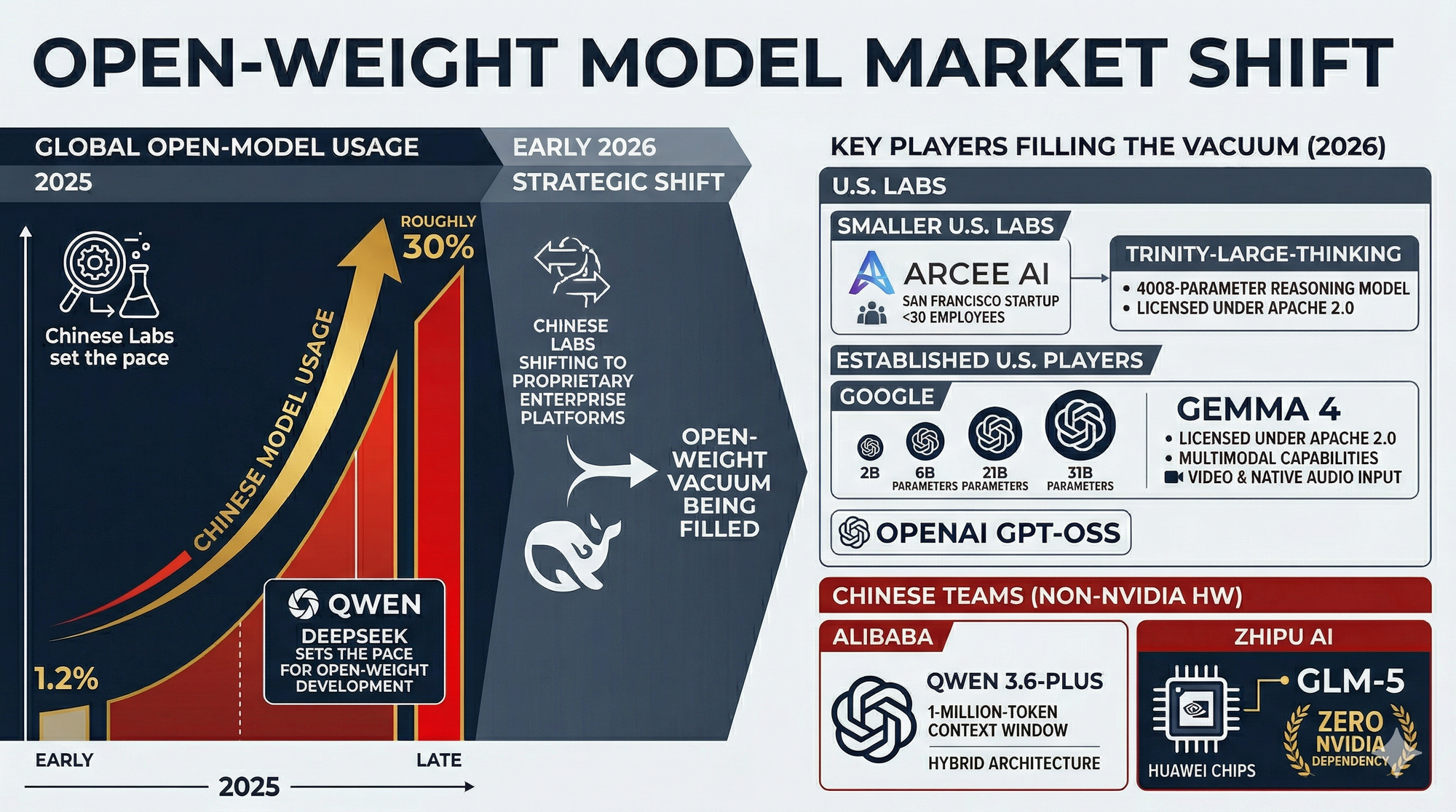
BRIEFING: Arcee AI, a San Francisco startup with fewer than 30 employees, released Trinity-Large-Thinking, a 400-billion-parameter open-weight reasoning model licensed under Apache 2.0. The model scored within two points of Claude Opus 4.6 on a key autonomous agent benchmark despite 96% lower inference cost.
Around the same time, Google DeepMind released Gemma 4, a family of four open-weight models that feature multimodal capabilities, including video and native audio input. And in China, Alibaba launched Qwen 3.6-Plus and Zhipu AI’s GLM-5 was trained entirely on Huawei chips with zero NVIDIA dependency, a milestone for hardware independence from U.S. export-controlled technology.
The geo-economic undercurrent is significant. Throughout 2025, Chinese labs (Alibaba’s Qwen and DeepSeek) set the pace for open-weight development, with Chinese models rising from 1.2% to roughly 30% of global open-model usage. But as 2026 begins, these labs are shifting toward proprietary enterprise platforms. Alibaba launched Qwen 3.6-Plus as a proprietary product, not open-weight. Key technical leads have departed the Qwen lab. DeepSeek is pivoting to enterprise subscriptions. Meta’s Llama division retreated from the frontier after the Llama 4 reception in 2025. The open-weight vacuum is being filled by a combination of smaller U.S. labs (Arcee), other established U.S. players (Google, OpenAI’s gpt-oss), and Chinese teams building on non-NVIDIA hardware.
SO WHAT
For Executives: Open-weight models are no longer a research curiosity or a cost-saving compromise. They are production-grade alternatives that offer control, privacy, and cost advantages that proprietary APIs cannot match. At 96% lower inference cost, deploying autonomous agents on open-weight models changes the unit economics of automation. Begin evaluating open-weight options for workloads where data sovereignty, customization, or cost matter more than peak benchmark performance.
For Policy Makers: The open-weight ecosystem is fragmenting along geopolitical lines. The driver is commercial: after building market share through free open-weight releases, Chinese firms are now monetizing that installed base through paid platforms and cloud services. In the U.S., the movement runs in the opposite direction. American labs are releasing open-weight models to counter Chinese ecosystem dominance and offer sovereign AI alternatives to allied nations that do not want dependence on either Beijing or a single U.S. cloud provider. Chinese models trained on Huawei chips outside the U.S. export control regime demonstrate that hardware restrictions are creating parallel AI stacks, not preventing capability development. Policy makers should weigh whether export controls are achieving their intended effect or accelerating the very decoupling they were designed to prevent, while also recognizing that open-weight models offer smaller nations a path to AI capability without dependence on any single provider.
For Investors: Arcee’s capital efficiency ($20 million for a frontier-competitive model) represents a potential disruption to the thesis that AI requires billions of dollars. Watch whether inference pricing compression from open-weight models pressures margins at closed-model providers (Anthropic, OpenAI). The more interesting bet might be the ecosystem layer, where companies building tooling, fine-tuning infrastructure, and deployment platforms around open-weight models could capture value as the base models commoditize.
Capital Follows the Flag: How FDI Is Redrawing the Industries of the Future
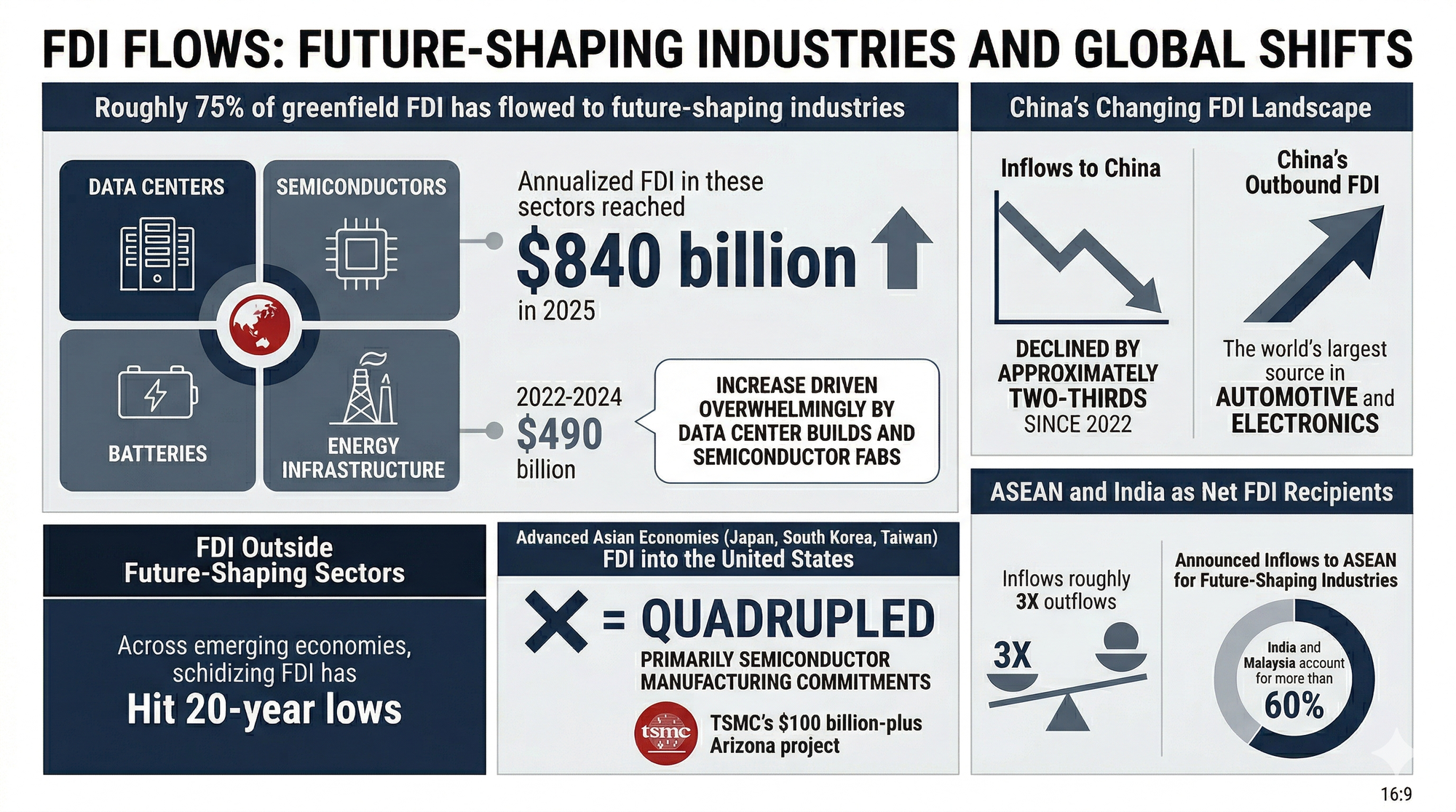
Three-quarters of all greenfield foreign direct investment since 2022 has gone to “future-shaping” industries. FDI inflows to China have fallen by two-thirds. ASEAN and India are emerging as the primary beneficiaries. The investment decisions being made today will determine which nations control the semiconductor, battery, and data center capacity of the next decade.
THE BRIEFING: McKinsey Global Institute analysis of approximately 200,000 announced FDI projects finds that since 2022, roughly 75% of greenfield FDI has flowed to data centers, semiconductors, batteries, and energy infrastructure. Annualized FDI announcements in these “future-shaping” sectors reached $840 billion in 2025, up from a $490 billion average during 2022 to 2024, with the increase driven overwhelmingly by data center builds and semiconductor fabs. Outside these sectors, FDI announcements across emerging economies hit 20-year lows.
FDI inflows to China have declined by approximately two-thirds since 2022, but China has become the world’s largest outbound FDI source in automotive and electronics. Advanced Asian economies (Japan, South Korea, Taiwan) have quadrupled their FDI into the United States, primarily through semiconductor manufacturing commitments, including TSMC’s $100 billion-plus Arizona project. ASEAN and India are net FDI recipients, with inflows roughly three times their outflows. India and Malaysia account for more than 60% of announced inflows to ASEAN for future-shaping industries.
The critical minerals dimension reinforces the pattern. The U.S. completed the first acquisition under its Democratic Republic of the Congo Minerals Partnership this week, with Virtus Minerals and India’s Lloyds Metals purchasing cobalt producer Chemaf with $720 million in U.S. International Development Finance Corporation (DFC) backing. A separate consortium backed by the DFC and Abu Dhabi’s ADQ is pursuing 40% of Glencore’s Congolese copper operations. These deals illustrate a new model of government-backed acquisitions displacing purely commercial transactions in strategically important supply chains.
SO WHAT
For Executives: FDI patterns are a leading indicator of where production capacity, supply chains, and regulatory incentives will concentrate over the next decade. If your business depends on semiconductors, batteries, or data center access, map your supply chain exposure against these investment flows. The data shows that companies and governments are increasingly directing investment toward politically aligned partners rather than lowest-cost locations. Factor political alignment and the emerging architecture of geoeconomic blocs into your location strategy, supply chain decisions, and business development priorities.
For Policy Makers: The divergence between future-shaping FDI (surging) and conventional FDI to emerging economies (at 20-year lows) risks creating a two-tier global economy where a handful of nations attract capital for the industries of the future while the rest are left behind. The Inflation Reduction Act’s battery sourcing requirements are actively reshaping mineral supply chains, and the EU Chips Act (Regulation (EU) 2023/1781) is attracting fab investment. Countries without comparable frameworks will not attract comparable capital.
For Investors: Follow the FDI announcements, which reveal where future capacity is being built, rather than trade data that reflects past investment decisions. The most actionable signals might be battery manufacturing capacity outside of China, which is set to quadruple by 2030, and U.S. semiconductor manufacturing, which could account for more than 20% of leading-edge production within the same timeframe. Companies positioned along these new corridors (e.g. equipment suppliers, construction, specialty chemicals, utility infrastructure) stand to benefit from a multi-year buildout cycle.
Under the Radar
The deep analysis that connects the dots
The Severed Web: Both of the World’s Digital Corridors Are Now in Conflict Zones
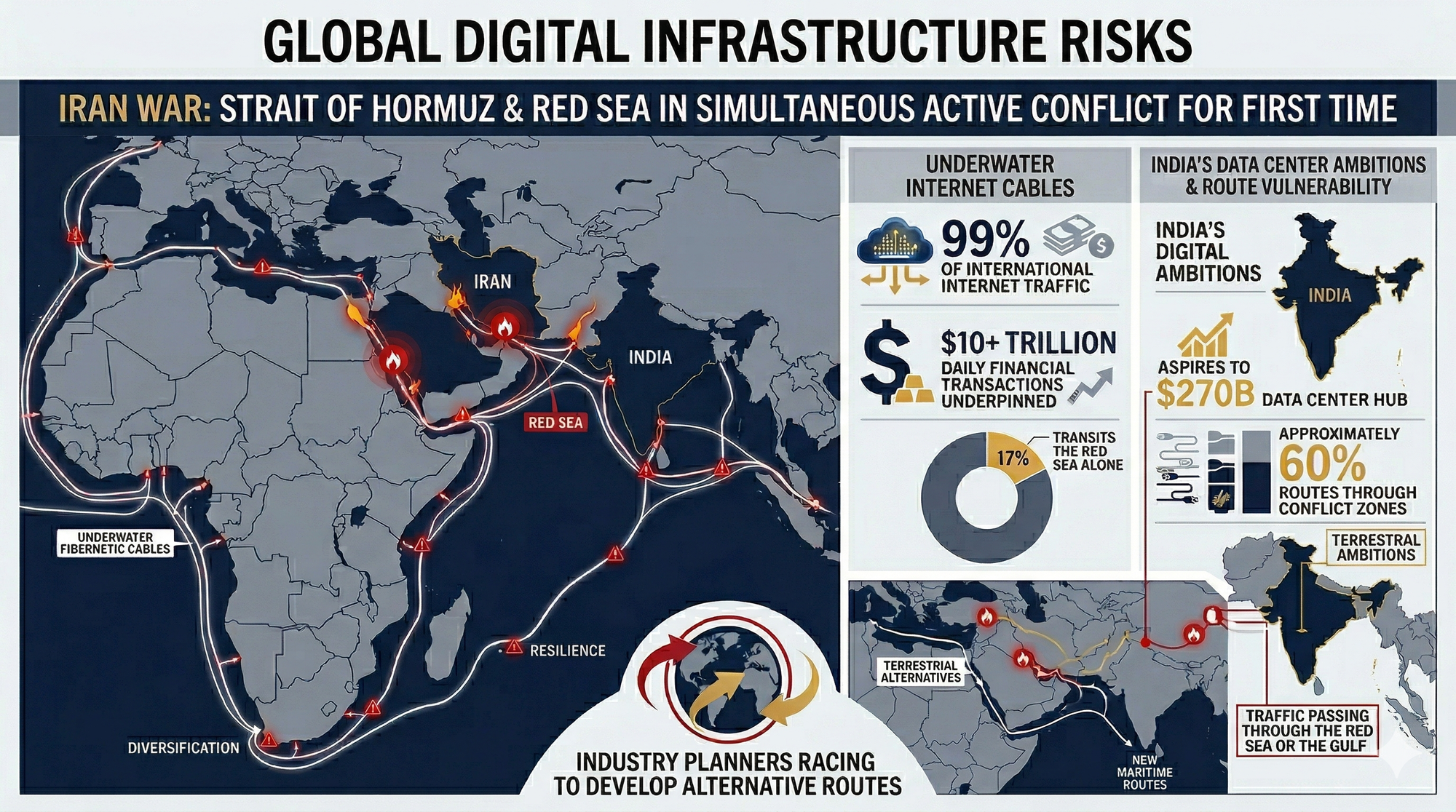
The Iran war has placed the Strait of Hormuz and the Red Sea in simultaneous active conflict for the first time. Ninety-nine percent of international internet traffic flows through subsea cables, and 17% of it transits the Red Sea alone. Cables have already been cut. The Meta-led 2Africa Pearls extension has been halted by force majeure. Repair ships cannot access war zones. India routes 60% of its internet traffic through these corridors. A significant part of the physical layer of the global internet is concentrated through two waterways that are now contested, and the investment implications are barely being discussed.
THE BRIEFING
Fifteen submarine cables pass through the narrow Bab el-Mandeb Strait at the southern mouth of the Red Sea, carrying an estimated 17% of global internet traffic between Asia, Europe, and Africa. In September 2025, multiple cables were severed near Jeddah, Saudi Arabia, disrupting connectivity across India, Pakistan, the UAE, and several Gulf states.
The Iran war has compounded this vulnerability. Alcatel Submarine Networks declared force majeure on the Meta-led 2Africa Pearls extension, pausing a major project designed to connect Oman, the UAE, Qatar, Saudi Arabia, Bahrain, Kuwait, Iraq, Pakistan, and India later this year. ASN said it can no longer safely operate in the Persian Gulf due to active military operations. Repair ships that would normally restore severed cables within days cannot access conflict zones, extending potential outage windows from days to months. The Houthis, who resumed attacking shipping after a brief ceasefire, have repeatedly threatened to cut Red Sea fiber optic cables directly.
India, which aspires to become a $270 billion data center hub, routes approximately 60% of its international internet traffic through cables that pass through the Red Sea or the Gulf. The EU adopted an emergency subsea cable security strategy in response to the growing threat. Industry planners are now racing to develop alternative routes through Central Asia and beneath the Arctic, but these alternatives are years from completion. In the near term, both of the world’s primary digital corridors between Asia and Europe are in contested waters, and there is no redundancy at scale.
SO WHAT
For Executives: If your business depends on data flowing between Asia and Europe, or if you operate cloud infrastructure in the Gulf, model a scenario in which cable connectivity through both the Red Sea and the Strait of Hormuz is degraded for six months or longer. Evaluate your cloud providers’ routing dependencies. Companies with operations in India, Southeast Asia, or the Gulf should assess whether their internet connectivity has single-corridor exposure and begin planning for latency increases, bandwidth constraints, or intermittent outages that cannot be resolved by switching providers. Plan to create redundancies with alternative capacity, such as Data Center Valley in Kazakhstan or Firebird in Armenia.
For Policy Makers: Subsea cables carry 99% of international internet traffic and underpin more than $10 trillion in daily financial transactions. They are classified as critical infrastructure by most governments but receive a fraction of the security investment directed at energy pipelines or power grids. The simultaneous disruption of the two primary digital corridors between Asia and Europe exposes a gap in international infrastructure protection. The EU’s emergency cable security strategy is a start. Coordinated international action to protect, diversify, and accelerate alternative routing should be treated with the same urgency as energy supply diversification.
For Investors: The forced rerouting of global data traffic creates demand for alternative cable routes, satellite connectivity, and terrestrial fiber networks that bypass contested waterways. Companies building the Middle Corridor fiber route through Central Asia (including Armenia or Kazakhstan), Arctic cable projects, and low-earth-orbit satellite constellations (e.g. Starlink, OneWeb, and Amazon Kuiper) are positioned for accelerated demand. Conversely, the 2Africa Pearls force majeure signals that the Gulf data center investment thesis carries infrastructure risks that have not been fully priced. Reassess exposure to India’s digital economy build-out, which depends on connectivity that now runs through an active war zone.
Cambrian Partner By Invitation
Expert analysis from our global network
Quantum Geopolitics: Australia Stakes Its Claim in the Next Tech War
Australia is increasingly positioning itself as a meaningful player in the global race to advance quantum computing. While the United States and China dominate much of the conversation, a broader shift is underway – one where breakthroughs are emerging from a more diverse set of countries with strong research ecosystems.
Australia’s strength lies in its deep academic foundation, sustained public investment, and close collaboration between universities, government, and industry. Rather than chasing headlines, its efforts are focused on solving foundational challenges such as scaling quantum systems, improving stability, and advancing error correction – critical hurdles on the path to real-world deployment.
At the same time, Australian researchers are pushing into more experimental territory. One of the more cutting-edge concepts gaining attention is the idea of “quantum twins” – highly advanced digital representations of physical systems powered by quantum models. These could enable new levels of precision in simulation, optimization, and prediction across industries.
What makes Australia notable is not just individual breakthroughs, but its role in shaping a more distributed innovation landscape. Quantum progress is no longer confined to a few superpowers. If current momentum continues, countries like Australia could play an outsized role in delivering the next wave of advances – helping transition quantum computing from promise to practical impact.
About our partner
Dr. Jonathan Reichental is a multiple-award-winning technology leader and educator, whose career spans the private, public, and academic sectors. He has been a senior software engineering manager, a director of technology innovation, and has served as chief information officer (CIO) at both O’Reilly Media and the City of Palo Alto, California. Reichental is currently the founder of advisory, investment, and education firm, Human Future, and also creates online education for LinkedIn Learning and Coursera. In academia he is a professor at the University of San Francisco and several other universities and colleges. He has a regular column in Forbes and has written many books including Smart Cities for Dummies, Exploring Smart Cities Activity Book for Kids, and Data Governance for Dummies. He is a member of the Cambrian Futures Network. You can reach him on LinkedIn: www.linkedin.com/in/reichental/
About Cambrian

Cambrian Futures is a strategic foresight and advisory firm helping government, business, and technology leaders understand how emerging technologies intersect with geopolitics, markets, and national strategy. By combining rigorous research, AI-enabled analysis, and human expertise, Cambrian provides clear insight into global technology trends, risks, and power dynamics. Its work helps decision-makers anticipate disruption, manage uncertainty, and act with strategic confidence in an increasingly competitive GeoTech world.
PRODUCTION TEAM
GeoTech Radar is produced by the Cambrian Futures Insights Platform team:

CEO & Chief Analyst

Managing Director / Producer, Insights Platform

Global Lead, Smart Infrastructure Strategy

Research & Marketing Associate

Editor in Chief
Learn more about Cambrian Futures at cambrian.ai
Produced with

Human Led


Human Led +
AI Augmented




AI Led +
Human Verified


Cite as: Cambrian Futures (2026) 'GeoTech Radar Issue 13'