

The Memory Squeeze. The Havana Connectivity Blackout. The Nonstate AI Actor Loophole.
IN THIS ISSUE:
CEO's Perspective
Strategic outlook from Cambrian leadership

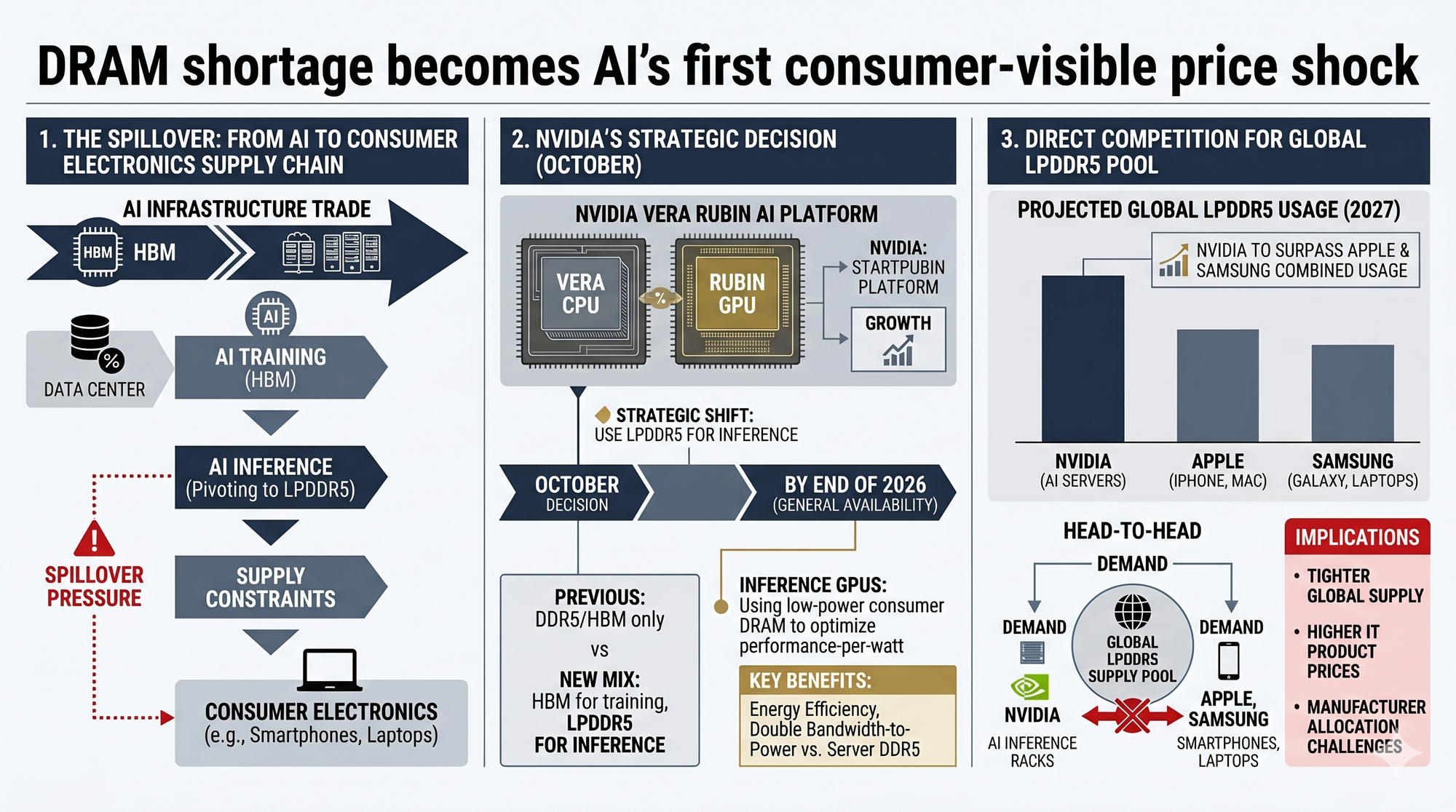
A 5G smartphone in India costs roughly 30 percent more than it did six months ago. The cause sits two markets away. Nvidia chose to build its AI inference chips around the same memory used in consumer phones. That design choice put phone makers in direct competition with AI server builders for the same pool of memory chips, and AI demand is the larger force. The price increase is now moving down the chain to retail.
I kept that linkage in mind while reading the rest of this issue. Every story turns on a version of it.
The secondary use is the hidden cost
Most of the goods, services, infrastructures, and platforms running through our economies have a primary use that participants understand and trade against. They also have secondary uses, less visible and less negotiated, that more powerful actors exploit despite the intentions and actions of the primary participants. While the original transaction still resides with the primary use, these ancillary uses have usurped the real leverage. As the two separate, strategic activity fills the gap..
Consider the new dynamics driving the market for DRAM memory chips. The use of DRAM for inference servers has displaced consumer devices as the primary market driver. Nvidia made the call with its design, and now the price effect lands in entry-level phones in Lagos and Lucknow, in PlayStation 5 retail pricing, and in nearly every device that depends on the memory pool. The consumer market and the AI buildout used to be separate. They no longer are.
Starlink is the Cuba version of the same pattern. The primary use of low-Earth-orbit satellite internet is connectivity for places that lack it. The secondary use, now operational, is statecraft. Washington offers Starlink to the Cuban population as humanitarian relief, but Havana reads it as the installation of foreign infrastructure on national territory and criminalizes the usage of Starlink equipment. Both governments are correct about the secondary use. The Cuban citizen sits between two states, each treating the satellite as an instrument of policy, not simply a matter of connection.
The Beijing AI safety protocol is the most refined version of the move. The primary use of a frontier AI model, as negotiated in the protocol's language, is commercial deployment that needs to be kept away from terrorists and criminals. The secondary use, deliberately unnamed, is state-level cyber operations. Both the U.S. and Chinese governments understand that the secondary use is where the real capability lives, but they have agreed to talk only about the primary use.
As I noted last week, the real substance often lives in the items excluded from the framework. These secondary uses live in those exclusions, where one party defines the real usage and dynamics of a technology, infrastructure, or asset, while other parties remain bound to a primary use that becomes increasingly marginalized.
As executives, we sit on both sides of this evolution. Our companies routinely assign secondary uses to inputs we acquire, content we ingest, and infrastructure we deploy. But larger actors also subject us to new secondary uses we do not expect – suppliers with monopoly positions, governments writing protocols that exclude important matters, or platforms whose terms shift under our products. The companies that survive the next five years will know which secondary uses are being assigned to them, and by whom, and they will price the assignment honestly rather than pretending the primary use is still the whole story.
The work this week is to look at your business and ask which of its key inputs, infrastructures, or frameworks has a secondary use that someone else currently defines. The party defining the secondary use might have greater influence over your operating margin than your business plan projected. You can renegotiate the assignment, accept it knowingly, or be surprised by it later. Those are the three options. The last one is the most expensive.
Olaf
On the Radar
The signals affecting the GeoTech landscape this week
The Memory Squeeze
DRAM shortage becomes AI's first consumer-visible price shock as the chip rally reorders global supply.
TL;DR: The Philadelphia Stock Exchange Semiconductor Index, the benchmark most widely used by institutional investors to track the sector, has gained 65% year-to-date in 2026 on AI infrastructure demand, with Micron up 38% in a single week. Memory chip prices have nearly doubled, and entry-level 5G phones in India are up 30% since October. The cost of training AI is now being collected from the smartphone buyer.
BRIEFING: The semiconductor rally that started as an AI infrastructure trade has spilled into the consumer electronics supply chain. Memory chipmakers have detached from the broader market. Micron, SanDisk, and Broadcom all project gross margins above 75% for 2026, according to FactSet. The trigger is Nvidia's October decision to use LPDDR5, a low-power version of consumer DRAM, in its inference graphics processing units by the end of 2026. That puts Nvidia in direct competition for the same memory pool as Apple, Samsung, and every Android device maker.
The downstream pricing is now visible. A Jefferies note from late March forecasts a 31% year-over-year decline in global smartphone shipments over the next 12 months, a contraction without precedent outside the pandemic. The price of entry-level 5G phones in India has increased about 30% since October. Sony raised PlayStation 5 prices by as much as $150 in March. The Semiconductor Industry Association reports global sales rose 79.2% year-over-year in March, and Taiwan Semiconductor Manufacturing Company (TSMC) has raised its long-term forecast for the global semiconductor market to $1.5 trillion by 2030, up from a prior $1 trillion estimate.
SO WHAT
For Executives: Hardware-dependent product roadmaps for 2026 and 2027 should have their costs recalculated now. Any device, vehicle, or industrial system that consumes DRAM or NAND faces input cost pressure that probably will not ease until at least 2027, when current fab buildout cycles begin producing. Lock in memory supply contracts for the next 18 months where possible. Assume single-digit-percentage margin compression for hardware-exposed lines and pass through where competitive position allows. The companies that move first to communicate price changes to enterprise customers will be the ones blamed least.
For Policy Makers: The AI buildout is now generating a consumer-price externality, and the U.S. policy toolkit needs three additions. First, a national strategic memory reserve, modeled on the Strategic Petroleum Reserve and sized to cover 60 to 90 days of U.S. consumption, would buffer both consumer markets and defense procurement against the next supply shock. Second, allied capacity coordination with Japan, South Korea, and the European Union to expand non-Chinese memory fab capacity by 2028 should become a formal track at the next Quad-plus economic dialogue. Third, the CHIPS and Science Act follow-on funding, currently weighted toward logic processing, should be rebalanced to direct at least 30% of remaining allocations toward memory production. Treasury, Commerce, and the U.S. Trade Representative should coordinate the package within the next two quarters.
For Investors: Views diverge on duration. Bank of Tokyo Investment Group's Jonathan Krinsky has flagged the move as comparable in magnitude to the 1999 dot-com run, suggesting cyclical risk. Others, including those building positions in pure-play memory names, argue this is a multi-year repricing rather than a cycle. The agreed point is that memory has become materially more important to the AI buildout than logic processing, and that this shift is reordering relative valuations across the semiconductor stack. The defensive plays are the picks-and-shovels infrastructure (ASML, Applied Materials) and the integrated foundry leader (TSMC at 27x forward earnings), which has more cyclical insulation than the memory pure-plays at current multiples.
For Service Providers: Clients in consumer electronics, automotive, medical devices, and industrial Internet of Things will be asking for memory sourcing strategy, supply contract restructuring, and price pass-through frameworks in the next two quarters. The advisory opportunity is in the second-order effects – which categories of product launch should be delayed, which inventory positions should be built ahead of the next leg of price increases, and how to communicate price changes to enterprise procurement without losing the account. Due to the uncertain longer term demand-supply balance, frame the engagement around scenario planning, not forecasting.
The Havana Connectivity Blackout
Washington has drained Cuba's fuel reserves to zero while offering Starlink internet as humanitarian relief; Havana treats the satellite network as a national security threat and is refusing.
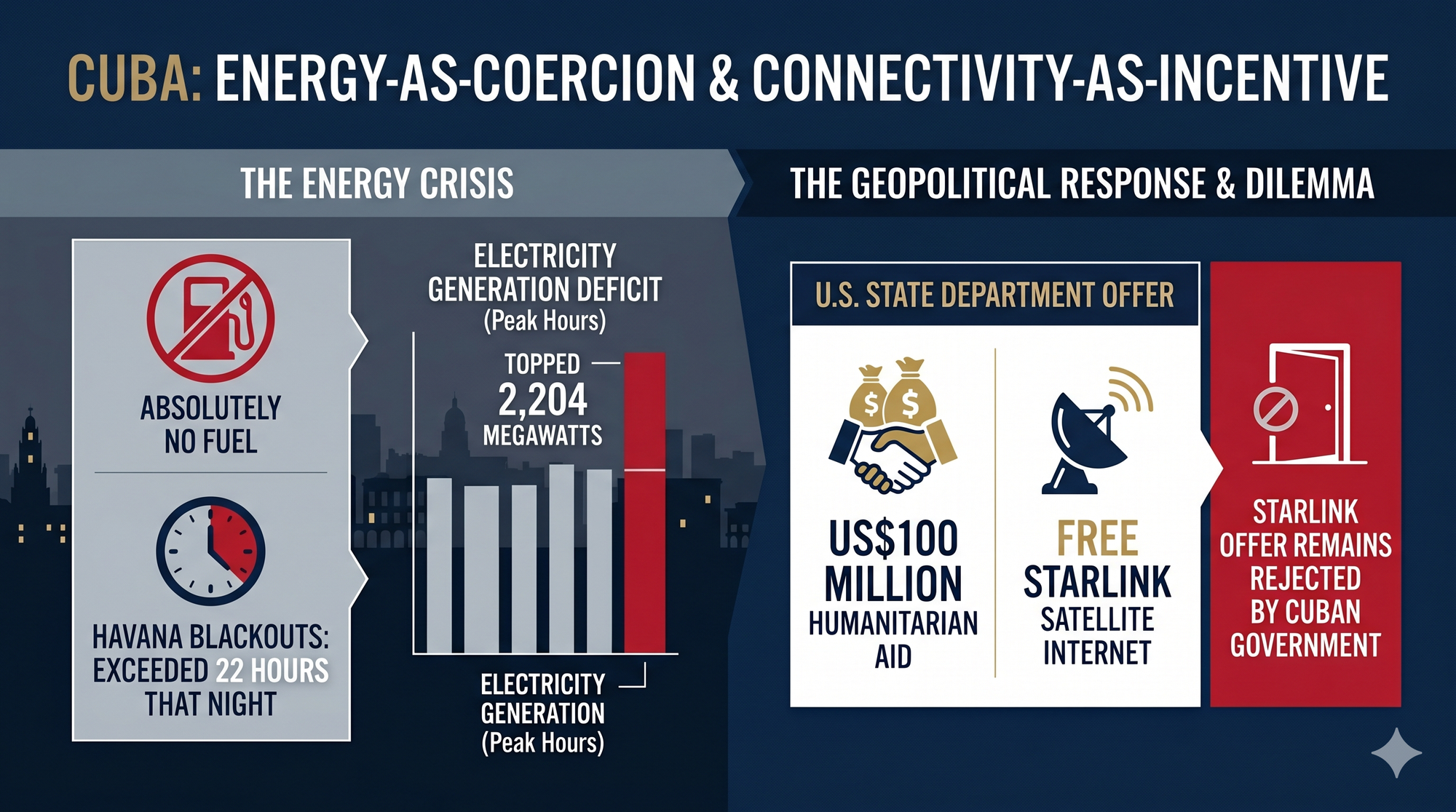
TL;DR: Cuba's energy minister confirmed on May 13 that the island has zero fuel and zero diesel, with Havana blackouts reaching 22 hours that night. The next day, CIA Director John Ratcliffe led the highest-level U.S. delegation to Havana in years. Washington's parallel offer of free Starlink internet, rejected by the regime, is the part of this story most worth watching. Connectivity has become an instrument of coercion.
Briefing: Cuban Energy Minister Vicente de la O Levy said on May 13 that the country has "absolutely no fuel, absolutely no diesel" and that reserves are spent. Havana blackouts exceeded 22 hours that night, and protests broke out in at least 12 municipalities. In January, U.S. forces seized Venezuelan President Nicolás Maduro and took control of Caracas's oil industry, ending the flow of Venezuelan crude to Cuba. Later that month, President Trump imposed a blockade that barred foreign oil deliveries to Havana. Since January 2026, the administration has imposed more than 240 sanctions against the regime, intercepted at least seven tankers, and reduced energy imports by 80% to 90%.
On May 14, CIA Director John Ratcliffe led a U.S. delegation to Havana to meet Cuban Interior Minister Lazaro Alvarez Casas and the head of Cuban intelligence services. Federal prosecutors are weighing charges against 94-year-old Raúl Castro in connection with the 1996 shootdown of two U.S. civilian aircraft. The State Department restated its offer of $100 million in humanitarian aid to be distributed through the Catholic Church, plus free Starlink satellite internet. Havana's foreign ministry initially called the aid offer a "$100 million lie," then on May 14 said it was willing to discuss the terms. However, Cuba continues to reject the Starlink offer, with state media outlet Razones de Cuba comparing the satellite network to "the installation of microphones, cameras, or missile launch bases on national territory." Possession of Starlink equipment carries a three- to eight-year prison sentence under Cuban law.
So What
For Executives: Multinationals with Cuba exposure (telecom, tourism, agriculture, remittance services) should treat the next 60 days as a binary regime-transition window. Either the Castro indictment plus the energy collapse forces concessions and a managed opening, or Havana absorbs another wave of out-migration and the status quo extends. Either path implies a near-term repricing of risk for the region. Mexico, Panama, and the Dominican Republic will absorb migration flows and should be modeled separately.
For Policy Makers: Cuba is a live test of energy-as-coercion paired with connectivity-as-incentive, and in some cases submission. The Starlink offer establishes that the U.S. is now prepared to bypass state telecom monopolies through low-Earth-orbit satellite infrastructure, and to do it as a humanitarian gesture rather than a regime change tool. That precedent will be applied elsewhere. The State Department, Treasury, and the Department of War should formalize the doctrine before the next crisis forces an improvised version. The legal framework for offering satellite connectivity to a sanctioned regime's population, and for protecting users from local prosecution, needs to exist on paper rather than in press conferences.
For Investors: Keep an eye on three asset classes. First, satellite communications: SpaceX's Starlink and competitors (Eutelsat OneWeb, Amazon Kuiper) are gaining a strategic-utility premium that consensus equity estimates have not yet priced in. Second, Caribbean and Florida real estate and consumer firms face migration-driven demand surges over the next 12 months. Migration may also cause volatility in Mexico, Panama, and the Dominican Republic. Third, Cuban sovereign debt instruments held by distressed funds are now in a window where the optionality is real but the timing is unknowable. For now, sizing should reflect that the regime has chosen ideological survival over economic relief this month, but a change in posture could force rapid resizing on short notice.
For Service Providers: The advisory opportunity is in scenario planning around environments where connectivity is contested. Clients in telecom, defense, and humanitarian logistics will need frameworks for operating where satellite internet is the only reliable path and local governments criminalize its use. The compliance question – can a U.S. company support connectivity for citizens of a sanctioned regime under State Department humanitarian licensing? – is unsettled and will be litigated in the next 12 months. Service providers who build out the playbook now will be the ones called when the next Cuba-like situation breaks. Communication strategies need to reflect and navigate these complexities carefully.
The Acid Test
A Chinese chemical export decision tests whether friendshoring works when Beijing's pressure point sits one layer below the critical-minerals watchlist.
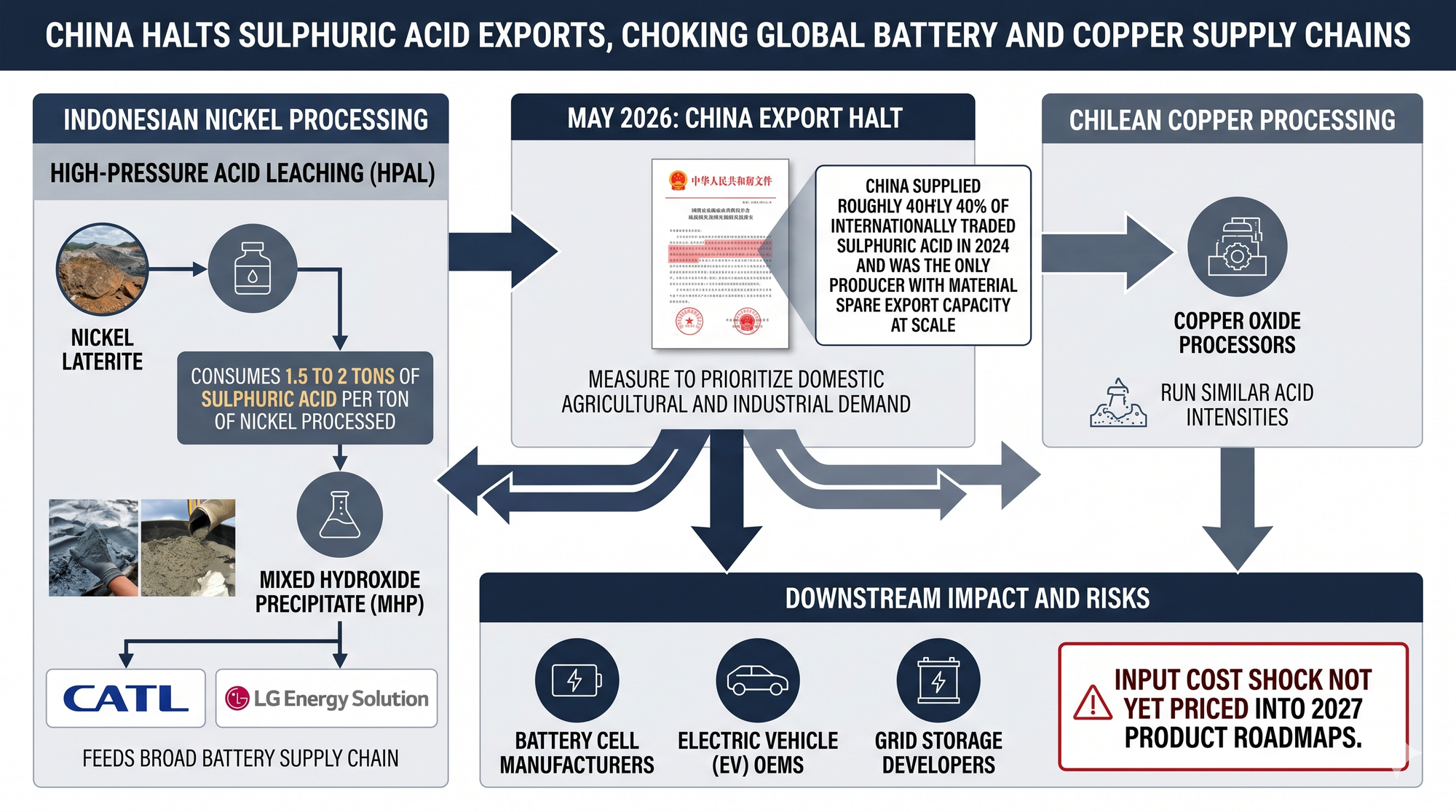
TL;DR: China halted sulphuric acid exports in May 2026 to prioritize domestic demand, choking the chemical input that Indonesian nickel and Chilean copper processors depend on. Sulphuric acid is the world's most-produced industrial chemical and sits on no strategic-materials watchlist, which is precisely why it has become an effective lever. Indonesian nickel processors, the most acid-dependent buyers in the global battery supply chain, began drawing on strategic inventories within days of the announcement.
Briefing: China's General Administration of Customs implemented export restrictions on sulphuric acid in early May, officially framing it as a measure to prioritize domestic agricultural and industrial demand. China supplied roughly 40% of internationally traded sulphuric acid in 2024 and was the only producer with spare export capacity at scale. Peter Harrisson, principal analyst at commodities research firm CRU, told Argus Media that the loss of Chinese trade cannot be replaced from other origins on a 12- to 18-month horizon. Spot prices in Chile rose 54% between late December 2025 and mid-April 2026, and Indonesian nickel processors began drawing on strategic inventories.
Beijing's move ripples across the entire battery supply chain. High-pressure acid leaching, a necessary step in the production of materials for top battery makers, consumes roughly 1.5 to 2 tons of sulphuric acid per ton of nickel processed. Indonesian nickel, one of the largest beneficiaries of the U.S. Inflation Reduction Act's tax credits for friendshoring projects that source critical minerals from countries with U.S. free trade agreements, relies on robust supplies of sulphuric acid. For its part, Beijing framed the export restriction as a domestic policy decision, not an export control, which leaves no World Trade Organization hook, no retaliation target, and no obvious diplomatic counter-move.
So What
For Executives: Battery cell manufacturers, electric vehicle original equipment manufacturers (OEMs), and grid storage developers with supply chains routed through Indonesian nickel face an input cost shock that is not yet priced into 2027 product roadmaps. Over the next 60 days, take a few steps. First, audit chemical input dependencies at least two tiers upstream of the named critical mineral. Lock in sulphuric acid offtake from non-Chinese producers (e.g. Morocco, Canada, Mexico) where capacity exists, even at premium prices. And build 60- to 90-day strategic inventories at the processor level. Companies that wait for the next Inflation Reduction Act guidance update before acting will be working against pricing that has already moved.
For Policy Makers: The export restriction reveals a gap in how the U.S. and allied governments define strategic materials. Critical-minerals watchlists at the Department of Energy, Department of War, and U.S. Geological Survey track 50 named minerals and metals. None of them track the chemical inputs that make those minerals usable. The pragmatic step is to expand strategic materials tracking to include the top 10 industrial chemicals whose absence would halt processing of any listed critical mineral. Sulphuric acid, hydrochloric acid, sodium hydroxide, and ammonia are the obvious candidates. The European Union Critical Raw Materials Act has the same gap. A coordinated U.S.-EU update to both frameworks within the next two quarters would close the most exposed window before Beijing applies the same logic to the next sub-strategic input.
For Investors: Three positions are worth examining. First, non-Chinese sulphuric acid producers with export capacity (Nutrien, Mosaic in North America; OCP in Morocco) face demand pull that is durable rather than cyclical and that the equity prices have not yet absorbed. Second, Indonesian nickel project equities (Vale Indonesia, Harita Nickel) face margin compression that consensus 2027 estimates do not yet reflect. Third, the friendshoring premium in battery supply chain equities, built on the assumption that non-Chinese sourcing reduces geopolitical risk, deserves a fresh look. If friendshoring routes still depend on Chinese chemical inputs, that premium is overstated. Position sizing should reflect that the next 60 days will reveal which downstream contracts have force majeure protection and which do not.
For Service Providers: The advisory opportunity sits in three places. First, audit supply chains for clients who do not currently track chemical inputs upstream of their named critical minerals. This is mechanical analysis that most procurement teams have not done. Second, review force majeure and contract terms for offtake agreements that might now be triggerable, particularly in the Indonesian nickel concentrate and Chilean copper cathode trades. Third, generate policy strategy for clients seeking Inflation Reduction Act tax credit qualification when their qualifying-country supply chain routes through a Chinese chemical input. This is an unsettled question, and the firms that frame it for Treasury guidance will help shape the answer.
The Data Middleman Economy
Twenty-one scraping firms become the unpriced supply chain for AI agents, with OpenAI, Amazon, and major publishers as customers.
TL;DR: Media industry analyst Matthew Scott Goldstein has documented at least 21 companies that scrape publisher content without paying for it and sell the resulting data services to clients including OpenAI, Amazon, and The Telegraph. The economics: 100% extraction, 0% paid back. The category is rebranding from "web scrapers" to "agentic infrastructure" without changing the underlying business model.
Briefing: Goldstein's report, summarized by Digiday in late April, identifies at least 21 firms, several with venture funding in the hundreds of millions, that systematically scrape publisher content and resell it as a data service. Named vendors include Firecrawl, Exa, Tavily, Brave, You.com, Perplexity Sonar, and Bright Data; TollBit's parallel index identifies nearly 40 such vendors. The customer base includes OpenAI, Amazon, and publishers such as The Telegraph who buy back access to content that originated, in some cases, from competitor publications. One publishing executive told Digiday the new vendors look like 50 startup demand-side platforms for content, except "they're taking a 100% fee."
The defining move is the rebrand. Web scraping has been an objectionable business model for years; legal and reputational pressure had been mounting against the category. The repositioning as "agentic infrastructure," the technical layer that allows autonomous AI agents to access live web content, is changing that. Industry analyst Pete Pachal flagged Parallel Web Systems as an example, arguing on LinkedIn that the underlying economics have not changed even as the enterprise pitch has improved. The rebrand brings venture capital, enterprise contracts, and AI-stack credibility to a business model that publishers had nearly succeeded in delegitimizing. Gartner projects 40% of enterprise applications will feature task-specific AI agents by year-end 2026, up from under 5% in 2025. Each of those agents consumes web content at machine speed, and the scraper-turned-infrastructure firms are positioning to supply it.
So What
For Executives: Publishers, media companies, and any business whose intellectual property lives on the open web need a current audit of where their content is being ingested by third-party scrapers and resold. Cloudflare and other infrastructure providers now offer copyright-protecting defaults, but most legacy publishing operations are not configured to use them. The window to license content to AI companies on commercial terms is closing as the scraper economy professionalizes and the legal precedent is shifting away from requiring proof of a specific instance of harm toward recognizing that scraping at industrial scale is itself the harm. Executives with content portfolios should be in licensing conversations now.
For Policy Makers: Copyright law was written for human-scale infringement and is being asked to govern machine-scale ingestion. The European Union's text and data mining exception under Article 4 of the Copyright Directive permits commercial AI training on copyrighted content unless rights-holders explicitly opt out, a default that reverses the U.S. fair-use ambiguity by giving publishers a clear mechanism to withhold consent. Congress has held hearings but no legislation has moved. The pragmatic intermediate step is requiring AI companies and data brokers to maintain auditable logs of training data sources, which would shift the burden of proof in litigation without requiring a wholesale rewrite of copyright statute. The Federal Trade Commission and the Copyright Office should coordinate on a joint guidance document by year-end.
For Investors: The data middleman category is venture-funded and exit-oriented; expect consolidation as the underlying legal risk increases. The defensible plays are firms that pay for licensed content (Reuters, Associated Press partnerships) or that own proprietary data flows the scrapers cannot replicate (Bloomberg, S&P, specialized financial data). The vulnerable plays are publisher equities whose digital business models depend on referral traffic from search and social, both of which are being eaten by AI-mediated discovery. Organic click-through rates on Google AI Overview queries are down 61% since mid-2024, with paid click-throughs down 68%.
For Service Providers: Three engagement types are available now. First, content audit and protection for media and information services clients, working with Cloudflare, DataDome, and similar infrastructure providers. Second, content licensing strategy for publishers negotiating with frontier model providers and data brokers, where the deal structure (one-time payment, ongoing royalty, training-data-specific licensing) is still being invented. Third, AI agent governance for enterprise clients who are deploying agents that consume third-party content and may inherit legal exposure they have not priced. The first two are obvious; the third is where the next 18 months of advisory revenue will come from.
Under the Radar
The deep analysis that connects the dots
The Nonstate Actor Loophole in the U.S.-China AI Safety Protocol
What the Beijing AI safety protocol carefully leaves out, and why both governments are content to leave it there.
THE CARVE-OUT
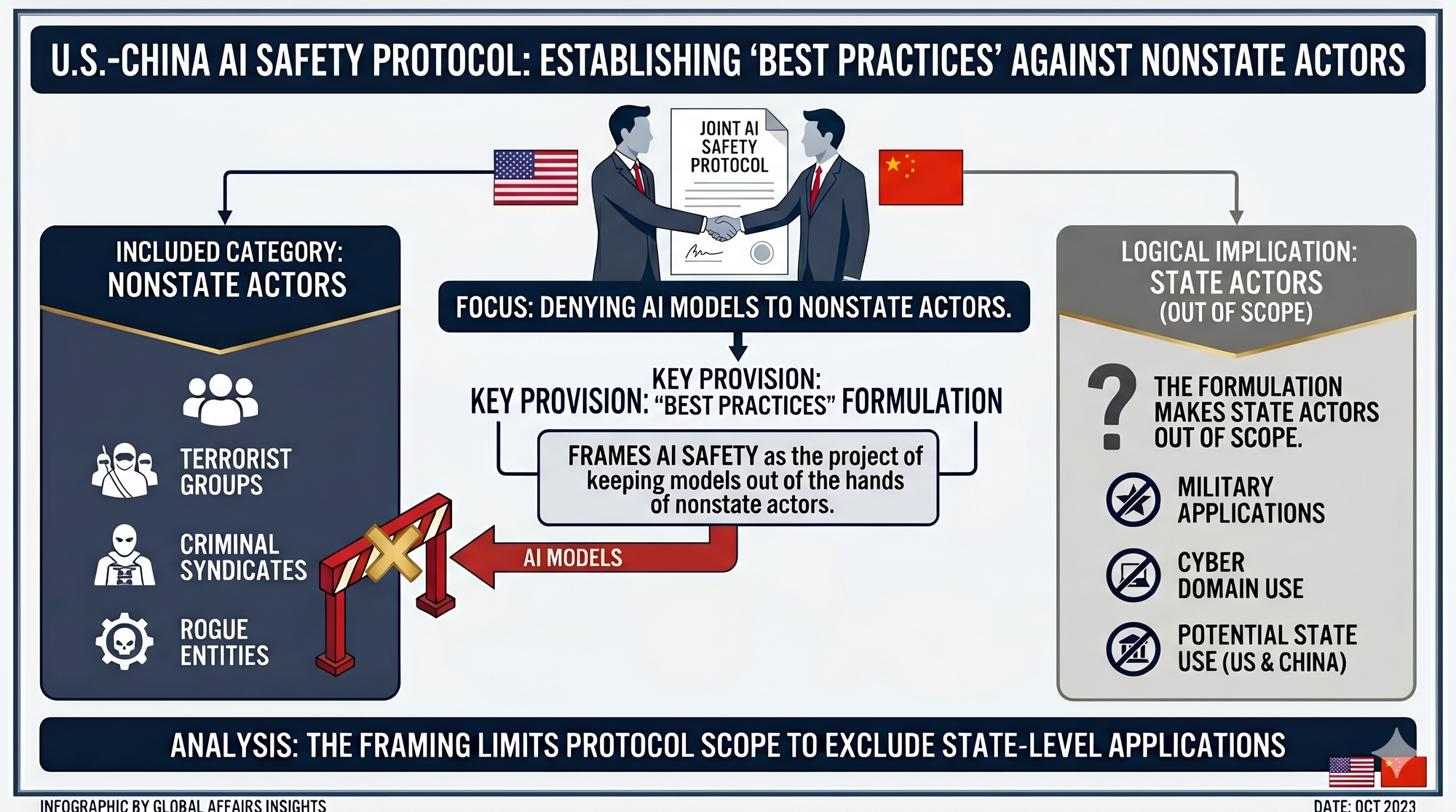
The Bessent formulation creates a category, nonstate actors, and frames AI safety in terms of barring their access to models. The logical implication is that state actors are out of scope. China's military AI applications, surveillance state deployments, and cyber operations are not part of the conversation. Neither are equivalent U.S. capabilities. Both governments have agreed, in effect, to talk about AI safety in a way that explicitly excludes the AI safety problem most directly relevant to great-power competition.
That carve-out is not accidental. The Council on Foreign Relations' Mike Froman, writing this week, observed that the AI safety track "does not seem to include a conversation about China's potential use of AI, including in the military or cyber domain." What Froman's framing misses is that the same point applies in reverse. Nothing in the protocol limits how the U.S. government uses domestic frontier models for similar purposes. The protocol is structured so that neither side has to give up anything it actually wants. If nuclear non-proliferation history has taught us anything, it is that reciprocity and verification on both sides are key to mutual trust.
WHY THE FRAMING MATTERS OPERATIONALLY
Three concrete consequences follow from the nonstate actor framing. First, the protocol is fully compatible with the Nvidia H200 deal. On May 14, Reuters reported that Washington had cleared sales of Nvidia H200 graphics processing units to approximately ten major Chinese technology firms, including Alibaba, Tencent, ByteDance, and JD.com. If the protocol's stated concern is criminal or terrorist misuse, then commercial chip sales to large Chinese technology firms sit outside its frame entirely, regardless of those firms' relationships with the Chinese state. The protocol does not address that question. Conveniently, no Chinese firm has yet taken delivery; Beijing appears to be discouraging purchases partly because the U.S. requires 25% of chip-sale revenues to flow to the U.S. Treasury. The chip deal is structured to be plausibly approved and plausibly stalled, which is also a feature, not a bug.
Second, the protocol implicitly legitimizes findings that should be uncomfortable for both governments. Researchers at the Center for Strategic and International Studies published analysis in February 2026 showing that China's Qwen2 model chose escalatory options in roughly 45% of foreign policy crisis scenarios across 66,473 simulated data points. The same study found that U.S. models including Meta's Llama 3.1 and Google's Gemini 1.5 Pro showed comparable escalatory tendencies, and that DeepSeek displayed similar hawkish patterns particularly when scenarios involved Western democracies. The CSIS authors, Benjamin Jensen and Yasir Atalan, argued ahead of the summit that shared AI benchmarking across U.S. and Chinese models should be a central agenda item, precisely because the escalation problem cuts across both countries' frontier models, not just China's. It was not on the agenda. The nonstate actor framing means it does not need to be.
Third, the protocol establishes Anthropic's Mythos model as the implicit threat template. Mythos located vulnerabilities in every major operating system and web browser, but Anthropic withheld the model from public release. The nonstate actor framing imagines this capability in the hands of a criminal group that would actively seek to exploit threats. It does not imagine the same capability in the hands of a state-level cybersecurity operations team that is vastly better resourced, has cleared internal review, and operates under the legal cover of national security. The protocol's central use case, preventing terrorist or criminal access to capable models, is the use case less likely to materialize at scale.
THE CORPORATE EXPOSURE
For companies running production systems on frontier models, the practical implication of the Beijing protocol is that the threat model published in policy documents will diverge further from the threat model that actually matters. Cybersecurity teams should plan for state-level adversaries using domestic and Chinese frontier capabilities against critical infrastructure, supply chain integrations, and customer-facing systems. The protocol does not constrain that activity, in either direction. Anthropic Chief Executive Dario Amodei estimated a six- to twelve-month window before Chinese AI models reach comparable cybersecurity capabilities. That window is the operational planning horizon, and it is shorter than the timeline for any meaningful protocol implementation.
The deeper question for executives, policy makers, investors, and service providers is whether the Beijing protocol is the beginning of a real AI safety regime or the end of one. The framing chosen is the same framing that has produced two decades of inconclusive talks about cyber norms between the same two governments. A working group that meets, generates white papers, and avoids the actual questions has a long precedent. This time, the actual questions are about whether the next generation of frontier models can be deployed by state actors against state targets without triggering the response infrastructure implied by the protocol. The answer, as currently written, is yes. Have we gotten one step closer to a non-proliferation regime between states or a Geneva-style convention bounding the legitimate use of AI in conflicts? That answer is clearly no.
Cambrian Partner By Invitation
Expert analysis from our global network
Stablecoins: New Twist on an Old Story
Stablecoins have attracted investors concerned about the volatility of other cryptocurrency types. With the passage of the GENIUS Act in the summer of 2025, these cryptocurrencies, which are linked to fiat currencies such as the U.S. dollar, gained significant support from the U.S. government. Treasury Secretary Scott Bessent argues that by promoting stablecoins linked to the U.S. dollar, he will indirectly increase the demand for U.S. Treasuries, lowering their yields in the face of rising fiscal deficits forecast due to the One Big Beautiful Bill Act.
Briefing
It’s a laudable goal, given that the country is running its largest fiscal deficits outside of wartime or its worst recessions. But is Mr. Bessent right? Will mainstreaming stablecoins improve the U.S. fiscal outlook? The story isn’t as straightforward as he lays out for two reasons.
The first reason centers on the concept of seigniorage, the economists’ term for the profit earned by issuers of currency (historically sovereigns). That profit arises from the difference between the value in goods and services that creating a unit of currency generates relative to the cost of its production. For example, printing a U.S. $100 note costs about $0.11 to produce, yet gains the Federal Reserve $100 worth of goods and services. That’s a margin any business would love to have.
Currency is a liability of the Federal Reserve, along with the reserve deposits banks keep at the Fed. Together, the two make up reserve money. The larger the increase in inflation-adjusted reserve money, the larger the real profits from seigniorage. While the Fed isn’t the U.S. Treasury, its profits are remitted to the Treasury. Hence, as its seigniorage increases, so also does the U.S. government’s revenues, which then lower the federal deficit.
By promoting stablecoins, the U.S. Treasury is shifting demand away from fiat currency and reserve money, thereby lessening seigniorage. The private issuers of stablecoins would be the ones who gain, tapping into those juicy margins. So why would the Treasury consider it? Some suggest that cryptocurrencies allow for faster, more efficient transactions that are not an option with U.S. dollars and the traditional banking system (e.g., transactions triggered via smart contracts). Of course, the Fed could facilitate such autonomous transactions by creating its own digital currency, and keeping seigniorage in its earnings, but that would shift profitable services away from commercial banks, shrinking their balance sheets and reducing the credit available to firms and households. The Fed could lend its mounting reserves back to commercial banks for their lending, but that could create a rat’s nest of political manipulation and a more centralized banking supervision framework. For Mr. Bessent and the U.S. Treasury, promoting stablecoins avoids those pitfalls in favor of an implicit assumption that the privatized seigniorage would flow back into higher demand for U.S. Treasuries by an amount greater than the government’s lost seigniorage.
So What
Assessing that argument is the second reason that mainstreaming stablecoins to support the U.S. fiscal outlook isn’t as straightforward as Mr. Bessent would suggest. Stablecoins must be backed at least one-to-one with U.S.-dollar assets, chiefly bank deposits, money market mutual funds (MMF), repurchase agreements with banks on high-quality assets, or short-dated U.S. Treasuries. Mr. Bessent’s argument succeeds if stablecoin issuers purchase enough Treasuries to offset any lost liabilities suffered by U.S. financial institutions, or if dollar-denominated stablecoins attract enough foreign inflows into U.S. financial institutions. However, history tells us that maintaining that environment is difficult over time, especially when governments’ fiscal positions weaken. In theory, so long as the assets surrendered by stablecoin issuers have a value equal to or greater than the value of stablecoin (i.e., the exchange rate is one for one), then the stablecoin will be safe. But the values of money market funds and bank deposits can fluctuate, as we saw during the global financial crisis. Furthermore, the mounting U.S. deficit and the associated increase in Treasury issuances would also jeopardize the value of stablecoins.
Counting on stablecoins to lessen the cost of financing the deficit misses the point. The viability of stablecoins, and of fiat dollars, depends on the U.S. lowering its primary deficit and boosting GDP growth. Without that, stablecoins will simply be a new twist on the old story of fiscal imbalance destabilizing economies.
About our partner
Dr. Don Hanna is a UC Berkeley professor with a professional background as a macroeconomic & market analyst with extensive experience advising some of the world's largest financial institutions, corporations and investors on events and outlooks in advanced and emerging markets, particularly in Asia.
About Cambrian

Cambrian Futures is a strategic foresight and advisory firm helping government, business, and technology leaders understand how emerging technologies intersect with geopolitics, markets, and national strategy. By combining rigorous research, AI-enabled analysis, and human expertise, Cambrian provides clear insight into global technology trends, risks, and power dynamics. Its work helps decision-makers anticipate disruption, manage uncertainty, and act with strategic confidence in an increasingly competitive GeoTech world.
PRODUCTION TEAM
GeoTech Radar is produced by the Cambrian Futures Insights Platform team:

CEO & Chief Analyst

Managing Director / Producer, Insights Platform

Global Lead, Smart Infrastructure Strategy

Research & Marketing Associate

Editor in Chief
Learn more about Cambrian Futures at cambrian.ai
Produced with

Human Led



Human Led +
AI Augmented




AI Led +
Human Verified


Cite as: Cambrian Futures (2026) 'GeoTech Radar Issue 20'