

The Kill Decision Is Already Autonomous, Tencent Rents Around the Chip Ban, and AI Sends Its Bills to the Gulf (Free Version)
INSIDE ISSUE 41:
GTR Terminal: Subscribers get full access to our live dashboard tracking the signals shaping the future. Your access link and password are one click away.
On the Radar
The signals affecting the GeoTech landscape this week
Tencent Rents the Chips It Cannot Buy
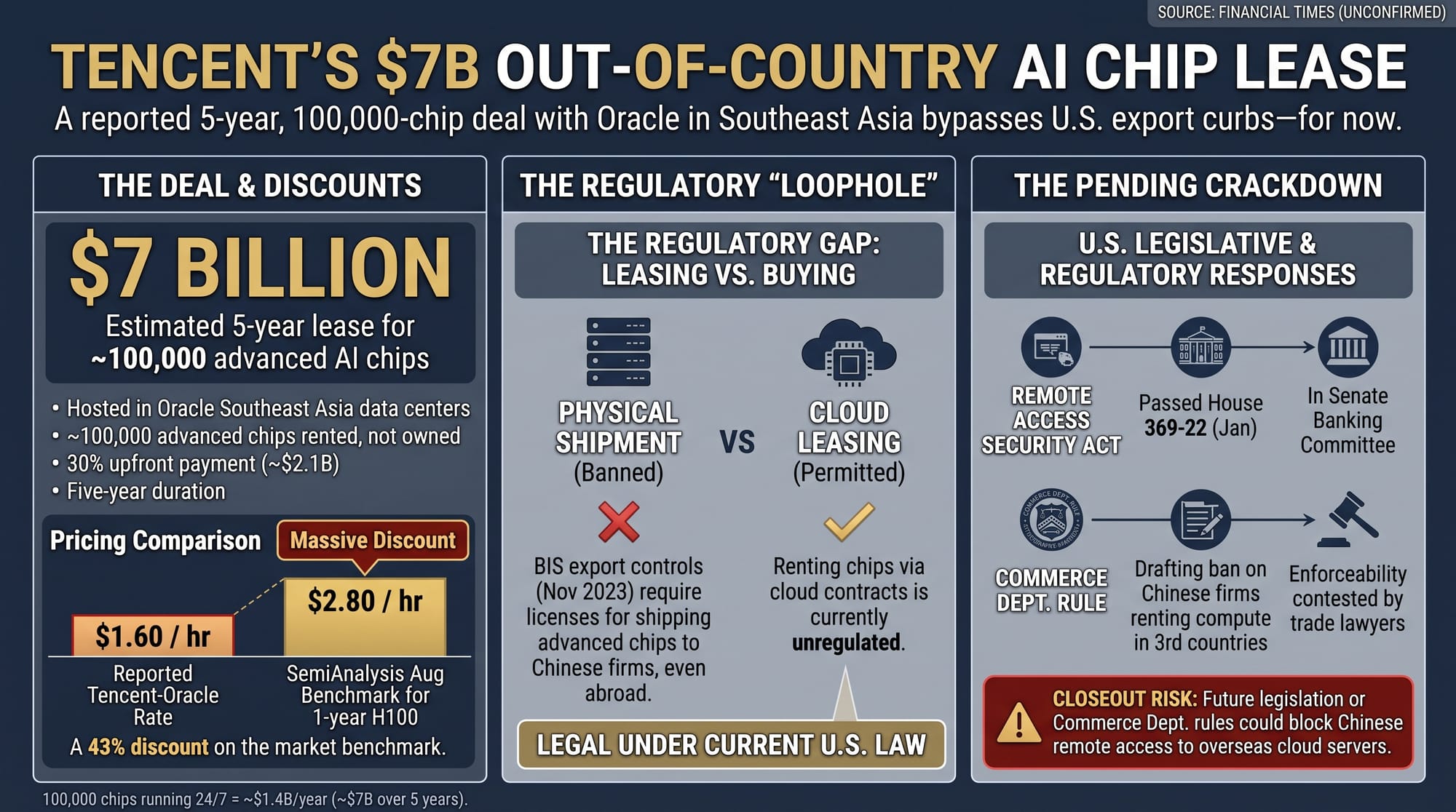
A reported $7 billion, five-year lease on 100,000 advanced chips in Oracle's Southeast Asia data centers turns the export-control loophole into a priced market.
BRIEFING: Tencent has agreed to rent time on roughly 100,000 advanced AI chips it cannot import into China, accessing the compute power from several Oracle data centers in Southeast Asia, according to a Financial Times report last week. While the FT reported the deal at five years and about $7 billion, roughly $1.60 per chip per hour, neither company has confirmed it. The price is about 43% below the $2.80 per hour SemiAnalysis benchmarked in August for an Nvidia H100 on a one-year contract. At that rate, by our calculation, 100,000 chips running around the clock cost about $1.4 billion a year, which matches the reported $7 billion over five years.
The lease is still legal. The Bureau of Industry and Security (BIS), the Commerce Department unit that runs export controls, has required licenses for physical shipments of advanced AI chips since November 2023, including to Chinese-headquartered firms abroad. However, renting the same chips through a cloud contract was left out of the restrictions. The Remote Access Security Act, which would regulate remote access to controlled computing, passed the House 369 to 22 in January but now sits in the Senate Banking Committee. The Information reports that Commerce is drafting a rule to block Chinese firms from renting compute in third countries, which one trade lawyer says cannot be enforced under current law.
SO WHAT
For Executives: If you buy or sell data center capacity in Southeast Asia, assume a U.S. remote-access rule arrives within a year. Audit colocation and cloud contracts for change-of-law clauses, require providers to disclose whether restricted-party tenants share the facility, and price the regulatory risk into anything multi-year. Hedge: The deal is reported and unconfirmed, and the Senate bill could stall, so anchor the review in contract clauses you control rather than a rule that might never arrive.
For Policy Makers: Renting these chips is legal today, and a U.S.-only ban would move the business to data centers in countries that do not apply U.S. rules. A rule that works has to be agreed with the governments whose data centers hold the chips. Start with Singapore, Malaysia, Thailand, and Indonesia: agree reporting thresholds for chip-hours sold to Chinese firms on U.S. restricted lists, and pair the reporting with incentives for those countries to host allied workloads. Hedge: Over-broad restrictions would push neutral hosts toward Chinese-financed facilities, so sequence incentives before prohibitions.
For Investors: A rental price 43% under benchmark is either a regulatory-risk discount or a sign Southeast Asia capacity is overbuilt. The durable position is the compliance layer, including compute brokers and cloud platforms that can prove who is renting what (a know-your-customer function for chips). Hedge: A single Commerce rule can strand rental revenue, so discount any operator whose order book leans on restricted-party demand.
For Service Providers: Clients hosting or selling compute in third countries need a restricted-party exposure review covering who rents the racks, what the contract says when a rule lands, and what fallback capacity costs. Build it on the House-passed bill text and existing BIS rules. Hedge: Advice keyed to the draft Commerce rule is premature, since the reported draft might not be enforceable under current law.