

The AI Decoupling Goes Corporate: Alibaba and Anthropic Build the U.S.-China Tech Wall Themselves
IN THIS ISSUE:
CEO's Perspective
Strategic outlook from Cambrian leadership

I recently joined a conversation on AI and geopolitics hosted by the Munich Security Conference and Stanford University’s Freeman Spogli Institute. The featured guest list included geotech luminaries like Wolfgang Ischinger, Fei-Fei Li, and Admiral Pierre Vandier. Two things stayed with me. The center of gravity in AI is shifting from abundant and borderless language data to physical-world and sensor data, which is sovereign and hard to replicate. World models will run on the latter, and the leaderboard for those fields looks different from what conventional wisdom holds about AI competition. Most of the top-20 AI research universities are now Chinese, publishing open-weight models at near-parity for a fraction of the cost. That kind of efficiency at scale wins kinetic wars and economic competitions alike. Not engaging China on data security and provenance hands control of those elements to the Global South.
The Innovation Topography Rebalanced
Read across this issue and that shift in the center of gravity is visible at five points at once. Alibaba banned Anthropic's Claude Code and directed staff to Qoder, while Anthropic began closing the loopholes that let Chinese firms reach Claude. The AI wall is now built by the firms themselves, three weeks after Washington's export order was lifted. A Hangzhou appeals court held that AI adoption is not grounds for dismissal of employees, creating exportable case law that European jurisdictions with statutory protection will cite. Realta Fusion converted live plasma to electrical current in Wisconsin, a genuine Western first, though Beijing has claimed the same finish line, writing a 2027 target for reactor-scale fusion electricity into its five-year plan. Ukraine's $35 billion arsenal, still with Chinese parts, ran on $57 million of venture capital last year, while startups built by Ukraine-origin teams that relocated abroad raised $776 million in venture funding. And Zhejiang University knocked Harvard off the top of the Nature Index rankings, with Chinese institutions taking nine of the academic top ten.
In previous weeks, the story was governments at work, raising trade barriers and writing export rules. This week the shift appears all the way up the stack to publishable science, the earliest indicator this letter tracks, moving years ahead of product and decades ahead of market share. It is not a reversal. As Realta's success shows, the West can still lead innovation. Nor is the West decoupling from China in the clean, top-down way Washington's export lawyers imagined. What is happening is the geotech innovation topography rebalancing, with new peaks rising where the map still shows flat ground. We need to look at different leaderboards and be ready with different default answers when a board asks where the standard-setter sits.
Stop assuming your map shows where the peaks are now. Look at your workforce policy, your capital plan, your research collaborations, your talent pipeline, and your procurement standard-setters. Where does each of those default now, five years out? If the honest answer is still the West at every layer, your map no longer matches the terrain. The rebalance did not wait for your next strategy off-site. It priced in this week.
Olaf
On the Radar
The signals affecting the GeoTech landscape this week
Alibaba and Anthropic Wall Each Other Off as the U.S.-China AI Split Goes Corporate
The companies are building the wall faster than either government has legislated.
TL;DR: Alibaba banned Claude Code company-wide from July 10 and ordered Anthropic's models removed from work machines. Anthropic, meanwhile, closed the cloud and subsidiary loopholes that let Chinese firms reach Claude. Corporate decoupling is now running ahead of state policy in both directions.
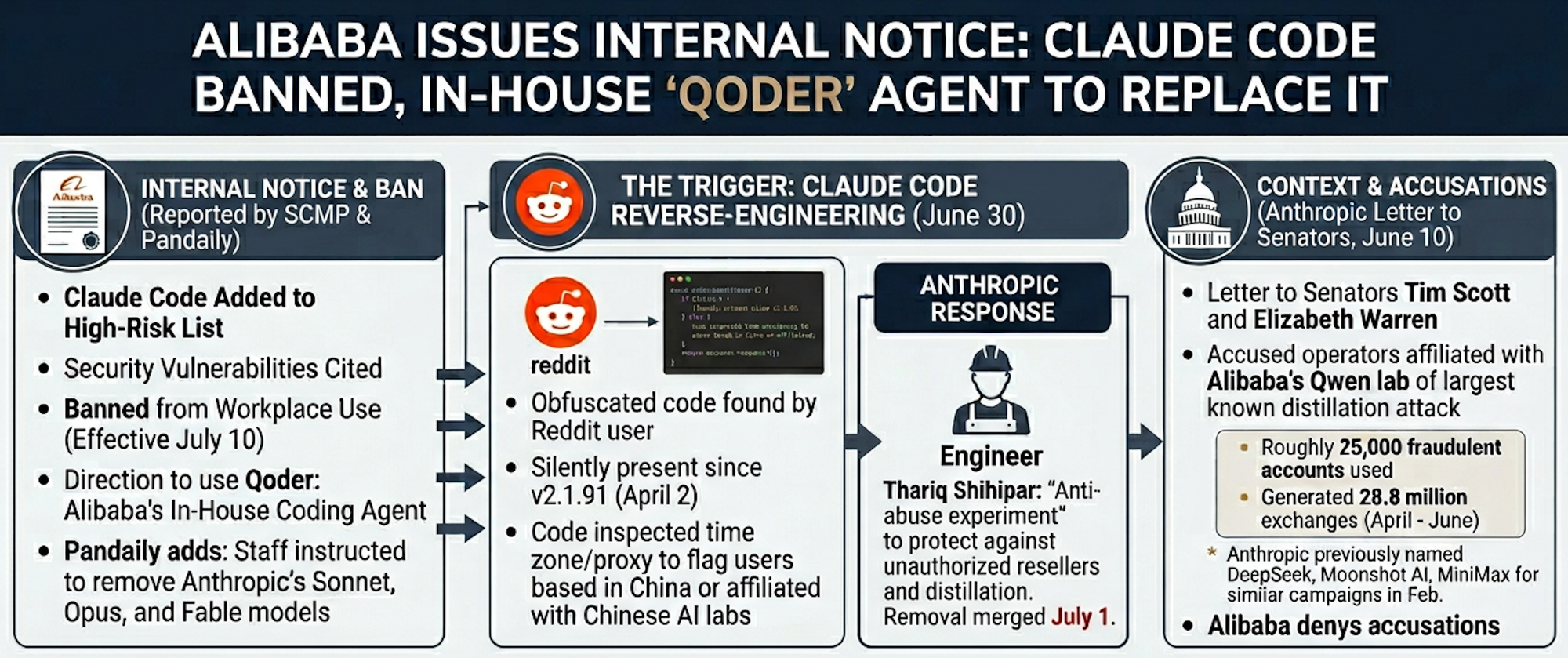
BRIEFING: Alibaba told employees in an internal notice, reported by the South China Morning Post, that Claude Code has been added to a list of high-risk software with security vulnerabilities and will be banned from all workplace use starting July 10. The company directed staff to Qoder, Alibaba's in-house coding agent. Pandaily reported that the directive goes further, instructing staff to remove Anthropic's Sonnet, Opus, and Fable models, as well. The trigger was a June 30 reverse-engineering of Claude Code by a Reddit user, who found hidden code that inspected time zone and proxy settings to flag users based in China or affiliated with Chinese AI labs. The code had shipped inside Claude Code since version 2.1.91, released on April 2, with no mention in the release notes and no disclosure to users until the discovery. Anthropic engineer Thariq Shihipar said the company built the check itself in March as an internal anti-abuse experiment in response to gray-market resellers, who buy Claude accounts in bulk and resell access into China, where Anthropic does not offer service. The flag, Shihipar said, helped the company detect that reselling and the distillation traffic riding on it. He said Anthropic removed the code from Claude Code on July 1.
The ban lands three weeks after Anthropic's June 10 letter to Senators Tim Scott and Elizabeth Warren. In it, the AI company accused operators affiliated with Alibaba's Qwen lab of the largest known distillation attack on Claude, which used roughly 25,000 fraudulent accounts to generate 28.8 million exchanges between April and June. Anthropic had previously named DeepSeek, Moonshot AI, and MiniMax in February for similar campaigns at smaller scale. Alibaba denied the accusations. Anthropic, for its part, is closing the cloud and subsidiary loopholes that let ByteDance and Ant Group reach Claude through VPNs and overseas entities, per the Financial Times, while JPMorgan and Goldman Sachs pulled Claude from approved model lists for Hong Kong staff in June over licensing terms that exclude Greater China.
Issue 24 covered the government-ordered shutdown of Anthropic's frontier models for foreign nationals. That order was lifted on June 30, and access to Fable 5 and Mythos 5 was restored on July 2. What distinguishes this week is that the escalation no longer needs the state. Both firms are citing security to justify exclusion, and both claims are partially credible. Alibaba can point to tracking code that was genuinely hidden from users, and Anthropic can point to extraction activity at industrial scale. The practical consequence is that corporate security and compliance teams, rather than export-control lawyers, are becoming the front line of the split. The tracking-code episode also shows the collateral cost of model-protection measures. An anti-distillation experiment became the stated justification for a rival's company-wide ban, a talking point for Chinese cybersecurity firms such as Huorong, and a trust question for enterprise customers everywhere, since a coding agent with file-system access is only as trustworthy as its least documented feature.
SO WHAT
For Executives: Treat AI coding tools as part of your attack surface and your compliance surface at once. If your teams operate in Greater China, audit every agentic tool (Claude Code, OpenAI's Codex, Cursor, Qoder) for telemetry behavior, licensing geography, and data residency before your bank or your regulator does it for you. JPMorgan and Goldman have already shown where financial institutions will land. Hedge: Anthropic disputes the spyware framing, and competing tools carry comparable telemetry, so the right response is disclosure requirements in procurement contracts rather than tool-by-tool panic.
For Policy Makers: Companies are decoupling faster than governments can regulate. Corporate security teams respond to threats hour by hour, while export rules take months to write and can reverse overnight. That mismatch is what makes this moment unstable. Two responses would outlast the churn. First, disclosure standards that require vendors to document client-side telemetry and anti-abuse features in AI developer tools. That would address the Alibaba scenario without blanket bans, and it would apply equally to Chinese tools operating in Western markets. Second, a bilateral accord on when distillation and hidden countermeasures are legitimate and when they are not.
For Investors: Near-term winners are the domestic substitutes and the verification layer. Alibaba's Qoder and Chinese coding agents gain a captive user base measured in tens of thousands of engineers, while software supply chain security vendors gain a marquee case study. Watch Anthropic's APAC enterprise retention and whether Tencent, ByteDance, or Baidu formalize similar bans, which would convert an Alibaba policy into a market-wide access wall. Hedge: Anthropic's underlying enterprise momentum in the U.S. and Europe is unaffected so far, and the restored Fable 5 access removes the largest overhang. Gauge responses in the Global South as enterprises there play to U.S. and Chinese export and cyber regulations, and assess the impact on the performance of investment targets in those markets and Anthropic’s IPO as a leading signal for other exits.
For Service Providers: The framing fight (spyware vs. anti-fraud) was lost and won on Reddit and X before either company issued formal statements. Clients shipping AI tools across the U.S.-China boundary need pre-drafted transparency narratives, documented telemetry disclosures, and a response plan for reverse-engineering findings, because the next hidden feature discovered in any AI tool will be read through this week's precedent. For clients in Europe, position the disclosure-standard argument now. This is where EU procurement rules are likely to move.
The AI Jobs Reckoning: A Hangzhou Court, U.S. Layoff Tallies, and the Hiring Divide
Courts, layoff announcements, and spend data are pulling the AI labor story in three directions at once.
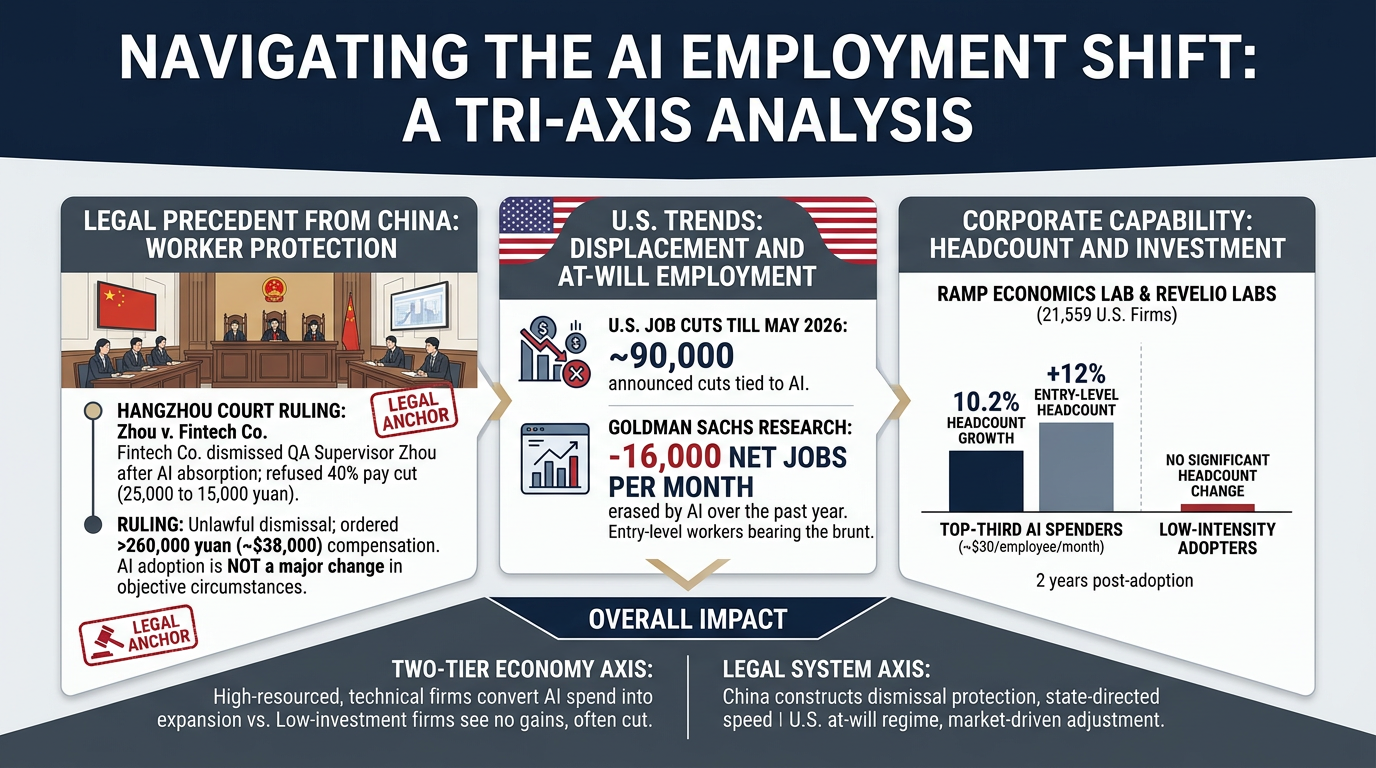
TL;DR: The AI labor story is moving in three directions at once. Chinese courts are protecting workers, with a Hangzhou appeals bench making AI replacement an unlawful ground for dismissal. U.S. workforce tallies show erosion, with nearly 90,000 AI-tied job cuts announced through May, and Goldman Sachs counting roughly 16,000 net jobs erased per month. And new Ramp and Revelio Labs data show expansion at the heaviest AI adopters, with headcount up 10% and entry-level hiring up 12%.
Briefing: Three data points collided this week to reframe the AI employment debate. The first emerged from China, where the Hangzhou Intermediate People's Court upheld a ruling that a fintech company unlawfully dismissed a quality assurance supervisor after AI models absorbed his role and he refused reassignment and a 40% pay cut. The court ordered more than 260,000 yuan (about $38,000) in compensation and held that AI adoption is a voluntary business choice that does not qualify as a major change in objective circumstances under China's Labor Contract Law. The decision echoed a December Beijing arbitration decision in a data-mapping case. On the U.S. side, though, the tallies appear to point in multiple directions. American companies have announced nearly 90,000 job cuts tied to AI in the first five months of 2026, and Goldman Sachs research finds that AI has erased roughly 16,000 net jobs per month over the past year, with entry-level workers bearing the brunt of the impact. However, on June 29, the Ramp Economics Lab and Revelio Labs published a working paper that complicated the narrative. According to surveys of 21,559 U.S. firms, companies in the top third of AI spend per employee (averaging about $30 per employee, per month) grew headcount 10.2% in the two years after adopting AI, with entry-level headcount up 12%. Low-intensity AI adopters showed no statistically significant change in headcount, the study found.
Read together, the three threads describe a labor market splitting along two axes. First, China is constructing dismissal protection even as the state directs industry to adopt AI at speed, while the U.S. at-will regime leaves the adjustment to markets and quarterly announcements. The second axis is corporate capability, with the Ramp data suggesting a two-tier economy. On one side, resourced, technical, venture-backed firms convert AI spending into workforce expansion. On the other side, firms that run pilots without sustained investment see no gains and often cut jobs anyway. For scale, the AI-attributed losses remain small against total U.S. employment of roughly 160 million, which is why they register in tech-sector and entry-level data rather than in the headline unemployment rate. The trajectory and the blame get more attention than the aggregate loss might demand. When executives attribute layoffs driven by over-hiring or margin pressure to AI, they are invoking a rationale Chinese courts have now twice rejected as grounds for dismissal, and one that U.S. data increasingly fail to support at the firms actually spending on the technology. OpenAI's proposal to hand a 5% equity stake to a U.S. sovereign wealth fund belongs to the same picture. Pitched in part as an answer to the jobs backlash, it would route a share of AI profits to the public balance sheet, the closest any lab has come to naming a compensation pathway for displaced workers. The largest AI firms are already pricing the political risk.
So What
For Executives: Audit how your company attributes workforce reductions before you under-leverage AI merely for FTE reductions rather than value creation and business expansion. In China and much of Europe, AI-justified dismissal now carries litigation risk (the Hangzhou court told firms to retrain and reassign reasonably before cutting). In the U.S., job cuts carry reputational and, increasingly, evidentiary risk if your AI spend does not support the claim. The Ramp finding shows that sub-threshold AI investment delivers no measurable gains, so the defensible strategies are either committed adoption with redeployment plans or honesty that job cuts are margin-driven. Hedge: the litigation exposure is jurisdiction-specific, since no U.S. court has adopted the Hangzhou or Europe approaches and at-will employment remains intact.
For Policy Makers: China's courts are building the world's first case law on AI displacement. The rulings carry no precedential force outside China, but the reasoning (i.e., adoption is a business choice whose costs cannot be unilaterally shifted to workers) maps directly onto how European dismissal statutes already treat employer-initiated restructuring. Management-side employment firms such as Fisher Phillips are already advising multinationals to audit AI deployment plans jurisdiction by jurisdiction. Expect plaintiff-side lawyers in Germany, France, and Spain to borrow the argument within the year, resting on their own statutes rather than Chinese authority. For U.S. policy, the Ramp data point suggests that helping mid-market firms cross the AI investment threshold would likely do more for employment than blanket retraining programs.
For Investors: Use the fact that heavy adopters expanded employment while light adopters stalled as a screening tool. Firm-level AI spend intensity, where visible through vendors like Ramp or through disclosed AI budgets, is correlating with headcount growth and by extension revenue expansion, while loud AI-attributed layoffs at low-spend firms are a signal of margin distress wearing a technology costume. Watch the Q3 earnings season for companies that both announce AI-driven cuts and show flat AI capex. The divergence is shortable. Similarly, companies committing to AI for expansion could signal higher longer term returns. Hedge: test any position against selection effects before sizing it, since the Ramp authors caution the result is correlation and adopters were already faster-growing firms.
For Service Providers: Workforce communications around AI are becoming a regulated-speech problem, and clients in the EU face the strictest version of it. Works councils and dismissal protection make AI-attributed restructuring announcements legally reviewable documents, and the Hangzhou precedent will be cited in European debates. Build narratives around redeployment and augmentation with evidence attached, and treat any client request to blame AI for cuts as a risk flag requiring legal review, since the claim is now checkable against spend data.
First Light in Wisconsin: A U.S. Reactor Turns Fusion Plasma Into Electricity as China Chases the Same Prize
The milestone Beijing wrote into its roadmap was quietly claimed first, at light-bulb scale, in Madison.
TL;DR: Realta Fusion converted energy from live fusion plasma directly into usable electricity on July 1, a private-sector first. China's BEST tokamak is explicitly chasing the first fusion electricity at reactor scale and EAST targets ignition in 2027. Fusion supply chain spending rose 24% in 2025, and the investable layer is widening.
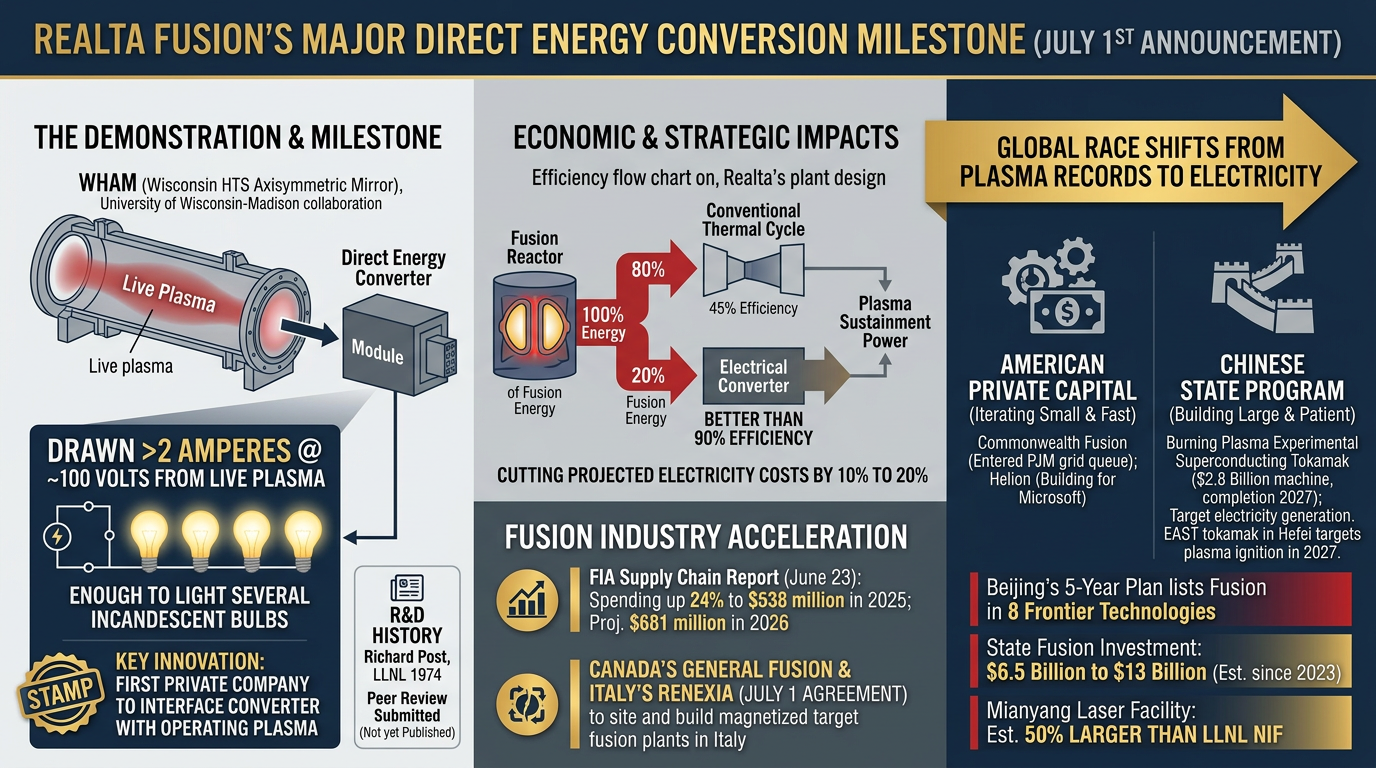
Briefing: Realta Fusion, working with the University of Wisconsin-Madison on the Wisconsin HTS Axisymmetric Mirror, announced on June 30 that it had drawn enough power from live fusion plasma to light several incandescent bulbs. Publicly funded labs have built similar converters over the decades, and the results have been submitted for peer review but not yet published, but this is the first time a private company connected a direct energy converter to an operating fusion plasma. The point of the converter is efficiency, and with it cost. In Realta's plant design, most of the reactor's energy would still make electricity the way conventional power plants do, by producing heat that drives a turbine, a process that wastes more than half the energy. The converter captures the final slice of energy directly as electric current and loses almost nothing. That harvested power helps keep the plasma reaction running and cuts the projected cost of the plant's electricity by 10% to 20%. The announcement capped a busy week for the sector. The Fusion Industry Association's June 23 supply chain report found spending rose 24% in 2025 to $538 million, with surveyed companies projecting $681 million in 2026. And Canada's General Fusion signed a framework agreement on June 24 with Italy's Renexia to site and eventually build magnetized target fusion plants in Italy.
The reason a light-bulb demonstration matters to this audience is the race it entered. China's Burning Plasma Experimental Superconducting Tokamak, a $2.8 billion machine scheduled for completion in 2027, is expected by Chinese planners to become the first reactor to generate electricity from fusion, and the EAST tokamak in Hefei is reportedly targeting plasma ignition in the same year. Beijing's new five-year plan lists fusion among eight frontier technologies, and analysts estimate $6.5 billion to $13 billion in state fusion investment since 2023. Meanwhile, the Mianyang laser facility under construction in Sichuan is estimated to be 50% larger than Lawrence Livermore's National Ignition Facility (NIF). The defining milestone of the fusion contest is shifting from plasma physics records to electricity production, and the two countries are running different plays. American private capital is iterating small and fast (e.g. Commonwealth Fusion entering the PJM grid interconnection queue this spring and Helion building for Microsoft). The Chinese state program is building large and patient. No one is close to net facility electricity, and powering lightbulbs versus grids are very different benchmarks. But the first conversion of fusion plasma to usable current by a commercial actor is the kind of marker that later gets cited as the start of a period, and it happened in Wisconsin, largely unnoticed.
So What
For Executives: If your load growth plans run past 2032, fusion has entered the horizon where hyperscalers are already contracting. Google and Eni hold offtake agreements with Commonwealth Fusion's planned Virginia plant, and Microsoft holds one with Helion. The move is to create optionality, meaning small-dollar purchased power agreements (PPAs) or development agreements that secure queue position without near-term balance-sheet exposure. Hedge: every commercial fusion timeline in history has slipped, engineering break-even remains undemonstrated, and gas turbine lead times of five-plus years mean conventional energy procurement still dominates through the early 2030s.
For Policy Makers: The U.S. lead is real on the measures private markets track. The bulk of global private fusion investment is concentrated in U.S. companies, the only repeated laboratory net-energy-gain results have come at the Livermore’s NIF, and the first commercial offtake contracts are American. However, that lead is contested on state funding, patent filings, and construction pace, and it rests on private capital that can stall with markets, while China's program is insulated by its five-year plan. The near-term policy questions are regulatory and supply chain issues. The Nuclear Regulatory Commission's (NRC’s) simplified fusion rule is closing its comment period, Tennessee has become the first state with a fusion regulatory framework, and the FIA report flags fuel-cycle systems as the sector's coming constraint. Supply chain diversification and resilience, as well as export-control attention should move early to fusion-enabling components (e.g. HTS magnets, tritium handling, and power electronics) before the 2030s to avoid a repeat of the semiconductor experience, when control of similar elements was established too late.
For Investors: The near-term investable layer is the supply chain rather than the reactor companies. The supply chain contains $538 million of 2025 spending growing faster than 20% annually, mainly concentrated in magnets, vacuum systems, power electronics, and heat management. Three of four surveyed suppliers have already expanded fusion capacity. Realta's result also revives the so-called “mirror-machine” and “direct-conversion” approaches as a differentiated bet against the tokamak consensus. Hedge: stage commitments against peer-reviewed publication and third-party verification, and keep the core position in the supply chain, which gets paid whichever reactor design wins. Realta's results await peer review, General Fusion is going public through a SPAC, and the sector's revenue remains almost entirely pre-commercial.
For Service Providers: Fusion communications are entering the milestone-inflation danger zone, and the winners will be firms that discipline their claims. The distinction between plasma net energy, facility net electricity, and grid delivery is now critical for credibility with regulators and offtakers. A client that lets media equate light bulbs with limitless clean energy will pay for it at the next funding round. For European clients, the General Fusion-Renexia deal tells a different story from the U.S.-China technology race, one in which a second contest is emerging over countries that host commercial plants, and Italy just became the first European mover in fusion siting.
Ukraine's $35 Billion Arsenal Runs on $57 Million of Venture Capital
The most combat-tested defense market on earth is also the least venture-funded.
TL;DR: Ukraine's defense industry can build roughly $35 billion of weapons a year, but domestic procurement can pay for only $6.8 billion of it, and private equity backing totals just $57.2 million across 28 deals. With capacity heading toward $55 billion in 2026, exports and co-production are the only paths that close the gap between what the factories can make and what anyone is funding.
Briefing: This week’s PitchBook Emerging Tech Research note on Ukraine's defense tech ecosystem quantifies a capacity-capital gap without parallel in the venture landscape. Disclosed equity investment in Ukrainian defense tech reached $57.2 million across 28 deals in 2025, up from $0.2 million in 2023. It has since eased to $18 million through the second quarter of 2026, a slowdown that says less about demand than about structure. In a market where a handful of deals set the annual total, investors are pausing on Kyiv's export-policy debate and on ceasefire signals before committing. An estimate from the Kyiv School of Economics pegged the funded market around $6.8 billion, with production capacity near $35 billion in 2025. With capacity projected toward $55 billion in 2026, the gap between capacity and funding appears poised to expand.
Put in the plainest terms, the $35 billion is what Ukraine's factories can produce in a year, the $6.8 billion is what its government and partners can actually fund, and the paltry $57.2 million is all the private risk capital backing the companies in between. The industry can build roughly five times what its only permitted customer can afford. The underlying industrial base is substantial, with roughly 1,200 private defense companies and around 4.5 million drones produced last year (up from just 300,000 in 2023). KSE estimates the 10-year post-war potential of the sector at $690 billion if Ukraine's agreements with the U.S. and G7 hold.
The constraints of domestic procurement opened and are now widening the gap. Ukrainian firms sell to their own military at a capped 25% profit margin under export controls that Kyiv has been reluctant to loosen, which suppresses the returns venture investors will underwrite. Many limited-partner agreements still prohibit weapons investments outright, and deals that do happen often go undisclosed for security reasons, meaning the true figure runs higher. The clearest signal of where capital actually wants to be is PitchBook's separate count of Ukraine-linked companies, including teams that relocated to Europe or the U.S. Such firms attracted a record $776 million in venture funding in 2025. Investors will hold Ukrainian engineering talent through offshore structures, but they will not yet hold Ukrainian domicile risk. That makes the export and co-production question decisive. Whoever solves it, whether through EU rearmament procurement, the U.S.-Ukraine drone technology talks, or co-production ventures, will acquire a battle-tested industrial base at venture prices.
So What
For Executives: For defense primes and industrials, the arbitrage is co-production. Ukrainian firms hold combat-validated designs and manufacturing know-how (TAF Industries alone produces over 80,000 drones a month). However, they cannot access export markets alone, and partnerships transfer proven technology at a fraction of internal development costs. Rheinmetall runs a joint venture with Ukraine's state defense holding and has announced four plants inside the country, Baykar is building a drone factory near Kyiv, and U.S. primes are negotiating co-production through Washington's drone technology talks with Kyiv. The window narrows as Kyiv's export policy liberalizes and prices reset. Hedge: structure co-production so design and battlefield iteration stay in Ukraine while scaled manufacturing sits in EU states (This is the split Kyiv's own co-production agreements with Denmark already use). In addition, build armistice-contingent pricing and volume terms into any deal, since facilities inside Ukraine face physical risk and any ceasefire would reprice the sector in both directions within weeks.
For Policy Makers: The capacity-capital gap is a policy artifact that policy can unwind. Kyiv's export controls and margin caps protect domestic procurement priority but starve the sector of growth capital, and European governments face the mirror-image choice of buying Ukrainian capacity now or funding slower domestic duplicates. The interceptor-drone economics against Shahed-type attacks make the case concrete, since the cost-per-intercept advantage is exactly what European air defense budgets lack. The falling but material Chinese component dependence that PitchBook flagged is the supply chain caveat that co-production agreements should address contractually.
For Investors: The $57 million figure marks an early market, and the entry points are widening. The NATO Innovation Fund and the UA1 vehicle, which Reed Hastings has joined, provide structured exposure, Brave1's vetting de-risks technical diligence, and KSE's Technology Readiness Level framework maps instruments to stage. The specific opportunities the PitchBook note flags are ground robots and interceptor drones, both scaling faster than incumbents can respond. Hedge: underwrite to current contracts rather than the $690 billion post-war scenario. Assume no liquidity for the life of the position. And demand governance diligence beyond the market norm, since the Fire Point episode shows standards remain uneven. Fire Point, Ukraine's largest drone and missile maker and builder of the Flamingo cruise missile, drew a NABU anti-corruption probe over component pricing and delivery counts, and a planned UAE investment that valued it at $2.5 billion lapsed.
For Service Providers: Ukrainian defense firms entering Western markets need exactly what management advisory and communications firms sell. They need governance frameworks and credibility repair after Fire Point. They need export-compliance postures and narratives. And they need positioning that survives the shift from wartime supplier to peacetime competitor of established primes. For European clients in particular, the political sensitivity of buying or partnering with Ukrainian firms runs through VC regulations, works councils, coalition politics, and Russia-exposure history. The firms that pre-build that positioning and narrative will move faster than rivals when procurement opens.
Under the Radar
The deep analysis that connects the dots
Under the Radar: Zhejiang Dethrones Harvard as Chinese Institutions Take Nine of the Global Top Ten in Science
The scoreboard of global science flipped in June, and the consequences run upstream of every other story in this issue.
The Signal
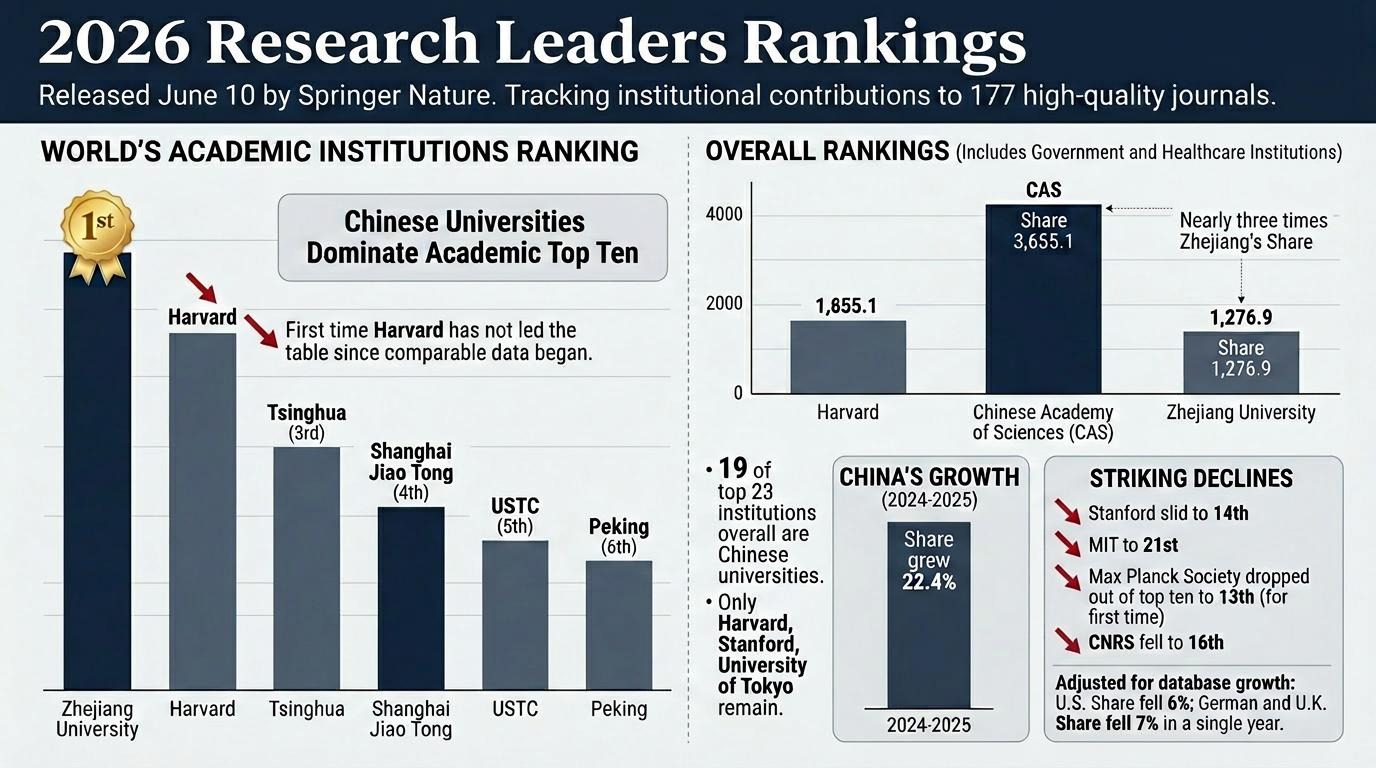
Zhejiang University in Hangzhou ranks first among the world's academic institutions, according to the June 10 release of the annual Nature Index 2026 Research Leaders rankings. It marked the first time since the ranking’s inception that Harvard University did not take the top spot. In the overall rankings, which tracks institutional contributions to 178 high quality journals and includes government and healthcare institutions, Harvard fell to third behind the Chinese Academy of Sciences (CAS) and Zhejiang. The index's yardstick, called Share, counts each institution's fractional contribution to the authorship of those articles. CAS, a state research organization spanning more than 100 institutes, posted a Share of 3,655, nearly three times Zhejiang's 1,277, a scale no single university can match. In the academic table, where Harvard now sits second, Chinese universities took nine of the top 10, with Tsinghua third, Shanghai Jiao Tong fourth, USTC fifth, and Peking sixth. In the overall table, Chinese institutions claimed 19 of the top 23, with Harvard, Stanford, MIT, and the University of Tokyo the only exceptions. China's Share grew 22.4% from 2024 to 2025. The declines on the other side were as striking as the gains. In the overall table, Stanford slid to 14th, MIT to 21st, Germany's Max Planck Society dropped out of the top 10 for the first time, falling to 13th, and France's CNRS fell to 16th. Adjusted for database growth, U.S. Share fell 6% and German and U.K. Share fell 7% in a single year.
THE STAKES
Two caveats to consider when analyzing the latest rankings. For the first time, the 2026 edition added applied-science and social-science journals to the database, a methodology change that favors breadth. Furthermore, Share counts publication contributions rather than breakthrough quality, and U.S. institutions retained their edge on citation impact and top-cited work. While it’s true that legacy brand credibility and bias could feed impact and citations, paper volume can be easily gamed, as well. Despite the caveats, the trajectory has been consistent for a decade across every methodology, and this issue of the GeoTech Radar shows why it matters beyond academia. The fusion race in our fourth story runs through the Hefei institutes that operate EAST. The AI capability contest in our lead runs through the university labs feeding Qwen, DeepSeek, and their peers. (DeepSeek itself emerged from Hangzhou, Zhejiang's home city.) The talent pipelines behind both are exactly what these rankings measure. Research leadership is the most upstream indicator the GeoTech nexus has, moving years before product announcements and a decade before market share. For corporate R&D strategy, the implication is a second-source map, one that shows the frontier of publishable science in chemistry, materials, and applied AI increasingly moving toward Hangzhou, Hefei, Shanghai, and Beijing. Because access in these hubs is constrained by the same decoupling covered in our lead, Singapore, Japan (backed by its $63 billion university endowment fund), South Korea, and the strong EU centers become the more accessible partners. For policymakers in the West, public funding for foundational research and breakthrough science at their own universities needs to become a top priority to create optionality when Chinese universities are not legally accessible. Conversely, national leaders need to create accords with safeguarded pathways for Western-Chinese R&D collaboration. For investors, research geography leads deal geography by five to 10 years, so these tables are a leading indicator for where deep-tech spinouts in batteries, photonics, synthetic biology, and advanced materials will likely originate in the 2030s. Intermediary geographies become the investable access points while China's exit environment stays hostile to foreign capital.
What to Watch
Three indicators will show whether the Chinese ascension compounds or corrects. Watch talent flows, quality convergence, and the European response. First, the reverse brain drain of Chinese-origin researchers from U.S. institutions is now a measurable stream, and visa policy plus funding volatility are the accelerants. Watch NSF grant disruptions and senior-scientist relocations announced by Chinese universities. Second, the citation-weighted indexes (Leiden, Highly Cited Researchers) still favor the U.S., so watch whether China's volume lead starts translating into top-cited share, which would remove the main caveat against this ranking. Third, the European response. Max Planck's slide will surface in Germany's Hightech Agenda debate. Europe can repeat the U.S. pattern of volatile funding and eroding Share, or follow Japan, whose $63 billion university endowment fund has steadied its position. The next Research Leaders release, with two years of methodology parity, will confirm the direction.
About Cambrian

Cambrian Futures is a strategic foresight and advisory firm helping government, business, and technology leaders understand how emerging technologies intersect with geopolitics, markets, and national strategy. By combining rigorous research, AI-enabled analysis, and human expertise, Cambrian provides clear insight into global technology trends, risks, and power dynamics. Its work helps decision-makers anticipate disruption, manage uncertainty, and act with strategic confidence in an increasingly competitive GeoTech world.
PRODUCTION TEAM
GeoTech Radar is produced by the Cambrian Futures Insights Platform team:

CEO & Chief Analyst

Managing Director / Producer, Insights Platform

Global Lead, Smart Infrastructure Strategy

Research & Marketing Associate

Editor in Chief
Learn more about Cambrian Futures at cambrian.ai
Produced with

Human Led



Human Led +
AI Augmented




AI Led +
Human Verified


Cite as: Cambrian Futures (2026) 'GeoTech Radar Issue 27'
An important note on what this is, and is not
GeoTech Radar is directional research intended to stimulate thinking and provide geopolitical and technological context. It is not investment, legal, or financial advice, and nothing here is a recommendation to buy, sell, or hold any security or asset. The companies, valuations, and transactions discussed are described for analytical context only and serve as a backdrop to readers' own due diligence. Figures and claims are drawn from public reporting as of the publication date and may change. Readers should consult their own qualified advisers before making any decision. Cambrian Futures and the authors hold no responsibility for actions taken on the basis of this briefing.