

The AI Backlash Goes Geopolitical. The Pentagon’s Procurement Trap. Washington’s Quantum Equity Stakes.
IN THIS ISSUE:
CEO's Perspective
Strategic outlook from Cambrian leadership

This month I sat on President Tokayev's AI Development Council in Astana, compared notes with Kazakhstan's AI minister, and met with the chief executives of several sovereign finance institutions. I then traveled to Ulaanbaatar to meet with Mongolia’s digital minister, its Deputy Central Bank Governor and various CEOs in that country. What struck me at each stop was the right balance between vision and practicality. The ambitions in those rooms were large and openly stated, especially in light of a tricky geopolitical context, but no one allowed their bold visions to float free of the means to deliver them.They tethered every aspiration to a capability, a timeline, a measure, and a person who would answer for the result. They considered vision and trackable capacity building as two sides of the same coin. Proof will be in the pudding as to whether and how much happens, but the pairing is the right precondition.
Owning Is Not Building
Watch the western powers right now and you see a lot of action that looks like control but has yet to produce any actual control. Washington has taken equity in firms it deems strategic. It is even facing calls from both political flanks to nationalize the model labs; it has rewritten the procurement rulebook, and Trump has signed executive orders at a pace that suggests momentum, but is volume without durability as courts invalidated or allowed litigation. Europe, meanwhile, spent the better part of a generation learning to regulate a list of links. It won that fight on the legal front if not on the economic one, then watched LLMs slip the regulatory system it had built only to relax it now, driven by a dire need of growth, defense technologies and deals with the US.
These great powers have aspirations in abundance, along with the instruments to express it. What they lack is the counterweight those smaller states would not stop talking about – the capacity building that turns ambition into something real. An equity stake is a claim on the upside, not a hand on the wheel nor an incentive yoked to a formal intent to build. An executive order is an intention, not a factory. A framework is a position, not a capability. What converts a claim into actual leverage is the disciplined other half – capacity built against milestones and owned by people who answer for delays and setbacks. That practical half is most evident in China, lagging in the United States, and only just now emerging in Europe. The balance of both aspiration and capacity building generates leverage, and that balance has come apart in the West.
This is why the transformations keep slipping. You cannot govern a search layer that reshaped itself overnight any more than you can refill a stockpile from factories you no longer staff. Ownership stakes and processes alone will not let you regulate compute that quite literally orbits beyond the reach of any statute. Possession without the capacity to build is not power. It is the performance of power, and the people across the table can tell the difference.
So here is the question I carried out of those rooms, and the one I would put to you. Strip away the stake, the mandate, the framework, and the deck. What are you actually building this quarter, who owns its delivery, and what happens if it slips? If you cannot answer as crisply as a minister in Astana or Ulaanbaatar will have to, you do not have a robust enough strategy. You have a paper position, not a physical or real one. And paper positions, as this issue shows from Washington to orbit, are precisely what the frontier is learning to move around.
Olaf
On the Radar
The signals affecting the GeoTech landscape this week
The AI Backlash Goes Geopolitical
Public rejection of AI is now a force on both political flanks. Executives are misdiagnosing a leadership failure as a communications problem.
TL;DR: A Wall Street Journal piece this week documented what surveys, polls, and commencement audiences have signaled for months. American sentiment toward AI is collapsing, fastest among Gen Z, and wealthier respondents expressed rosier views. The pattern is no longer just American. Ireland has imposed a de facto data center moratorium in Dublin until 2028. The Netherlands and Frankfurt have effectively banned new connections until 2030. OpenAI has put UK and Norway investments on hold over electricity prices. Protests are active in Scotland, Spain, Italy, France, Germany, Chile, Uruguay, Brazil, Mexico, and India. Politicians on the far left and the far right are converging on calls to nationalize foundation model firms. The misdiagnosis driving the corporate response, that this is a communications failure rather than a strategy and leadership failure, is the more dangerous of the two problems.
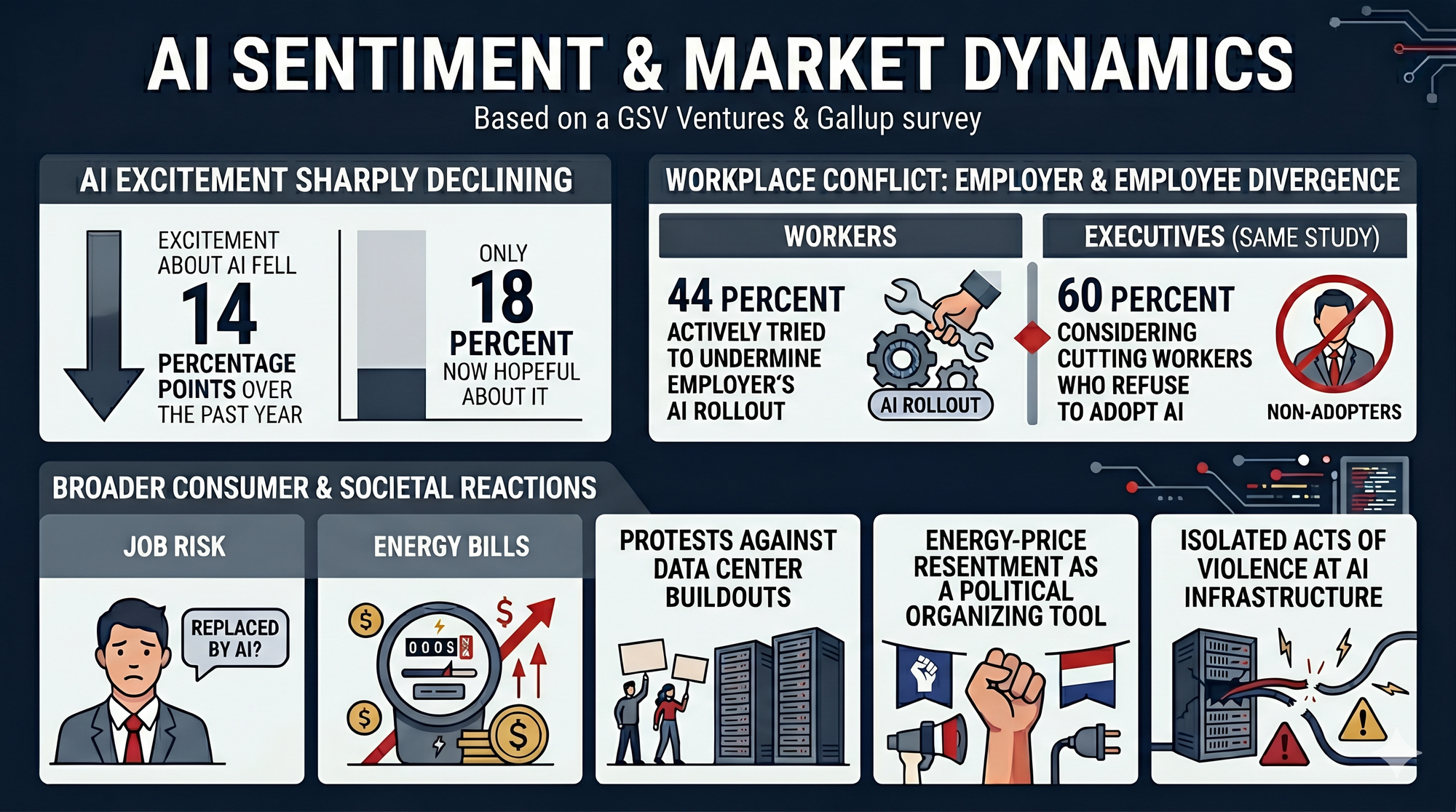
BRIEFING: The Wall Street Journal reported on May 19 that vocal opposition at commencement addresses, blocked data center permits, and plummeting poll numbers now define the public face of an industry whose executives had assumed adoption would do the persuading for them. Former Google CEO Eric Schmidt was met with audible jeering at the University of Arizona graduation while delivering a speech about AI’s transformative power. The piece catalogued a wider pattern of protests against data center buildouts, energy-price resentment as a political organizing tool, and isolated acts of violence directed at AI infrastructure.
The international evidence is sharper. By May 2026, the US Data Center Moratorium Tracker counted 78 active local moratoriums, up tenfold from eight a year earlier. Maine’s legislature passed the first proposed statewide ban, and the governor vetoed it. Senator Bernie Sanders and Representative Alexandria Ocasio-Cortez introduced federal legislation in March proposing an outright ban on new large-scale data center construction. Europe is moving faster. Ireland’s grid operator effectively halted new data center connections in Dublin until 2028 after the sector consumed 21 percent of Irish electricity, while Irish households absorbed roughly €100 per year in grid-upgrade costs. The Netherlands and Frankfurt enacted parallel measures lasting through 2030. OpenAI shelved planned UK and Norway investments citing electricity costs. Protests are active across Scotland, Spain, Italy, France, and Germany, and across Chile, Uruguay, Brazil, Paraguay, and Mexico. India has seen farmer protests over Google’s Visakhapatnam land allocation despite a 21-year corporate tax holiday extending to 2047.
The Gen Z data sharpens the political signal. A Walton Family Foundation, GSV Ventures, and Gallup survey published in May found Gen Z excitement about AI fell 14 percentage points over the past year, with only 18 percent now hopeful about it. A separate study by enterprise AI firm Writer with Workplace Intelligence, published in April, found 44 percent of Gen Z workers said they had actively tried to undermine their own employer’s AI rollout, while 60 percent of executives in the same study said they were considering cutting workers who refuse to adopt AI. Scott Galloway, the New York University Stern professor, has built a parallel argument noting that only wealthy Americans consistently view AI positively. The deeper signal is that Gen Z is not just frustrated with the rollout pace. A significant share is rejecting the tradeoff framing entirely, the idea that an AI-developed cure for cancer justifies whatever social and economic dislocation accompanies the arrival. AI-linked firms now account for roughly 45 percent of the value of the S&P 500, and concentration of that scale alongside a tradeoff rejection of that intensity is the political instability inside the equity story.
SO WHAT
For Executives: The underlying force behind the layoffs is older than artificial intelligence itself and is now the most expensive distortion in the system. Under US Generally Accepted Accounting Principles (specifically ASC 350-40), software development costs capitalize as intangible assets and amortize over useful life, including programmer time, software licenses, and third-party development services. Employee training is explicitly excluded from capitalization and must be expensed immediately. A $1 billion spend on cloud and AI tools lands on the balance sheet as a depreciable asset producing earnings over years. A $1 billion spend on workforce reskilling crushes this quarter’s earnings and never reaches the balance sheet at all. The Chief Financial Officer bias toward technology over workforce investment is not malice. It is the rules markets reward, and it is precisely the signal employees, voters, and increasingly regulators are reading from corporate layoff announcements. Companies that have begun standing up new agent-economy roles, AI-Augmented Service Operators, Continuous Support Workers, Escalation Specialists, Quality Assurance and Safety Compliance Specialists, and the human-AI orchestration manager roles emerging in 2026, are quietly building the operating model that defuses the rebellion. The right reframe is not better messaging. It is a credible value-creation strategy that uses AI as an augmentation lever rather than a cost lever, paired with public advocacy for accounting reform that lets workforce investment be capitalized on terms closer to the technology that displaces it. Companies announcing AI-driven headcount cuts while raising guidance are inviting the regulatory response their lobbyists will then have to fight.
For Policy Makers: The democracies that built the AI economy must now respond to the people pushing back on it, and the central constraint is that the response cannot copy the autocratic playbook for managing dissent. China’s approach to comparable backlash is to suppress the dissent and centralize the technology in state hands. That option is not available in democratic systems, and pretending otherwise is the path through which populist movements on both flanks gain leverage. The far-left and far-right convergence in the United States, with Sen. Bernie Sanders and Steve Bannon both advocating versions of foundation-model nationalization, is the visible signal. The deeper signal is the international one. Energy permitting fights from Dublin to Visakhapatnam are the visible edge of a broader political question about who pays for the data center buildout and its energy, water, and environmental degradation, who captures the productivity gains, and who absorbs the displacement. Democratic responses available include workforce transition funding tied to AI-driven displacement, energy cost-sharing frameworks that prevent grid upgrades from being charged to households, disclosure requirements on AI-driven workforce changes, accounting reform that allows workforce investment to capitalize on terms closer to technology investment, and aesthetic and water-impact standards on hyperscale siting. Each of these is a legitimate response that addresses real grievances without seizing the underlying technology. Doing nothing in the next two to four years means inheriting a much sharper political bargain, and one that may include nationalization options not currently on any mainstream agenda.
For Investors: Concentration risk in AI-linked equities is also political concentration risk. Whether or not one agrees with the framing of generational injustice, there is a real probability that a critical mass of voters will demand windfall taxes, mandatory revenue-sharing on AI-augmented displacement, or stricter data-center siting rules within two election cycles. Markets are currently pricing the upside scenario. Position sizing should reflect a non-trivial tail in which the regulatory regime tightens before the productivity flywheel finishes spinning up. Adjacent sectors that benefit from the policy response, workforce reskilling platforms, AI governance tooling, grid-balancing energy infrastructure, distributed compute alternatives to hyperscale data centers, become more attractive on a risk-adjusted basis. The orbital compute story in this issue’s Under the Radar piece is the most consequential adjacent bet, because it is the most direct architectural escape from the terrestrial backlash that is now the central political constraint on the AI buildout.
For Service Providers: Boards are asking the wrong question, namely how to defend the AI rollout and the layoffs. The right question, and the advisory opportunity most consulting practices are still avoiding, is how to redesign the value-creation model so the rollout is defensible and the human-AI partnership generates broadly distributed benefits. Service providers that can move clients from headcount-cut narratives to credible augmentation, human-AI symbiosis, agent-orchestration, and new-role design will own the next eighteen months of board engagements. The standard efficiency-and-productivity slide deck is now a liability when placed in front of a skeptical workforce, consumer base, and regulator. The differentiator is showing a real operating model, not a deck.
The Pentagon’s Procurement Trap: Why Europe Is Pulling Ahead
The Iran war emptied U.S. munition stockpiles in days. The procurement and industrial base needed to refill them now lags Europe's.
TL;DR: Eleven weeks of war with Iran exposed what defense procurement specialists have warned about for years: the United States consumes munitions faster than it can replace them, fields multimillion-dollar interceptors against $20,000 drones, and runs a procurement system that takes years to do what Ukraine and Europe are now doing in months. The Pentagon's answer is a $1.5 trillion budget request and a Secretary of War who wants to tear up the rules. The deeper problem is that the United States has lost the industrial base, the workforce pipeline, and the procurement architecture needed to fight a peer war at scale, while Europe rebuilds its own.
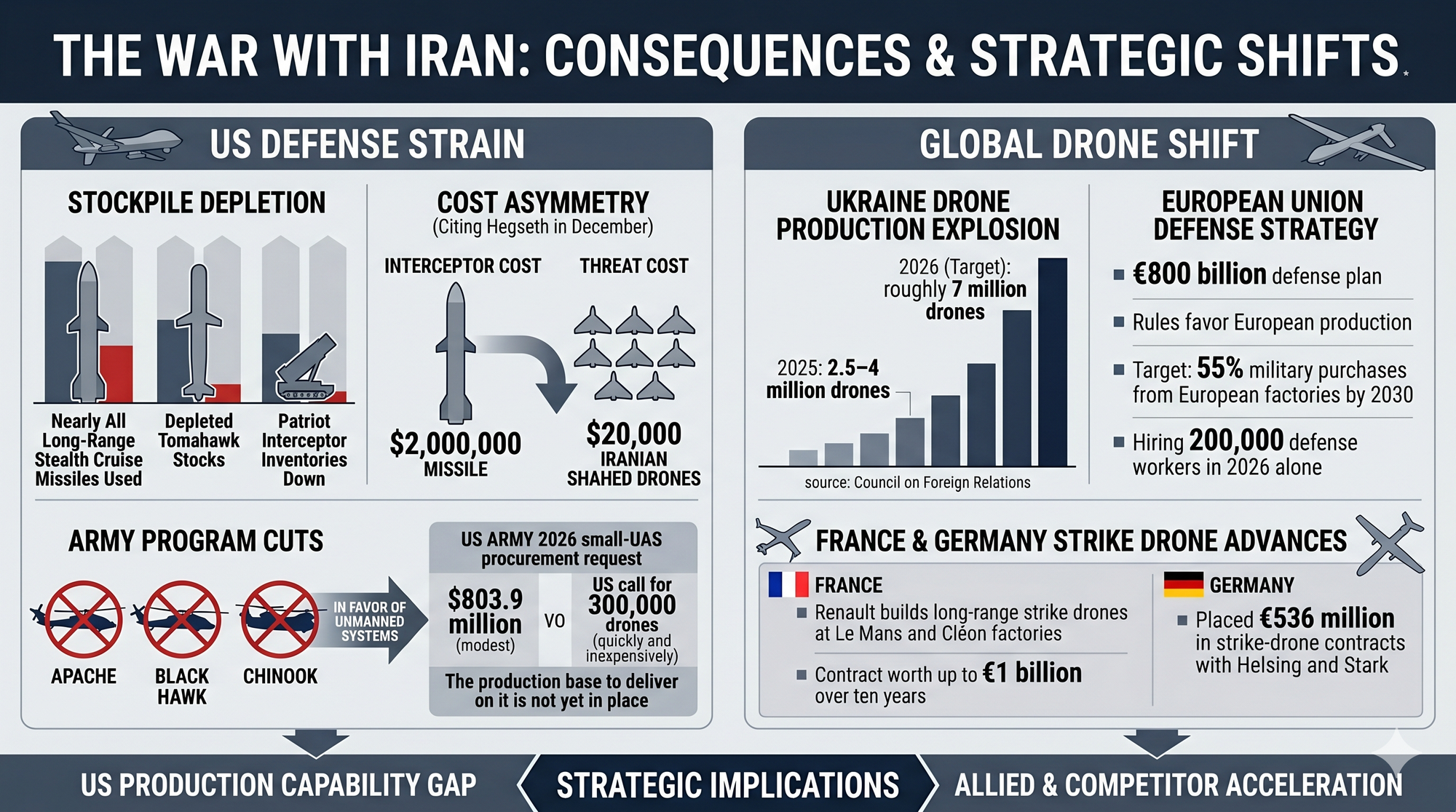
Briefing: The war with Iran, launched on February 28 and now in a tense ceasefire, burned through a reported $5.6 billion in munitions in its first two days. The United States used nearly all of its long-range stealth cruise missiles, depleted Tomahawk stocks, and drew Patriot interceptor inventories down to levels that have drawn questions from both parties in Congress. Defense Secretary Pete Hegseth told House appropriators the munitions question had been "foolishly and unhelpfully overstated," while the White House was reportedly preparing a supplemental request of $80 billion to $100 billion to backfill exactly those stockpiles. The cost asymmetry that drew Hegseth's public attention in December, namely $2 million missiles intercepting $20,000 Iranian Shahed drones, played out in real time and is now driving Army cuts to Apache, Black Hawk, and Chinook helicopter programs in favor of unmanned systems.
The contrast with allied capacity is sharpening. Ukraine manufactured between 2.5 million and 4 million drones in 2025 and is targeting roughly 7 million in 2026, according to the Council on Foreign Relations. The European Union's €800 billion defense plan, with implementation rules favoring European production, targets 55% of military purchases from European factories by 2030 and is hiring 200,000 defense workers in 2026 alone. France's Renault is building long-range strike drones at its Le Mans and Cléon factories under a contract worth up to €1 billion over ten years. Germany has placed €536 million in strike-drone contracts with Helsing and Stark. The U.S. Army's entire 2026 small-Unmanned Aerial System (UAS) procurement request is $803.9 million, modest by comparison. Hegseth's call for 300,000 drones "quickly and inexpensively" is real, but the production base to deliver on it is not yet in place.
So What
For Executives: The defense industrial base is the next big sectoral reshoring story, and unlike semiconductors it does not yet have a CHIPS Act behind it. Industrial companies, contract manufacturers, and aerospace suppliers should be designing frugal and agile manufacturing techniques and supply chains, mapping which existing lines can be dual-used for defense work, which workforce pipelines can be tied to community colleges and similar schools, and which partnerships with non-traditional defense entrants like Anduril, Shield AI, and Epirus open paths to Pentagon contracts that were previously closed. A template already exists in Camden, Arkansas, where Lockheed is recruiting high-school seniors and partnering with Southern Arkansas University Tech for apprenticeships to staff missile production. Boards that pre-position now will be in the room when the supplemental funding lands.
For Policy Makers: Procurement reform without industrial-base policy is a slogan. Hegseth's push to give commanders independent buying authority, lift restrictions on small UAS purchases, and break the lock of the traditional defense contractors is directionally right but operationally insufficient. The binding constraints are workforce, propellant and energetics chemistry, rare-earth magnet supply, and AI-driven machine-tool capacity, none of which respond to acquisition rule changes alone. Bipartisan support for a defense-industrial equivalent of the CHIPS Act, paired with rare-earth and energetics onshoring incentives, is the policy package that matches the threat. Sole reliance on supplemental appropriations produces stockpile rebuilds but not lasting industrial capacity.
For Investors: The defense-tech investment thesis is no longer speculative, it is demonstrated by combat consumption rates and manufacturing lags that the public market has not yet fully repriced. Private entities such as AeroVironment, Kratos, and Anduril sit on a durable demand tailwind that the Iran war made undeniable. The resolution is turning European competition into renewed partnerships. An €860 billion EU spending plan that explicitly favors European producers caps the addressable market for U.S. exporters, and it might push U.S. firms to set up European subsidiaries, the inverse of the pattern of the last 20 years. Investors should be modeling defense-tech as a U.S.-and-Europe play with rising European share, not a U.S.-led monopoly story.
For Service Providers: The supply chain due diligence, workforce design, and certification consulting opportunities in defense industrial base buildout are open, large, and underdeveloped. Most service providers either lack the cleared talent or lack the depth of manufacturing operations to meet the demand. Firms that combine cleared advisory capability with industrial engineering, especially around energetics, precision machining, and dual-use additive manufacturing, will be in the strongest position. The window to build that capability is now, before the supplemental appropriations land and the established defense consultancies absorb the easy work.
Washington’s Quantum Equity Stakes
Commerce will hold passive equity in nine quantum firms. The sovereign-capital playbook used in chips is now a stack-wide instrument.
TL;DR: The US Department of Commerce announced letters of intent for $2.013 billion in incentives to nine companies under the CHIPS and Science Act, with the federal government taking a minority, non-controlling equity stake in each. IBM receives $1 billion to anchor a new dedicated quantum chip foundry. GlobalFoundries receives $375 million to operate a second federally backed quantum foundry. Seven additional companies share the balance. The sovereign-capital tool that built the US semiconductor reshoring strategy is now extending down the deep-tech stack.
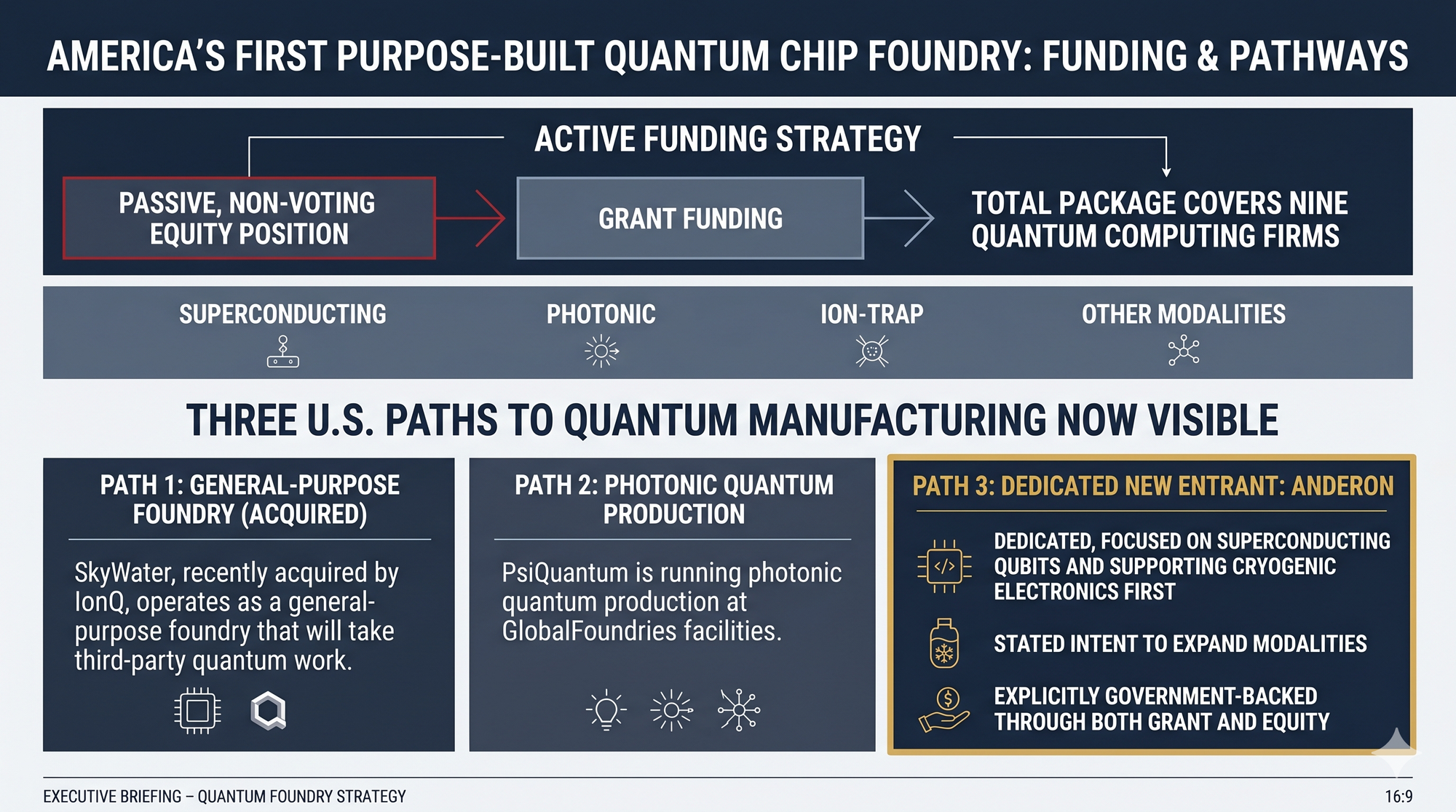
Briefing: The Department of Commerce announced on May 21 that it had signed letters of intent to provide $2.013 billion in CHIPS and Science Act incentives to nine companies, structured to give the federal government a minority, non-controlling equity stake in each. IBM Chief Executive Arvind Krishna confirmed that IBM will receive $1 billion to anchor Anderon, described as America’s first purpose-built quantum chip foundry, building on IBM’s existing 300-millimeter wafer fabrication of its Loon and Nighthawk quantum processors in Albany since November 2025. GlobalFoundries will receive $375 million to establish a secure domestic quantum foundry capable of handling multiple architectures including superconducting and trapped-ion modalities. The remaining seven firms, including IonQ and PsiQuantum, share the balance for quantum hardware development.
The simpler way to describe the landscape after this week’s announcement is that the United States now has two federally backed quantum foundries (IBM’s Anderon and GlobalFoundries’ new dedicated facility), one independently owned general-purpose foundry that can take quantum work (SkyWater, recently acquired by IonQ), and seven federally backed firms building actual quantum machines on top of that manufacturing base. PsiQuantum, one of the seven, has historically run its photonic quantum production at GlobalFoundries facilities, and the deal cements that relationship under federal capital.
The stated intent is more specific than “subsidy.” Commerce Secretary Howard Lutnick has framed the equity-stake approach as letting taxpayers participate in the upside when the government has decided to subsidize a strategic industry anyway. The Intel precedent is the directional anchor. The August 2025 Intel deal converted $8.9 billion of federal funding into a 10 percent equity stake, and Intel’s share price has risen approximately 380 percent since the agreement. The mechanism is now standard for sectors Washington deems strategic: minority, non-controlling stakes that give the government no day-to-day strategic influence but do entitle taxpayers to share in the appreciation if the bet pays off, and that carry consent and information rights distinct from those of typical institutional investors.
So What
For Executives: The sovereign-capital tool is now a stack, not a sector. Companies operating in any technology Washington deems strategic, quantum, advanced packaging, rare-earth processing, energetics, biomanufacturing, should expect the equity-stake template to become the default. The Intel precedent is the directional shape. A federal equity holder is not the same as a typical institutional investor. It carries national-security review obligations on subsequent acquisitions, can complicate foreign direct investment screening for inbound capital, and creates political risk on initial public offering or sale timing that institutional investors do not. Executives should pre-think the corporate-action calculus. A federal equity holder will not block a strategic sale or partnership, but it will make every transaction subject to political review, scrutiny from Congress, and disclosure obligations that a typical cap table does not impose.
For Policy Makers: The equity-stake instrument is moving faster than the institutional architecture to manage it. The United States now holds passive positions across semiconductor, quantum, critical minerals, and an expanding list of strategic firms, but the government lacks a centralized portfolio manager, a sovereign wealth fund analog, or clear rules on when and how stakes are divested. The institutional question is whether Treasury, Commerce, or a new entity should consolidate management of these positions, with what governance and what reporting to Congress. For non-US sovereign-capital allocators reading this, the question is sharper. The UAE’s Mubadala, Saudi Arabia’s Public Investment Fund, Singapore’s Temasek and GIC, and Norway’s Government Pension Fund Global all hold significant positions in US technology firms. They now need to decide how they price US-federal-equity overhang on those positions, whether to disclose to their own beneficiaries the presence of a US government co-investor, and how to interact with the equity-staked firms on diligence and governance. The EU faces a parallel question on whether US-equity-held firms should be treated differently under foreign direct investment screening rules, particularly in cases where those firms acquire EU technology assets. The Politically Exposed Person nature of certain investments, including the disclosed connection between PsiQuantum and Donald Trump Jr.’s 1789 Capital, will also need to be addressed in how allied governments treat the new equity-held cohort.
For Investors: Quantum is no longer a pure venture-capital play, and three concrete actions follow. First, re-rate the nine-firm cohort to reflect the federal-shareholder discount on M&A optionality. The Intel precedent shows the price appreciation potential is real, but so is the constraint on corporate actions. Second, overweight the picks-and-shovels quantum supply chain, namely cryogenic systems, control electronics, and error correction software. These firms get the demand tailwind from the federal capital landing on the nine-firm cohort without the governance complexity or political review surface area that comes with direct federal equity ownership. They are the cleaner trade. Third, watch for the next equity-staked sector. The pattern across semiconductors, critical minerals, and now quantum suggests biomanufacturing, advanced materials, energetics, and potentially fusion are the candidates. Positioning in these sectors before the equity-stake template arrives is the asymmetric bet, particularly for investors who can manage the political-review complexity that comes with federal equity.
For Service Providers: The compliance and governance services market around federally backed strategic firms is going to grow substantially. Companies with federal equity stakes face new reporting obligations, export-control complexity, and personnel security requirements that most quantum startups are not staffed to handle. Service providers with national-security clearances, export-control expertise, and government-contracting depth have a clear opportunity to embed early with the nine-firm cohort. The same opportunity will exist for each successive round of equity-staked sectors.
AI Super-Apps Become the New Gatekeepers
Google rebuilt search around Gemini. China's super-apps already order products on users' behalf. The two synthesis layers are now competing for who answers when the world looks something up, and the answer is a sovereignty question.
TL;DR: Google's I/O announcement that it would replace ranked search results with a Gemini-composed answer page is the consolidation of a Western synthesis layer. China's Alibaba, ByteDance, and Tencent operate the parallel Eastern layer, with 600 million Chinese users on agentic super-apps that purchase on their behalf. Whoever controls the synthesis layer in a given country shapes what its citizens read about Taiwan, Ukraine, the Uyghurs, and election integrity. The contest for the Global South, meaning Indonesia, Brazil, India, Saudi Arabia, and Kenya, is currently happening. Western democracies must build a contestable synthesis architecture without copying Beijing's controlled-information playbook. That is the harder problem, and it is the one currently being lost.
Briefing: The week's news pegs are clear. Google's I/O announcement on May 19 confirmed the rebuild of Search around Gemini 3.5 Flash, with composed answer pages replacing ranked links. The Gemini app now reaches 900 million monthly active users. Alphabet has guided to $180 to $190 billion in 2026 capital expenditures, the largest infrastructure commitment in commercial computing history. The Economist's coverage of the Chinese super-app race documented that Alibaba, ByteDance, and Tencent are racing each other to embed agents into their existing super-apps, with the user increasingly displaced from the purchase decision itself. The competitive question, as The Economist framed it, is no longer who has the smarter model. It is who controls the surfaces, including search, browser, phone, inbox, and payment rail, where users already spend their day.
What that framing misses is the geopolitical layer. The two synthesis architectures are not just competing for revenue. They are competing for which becomes the default in each country's information environment. In Indonesia, the choice between WeChat-pattern super-apps and Google's Gemini-rebuild is not a consumer preference, it is a question of which government's regulatory reach extends into Indonesian users' daily inference. In Saudi Arabia, where the Public Investment Fund is funding both Chinese and US AI infrastructure, the synthesis layer choice is being made in palace conversations, not app store rankings. In the European Union, the question is whether the AI Act can be extended to govern composed answer pages before either US or Chinese platforms lock in distribution. In each case, the choice has the same character: which adversary's model do you accept as the default explainer of the world to your population?
So What
For Executives: The operational environment for customer discovery has fractured by jurisdiction, ending the PageRank era of global consistency. In the United States, United Kingdom, and European Union, brand visibility now effectively collapses into the logic of how Gemini synthesizes your presence. In China, value is captured or lost based on how Alibaba, ByteDance, and Tencent’s agentic architectures route users. Across the Global South, both stacks compete for dominance with outcomes that shift quarterly. For any multinational, the strategic imperative is to audit which synthesis layer governs each specific market and how the firm is represented within it. A global brand strategy that presumes a unified discovery layer is no longer a strategy; it is a legacy assumption that the frontier has already moved around.
For Policy Makers: The temptation to import either the US or the Chinese model wholesale is the trap. The US model concentrates synthesis power in three or four private firms with no contestability obligations. The Chinese model places it under direct state direction. A Central Asian, Gulf, or European regulator reading this should be asking a third question: what would a contestable synthesis layer look like? At minimum, it requires source attribution that the user can inspect, jurisdictional rules on which sources can be silently omitted from a composed answer, and a mechanism for affected publishers or governments to dispute a synthesis output. The European Union's AI Act is the closest existing framework, but it was written before composed-answer search existed and needs an explicit amendment. Indonesia, Brazil, India, and Saudi Arabia have the leverage of market size to demand contestability features as a condition of distribution. They are not using it yet. Western democracies have a window, measured in quarters not years, to define what a non-Chinese, non-US-monopoly synthesis layer looks like before the two existing options become the only options.
For Investors: The platform-economics tell is geographic, not just competitive. Three concrete actions follow. First, underweight pure-play AI model companies without an integrated distribution stack. Google's combination of model, chips, operating system, browser, search, and webmail, mirrored by Alibaba, ByteDance, and Tencent on the Chinese side, structurally compresses the margins of model-only competitors as the gatekeepers commoditize them. Second, overweight the layer below the gatekeepers in markets that have not yet chosen between the US and Chinese stacks, including Indonesia, Brazil, Mexico, Nigeria, Saudi Arabia, the United Arab Emirates, and Vietnam. Infrastructure providers, payment-rail operators, identity-verification firms, and local distribution partners are the underpriced exposure to the Global South synthesis-layer contest. Third, position early in synthesis-audit and source-attribution tooling. As regulators in the EU, Gulf, and Asia move toward contestability requirements over the next 18 to 24 months, the firms that built the audit infrastructure ahead of the rule will be the acquisition targets.
For Service Providers: The advisory category that did not exist eighteen months ago is now visible. Multinational clients need synthesis-layer presence assessments by country, with separate strategies for markets governed by Gemini, by Chinese super-apps, by EU regulation, and by emerging sovereign frameworks. Beyond presence, regulated-industry clients in policy, pharmaceuticals, financial services, and energy need a new practice: auditing and contesting the synthesis outputs that increasingly shape regulator, journalist, and court understanding of their sectors. Firms that can offer scientific veracity and quality assurance checking against AI-composed outputs, particularly in the three or four languages where the synthesis layer matters most outside English and Mandarin, will own a category that the established consultancies have not yet recognized.
Under the Radar
The deep analysis that connects the dots
Compute Above the Border: SpaceX's S-1 Discloses an Orbital Data Center Plan No Government Currently Regulates
A single private U.S. company has filed plans to deploy strategic-scale compute infrastructure outside any state's territorial jurisdiction, and no government has the framework to regulate it.
THE CARVE-OUT
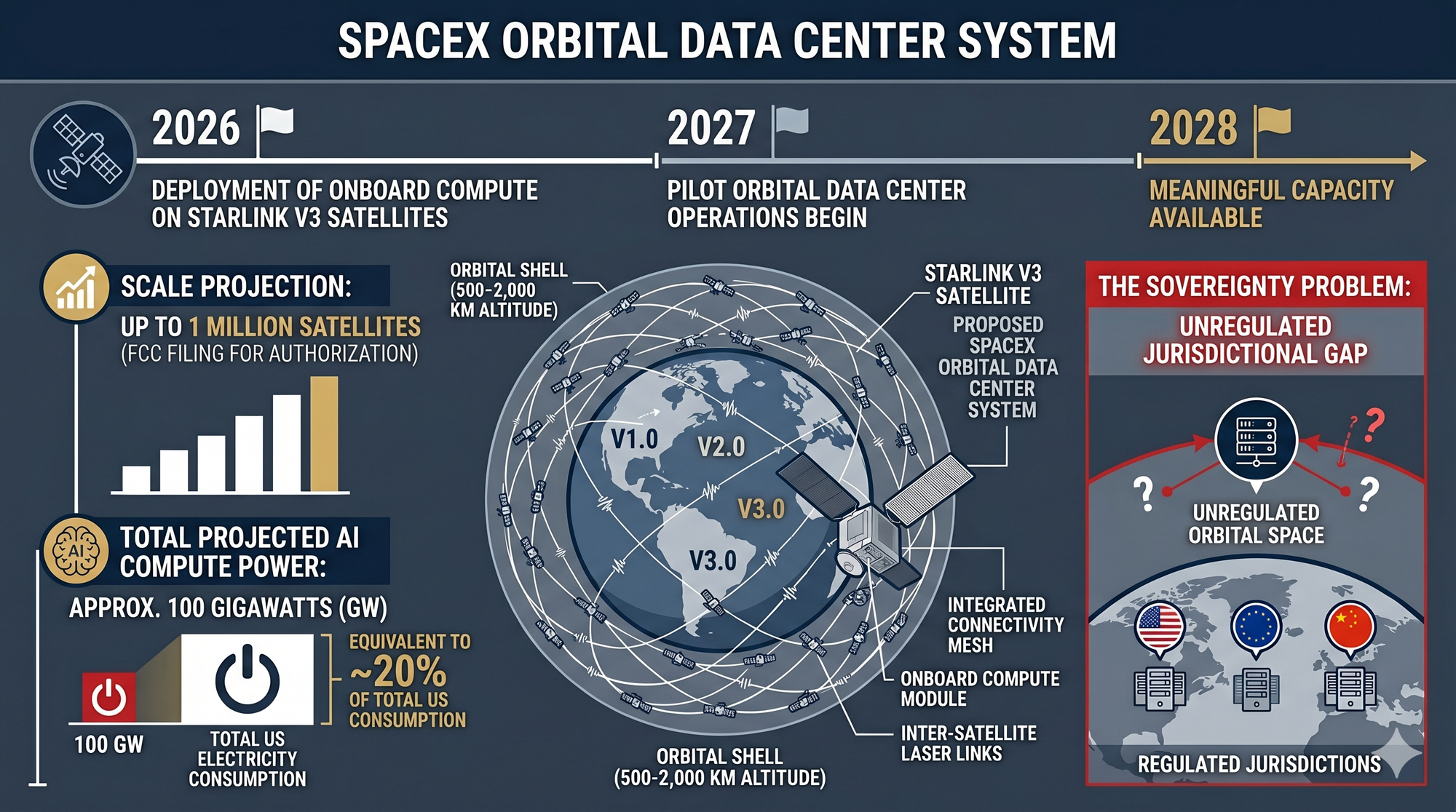
SpaceX’s S-1, filed with the Securities and Exchange Commission this week ahead of a targeted June Initial Public Offering at a roughly $1.75 trillion valuation, contains a disclosure that most coverage has treated as a product roadmap. It is something larger. The filing confirms that SpaceX plans to deploy onboard compute on its next-generation Starlink V3 satellites starting in 2026, with initial orbital data center operations beginning in 2027 and meaningful capacity available in 2028. SpaceX has separately filed with the Federal Communications Commission for authorization to launch up to a million satellites under the proposed SpaceX Orbital Data Center System, an integrated compute-and-connectivity mesh operating between 500 and 2,000 kilometers altitude. The compute satellites will operate in Sun-synchronous orbit and rely on continuous solar power, with heat dissipated through radiators and vapor chambers rather than the cooling water and grid electricity that drive terrestrial data center fights. SpaceX projects the constellation could eventually deliver approximately 100 gigawatts of dedicated AI compute capacity, equivalent to about 20 percent of current total US electricity consumption.
Importantly, the orbital compute build is for commercial AI workloads, not for the Pentagon’s Proliferated Low Earth Orbit (PLEO) Starshield satellite-internet program. SpaceX has announced an initial customer relationship with Anthropic, but the contracted Anthropic deal disclosed in the S-1 covers 300 megawatts of terrestrial compute capacity at xAI’s Colossus 1 data center in Memphis at $1.25 billion per month through May 2029. Anthropic has only expressed interest in future orbital compute partnership, not committed. That distinction matters. SpaceX has not yet anchored a paying customer for orbital compute itself, but the terrestrial deal provides the cash flow and the political case for the orbital build.
The S-1 contains a sentence buried in the regulatory disclosures that is the most important line for GeoTech readers. SpaceX states that “in order to achieve our orbital compute goals, we may prioritize our own launch payloads over additional U.S. government” missions. Translated, the operator of America’s primary national-security launch capability and the dominant provider of the Department of Defense’s PLEO Starshield satellite-internet program is publicly notifying its government customers that its own orbital compute build will compete for launch capacity with their national security payloads.
The Opportunity and the Risk
The opportunity is straightforward and large. Solar-powered, water-free, jurisdictionally-unconstrained compute at hyperscale solves several of the political and environmental fights documented elsewhere in this issue. Story 1 catalogued the data center moratoriums and protests slowing terrestrial AI buildouts from Dublin to Visakhapatnam. Orbital compute escapes the local-grid, local-water, and local-aesthetic objections that have stalled hundreds of gigawatts of planned terrestrial capacity. For AI labs facing those constraints, this is the architectural escape, and the economic case to participate is strong.
The risk is the inverse of the opportunity. A single private actor, with no operational redundancy and no peer competitor at scale, would hold sovereign-grade compute infrastructure that no government can reach or regulate. The same actor is the dominant national-security launch provider, the dominant military satellite-internet provider, and the dominant electric-vehicle manufacturer. The S-1 itself flags that SpaceX has no key-person insurance on Musk, that Brazilian courts have previously frozen Starlink local assets in disputes related to other Musk entities, and that Grok faces ongoing law-enforcement investigations across multiple jurisdictions. In February, Senators Elizabeth Warren and Andy Kim raised the possibility of undisclosed Chinese investment in SpaceX. The S-1 does not resolve that question. For a company that derives roughly a fifth of its revenue from US federal agencies and holds approximately 97 percent of awarded task orders under the $13 billion PLEO Starshield ceiling, any of these would be a material disclosure on a normal IPO. For a company on which the Department of War has standardized for secure broadband and crewed access to orbit, the combination is a sovereign-risk roundup.
The Jurisdictional Gap
The sovereignty problem is that orbital compute sits in an unregulated jurisdictional gap. The FCC licenses spectrum and orbital slots but does not regulate what compute runs on the satellites. The Federal Aviation Administration licenses launches but not what payloads do once they reach orbit. The Department of Commerce’s Bureau of Industry and Security regulates export of physical technology, but inference performed in orbit on data uplinked from a foreign jurisdiction does not map cleanly onto current export-control categories. The Committee on Foreign Investment in the United States (CFIUS) reviews inbound investment in critical infrastructure, but no US statute currently defines orbital compute as critical infrastructure. Data center siting rules, which drive the political backlash that has slowed terrestrial AI buildouts and is documented in Story 1, do not apply to a facility orbiting at 550 kilometers altitude. The territorial assumptions baked into every framework governing AI infrastructure on Earth simply do not reach into orbit. As with the rebuild of search and the rise of agentic super apps documented in Story 4, the private actor is moving faster than the public framework, and the actor has compounding advantages that build over time, integrated stacks on the ground, and jurisdictional escape in orbit.
What the IPO Triggers
What follows the IPO will determine whether orbital compute becomes a genuinely sovereign category or remains a niche capability. Three signals are worth tracking. First, whether any frontier AI lab beyond Anthropic publicly commits to orbital compute capacity, particularly Microsoft, Amazon, or Meta, which would signal that hyperscaler demand is real rather than experimental. Second, whether the FCC, the Department of Commerce, or the Department of War moves to assert regulatory authority over orbital compute specifically, separate from launch and spectrum. Third, whether allied governments, particularly the European Union and Japan, attempt to extend their AI Act and AI governance frameworks to inference performed in orbit on data originating in their territories. The European Union has tried to extend the General Data Protection Regulation into similar gray zones before, with mixed success. The orbital case will be harder because the physical infrastructure is unreachable and beyond national airspace. Data provenance could play a more immediate role in justifying extraterritorial regulation, with allied governments asserting jurisdiction over the data uplinked from their territory even if they cannot reach the satellite that processes it.
For executives running AI workloads, the practical implication is a new architectural option that did not exist 18 months ago, compute that sits outside any national data-residency regime. That is attractive for some use cases and disqualifying for others, depending on which regulator a given client most fears. For investors evaluating the SpaceX IPO at a $1.75 trillion valuation, the orbital compute roadmap is the optionality that justifies the multiple. It is also the risk that the analyst community is currently underpricing, because no framework exists to constrain it and frameworks tend to arrive after the infrastructure does. For policy makers in Washington, Brussels, Tokyo, and London, the question is whether to treat orbital compute as a category that requires new statutory architecture before the constellation is launched, or to inherit the architecture private actors build in its absence. The downside of doing nothing is specific. By the time meaningful orbital capacity is online in 2028, the regulatory baseline will be whatever SpaceX and its first customers established commercially. Allied governments will not be able to extend jurisdiction post-hoc to infrastructure they cannot physically reach. The orbital compute architecture risks becoming a US private-sector default in the same way the terrestrial internet did, and that took 25 years to partially regulate.
Cambrian Partner By Invitation
Expert analysis from our global network
Japan's Dual-Use Awakening
SusHi Tech Tokyo (Sustainable High Tech Tokyo), an annual startup promotion event put on by the Tokyo Metropolitan Government, delivered a remarkable highlight: Prime Minister Takaichi Sanae joined by Tokyo Governor Koike Yuriko for a succinct joint keynote. One could not help but appreciate the tableau of what The Economist called the world's most powerful woman joining the veteran governor of one of the world's most well-run cities, herself a former two-time member of Japan's Cabinet, for a joint appearance.
Briefing
In six minutes, PM Takaichi hit three key points about the importance of startup scaling, deep-tech startups, and regional startups. All three bear consideration.
Startup scaleups – Japan is mindful that its startups tend to end up as small caps or SMBs. Creating unicorns requires creating a growth stage capital ecosystem.
Deep tech startups – Japan has defined 17 technology priority areas. The PM cited AI, semiconductors and quantum, and others include fusion, shipbuilding, and foodtech.
Regional startups – Tokyo is a super-city that exerts its gravitational pull on, well, everything. In an aging economy, the effects of this show up most clearly in the countryside. PM Takaichi highlighted support of regional startups and is looking to them as a new form of job creation in the countryside.
Panel moderators and other participants at SusHi Tech Tokyo made regular reference to "dual-use technology" (i.e., technology for both civilian and government markets). PM Takaichi and other government speakers both referred to using the government's power of procurement to help startups grow.
So What
So what could dual-use mean in Japan, particularly since in the U.S. many of the most famous technologies, including GPS, the Internet, and self-driving cars, all had military sponsors at their outset? And given that China has an explicit "military-civil fusion" association?
Recall that Japan's constitution renounces war in the form of Article 9. (The fact that this remains true 80 years later is itself a historical feat.) Hence the nomenclature of Self-Defense Forces, and the slow steady iterative progress towards a military that can project capacity beyond Japan's immediate borders. Just in April 2026, Japan scrapped a ban on weapons exports, although the removal itself is limited. Export is limited to 18 countries with which Japan has signed defense equipment and technology transfer agreements. (Japan does not yet have one with Ukraine.)
Japan's defense budget has almost doubled since 2022, when Russia invaded Ukraine. Multiple prime ministers, Kishida, Ishiba, and now Takaichi, have since held the role, and while some have been more dove-ish and some more hawk-ish, all have been in alignment on this. Nine trillion yen at current exchange is around $57 billion USD.
Here is where demographics becomes a factor. Japan is aging, shrinking, and centralizing at the same time. This is the same centripetal force I alluded to above. One regularly sees it in countries with a super-city at the center, like South Korea, France, or the United Kingdom, but in an aging country, the presence of a super-city means demographic impacts are most visible in the countryside.
So while the country's defense primes, such as Mitsubishi Heavy, have retained their production capabilities, they too have staff limitations. Staff shortcomings mean that automation will have to stand in.
One can see signs of this in two clear defense investments in "stand-off" capabilities, namely the ability to defend and counterstrike through things like missile defense, and the use of unmanned assets such as UAVs, USVs, and UUVs for littoral defense. Japan's SHIELD (Synchronized, Hybrid, Integrated and Enhanced Littoral Defense) program sets aside roughly $700M USD for this purpose.
Although the term "dual-use" is clearly trickling into academic and industry fora, I was struck by how it showed up at a startup event like SusHi Tech. Even the winner of a youth pitch contest (the ITAMAE Shusseo Challenge, for which I was a judge) embodied this. The University of Tokyo student proposed undersea drones for deep sea critical minerals exploration, very much a dual-use idea.
Look for more linkages between Japan and allied nations, including more academic, industry, government, and technological exchanges, as Japan begins to build out its dual-use ecosystem.
About our partner
Jon Metzler is Continuing Lecturer at the Berkeley Haas School of Business. He is also director at the Institute for Business Innovation at Berkeley Haas, where he helps support academic, industry, and government partners. Jon has taught at Berkeley Haas since 2014. Prior to returning to campus to teach, Jon founded Blue Field Strategies, a consulting firm helping infrastructure firms accelerate service innovation. Recent publications include contributions to Longevity Hubs: Regional Innovation for Global Aging, published by MIT AgeLab via MIT Press in 2024. With two members of Keio University faculty, Jon co-authored University-led Regional Revitalization (大学まちづくり 地方創生 担い手不在を覆す), a Japanese-language book published in March 2026 by Japan Business Press.
About Cambrian

Cambrian Futures is a strategic foresight and advisory firm helping government, business, and technology leaders understand how emerging technologies intersect with geopolitics, markets, and national strategy. By combining rigorous research, AI-enabled analysis, and human expertise, Cambrian provides clear insight into global technology trends, risks, and power dynamics. Its work helps decision-makers anticipate disruption, manage uncertainty, and act with strategic confidence in an increasingly competitive GeoTech world.
PRODUCTION TEAM
GeoTech Radar is produced by the Cambrian Futures Insights Platform team:

CEO & Chief Analyst

Managing Director / Producer, Insights Platform

Global Lead, Smart Infrastructure Strategy

Research & Marketing Associate

Editor in Chief
Learn more about Cambrian Futures at cambrian.ai
Produced with

Human Led



Human Led +
AI Augmented




AI Led +
Human Verified


Cite as: Cambrian Futures (2026) 'GeoTech Radar Issue 21'