

Russia Hits Kyiv's Data Centers, Korea Funds U.S. Power, and U.S. Towns Reroute AI (FREE VERSION)
INSIDE ISSUE 40:
GTR Terminal: Subscribers get full access to our live dashboard tracking the signals shaping the future. Your access link and password are one click away.
On the Radar
The signals affecting the GeoTech landscape this week
Russia Strikes Kyiv's Data Centers
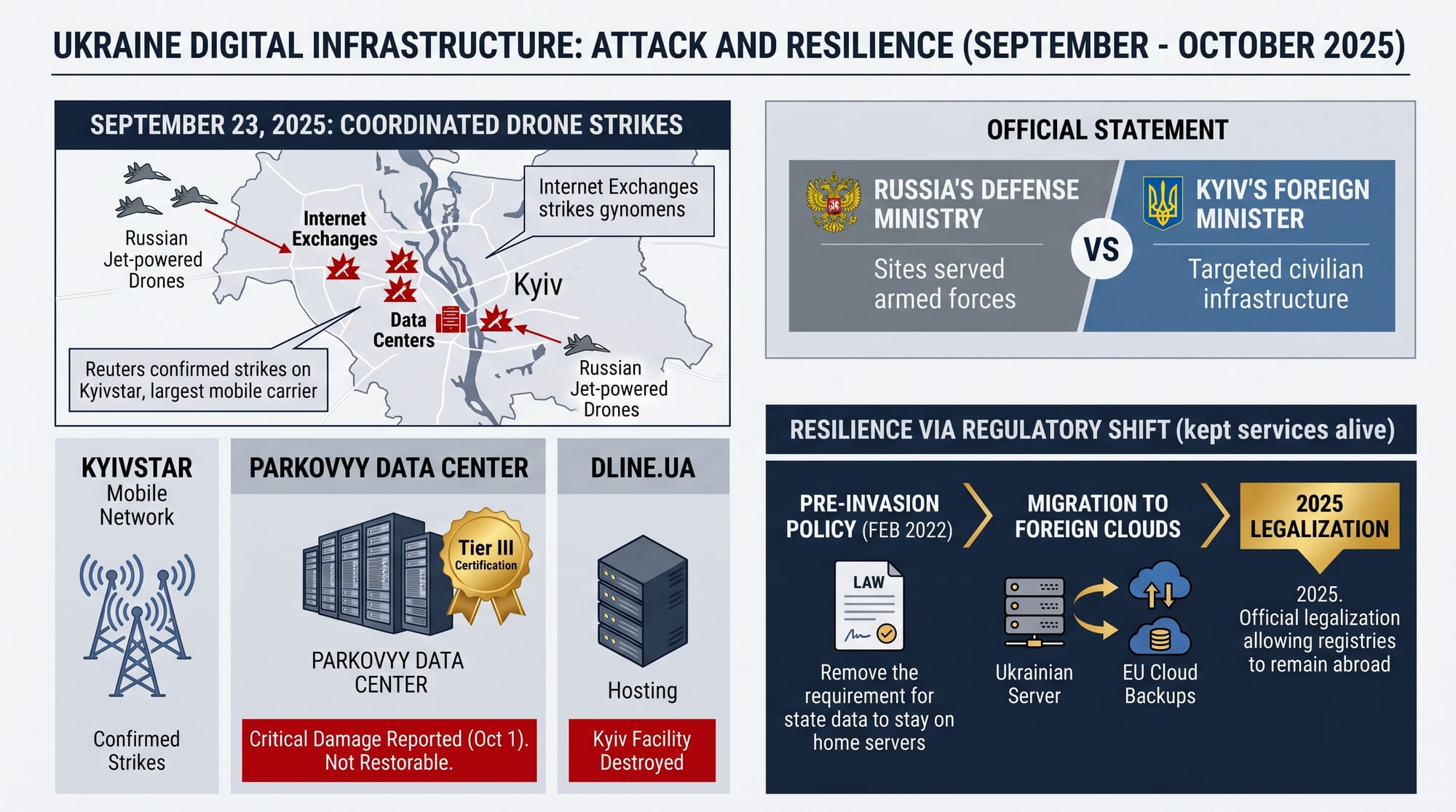
Russian drones spent a week destroying the buildings that host Ukraine's commercial computing. The services that kept running were the ones with copies in another country.
BRIEFING: Starting September 23, Russian drones hit data centers and internet exchanges across Kyiv, and Reuters reported a strike on the headquarters of Kyivstar, the largest mobile carrier. Parkovyi, a commercial data center operator in Kyiv, said on October 1 that it had suffered critical damage and could not be restored. Hosting firm Dline.ua said its Kyiv facility was destroyed. Russia's Defense Ministry said sites it struck served Ukraine's armed forces. Ukraine's foreign minister said Russia was targeting data centers to disrupt the flow of information.
Despite the damage, services kept running from backups outside Ukraine. Parkovyi said its customers' data sits on backup sites in the EU. For government data, that option dates from the week before the 2022 invasion, when parliament passed a cloud law that opened the way to storing state data abroad. The country then moved state registries, including population, land, and tax records, to foreign clouds and, in 2025, let them stay abroad. On September 29 the cabinet set aside about $12 million for more backups in separate locations.
It is the second time this year that commercial data centers have come under military attack. In March, drone strikes damaged three Amazon data centers in the UAE and Bahrain, and Iran's Revolutionary Guard called the strikes deliberate. Many governments still require sensitive data to stay at home. India's central bank requires payment data to be stored only in India, and Saudi Arabia requires government agency data to remain in the Kingdom, with narrow exceptions. Others are building the opposite model. Estonia keeps state servers in Luxembourg, Bahrain passed a law in 2018 that lets foreign data stored there stay under its home country's law, and Saudi Arabia proposed a similar law in 2025 that remains a draft.
SO WHAT
For Executives: Find out this month where each critical system physically runs and whether a complete copy exists in a second country. Then restore from that copy as a test, because Parkovyi's customers learned in one week which backups worked. Where a local law forbids a foreign copy, ask the regulator in writing for a wartime exception. Read the war exclusion in your property and cyber insurance. Hedge: A copy abroad puts your data within reach of the host government. Choose the host for its legal protections first and its price second.
For Policy Makers: Rules that keep data inside the country carry a defense cost. Write an exception that allows encrypted copies in allied countries, and settle the terms government to government. Estonia did this in 2017 with a data embassy in Luxembourg, a server room abroad that holds state databases under diplomatic-style immunity. Taiwan is moving 18 critical civilian systems to the cloud, with encrypted backups offshore. Run a full restore drill before you need one. Hedge: Offshore copies shift your dependence to the host and to subsea cables. Keep a domestic copy as well and test both.
For Investors: Capacity in more than one country is becoming a purchase requirement wherever drones or missiles can reach. That favors operators with sites in several jurisdictions and cloud providers with services in regions next door. Ask every portfolio company in Eastern Europe, the Gulf, and East Asia for its recovery time after losing a building. Hedge: The Kyiv campaign is two weeks old and Russia could change targets. Wait for contract changes before repricing a whole sector and look for the most resilient compute assets in which to invest.
For Service Providers: Sell a cross-border resilience audit in four parts: 1) a map of where systems run; 2) the legal permission for foreign copies; 3) a timed restore test; and 4) an insurance review. Law firms should chart each client country's data residency rule against its wartime exceptions. Hedge: Some regimes forbid any foreign copy and others only require a local one. Scope the legal answer before the engineering.