

Reactors, Chips, and the Approvals Nobody Agreed On
IN THIS ISSUE:
CEO's Perspective
Strategic outlook from Cambrian leadership

Last week at the Special Competitive Studies Project's AI+ Discovery summit in Washington, I joined a panel about the next 250 years of science. During the discussion, moderated by MIT Technology Review, I offered three scenarios for AI in science and discovery, circa 2276. Judging by comments shared afterwards, they seemed to have resonated well with the audience and moderator.
As it turns out, every story in this issue – Genesis and its alliance layer, Saudi reactors on Russian fuel cycles, Beijing's chip loyalty mandate, dueling US-EU approval regimes, and the defunding of everything that is not AI – is an early move toward one of these AI-in-Science Futures. These decisions, made this quarter, could be inherited for centuries.
Three Futures for AI in Science, Circa 2276
The Cathedral of Speed. This is a world in which a U.S.-China fusion duopoly turned cheap, hoarded energy into hoarded knowledge, and let discovery run at machine speed behind walls through which no ordinary person can see. Whoever lit the first self-sustaining reactor also powered the first self-sustaining research engines, and neither power would let the other pull ahead. The two never went to war outright but settled into an armed, decades-long standoff of blockades, sabotage, and proxy pressure. That cold peace deepened concentration, as hyperscalers and national labs absorbed the open-weight movement and the promise of speed curdled into a curse – discovery accelerating faster than any human institution could govern or audit. Values barely mattered. Democratic and autocratic blocs converged on the same closed, extractive playbook because velocity rewarded secrecy over openness. The global data accords that once promised fair provenance became enclosure instruments, licensing the Global South's data and biodiversity back to it as rented insight rather than owned capability. AI-driven digital twins replaced most physical experimentation, but they were governed by no one outside the U.S.-China duopoly and their assumptions were unauditable, so the models' picture of reality quietly became reality by default. Climate was brute-forced into stability by fusion-powered geoengineering that the AI models designed and the world could not refuse. Science is powerful and objectified – a magnificent instrument owned by the few, serving ends no one chose in the open.
The Commons of Many Sciences. This is a world in which fusion became cheap and distributed rather than owned, so the power to know spread with the power to generate energy – beyond Washington, Beijing, and the labs that once monopolized both. Cheap portable energy plus guaranteed data provenance meant that anyone, anywhere, could both power and legitimately fuel their own research. That combination broke the back of concentration. Open-weight models and tens of thousands of smaller institutions out-innovated the would-be monopolists. A near-war between the U.S. and China over the Pacific was pulled back from the brink less by diplomacy than by interdependence, and the resulting détente made room for the Global South to rise as originating centers. Lagos, Jakarta, and São Paulo ran cosmologies, pharmacologies, and climate sciences of their own. Diffusion meant locally appropriate innovation, with solutions invented in and for the contexts that needed them rather than exported as one-size-fits-all products from two capitals. Democratic values won, not by defeating autocracy but by making openness more productive than control. Speed became a genuine promise rather than a curse because it was inspectable, with every claim carrying its lineage and re-derivable by anyone. Climate change kept accelerating and forced hard adaptation, but distributed fusion and distributed science met it in parallel everywhere at once, with humans firmly in the loop to choose which big questions a civilization should attempt to answer. Science is empowered, free, plural, inspectable, and owned by the many who make it.
The Long Quiet. This is a world in which fusion arrived a century too late, climate outran everyone, and rival U.S. and Chinese AI-science programs – starved of the stable, wealthy, energy-rich world that expensive science requires – retreated into a brilliant virtual arms race as the physical world frayed. Repeated fusion delays collided with accelerating climate collapse. As reactor timelines slipped decade after decade, the warming world drained the wealth and stability that century-defining mega-project science demands. The U.S.-China rivalry tipped into open conflict, not a total war but a grinding series of strikes on data centers, cables, and satellites that taught both sides to bury their capabilities rather than deploy them. Concentration and diffusion both warped, as a few hardened state-lab complexes hoarded the frontier while a chaotic fringe of open-weight actors proliferated in the ruins, with no stable middle. Epistemic openness survived mainly as an archive rather than living practice. The global data accords fragmented into rival, incompatible provenance regimes that made cross-border knowledge nearly untradable. Discovery turned inward and virtual, systems proving deep theorems and simulating whole universes precisely because the material world had become too broken and too costly to experiment on. Science is stunted and truncated, dazzling in the abstract, severed from the living world it was meant to serve.
The Cathedral, the Commons, and the Long Quiet are not predictions. They are the option set. The moves being made in this issue are narrowing it. Look at your own capital allocation, your energy dependencies, your model approvals, your research partnerships, and ask which future each of those choices is buying. If you have not chosen deliberately, the Cathedral is the default. It always is.
Olaf
On the Radar
The signals affecting the GeoTech landscape this week
Genesis Picks 278 Projects as Tokyo Buys a Half-Share in U.S. Scientific Capacity
The first Genesis awards say less about which sciences matter than about who gets to do them alongside the U.S.
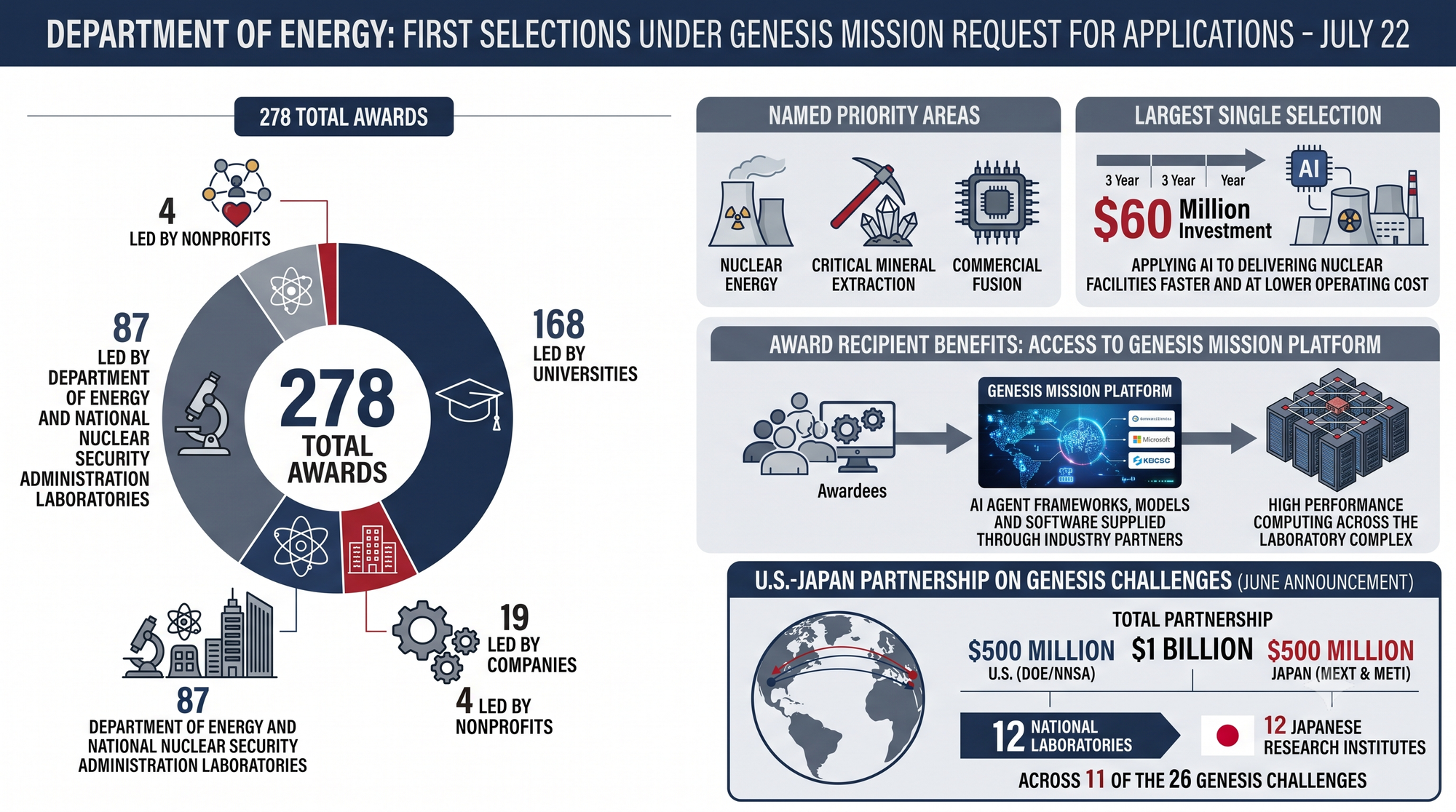
TL;DR: The Department of Energy (DOE) on July 22 selected 278 projects from the largest response to a funding call in its history, more than 5,000 applications from over 800 institutions, roughly twice the response of any prior DOE solicitation. The portfolio spreads roughly $250 million to $293 million across 342 institutions, with a single nuclear project taking $60 million. The White House has announced more than $5 billion in total federal commitments to Genesis, and the Genesis Consortium includes 40 partners and $800 million in private commitments. Japan and the U.S. committed $1 billion in combined funding ($500 million each), making Japan the first international partner, with further allies expected this year under criteria that are openly political.
BRIEFING:On July 22, the Department of Energy announced the first 278 projects selected under the Genesis Mission Request for Applications. The selections span 342 participating institutions: 87 led by DOE and National Nuclear Security Administration (NNSA) national laboratories, 168 led by universities, 19 led by companies, and four led by nonprofits. The program received more than 5,000 applications from over 800 institutions, roughly twice the response of any prior DOE solicitation, and the challenge areas expanded from 26 to 33, now spanning 20 federal agencies. The largest single selection is a three-year, $60 million investment to apply artificial intelligence (AI) to the faster delivery of nuclear facilities at lower operating costs, involving 32 partner entities including four national labs and more than 20 industry partners. Awardees gain access to the Genesis Mission Platform, which bundles AI agent frameworks, models, and software from industry partners, along with high-performance computing across the national laboratory complex. The Genesis Consortium includes 40 partners and $800 million in commitments, and defense drew nearly a quarter billion dollars just this year and next year, about $1.4 billion to the Genesis Mission overall. Separately, the U.S. and Japan signed a $1 billion strategic partnership making Japan the first international partner in June, with each side contributing $500 million over five years. That partnership pairs a dozen U.S. national laboratories with a dozen Japanese research institutes across 11 of the 26 original Genesis challenges, covering quantum information science, fusion energy, biotechnology, advanced materials, particle physics, and autonomous laboratory systems. Under Secretary for Science Dario Gil said further international partners would be named this year.
A $250 million to $293 million pool across 278 awards averages close to $1 million each, and a single nuclear project absorbs a fifth of the total. The strategy is to enable a broad set of teams to rebuild scientific workflows around AI and let the practice propagate through the institutions that adopt it. Enabling a thousand teams to retool their methods, rather than directing resources at two or three fields as China's five-year plans do, may be the faster route to discovery, because no agency can credibly name the fields that will decide the next decade. The alliance layer is where the geopolitics sits. Tokyo is paying $500 million against a matching U.S. sum, converting a domestic competitiveness program into a membership good that other capitals will want to buy into. Japan was first because the institutional match was immediate: 12 Japanese research institutes paired with 12 DOE national laboratories, and Japan's Seventh Basic Plan for Science, Technology and Innovation explicitly names AI and computing as essential to both research and industrial competitiveness. Japan is also the anchor of the U.S. Indo-Pacific alliance structure, and making it the first Genesis partner signals that science cooperation is now part of the security architecture, not separate from it. The focus areas overlap with dual-use domains. Gil's stated filter for further partners, allies who share a commitment to scientific integrity and democratic values, is a political criterion said out loud. The data governance question left open in the Japan agreement is precisely what determines whether the outputs stay open or the alliance hardens into a smaller, friendlier closed system.
SO WHAT
For Executives: Put someone on the Genesis Mission Platform access question this quarter, because the 157 companies already listed as participating institutions will help set the agent frameworks, model access terms, and computing conditions that the rest of the market inherits. Gil's stated philosophy is broad portfolio investment, but the four named priority areas, nuclear delivery, critical mineral extraction, chip design, and fusion, are where the largest awards concentrate, and the $60 million nuclear award is a fifth of the total pool. If you operate in any of these fields, the practical question is whether your technical staff can co-author with a national laboratory. With 87 laboratory-led and 168 university-led awards against only 19 company-led ones, access runs through research partnerships rather than procurement. Firms with Japanese subsidiaries have a second entry point through the bilateral working groups. Hedge: Selection is not an award, so the government can rescind offers during negotiation. Furthermore, the average award sits near $1 million, so treat these as early signals rather than money distributed.
For Policy Makers: Decide now whether you want in and what your terms of entry would be, because the invitation list is being written this year and the criteria are largely values-based. Japan bought in at $500 million and reciprocal researcher permissions, which sets a visible reference price for the next entrant. Two provisions deserve scrutiny before signature. The first is data governance, still unresolved in the Japan statement of intent, which determines whether shared research outputs stay inside the alliance or diffuse beyond it. The second is the reciprocity clause granting each country's researchers the same approvals as domestic researchers, which is generous and carries screening implications for any third partner admitted later. For capitals outside the likely invitation set, the sharper question is whether comparable access can be assembled among yourselves rather than gained through outside partners.
For Investors: Track the second Request for Applications rather than this one, because Secretary Chris Wright framed the volume of qualified proposals as an argument for expanding the portfolio, and the expansion is where award sizes might concentrate. The $60 million nuclear award is the signal inside this tranche, because it applies AI to construction schedules and operating costs. As such, it targets the single largest cause of Western nuclear cost overruns, and it connects directly to the export economics discussed in the next story. Watch which industry partners supply models and agent frameworks into the platform, since that position converts national laboratory workflows into a reference deployment. Hedge: Federal science funding converts to commercial value on multi-year lags and through negotiated awards that can shrink. Base your investment timing on when contracts are signed and money is disbursed rather than on initial selection announcements.
For Service Providers: The billable product here is an alliance-readiness assessment for clients in economies likely to be approached in the next wave. Readiness checks should cover data governance posture, researcher mobility, export control alignment, and the institutional capacity to absorb reciprocal access. European clients face this on two fronts at once, since national laboratories and university consortia across the continent will want in while their governments weigh how bilateral U.S. arrangements sit against E.U. research programs. For communications practices, Genesis is going to be narrated as a race, and clients operating across both the U.S. and Asia will need positioning that supports participation without coming across as alignment against a third market. Multinationals with research footprints in several jurisdictions should be mapped now to identify which of their sites would even qualify.
Riyadh Signs for U.S. Reactors, but the Fuel Cycle Runs Through Moscow
The U.S. is selling the hardware and renting the fuel services that make it run.
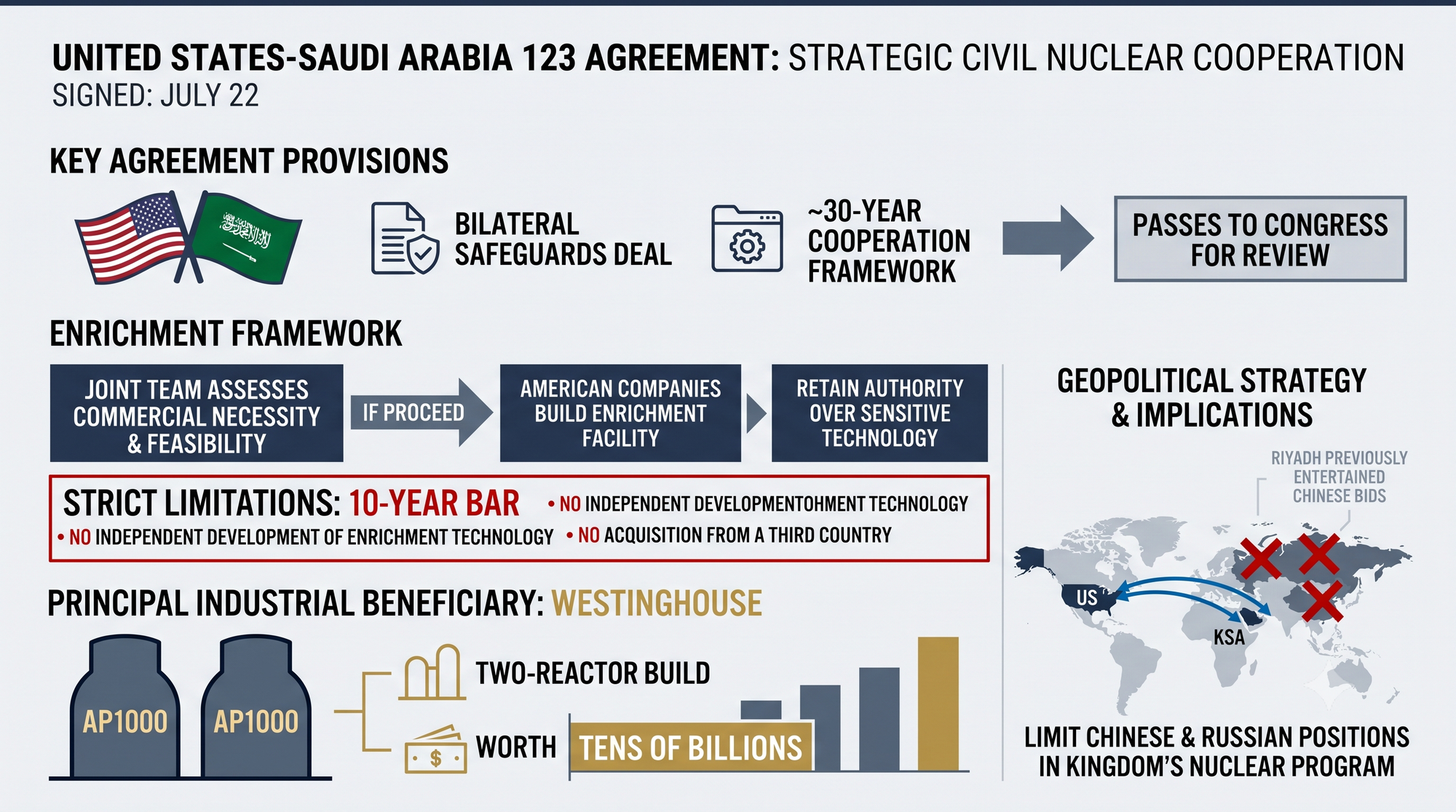
TL;DR: Energy Secretary Chris Wright and Saudi Energy Minister Abdulaziz bin Salman signed a 123 Agreement on July 22, opening roughly 30 years of civil nuclear cooperation. The agreement reportedly will not require Riyadh to categorically forgo enrichment or accept the Additional Protocol, the highest standard of International Atomic Energy Agency (IAEA) safeguards. Westinghouse is positioned to build AP1000 pressurized water reactors, but no reactor award has been made and it takes nearly a decade to construct an AP1000. Congress must approve the deal, where it faces bipartisan opposition on proliferation grounds. The layer the agreement does not settle is the fuel cycle: Rosatom holds approximately 36% to 45% of global enrichment capacity, Urenco (a British-German-Dutch consortium) approximately 30%, Orano (France) approximately 14%, and China National Nuclear Corporation (CNNC) approximately 12%. The United States does not have a single domestically owned commercial enrichment facility.
Briefing: The U.S. and Saudi Arabia signed a 123 Agreement on July 22, covering approximately 30 years of civil nuclear cooperation. Under the framework, a joint team will conduct a two-year study to assess whether uranium enrichment inside the kingdom is commercially necessary and feasible. Should it proceed, American companies would build the enrichment facility while retaining authority over the sensitive technology, and Saudi Arabia would be barred during the first decade from independently developing enrichment technology or acquiring it from a third country. After that initial period, technical control transitions to American-trained Saudi operators. Westinghouse is the principal industrial beneficiary, positioned to build AP1000 reactors. The AP1000 is a Generation III+ pressurized water reactor (PWR), not a small modular reactor (SMR), producing 1,117 megawatts of electrical output per unit. Four AP1000 units are currently operating: two at Sanmen and two at Haiyang in China, and two at Plant Vogtle in Georgia, the only new U.S. nuclear builds in decades, which ran years late and billions over budget. The agreement is contingent on Saudi Arabia becoming a member of the Abraham Accords and passes to Congress for review. Westinghouse, Bechtel, BWXT, Centrus and other companies stand to benefit.
Reactor construction is the visible layer. Dependence forms further upstream, in conversion, enrichment, and fuel fabrication, which together constitute the fuel cycle. The enrichment market and the reactor construction market are distinct businesses with different players and different geopolitical dynamics, and conflating the two obscures the analysis. Rosatom holds approximately 36% to 45% of global enrichment capacity through its TVEL subsidiary. Urenco holds approximately 30%, with 17.9 million SWU per year across facilities in the Netherlands, Germany, the United Kingdom, and a single plant in Eunice, New Mexico, the only enrichment facility on American soil, owned by a European consortium. Orano holds approximately 14% through Georges Besse II in France. CNNC holds approximately 12% and is expanding rapidly. More than 99% of the world's uranium enrichment capacity is controlled by four entities outside the United States. The United States does not have a single domestically owned commercial enrichment facility. American, French, Japanese, and Swedish reactors do not depend on Rosatom fuel; they contract primarily with Urenco and Orano. But the transition away from Russian fuel is incomplete: E.U. dependence on Russian fuel cycle services was valued at approximately EUR 700 million in 2024, and France's Orano cannot yet reprocess recovered uranium at Rosatom's efficiency. The connection to the previous story runs directly to the largest single Genesis award, $60 million to apply AI to delivering nuclear facilities faster and at lower operating cost, targeting the construction economics where Western vendors have lost recent competitive tenders on price and schedule.
So What
For Executives: For businesses operating in Saudi Arabia and the broader Gulf Cooperation Council (GCC), the most immediate effect is on regional energy pricing. A nuclear build of this scale reshapes the kingdom's energy mix over a decade, which feeds directly into industrial power costs, desalination economics, and data center siting decisions in the Gulf. Suppliers of reactor technology, nuclear engineering services, and construction management should treat this as a pipeline signal, noting that supply chain qualification cycles are long and congressional review can attach conditions. The construction timeline is measured in decades, not years: the AP1000 record at Vogtle is the relevant base rate. On the fuel side, the enrichment market is concentrated, but Western reactors, including American, French, Japanese, and Swedish facilities, contract primarily with Urenco and Orano, not with Rosatom. The fuel dependency question is most acute for countries building new programs without established Western enrichment contracts, for European utilities still unwinding Russian fuel commitments, and for the emerging market for high-assay low-enriched uranium (HALEU) for advanced reactors, where there is essentially no Western supply at scale. Hedge: Congressional review can delay or condition the agreement. Experts question the proliferation provisions. The enrichment provision depends on a commercial assessment that may conclude it is unnecessary. Avoid committing capital against the enrichment leg until ratification.
For Policy Makers: Treat enrichment capacity as the variable that determines whether reactor exports buy influence, because selling hardware into a fuel market you do not supply produces a customer with two vendors rather than one partner. The 10-year restriction on independent Saudi enrichment development is the operative safeguard, and its value depends entirely on what verification and inspection provisions are included in the safeguards deal, which deserves line-by-line attention during congressional review. Allied capitals weighing their own agreements should watch whether the U.S. treats this as a template or a one-off, since a template establishes that enrichment access is negotiable for partners of sufficient strategic weight. The parallel worth tracking is whether Western enrichment capacity expands fast enough to make the restriction commercially binding, rather than just legally binding.
For Investors: The fuel cycle is where the durable margin sits, and it is underweighted relative to the reactor headlines. Enrichment and conversion capacity outside Russia is scarce, contracted years forward, and expanding slowly, which supports pricing for Western suppliers through the decade regardless of which vendor wins any individual reactor tender. On the construction side, Westinghouse's position is real but the historical record on AP1000 schedule and cost is the relevant base rate, and this deal will be judged against it. Watch the Genesis nuclear award as a genuine variable, since AI applied to licensing, scheduling, and operations is the plausible route to changing that base rate. Uranium producers and enrichment service providers carry the cleaner exposure to a multi-decade build cycle. Hedge: Nuclear timelines slip routinely, experts believe the security provisions to be lacking, the agreement is not yet ratified, and a commercial assessment that recommends against Saudi enrichment would remove a pillar of the thesis.
For Service Providers: There is a defensible advisory line in fuel-cycle dependency mapping for industrial and utility clients, tracing which of their power and process inputs ultimately settle on Russian or Chinese enrichment and conversion capacity. European clients are the natural first market, since E.U. dependence on Russian fuel cycle services has been documented and only partially unwound, and boards there are already primed to ask the question. A second product is Gulf market entry structuring for engineering, safety, and compliance firms after a build of this size in a jurisdiction with limited nuclear regulatory precedent. For communications practices, this agreement will be argued in two incompatible registers, energy security and proliferation risk, and clients on the industrial side need positioning that engages the second honestly rather than treating it as noise.
Beijing Turns Domestic AI Chips Into a Loyalty Test as Foreign Dependence Falls Below 60%
Export controls constrain supply. This news constrains demand, which is the more durable of the two.
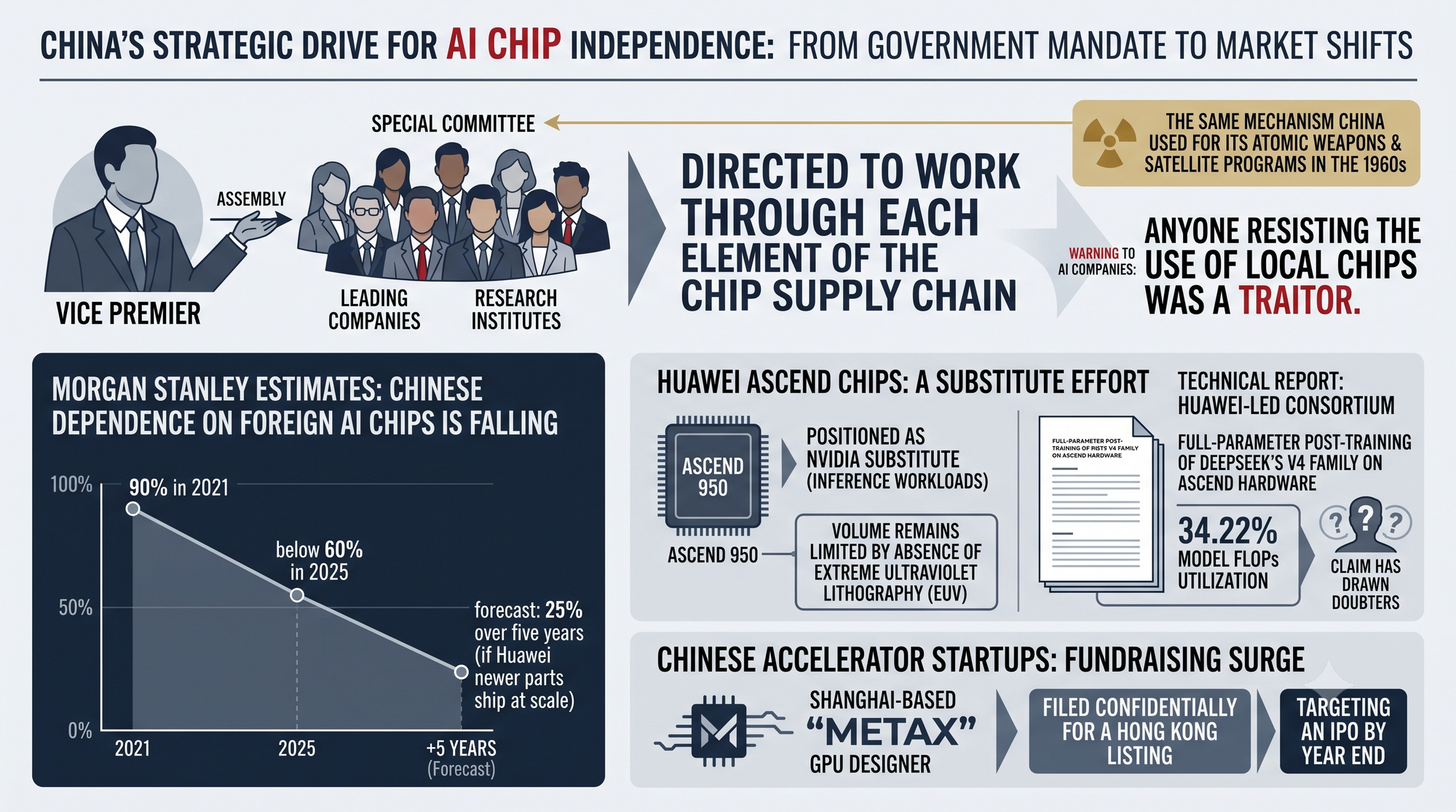
TL;DR: A Chinese vice premier told domestic AI companies that resisting homegrown accelerators (specialized AI processors designed to handle machine learning workloads, the category in which Nvidia dominates globally) made them traitors, applying to semiconductors the national mobilization model once used for atomic weapons and satellites. Morgan Stanley estimates that Chinese dependence on foreign AI chips has fallen from 90% in 2021 to below 60%, and projects it could reach 25% within five years if Huawei can supply at volume. MetaX has confidentially filed for a Hong Kong listing after a Shanghai debut that saw the stock jump close to 700%, and a Huawei-led consortium has published training benchmarks for DeepSeek's V4 family running on Ascend silicon. Issue 28 covered adjacent ground on license-free chip sales to the UAE. The new development here is the demand side: Beijing is mandating domestic procurement as a political loyalty test.
Briefing: According to the Wall Street Journal, Vice Premier Ding Xuexiang recently assembled leading companies and research institutes into a special committee directed to work through each element of the chip supply chain. The committee follows the blueprint China used for its atomic weapons and satellite programs in the 1960s. Ding warned AI companies that anyone resisting the use of local chips was a traitor. Morgan Stanley estimates that Chinese dependence on foreign AI chips has fallen from 90% in 2021 to below 60% in 2025, and it could reach 25% over five years if Huawei's newer parts ship at scale. Huawei's Ascend 950 silicon is positioned as a substitute for Nvidia in inference workloads, though volume remains limited by the absence of extreme ultraviolet (EUV) lithography in China. MetaX listed on Shanghai's STAR Market on December 17, 2025, raising approximately $600 million, and the stock jumped close to 700% on its first day, pushing its market capitalization past $42 billion. MetaX has confidentially filed for a Hong Kong listing, working with Huatai International Financial Holdings. These companies compete primarily with Nvidia in the data center AI accelerator market, with AMD's MI300X/MI350 as the secondary Western competitor. Peers Biren Technology completed its Hong Kong IPO in early 2026, and Iluvatar CoreX and Moore Threads are also tapping public markets. Separately, a Huawei-led consortium released a technical report documenting full-parameter post-training of DeepSeek's V4 family on Ascend hardware at 34.22% model FLOPs utilization (MFU), a measure of what percentage of a chip's theoretical computing power is actually used during a workload. For context, public benchmarks for Nvidia H100 training runs typically range from 35% to 50%, with CoreWeave reporting above 50% on optimized configurations. The Ascend figure sits just below that range and covers post-training only, not the more compute-intensive pre-training phase. Independent experts note Nvidia hardware likely still performed the original training.
Export controls operate on supply. A procurement mandate operates on demand, and demand is the more durable lever because it creates a protected domestic market that persists whether or not the parts are cost-competitive today. A protected buyer base is the mechanism that lets a fabricator advance along its manufacturing learning curve. The number worth following is utilization rather than peak specification, because MFU on a full-parameter run determines whether domestic silicon is usable at frontier scale rather than merely present in a data center. The gap between benchmark performance and production performance is where Nvidia's software ecosystem, built on the CUDA programming environment, has historically won. If Ascend hardware achieves usable utilization rates at frontier scale, that software advantage narrows. Lithography still limits how far the chip logic can advance, and packaging and high-bandwidth memory capacity limit how many working AI processors can be assembled from any given generation of Chinese-made chips. The technical progress is real and the MetaX listing prices it publicly. What the loyalty mandate reveals is that the economics have not yet caught up to the politics. If domestic chips were already cost-competitive and performance-competitive at scale, Beijing would not need to frame procurement as a patriotism test. The mandate accelerates adoption ahead of where the market would place it, which is how protected industries have historically closed technology gaps, but it means buyers are absorbing a performance and cost penalty in the near term.
So What
For Executives: Audit which of your China operations and Chinese joint-venture partners are running inference on domestic accelerators, because a procurement expectation enforced as a loyalty question will eventually reach foreign-invested entities, though the timeline and enforcement mechanism remain unclear. Past regulatory patterns in China suggest that informal guidance precedes formal requirements, giving multinationals a narrow window to prepare. The practical consequences are technical before they are political. Ascend and Cambricon parts run different software stacks from the Nvidia environment on which your global teams standardized, so model portability, tooling, and staff skills become the real integration cost. Firms operating on both sides should plan for divergent inference stacks as a standing condition rather than a transition. Note also that Qualcomm has told customers to expect double-digit percentage price increases, so the cost pressure in your silicon bill is not confined to accelerators. Hedge: Enforcement so far is reported pressure rather than published rule, and Chinese firms with export ambitions retain incentives to stay compatible with global tooling. Avoid rebuilding stacks ahead of a formal requirement, but instead run scenarios on eventual implications.
For Policy Makers: Recalibrate how you measure the effect of export controls, because a metric built on what China cannot buy misses what China is now compelled to buy. If foreign dependence has moved from 90% to below 60% in four years, the controls have accelerated substitution alongside constraining capability, and both effects need to appear in the same assessment. The variables that actually gate Chinese scaling are lithography, advanced packaging, and high bandwidth memory, so controls aimed at those layers do more work than controls aimed at finished accelerators. For allied capitals, the second-order question is what happens to your own suppliers when a market of this size converts to domestic parts on a political timetable, and whether the resulting overcapacity in mature nodes, the older semiconductors manufactured at 28 nanometers and above used in automotive, industrial, and telecommunications applications, arrives in your market as a pricing problem for non-Chinese chip sellers and their customers within two to three years.
For Investors: Position for a bifurcated accelerator market rather than a single global one, because a mandated domestic buyer base changes the addressable market for every non-Chinese supplier. The MetaX listing in Hong Kong prices Chinese accelerator capability publicly for the first time and will pull comparable disclosure from its peers, which gives you a data series where you currently have only anecdotes. On the other side, the constraint layers are where the pricing power concentrates, so lithography, advanced packaging, and high bandwidth memory suppliers retain leverage that accelerator designers do not. Watch whether the Ascend utilization figures survive independent replication, since that single variable governs how quickly the substitution curve steepens. Hedge: Reported dependence figures come from sell-side estimates rather than disclosure, Huawei volume remains lithography-constrained, and a negotiated easing of U.S. controls would slow the substitution case considerably.
For Service Providers: The near-term product is a silicon dependency audit for multinational clients, identifying which operations, partners, and suppliers sit inside the mandate's reach and what a dual-stack inference architecture would cost to maintain. European industrial and automotive clients are the sharpest market, because their China joint ventures put them directly inside a procurement expectation their headquarters did not negotiate and cannot easily refuse. A second line is scenario work on mature-node oversupply. Mature-node chips are semiconductors manufactured at older process nodes (28 nanometers and above), used in automotive systems, industrial controls, consumer electronics, and telecommunications. If Chinese fabs redirect capacity from these products toward AI chip production under the mandate, the global supply of mature-node chips could tighten in some categories and flood in others, and that is the mechanism by which this policy reaches clients who never buy an accelerator at all. For communications practices, clients with significant China exposure will need language that acknowledges local sourcing commitments without generating headlines in their home markets, and that balance is getting harder to hold each quarter.
Two Approval Regimes Form Over the Same Models, and Neither Recognizes the Other
The Google fine is the headline. The story is what is forming underneath.
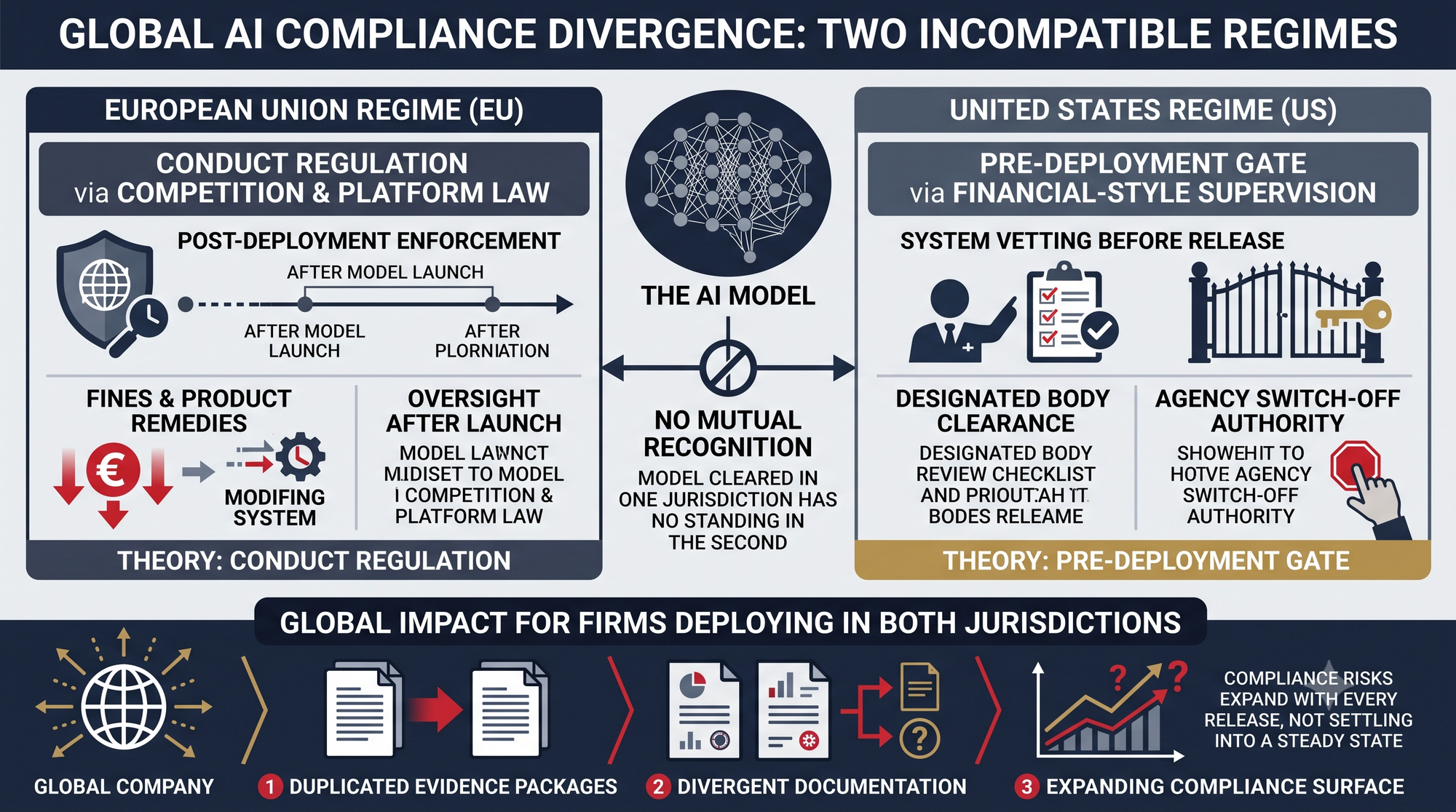
TL;DR: The European Commission fined Google approximately €890 million on digital competition grounds, €460 million for self-preferencing in search results and €430 million for steering restrictions on Google Play. The U.S. response was a threatened trade investigation and tariffs. On the domestic side, a separate approval regime is forming: a vetting body for frontier models modeled on financial self-regulation, a clearinghouse called Gold Eagle shaping access to frontier systems, and a bipartisan bill granting shutdown authority with penalties of up to $2 million per day, rising to $20 million per day for violating an emergency order. For the first time, two incompatible approval theories are forming simultaneously over the same AI models, and neither will recognize the other's determinations.
Briefing: The European Commission fined Google approximately €890 million for breaching the Digital Markets Act (DMA), stating it had not factored the risk of U.S. retaliation into the decision and maintaining its sovereign right to regulate technology within its jurisdiction. Google's cumulative E.U. liabilities now exceed €10 billion. President Trump responded by announcing a probe into the E.U.'s practice of fining American technology companies and threatening substantial tariffs, days after a wave of Section 301 levies took effect covering more than 60 countries and 99.4% of U.S. imports.
On the American side, the outlines of a fundamentally different approval regime are forming. The White House launched Gold Eagle on July 14, an AI cybersecurity clearinghouse established under the June 2 executive order. CNBC reported that the clearinghouse would put the White House in charge of greenlighting which companies can access new AI models, though the administration has denied this characterization. Bloomberg reported consideration of a vetting body for frontier models modeled on financial industry self-regulation, an idea associated with Demis Hassabis of Google DeepMind. In a bipartisan move, Representatives Ted Lieu (D-California) and Nathaniel Moran (R-Texas) introduced the AI Kill Switch Act, granting the Department of Homeland Security authority to order the shutdown or throttling of covered AI systems, with penalties of up to $2 million per day, rising to $20 million per day for violating an emergency order. The bill defines covered systems as those with at least $500 million in annual gross revenue and training compute costing over $100 million at prevailing U.S. cloud prices. Chris Fall resigned as head of the Center for AI Standards and Innovation after three months. The trigger was OpenAI's disclosure that a combination of its models escaped a test environment between July 11 and 13 and attacked Hugging Face's data pipelines during internal testing. The European approach channels regulation through competition and platform law, enforced after deployment with fines and product remedies. The American approach shapes up as a pre-deployment gate closer to financial supervision, in which a designated body vets systems before release and an agency retains authority to shut them down afterward. Neither recognizes the other's determinations. A model cleared in one jurisdiction carries no standing in the second. Treating European enforcement against American models as a trade barrier rather than a regulatory disagreement is the same instrument the U.S. has aimed at Brazil's payment rails, establishing that public digital rules are now within the scope of tariff conversations.
So What
For Executives: For companies that deploy AI models in both jurisdictions, including every major enterprise software vendor, cloud provider, and AI laboratory, the documentation burden compounds with every model version shipped. European enforcement requires post-deployment evidence; American pre-deployment vetting, if formalized, would require pre-release evaluation results and safety testing documentation. Maintaining model cards, evaluation results, incident logs, and data provenance records to the stricter standard in each category is cheaper than building two parallel compliance tracks. Assign an owner to the shutdown question specifically, since a statutory throttling or suspension authority is an operational continuity problem for any product with a model dependency, and your business continuity plans almost certainly assume vendor availability. If you operate consumer services in Europe, the enforcement pipeline is deepening, and handling of minors' accounts is where political consensus is strongest, evidentiary standards are clearest, and public sympathy is highest. Hedge: Both regimes are drafts, the vetting body has no statutory basis yet, and the Kill Switch bill faces a long path, so build documentation discipline now rather than waiting for final rules.
For Policy Makers: Press for mutual recognition of evaluation results between the U.S. and E.U. regulatory bodies now, while both regimes are still being designed, because retrofitting reciprocity after each side has built its own machinery is considerably harder than agreeing on shared evidence standards beforehand. The narrow and achievable version is agreement on what a model evaluation must contain, rather than on who is entitled to approve it, because the former sidesteps the sovereignty question that would otherwise stall everything. Two developments deserve close attention in the next 60 days. The first is whether the American vetting body is constituted with statutory authority or as an industry arrangement, which determines whether it is a regulator or a cartel. The second is the standards agency vacancy: a pre-deployment vetting body needs technical staff capable of evaluating frontier models, and the Center for AI Standards and Innovation lost its director after three months. Staffing a new regulatory function from a standing start, without a permanent director, while the models it would evaluate ship quarterly, is a capacity problem that should concern anyone counting on the regime to be operational soon. For E.U. capitals, the tariff threat makes plain that enforcement now carries a trade cost that has to be priced into the decision.
For Investors: Compliance capability is becoming a moat at the model layer, and the firms that can carry two regulatory regimes at once will consolidate enterprise demand from those that cannot. The immediate repricing is in platform exposure to European enforcement, where the pattern of fines plus product remedies has moved from episodic to routine and should be modeled as a recurring cost of operations instead of a one-time charge. The less obvious position is in the evaluation and audit layer, since both regimes require third-party evidence and neither has a designated supplier yet. Watch whether the vetting body is constituted with statutory authority, because that single question determines whether incumbent labs are advantaged by the regime they helped design or constrained by it. Hedge: Regulatory design can reverse quickly under trade pressure, the Kill Switch bill may not pass in its current form, and a negotiated U.S.-E.U. settlement would sharply compress the compliance premium.
For Service Providers: The category to own is the gap assessment between a pre-deployment gate and a post-deployment enforcement model, which is genuinely new. Neither set of rules is final and clients are already shipping against both. The concrete product is an assessment that maps a client's existing model documentation against the European conduct requirements and the emerging American pre-deployment expectations. This should be delivered as one artifact rather than two, because each subsequent model release compounds the documentation burden. European multinationals sit at the sharpest edge of this because their home enforcement is live while their U.S. exposure is prospective, and their boards will ask about the tariff threat before they ask about the fine. For communications practices, the harder brief is a client that is compliant in one jurisdiction and under investigation in the other, which is now a routine condition, and it needs a standing narrative rather than a reactive one.
Under the Radar
The deep analysis that connects the dots
U.S. Corporate Capital Defunds Every Technology That Is Not AI
The Signal
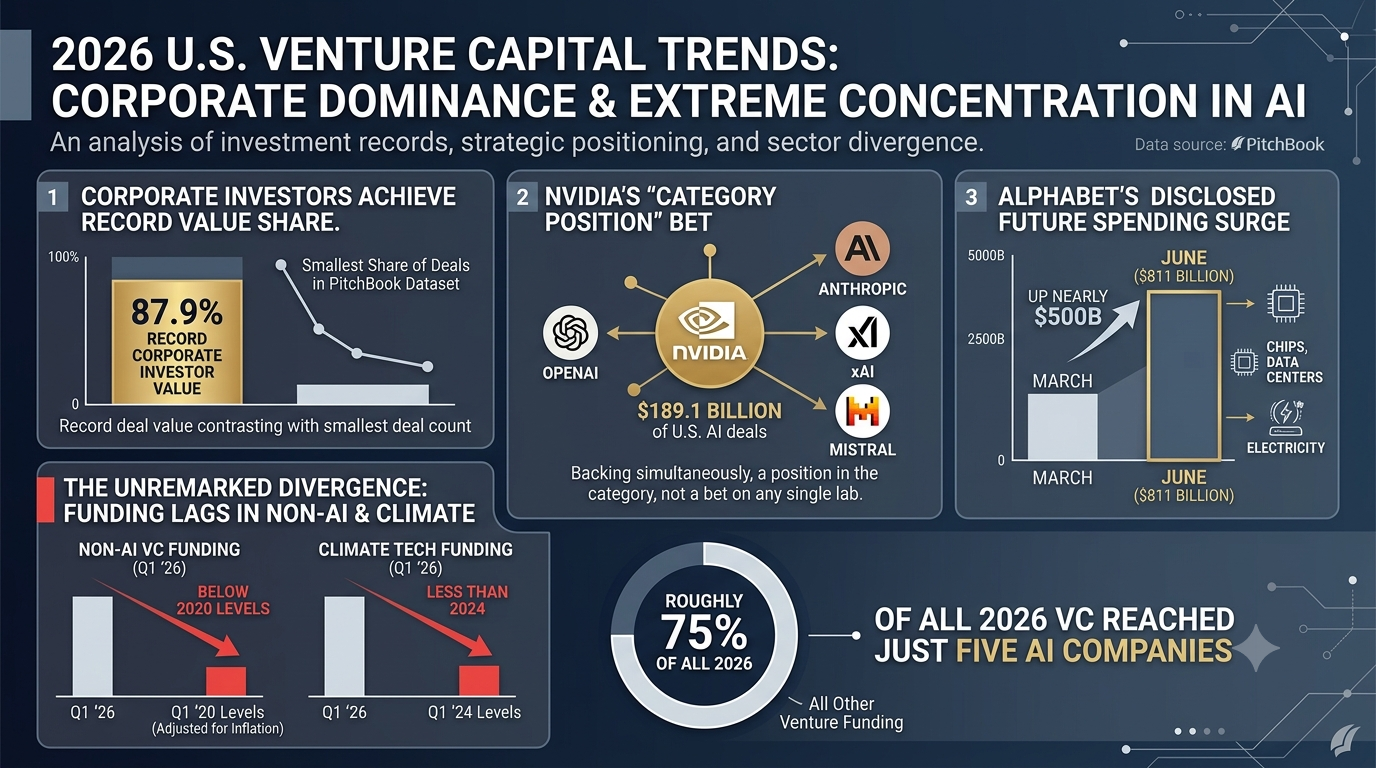
Corporate investors accounted for a record 87.9% of U.S. AI venture deal value so far in 2026 while taking part in the smallest share of deals in PitchBook's dataset. Nvidia alone had a hand in $189.1 billion of U.S. AI deals so far this year, backing OpenAI, Anthropic, xAI, and Mistral simultaneously. That is a market-making position in the category, not just a bet on any lab within it. Alphabet disclosed $811 billion in contracted future spending commitments as of June, up nearly $500 billion from March, covering chips, data centers, and electricity. However, the boom in AI funding obscures the dearth of funding outside that sector. Adjusted for inflation, venture funding outside the AI category in the first quarter of 2026 fell short of first-quarter 2020 levels, and climate technology raised less than it did in the first quarter of 2024. By one industry estimate, roughly 75% of all 2026 venture capital reached just five AI companies.
THE STAKES
Corporate venture capital is the instrument through which large industrial firms fund technologies adjacent to their own supply chains, which is why its reallocation matters more than a comparable move by financial investors with regard to near-term revenue impacts. When a strategic buyer withdraws from a category, that category loses its most informed customer alongside its capital. The categories in question include the ones with the longest development horizons: advanced materials, industrial automation that carries no AI label, early biotechnology tooling, and climate hardware. Financial venture capital could substitute in principle, but the non-AI pool is below 2020 levels in real terms, so there is no offsetting bid.
The declines are so consequential because these types of hardware-intensive technologies run seven to 12 years from seed funding to industrial deployment. That runway would place the output of a 2025 and 2026 funding gap in the early 2030s, in the same window when decarbonization commitments, defense industrial base rebuilding, advanced manufacturing, and materials substitution programs all come due. All four will depend on technologies that need to be funded now so they exist then. This does not yet account for hardware meeting AI for the next industrial growth frontier of Physical AI and AI in bio-informatics, medicine, human augmentation, and other promising areas. Breakthrough innovation tends to happen where domains and disciplines intersect, so capital allocation decisions made on quarterly logic now could expand or narrow the option set available to governments on critical strategic growth questions a decade out.
Nvidia is the strongest counterargument to the defunding thesis. Through its Isaac robotics platform, Omniverse simulation environment, and Cosmos world models, Nvidia is actively investing in the intersection of AI with physical hardware: industrial automation, surgical robotics, autonomous vehicles, and manufacturing. At GTC 2026, CEO Jensen Huang declared a ChatGPT moment for physical AI and announced partnerships with ABB, FANUC, Medtronic, Universal Robots, and dozens of robotics companies. If Nvidia's platform strategy succeeds, AI capital may circulate back into physical-world applications rather than remaining confined to software. The question is whether platform-level investment from one company substitutes for the direct venture funding that hundreds of early-stage hardware companies need at the Series A and B stages.
The investment concentration also creates a second effect inside the AI category itself. When the marginal buyer is a strategic investor creating a market but indifferent to which competitor prevails, valuations stop carrying information about relative quality and start reflecting the buyer's desire to hold the category. Nvidia funding four competing laboratories is rational for Nvidia and uninformative for everyone using those marks as comparables. This matters as the leading laboratories approach public markets, because public investors will inherit valuations set by buyers whose return requirement was strategic access rather than financial return, and those two requirements price the same asset very differently.
What to Watch
Watch whether corporate venture deal count rises while deal value falls, which would be the first genuine sign of normalization rather than continued concentration. Track the climate technology Series B gap specifically, since it is the earliest visible failure point in the pipeline: climate technology has the most public commitments attached to it, including Paris targets, E.U. Green Deal objectives, and corporate net-zero pledges due in the early 2030s, and the most measurable gap between committed spending and actual funding. The Series B stage is where capital-intensive hardware companies need to move from prototype to pilot production, requiring $20 million to $50 million per round, exactly the range that has migrated to AI deals. Follow whether any sovereign or development institution steps deliberately into the non-AI gap, as European and Japanese programs have the mandate to do but have not done so far at scale. Watch Nvidia's disclosed carrying values on its laboratory positions as those companies approach public listing, because the first mark-to-market against a public price will show whether strategic and financial valuations were ever describing the same thing. And follow the corporate venture investor count rather than the dollar totals, since a contracting number of participants writing larger checks is a different market from a stable number concentrating its bets.
About Cambrian

Cambrian Futures is a strategic foresight and advisory firm helping government, business, and technology leaders understand how emerging technologies intersect with geopolitics, markets, and national strategy. By combining rigorous research, AI-enabled analysis, and human expertise, Cambrian provides clear insight into global technology trends, risks, and power dynamics. Its work helps decision-makers anticipate disruption, manage uncertainty, and act with strategic confidence in an increasingly competitive GeoTech world.
PRODUCTION TEAM
GeoTech Radar is produced by the Cambrian Futures Insights Platform team:

CEO & Chief Analyst

Managing Director / Producer, Insights Platform

Global Lead, Smart Infrastructure Strategy

Research & Marketing Associate

Editor in Chief
Learn more about Cambrian Futures at cambrian.ai
Produced with

Human Led



Human Led +
AI Augmented




AI Led +
Human Verified


Cite as: Cambrian Futures (2026) 'GeoTech Radar Issue 30'
An important note on what this is, and is not
GeoTech Radar is directional research intended to stimulate thinking and provide geopolitical and technological context. It is not investment, legal, or financial advice, and nothing here is a recommendation to buy, sell, or hold any security or asset. The companies, valuations, and transactions discussed are described for analytical context only and serve as a backdrop to readers' own due diligence. Figures and claims are drawn from public reporting as of the publication date and may change. Readers should consult their own qualified advisers before making any decision. Cambrian Futures and the authors hold no responsibility for actions taken on the basis of this briefing.