

NATO Rearms for the Drone Age as Beijing Weighs an AI Wall
IN THIS ISSUE:
CEO's Perspective
Strategic outlook from Cambrian leadership

I spent time this past week with the C-level founders of Signals2Scenarios in Europe. Our conversation kept returning to a problem General Counsels and CFOs across the EU, the U.S., and Asia now share. The stated perimeter of a sanction, i.e. the geographic or organizational boundary of a license, a procurement rule, or an industry code no longer describes where the actual activity flows, because code, data and workloads get distributed and diffused too easily or aren’t easily monitored or reversible. That gap between sanctioned geographic parameters is where losses – based on missed licensing revenue or compliance penalties – accrue, and they will be landing on GC’s and CFO's desk first, who have to budget and account for them. The tools the legal and finance functions were built to run assume perimeters that hold or are stable for a while. They do not.
The Perimeter No Longer Describes the Flow
The mismatch shows up across each of the topics in this issue. Beijing is considering a wall around its top open-weight and proprietary models the same week Chinese systems overtake U.S. usage share on OpenRouter. China may be shrinking the perimeter of a market it is already dominating globally. Meanwhile, the U.S. Commerce Department moved the UAE into the exclusive closest-ally export tier the same week the Financial Times documented that OpenAI and Google are selling to Singapore units of Alibaba, Baidu, and Tencent. The perimeter expands deliberately in the Gulf and leaks passively in Southeast Asia. All 193 UN member states demanded a ban on autonomous weapons the same week NATO committed $40 billion to counter-drone systems that assume autonomous adversaries. The normative ethics perimeter and existential defense procurement perimeter describe the same technology with incompatible rules. In Ankara, the US defense manufacturing perimeter expanded outward with ATACMS being licensed to Germany and Patriot being licensed to Kyiv, while the US conventional security guarantee perimeter is quietly contracting. Allies bought American licenses while planning for American absence. And in Africa, half the phones sold stream device telemetry to Chinese servers, sending data across borders where no African regulator can protect their citizens.
In previous weeks, toll booths went up, then gatekeepers saw actors circumventing them, and finally the innovation topography rebalanced. This week the perimeter drawn to govern the old topography no longer contains the new one. The instruments of export controls and regulations aren’t adjusting to follow the traffic.
Stop reading policy through the maps that generated it and proactively draw new parameters. Assume policy and regulations will move in due course and plan compliance and budgeting scenarios around those. Look at every control regime your operations depend on, sanctions, procurement rules, export licenses, industry codes, and ask where the perimeter has come apart from the flow it was drawn to govern. If your compliance function is still optimizing to the stated design, you are protecting yourself against last decade's distribution of activity. The actual distribution is elsewhere. And the government instruments will be redrawn to match it, on someone else's schedule and in someone else's interest, unless you have already priced where the redraw lands.
Olaf
On the Radar
The signals affecting the GeoTech landscape this week
NATO's Ankara Summit Puts $50 Billion in New Orders and a $40 Billion Drone Program Behind Europe's Rearmament
The alliance turned burden sharing into industrial policy in Turkey this week.
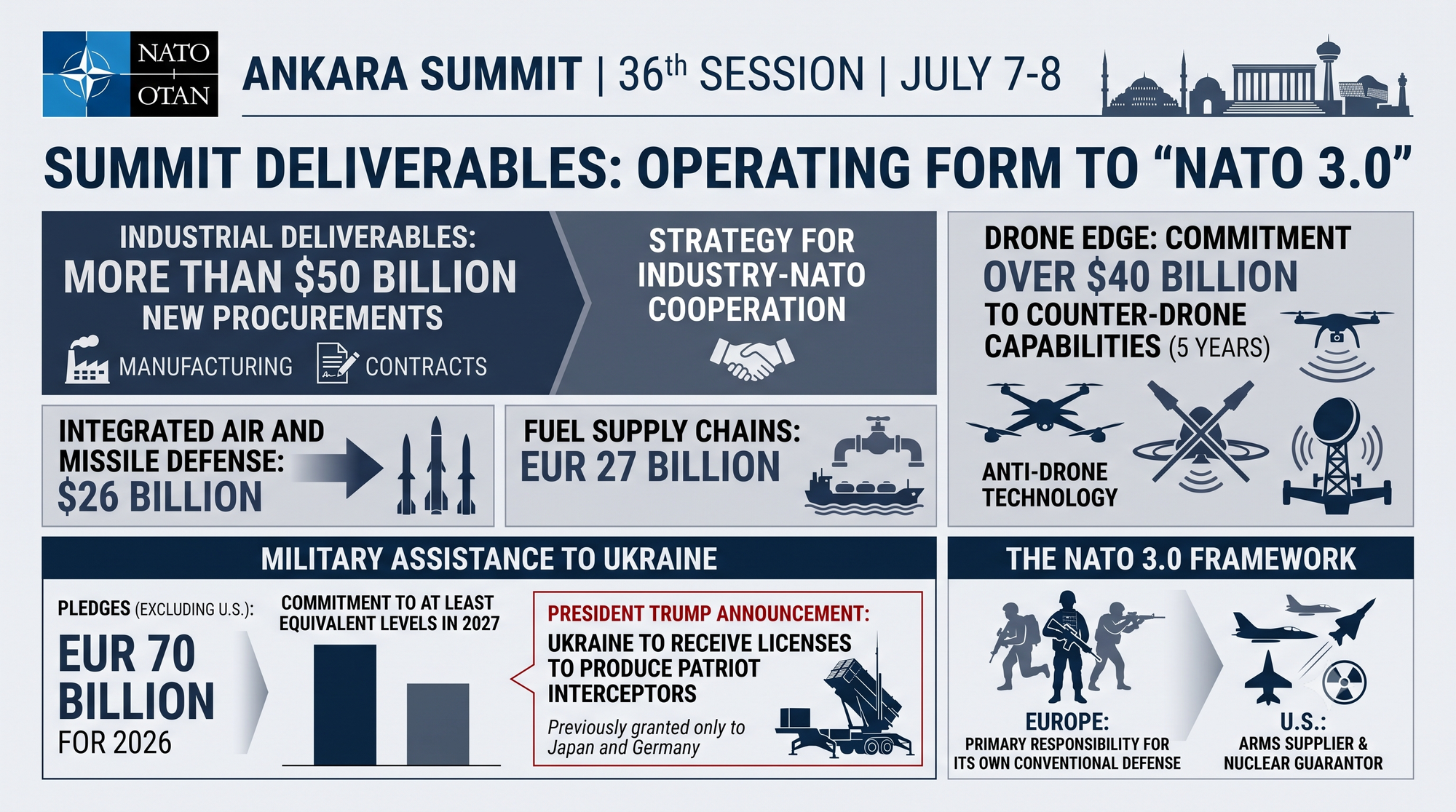
TL;DR: NATO's 36th summit delivered more than $50 billion in new procurements, a $40 billion counter-drone program, and an $80 billion pledge to Ukraine for 2026. Meanwhile Patriot production licenses and missile co-production deals move defense manufacturing onto Ukrainian and European soil.
BRIEFING: Thirty-two heads of state met in Ankara on July 7 and 8 for NATO's 36th summit. Allies announced more than $50 billion in new procurements, including Northrop Grumman Triton surveillance drones, Saab GlobalEye early-warning aircraft, and 900 Patriot interceptors. They also endorsed the Strategy for Industry-NATO Cooperation and launched Drone Edge, a separate program committing over $40 billion to counter-drone capabilities across five years. Integrated air and missile defense drew a further $26 billion and fuel supply chains $31 billion. Allies excluding the U.S. pledged $80 billion in military assistance to Ukraine for 2026 and committed to at least equivalent levels in 2027. President Trump announced that Ukraine will receive licenses to produce Patriot interceptors, a permission previously granted only to Japan and Germany. Lockheed Martin and Rheinmetall drafted an agreement to build ATACMS missiles in Germany, the first manufacture of that weapon outside the U.S.
The summit gave operating form to what the Pentagon calls NATO 3.0, in which Europe assumes primary responsibility for its own conventional defense while the U.S. serves as arms supplier and nuclear guarantor. Munich-based Helsing is raising at a valuation near $18 billion, Germany's parliament approved a $250 million AI systems contract for the firm, and its attack drones cost roughly $20,000 against $100 million for a crewed fighter. European rearmament is migrating toward venture-backed manufacturers and co-production plants on European soil, financed by the European Union's roughly $920 billion ReArm Europe framework (EU, not NATO, money) and national budgets converging on the 3.5% core target, which only five allies have reached so far, led by Poland and the Baltics, while Spain and Italy lag well behind. The unresolved critical question is trust between European NATO members and their indispensable American partner. A U.S. review of its roughly 80,000-troop European posture runs through year-end, and allies who buy American licenses while planning for American absence are doing both for the same reason, resilience in the face of continued U.S. decommitment.
SO WHAT
For Executives: Map your exposure to the ReArm Europe pipeline now, because the pull into dual-use supply chains is happening at the component level, from carbon fiber and optics to machine vision and battery packs. Suppliers that never considered themselves defense firms are inheriting export-licensing obligations, security vetting requirements, and customer concentration questions in a single contract cycle. Assign ownership for dual-use compliance before the first order arrives, and audit which of your products already sit inside someone else's defense bill of materials. Hedge: Procurement still moves at government speed even when the announcements do not, and a negotiated settlement in Ukraine would compress order books. Anchor capacity decisions in capabilities with civilian crossover, such as counter-drone systems for airports and critical infrastructure.
For Policy Makers: Treat co-production licenses as the new alliance currency. The Patriot precedent will draw immediate requests from Poland and the Baltic states, and the terms that matter most are intellectual property and iteration rights. Assembly is no consolation prize either, since licensed production builds the skilled workforce and certified processes that could seed a broader European smart-manufacturing base. Whoever owns the battlefield feedback loop owns the next product generation, which is the quiet lesson of Helsing's Ukraine deployments. The U.S. force posture review will set the tempo for every European procurement decision, and the $170 billion SAFE loan program, another EU instrument, is already tilting purchases toward European suppliers. Expect buy-European pressure and American license offers to compete head-to-head in every major tender.
For Investors: Price defense tech for a long buildout rather than a news cycle. The $40 billion counter-drone line is a five-year revenue commitment with named procurement channels, and Helsing's roughly $18 billion valuation reprices the entire European cohort, including Quantum Systems and the Rheinmetall supplier base. Watch how procurement flows into order books over the next 12 to 24 months, because the gap between announced programs and booked contracts is where this cohort's private marks will be tested. Publicly traded mid-sized defense manufacturers with co-production contracts offer the same trend at valuations you can actually see, unlike private marks. And a note allocators should read twice: no German or EU law bars venture funds from investing in defense. The binding constraint sits in fund documents, since many established European funds, above all those backed by the European Investment Fund, carry limited-partner exclusions on weapons and ammunition. Those clauses are loosening fast, with the EIF now backing defense-tech funds through a dedicated Defence Equity Facility and even single-use military technology, but weapons and ammunition remain excluded, so diligence starts with the LP agreement rather than the pitch deck. Hedge: These valuations assume sustained conflict and rising budgets. A ceasefire or U.S. re-engagement under a future administration could compress them quickly, and Helsing's own co-founder calls the space noisy. Underwrite to booked government contracts rather than addressable-market narratives. Also, monitor for collisions of certain NATO member strategies (e.g. Turkey) with U.S. goals in the Middle East and their impact on U.S. licenses across all NATO members.
For Service Providers: Germany's rebalancing from automotive to defense manufacturing is now a workforce, communications, and governance assignment rolled into one. Helsing staffs its drone factory partly with laid-off carworkers, and every industrial client entering defense faces the same double message: secrecy about locations, capabilities, and dual-use dilemmas alongside publicity about local hiring and patriotic purpose. Pre-draft that narrative before municipal politics writes it first. Defense entrants also need security-vetted communications practices, from press access protocols to employee social media policy. Boards reversing longstanding ESG defense exclusions need documented reasoning and negotiated deals that will withstand both activist scrutiny and shareholder challenges at the next annual meeting.
Beijing Weighs Blocking Foreign Access to Its Own AI Models as Chinese Systems Overtake U.S. Usage Share
The world's most adopted AI may be about to go behind a wall.
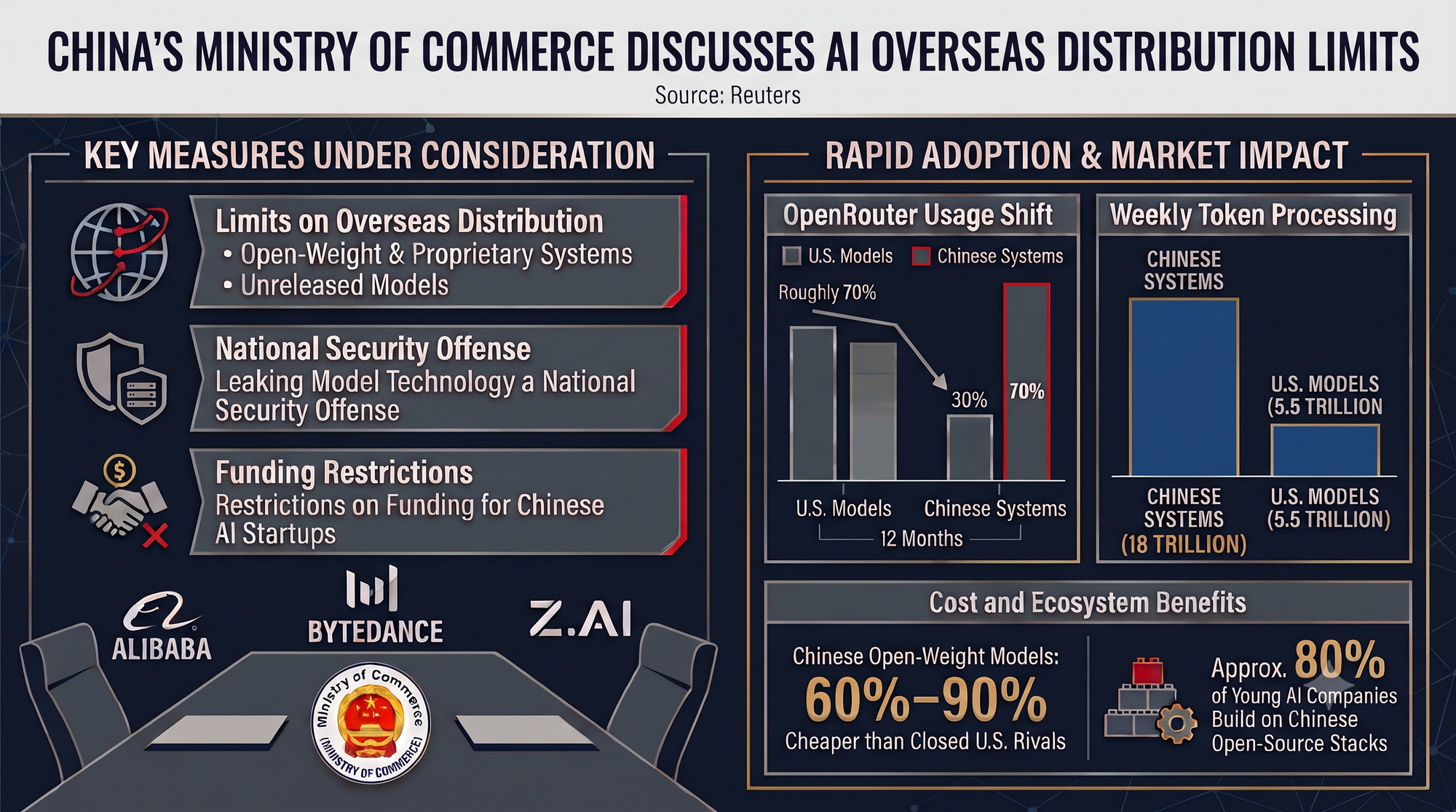
TL;DR: Reuters reports China's Ministry of Commerce has met with Alibaba, ByteDance, and Z.AI about restricting overseas access to the country's most advanced AI models weeks after Chinese systems overtook American models' share of global usage.
Briefing: China's Ministry of Commerce has convened the country's leading AI developers, including Alibaba, ByteDance, and Z.AI, to discuss limits on overseas distribution of top Chinese models, according to Reuters. The measures under consideration cover both open-weight and proprietary systems, including unreleased ones. New proposals would make leaking model technology an offense under national security law and restrict who can fund Chinese AI startups. The deliberations land at a remarkable moment for adoption. On OpenRouter, a marketplace where companies buy access to many AI models through a single connection and can switch among them, making it a real-time gauge of which models businesses actually use, American models fell from roughly 70% of usage to 30% in 12 months. Chinese systems now process around 18 trillion tokens weekly against 5.5 trillion for U.S. models, in part because Chinese open-weight models run 60% to 90% cheaper than closed-model U.S. rivals. Chinese developers now out-download American ones on Hugging Face, and Andreessen Horowitz's Martin Casado estimates that around 80% of young AI companies build on Chinese open-source stacks. Last week, GTR reported that Microsoft had also struck a deal with China’s DeepSeek. On the American side, OpenAI released its strongest model to just 20 government-approved partners, following Anthropic’s approach of tiered releases for the sake of cybersecurity testing.
Both powers now treat frontier models as sovereign assets, and the walls are rising on each side of the Pacific at once. The timing puzzle cuts against a full shutoff. Restricting exports now would dilute an adoption lead just as it compounds, which is why the likelier outcome is licensed distribution with approved buyers rather than closure. Chinese legal signals point the same way. A Supreme People's Court dialogue on intellectual property no longer presumes open source is pre-competitive and states an ambition for China to write the global rules of AI open source. The exposure is widest in the Global South, where sovereign AI programs assume a continuous flow of frontier open-weight releases. If that flow slows, U.S. open-weight alternatives such as Nvidia's Nemotron and Google's Gemma could inherit demand overnight. Enterprise economics drove the migration in the first place. Agentic workloads have sent token costs compounding faster than measured productivity gains, and the cheap fix was Chinese efficiencies. Talent is a second current running in the same direction. Berkeley Nobel laureate Omar Yaghi is leaving for Tsinghua University to lead an AI-driven materials discovery institute, battery scientist Shirley Meng has traded the University of Chicago and Argonne for Singapore, and the backdrop is roughly 7,800 NIH and NSF grants cancelled or suspended in this year's U.S. funding pullback.
So What
For Executives: Inventory every workload running on Chinese open-weight models this quarter, and separate the two exposure classes: self-hosted weights and Chinese-hosted APIs. If you downloaded the model and run it on your own servers, Beijing cannot take it back. What you lose is access to future versions, so the model you hold slowly falls behind. API dependencies on Chinese-hosted services face immediate cutoff risk. Contract for fallbacks now, stand up routing infrastructure that can shift traffic between model families, and run one production workload through a migration test so you know the actual evaluation deltas and switching costs. Hedge: Current model versions stay usable whatever Beijing decides, so the exposure is to future capability rather than present operations. Do not let that comfort become inaction: budget a quarterly evaluation of U.S. and European open-weight alternatives and set the capability threshold that would trigger migration, which prices the gap at a fraction of a premature move.
For Policy Makers: Track adoption share as the diffusion metric that decides standards, because it is the one both capitals are now managing. Two gated superpowers leave third countries choosing on availability, and the American open-weight portfolio consists of corporate side projects rather than a policy instrument like China’s. A deliberate U.S. open-weight strategy, whether through procurement guarantees or public compute for open releases, is the direct response to a Chinese restriction. Europe already runs a version of that play, with the EU-funded OpenEuroLLM consortium and Switzerland's Apertus releasing open weights trained on public supercomputers, and with French state backing part of the Mistral story. Coordination with allies matters equally, since sovereign clouds in the Gulf and Southeast Asia already run Chinese weights at scale, and their upgrade decisions will be made in the next 12 months.
For Investors: Position for model plurality, and be specific about the beneficiaries. Model routers, fine-tuning platforms of the Tinker class, inference providers hosting mirrored open weights outside China, and the Nemotron and Gemma ecosystems gain under every version of a Chinese restriction. Application companies with a single Chinese-model dependency inherit a new supply risk, and Chinese AI listings raising abroad (e.g. MiniMax's $2 billion raise) now carry a policy discount that their prospectuses do not yet price. The near-term tell is MiniMax's open-source decision on its rumored M3 Pro. A restriction also hands pricing power back to U.S. closed-model labs just ahead of their public listings. Hedge: The Reuters sourcing describes deliberations rather than decisions, and Beijing has softened tech crackdowns before when adoption momentum was at stake. Even a finalized rule would likely be enforced with Beijing's customary discretion, a risk of its own but a different one from a blanket shutoff. Size positions to the licensing scenario rather than the shutoff scenario.
For Service Providers: Most clients discovered their Chinese-model dependencies by accident, which makes the audit the product. Offer model provenance mapping, export and sanctions classifications, and a tested migration path priced before any restriction lands. The premium version of that audit adds a repeatable testing rig that scores candidate replacement models against the client's own real workloads, since generic leaderboards will not survive a procurement committee. Governments in the Global South with sovereign AI programs built on Chinese weights need contingency advisory now, and firms that can map obligations under both the U.S. and Chinese regimes at once will find little competition, because almost everyone tracks only one side.
U.S. Opens License-Free AI Chips to the UAE While Its Models Reach China Through Singapore
One export perimeter, two open doors.
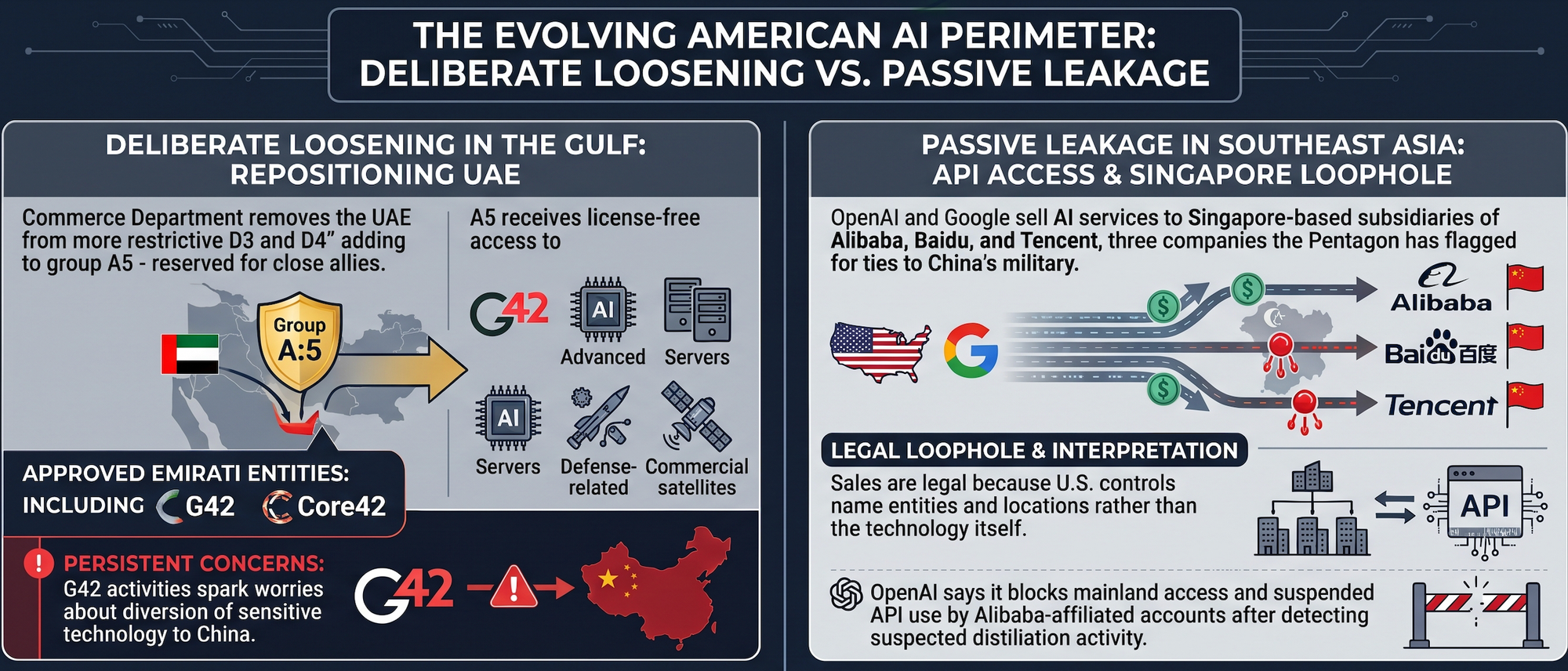
TL;DR: The U.S. Commerce Department moved the UAE into Country Group A:5, giving Abu Dhabi-based G42 license-free access to advanced AI chips. The same week, a Financial Times investigation showed OpenAI and Google selling AI services to Singapore units of Alibaba, Baidu, and Tencent.
Briefing: Effective July 10, the Commerce Department removed the UAE from more restrictive export regulations to Country Group A:5, the tier reserved for close allies. The change gives approved Emirati entities license-free access to advanced AI chips, servers, defense-related items, and commercial satellites. The attendant designation of the UAE as a U.S. Major Defense Partner opens the procurement channels for G42 and Core42 (G42’s sovereign compute infrastructure subsidiary covered in last week’s GTR). Sen. Elizabeth Warren attacked the G42 provision and the favorable treatment promised to state fund MGX, citing reported concerns about diversion of sensitive technology to China. The same week, a Financial Times investigation confirmed that OpenAI and Google sold AI services to Singapore-based subsidiaries of Alibaba, Baidu, and Tencent, three companies the Pentagon has flagged for ties to China's military. The sales are legal because U.S. controls name entities and locations rather than the technology itself, which leaves room for interpretation. OpenAI says it blocks mainland access and suspended API use by Alibaba-affiliated accounts after detecting suspected distillation activity.
The American AI perimeter is being loosened deliberately in the Gulf and leaking passively in Southeast Asia, showing that the controls drawn around entities and geography cannot govern technologies that move by corporate structure and API call. The Pentagon's restricted list, the entity-based arm of the same control system rather than a new geographic one, ballooned from 20 companies to 188 in its June revision, and a federal judge has stayed Alibaba's designation while a constitutional challenge proceeds. Courts are finding the entity approach too blunt at the same time cloud access shows it as too porous. The UAE upgrade also sets a price. A:5 status is now the visible reward for alignment with U.S. security operations, and other AI-ambitious states will bid for it. Expect the control debate to shift from chips toward model access and the data flows behind it, the still unlegislated third layer moving through the same offshore seams, a question the Financial Times investigation has pushed back onto the agenda in Congress.
So What
For Executives: Map AI service and data exposure by jurisdiction and by corporate parentage, because the legal perimeter follows both. A Singapore entity with a Shenzhen parent is a compliance question today and possibly a prohibited counterparty tomorrow. Add ultimate-parent screening to counterparty onboarding, write re-export and change-of-control clauses into AI service agreements, and screen against the Pentagon's 188-company restricted list, even where the law does not yet require it. After all, reputational standards are moving ahead of legal ones. Apple lobbying for permission it does not technically need shows how far the chilling effect already reaches. Hedge: The Alibaba judicial stay shows designations can be frozen or reversed on appeal, so build screening as a living process with review triggers rather than a one-time purge that strands relationships.
For Policy Makers: Treat the UAE upgrade as precedent with a price list attached. Riyadh will ask next, and the answer determines whether A:5 status becomes the standing currency of AI diplomacy. The credibility of the trade depends on verification, meaning continuing security conditions on G42 and Core42 with consequences that survive a change of political mood. Closing the Singapore seam is the harder problem, because controls on services do not exist as a regime and a unilateral version simply moves the routing to the next hub. That requires plurilateral machinery, meaning a small-group agreement among the handful of hub states rather than a global treaty, built with Singapore rather than around it. The FT investigation just supplied the legislative momentum.
For Investors: Gulf compute is de-risked at the policy layer, and the beneficiaries run down the whole stack, from G42 and Core42 capacity plays to U.S. chip and server suppliers gaining a license-free demand channel just as American domestic capex questions get louder. Emirati data center and power infrastructure now carries a policy tailwind that Saudi equivalents lack, and whether Riyadh achieves parity is the variable that would double the de-risked market. MGX's U.S. deployments, above all its equity stake in the Stargate data center buildout, carry the political scrutiny Sen. Warren just attached to them, which is a diligence item for any vehicle taking its capital. Hedge: The Warren objection previews a congressional review vector, and a single documented diversion incident could reverse A:5 treatment faster than it was granted, so favor exposure with contractual protection against status reversal and priced exit paths.
For Service Providers: Export-control classification for AI services is about to become a practice area, and the early clients are cloud resellers and model providers with Asian subsidiaries (followed by their auditors). Build the know-your-customer (KYC) product for API access, ultimate-parent screening, usage monitoring, and documented enforcement, because model providers will need to demonstrate what OpenAI has claimed about mainland blocking and suspected distillation. Productize the Singapore-seam review and mitigation solution for legal and audit clients. For European clients selling into Gulf AI buildouts, the offer is dual-regime navigation of the U.S. re-export rules layered over EU dual-use obligations – a combination almost no mid-market firm can currently map on its own.
The UN's Geneva Dialogue Demands an Autonomous-Weapons Ban the Week NATO Budgets $40 Billion to Defend Against Them
Rearmament and restraint are now running on the same calendar.
TL;DR: All 193 United Nations member states convened in Geneva for the first global AI governance dialogue, where Secretary General António Guterres called autonomous weapons morally repugnant and demanded a ban under international law. The meeting came just days before NATO committed more than $40 billion to counter-drone defenses.
Briefing: The UN held its first global dialogue on AI governance in Geneva with all 193 member states present. Secretary General António Guterres called autonomous weaponry, machines that select and engage targets and take life without human control or judgment, “morally repugnant,” demanded it be banned under international law, and insisted that decisions to take human life “must remain human forever.” He warned that AI is advancing at “runaway speed” and described “an experiment being run on our societies without a plan and without consent.” The practical target is AI-assisted target selection, which featured prominently in the recent U.S.-Iran conflict. The dialogue also introduced a child-safety pledge, asking developers to commit to child-safety testing, zero tolerance for exploitation imagery, and accountability when harms occur. A parallel private-sector track is forming, with a UN commission on AI co-chaired by Salesforce's Marc Benioff assembling technology executives. In the U.S., Illinois became the third state, after California and New York, to pass a catastrophic-risk AI law, and the first anywhere to mandate annual independent safety audits, which begin in 2028. Lawmakers estimate the three states together cover roughly 40% of the American AI market.
AI governance is bifurcating into procurement facts and normative pledges, and the two approaches often conflict. The NATO summit in Ankara committed $40 billion to defeating drones, while the UN in Geneva demanded limits on autonomous weapons, and both are accurate readings of the same technology. As a forum of 193 states, the UN dialog gives the Global South a seat that the G7, OECD, and NATO processes never offered, offering the floor to the states most exposed to AI harms they did not create. The missing piece remains the actual signing of a binding resolution with appropriate enforcement measures. Prior UN efforts on lethal autonomous weapons stalled for a decade inside the Convention on Certain Conventional Weapons, and the governments investing most heavily in autonomy have the least incentive to bind themselves. The instruments to watch are the quieter ones. Independent audit mandates of the kind contained in Illinois’ legislation give negotiators a verification template that weapons talks have always lacked, while pledge regimes give procurement officers a paper trail. Norms rarely stop the first deployment, but they usually price the second.
So What
For Executives: Expect pledge regimes to surface in procurement across borders within the year, in government RFPs first and enterprise contracts shortly after. Designate a single owner for AI-norms compliance now, whether in the general counsel's office or public policy. Inventory which of your products touch targeting, surveillance, or minors, because those three categories are where voluntary pledges harden into contract terms first. Signing the child-safety commitment, or preparing a documented explanation for opting out of it, is cheaper when done deliberately than under deadline. Hedge: None of the Geneva instruments bind yet, so the cost of early signature is low and the option value is high, while conspicuous refusal is the expensive position.
For Policy Makers: Illinois's independent-audit requirement gives treaty negotiators a verification template that autonomous-weapons talks have lacked for a decade, and exporting it into multilateral discussions costs less than building a new institution. The venue shift matters as much as the content, because a 193-state forum hands agenda-setting power to the Global South. Rather than press against key challenges, the Western delegations should arrive with answers for relevant issues such as data sovereignty, harm redress, and access to compute. The delegations that engage those items stand a greater change of writing the norms.
For Investors: Defense AI now carries normative beta, and it will price unevenly. Portfolio companies selling autonomy into targeting workflows face a debate about potential bans, with European limited partners applying dual-use screens faster than American ones. Expect fund-level bifurcation before any treaty text exists. The constructive side is a compliance-services market with a visible revenue calendar, since the Illinois audit mandate starts in 2028 and assurance firms, evaluation labs, and audit-tooling startups are the direct beneficiaries. Which labs sign the child-safety pledge is a governance-quality signal worth reading ahead of the public AI listings now queuing. Hedge: UN processes stall as often as they bind, so weight enforceable state-level audit laws over Geneva declarations in any underwriting model, and treat the call for a ban as sentiment rather than schedule. Study the processes of rough comparables, such as the CFC, landmine, and biochemical weapons bans, to gauge timelines and tipping points.
For Service Providers: Norm-tracking is billable, and the window for owning it is short. Clients need a single living map of UN pledges, state audit laws, and EU obligations, and no firm owns that document yet. Audit-readiness engagements ahead of the Illinois 2028 start date (and similar laws being passed in states like CA, CO, or NY to create precedents on requirements and safeguard techniques) are the concrete near-term product. Pledge-gap analyses should follow to show boards exactly where their public commitments and actual practices diverge. For communications clients with defense exposure, the Ankara-Geneva contrast is the frame their stakeholders will use, so prepare positioning that holds deterrence and restraint in the same statement. Clumsy handling of that tension is now a visible reputational risk.
Under the Radar
The deep analysis that connects the dots
Half the Phones Sold in Africa Stream Device Telemetry to Chinese Servers
The Signal
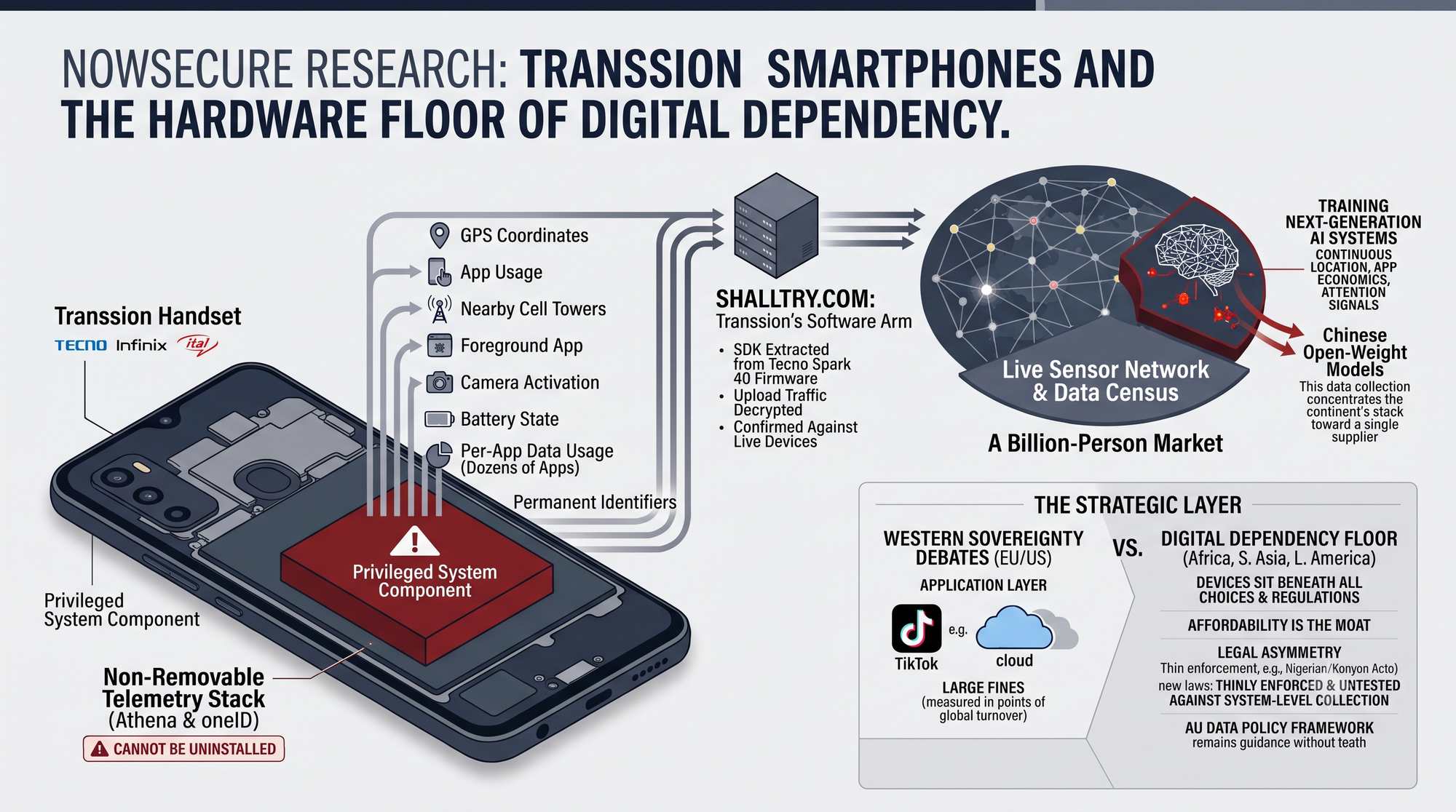
Security firm NowSecure published research on July 8 showing that Transsion, the world's fourth-largest smartphone maker by volume, ships an unremovable telemetry stack as a privileged system component on its Tecno, Infinix, and itel handsets. Together, those product lines account for nearly half of smartphones sold in Africa and a growing share across South Asia and Latin America. The framework, known as Athena for data collection and oneID for cross-app tracking, transmits GPS coordinates, app usage, camera activation, and battery state data, all bound to permanent identifiers, to server endpoints under shalltry.com, the domain of Shalltry, Transsion's Shenzhen-based software arm. Researchers extracted the software development kit from a Tecno Spark 40 firmware image, decrypted the upload traffic, and confirmed the findings against live devices. The same code ships as an SDK inside popular consumer apps including Boomplay and StarTimes, extending collection beyond Transsion's own hardware. The stack cannot be uninstalled. The only available mitigation is network-level blocking of the domains, an option open to carriers and enterprises but not to ordinary users. Researchers documented preinstalled malware on China’s Tecno handsets in African markets as early as 2020, but the new research indicates sanctioned first-party architecture rather than third-party compromise.
THE STAKES
This is the hardware floor of digital dependency. Western sovereignty debates concern the application layer, from TikTok to cloud contracts. This type of device-level collection sits beneath every choice a user can make and every app-level regulation a government can write. The legal asymmetry is the point. Conduct of this kind inside the EU would invite fines of up to 4% of a company's worldwide annual revenue under the GDPR, while legislation and enforcement in Africa carries too little weight. Nigerian and Kenyan data-protection laws are new, thinly enforced, and untested against system-level collection by a device maker, and the African Union's Data Policy Framework remains guidance without enforcement teeth. Transsion dominates precisely because its handsets cost what first-time buyers there can pay, which means the population being mapped is the one least able to switch to alternatives. Continuous location, app economics, and attention signals across a billion-person market amount to a live sensor network over the fastest-growing consumer population on earth, exactly the sovereign, physical-world data this letter has argued will train the next generation of AI systems. Set alongside Chinese open-weight models spreading through sovereign AI programs, and the continent's digital stack is concentrating toward suppliers from a single nation, China, at every layer from the handset up. Whoever holds the telemetry holds a census that neither regulators nor competitors can currently see.
What to Watch
Closely monitor responses from Nigeria's Data Protection Commission and Kenya's Office of the Data Protection Commissioner, the two African regulators with the most capacity to act, and track whether either treats system-level collection as a test case for laws written with apps in mind. The key is whether any government or carrier compels firmware changes, disclosure, or DNS-level blocking at network scale. Transsion's formal response and any movement in its Shenzhen-listed shares would signal that investors see regulatory exposure rather than a research story. Also look for independent replication of the NowSecure findings, which stand as the sole primary source for now and should be treated accordingly. U.S. or European tech diplomacy could pick up the case as an argument in the contest over African digital infrastructure for the 1.6 billion people who are often held to be the future of the global digital economy. So far, handset dependency has escaped the scrutiny applied to networks and undersea cables.
About Cambrian

Cambrian Futures is a strategic foresight and advisory firm helping government, business, and technology leaders understand how emerging technologies intersect with geopolitics, markets, and national strategy. By combining rigorous research, AI-enabled analysis, and human expertise, Cambrian provides clear insight into global technology trends, risks, and power dynamics. Its work helps decision-makers anticipate disruption, manage uncertainty, and act with strategic confidence in an increasingly competitive GeoTech world.
PRODUCTION TEAM
GeoTech Radar is produced by the Cambrian Futures Insights Platform team:

CEO & Chief Analyst

Managing Director / Producer, Insights Platform

Global Lead, Smart Infrastructure Strategy

Research & Marketing Associate

Editor in Chief
Learn more about Cambrian Futures at cambrian.ai
Produced with

Human Led



Human Led +
AI Augmented




AI Led +
Human Verified


Cite as: Cambrian Futures (2026) 'GeoTech Radar Issue 28'
An important note on what this is, and is not
GeoTech Radar is directional research intended to stimulate thinking and provide geopolitical and technological context. It is not investment, legal, or financial advice, and nothing here is a recommendation to buy, sell, or hold any security or asset. The companies, valuations, and transactions discussed are described for analytical context only and serve as a backdrop to readers' own due diligence. Figures and claims are drawn from public reporting as of the publication date and may change. Readers should consult their own qualified advisers before making any decision. Cambrian Futures and the authors hold no responsibility for actions taken on the basis of this briefing.