

Kyiv's Tech Doctrine Fight, Beijing's AI Global South Bloc, and the New Landlords of U.S. Compute
IN THIS ISSUE:
CEO's Perspective
Strategic outlook from Cambrian leadership

On Tuesday I joined the Special Competitive Studies Project's AI+ Discovery summit in Washington, closing the day on a panel about the next 250 years of science. The day’s discussions built toward a question the agenda did not state but underpinned every session: Who sets the speed, collaboration norms and translation mechanisms for AI-driven scientific discovery, and whose cognitive influence guides them? Genesis, the national labs' mission to make AI the engine of American science, is a competitive instrument as much as a research program. How will those dual goals affect policy, commercialization, and basic research?
The Standards War Is the War for Cognitive Influence
This week’s GeoTech Radar underscores how both global superpowers are trying to establish the defaults through which the rest of the world will think, transact, build, and fight. Beijing launched WAICO with 29 founding members and cooperation centers across six regional bodies, from ASEAN to the African Union to CELAC. The output is not simply models, it is a set of defaults for the direction AI development could take – training curricula, certification templates, and procurement norms that install Chinese frameworks before anyone consciously chooses one. Meanwhile, Washington is trying to uphold a payments standard it set by targeting not how Brazil moves money, the first time a tariff has aimed at a sovereign payment rail instead of products or industries. Every government running payment rails, from Delhi to Nairobi, must now contend with the fact that their standard is now subject to trade negotiations. In compute, Meta wants to rent roughly $10 billion of data center capacity to Anthropic over two years, while specialty lender Upper90 extended a $400 million loan to inference startup General Compute with AI chips as collateral. The terms that eventually emerge from these early stage negotiations could set the standard for how compute gets leased and financed across the industry.
Meanwhile, the U.S. is now competing on both the frontier and mature ends of the standards war at once. At the frontier of basic AI science, Genesis and the national labs are racing to keep AI-driven scientific discovery an American stronghold – the layer where Zhejiang University's rise to number one on the Nature Index, covered two issues ago, hit hardest. At the more mature commercial end, India's Dholera fab will open at 90 nanometers, two nodes behind its own announcement. Built on Taiwanese process technology and U.S. and Dutch equipment under the Pax Silica framework, the new fab enters a segment where Chinese is adding capacity fastest and where consumer and industrial demand across the Global South will be won or lost. The standards that govern how science gets done at the top and how chips get fabbed at the base are being contested in the same quarter. In Kyiv, former Defense Minister Mykhailo Fedorov’s approach – rapid experimentation and incremental improvement where speed is the decisive attribute – looks more like the Chinese innovation model than anything in the traditional Western or Euro-Eurasian playbook. His dismissal means €70 billion in allied procurement now flows through a command structure that might revert to the slower, more conventional approach the drone doctrine was built to replace.
The AI models a country trains on, the payment rails its citizens use, the compute terms its enterprises accept, the chip node its fabs can reach, and the military doctrine its forces adopt – all these are forces that shape decisions before anyone makes a conscious choice about norms and standards.
Look at every standard your operations currently run on. The model family. The payment rail. The compute terms. The procurement doctrine. The node your hardware is fabbed on. Ask who set each of those defaults and whose cognitive influence guides them. If you have not chosen deliberately, someone already chose for you. The standards war does not announce itself. It installs itself.
Olaf
On the Radar
The signals affecting the GeoTech landscape this week
Kyiv Fires the Architect of Its Drone War as €70 Billion in NATO Aid Changes Hands
A cabinet reshuffle in Kyiv is really a referendum on whether technology or manpower wins Ukraine's war.
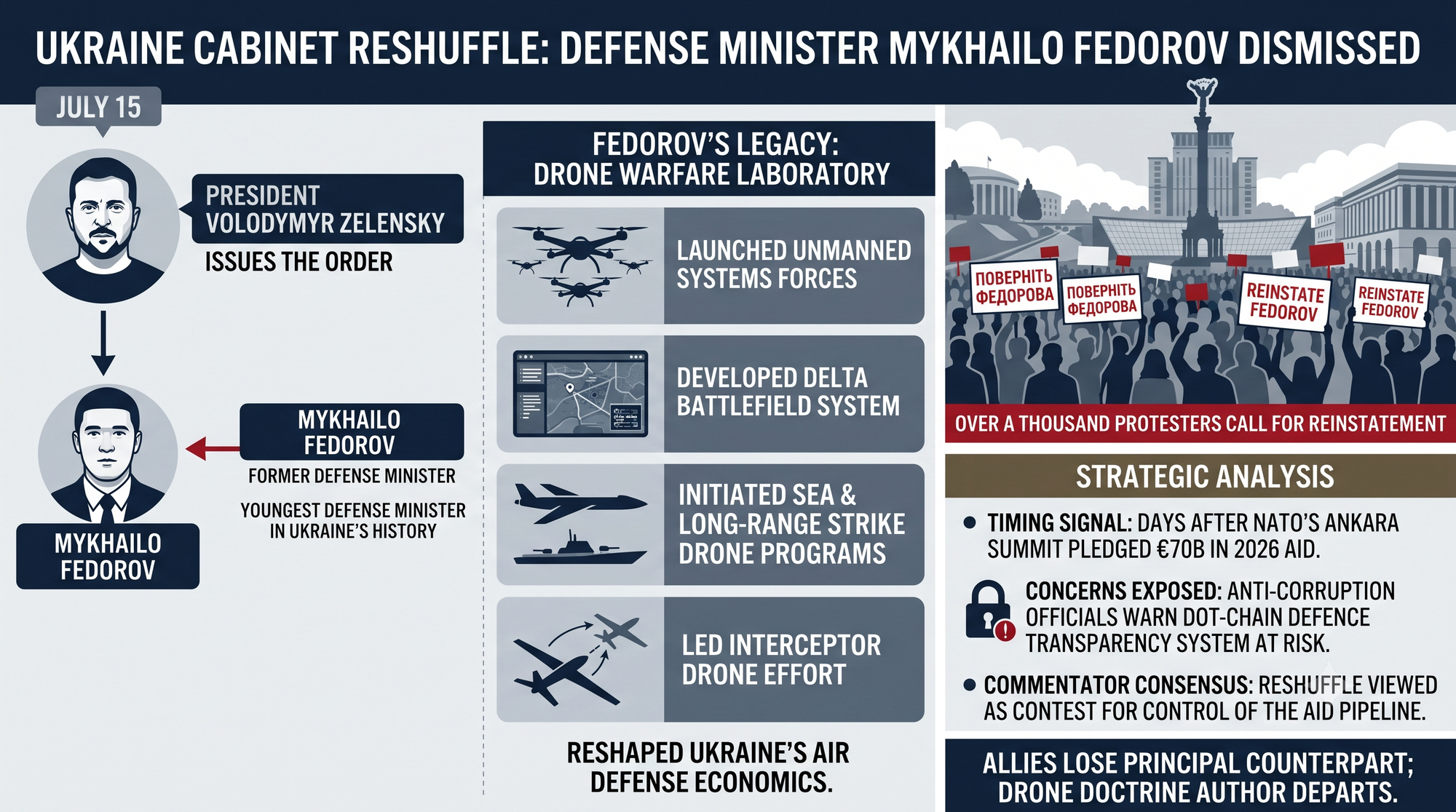
TL;DR: President Zelensky dismissed Defense Minister Mykhailo Fedorov on July 15, triggering six consecutive nights of protests in Kyiv, Lviv, Odesa, Dnipro, and Kharkiv. On July 21 he bowed to that pressure and removed Commander-in-Chief Oleksandr Syrskyi, appointing Major General Mykhailo Drapatyi, the reform-minded officer protesters had been calling for by name. Ukraine lost the author of its drone doctrine and kept the doctrine. Control of NATO's €70 billion 2026 aid pledge now sits with an acting defense minister parliament has not confirmed.
BRIEFING: President Volodymyr Zelensky removed Mykhailo Fedorov as Ukraine's defense minister on July 15, part of a government reconstruction that installed Serhii Koretskyi as prime minister. Fedorov, the youngest defense minister in Ukraine's history, launched the Unmanned Systems Forces, the Delta battlefield system, sea and long-range strike drone programs, and the interceptor drone effort that reshaped Ukraine's air defense economics. At a press conference the next day he said Zelensky had been forced to choose between him and Commander-in-Chief Oleksandr Syrskyi, confirmed that he had pushed to remove both Syrskyi and Chief of the General Staff Andrii Hnatov, and declined the advisory role he was offered. Protests followed on six consecutive nights in Kyiv, Lviv, Odesa, Dnipro, and Kharkiv, demanding Fedorov's reinstatement and Syrskyi's dismissal. The state-backed media organization United24 paused publication to join them, and senior officers resigned, including the deputy commander of the Air Force.
On the evening of July 21, Zelensky dismissed Syrskyi, who had led the armed forces since February 2024, and named Major General Mykhailo Drapatyi, 43, in his place. Drapatyi commanded the Joint Forces, held the line in Kharkiv in 2024, and had publicly backed Fedorov's attempt to change entrenched military rules, which is why protesters had been chanting his name. Zelensky said the General Staff will be reconfigured alongside the appointment, in consultation with acting Defense Minister Yevhen Khmara and Deputy Head of the President's Office Pavlo Palisa. The ministry itself remains unsettled. Ihor Klymenko, the interior minister first floated for the job, never reached a parliamentary vote and was moved instead to secretary of the National Security and Defense Council. Khmara, the acting head of the SBU and former commander of its Alpha special operations center, has run the ministry since July 20 under a temporary order, and lawmakers have questioned whether a serving officer may hold a post Ukrainian law reserves for a civilian.
The reshuffle landed days after NATO's Ankara summit pledged €70 billion in 2026 aid and shortly after Kyiv signed drone-production agreements with the E.U. Anti-corruption officials warned that competitive procurement, the DOT-Chain Defence transparency system, and the FREYJA missile defense program sat exposed during the interregnum, and part of Kyiv's anti-corruption community read the reshuffle as a contest for control of the aid pipeline. That reading looks weaker after July 21. A fight over procurement does not explain why six nights of protest ended with the removal of a commander-in-chief who does not control procurement, and the command conflict Fedorov described in public fits the sequence better. What the street settled was the doctrinal question. What it did not settle is who holds the pen on the aid pipeline, and for now that is an acting minister drawn from the security services rather than the defense industrial base.
SO WHAT
For Executives: Re-verify your Ukrainian counterparties before committing to Q4 production partnerships, because the ministry is being run on a temporary order by an official parliament has not confirmed. Fedorov's ministry ran co-production and Drone Deal partnerships on personal networks as much as institutional process, and acting minister Yevhen Khmara arrives from the security services rather than the defense industrial base. Expect decision timelines to stretch while the new team audits inherited programs, and expect review of the systems your invoices flow through, including DOT-Chain Defence and e-points, the combat credit scheme under which frontline units earn points for verified strikes and spend them on drones and electronic warfare gear through the Brave1 marketplace. Firms with joint ventures inside Ukraine should map which agreements are anchored in law and which rest on ministerial discretion. Hedge: NATO's €70 billion commitment and the E.U. drone production agreements were signed at alliance level and survive any minister, and a reform-minded commander-in-chief lowers the risk that the doctrine driving your order book gets reversed.
For Policy Makers: Tie the next aid tranches to named transparency mechanisms rather than to personalities, because personalities in Kyiv have just proven replaceable inside a week. DOT-Chain Defence, competitive procurement rules, and open-tender requirements can be written into disbursement conditions the way E.U. Commissioner Kubilius has already signaled, which converts a personnel crisis into an institutional test. Two things deserve allied attention in the next 60 days. The first is the parliamentary vote on a permanent defense minister, including the unresolved question of whether a serving officer may hold a post reserved by law for a civilian. The second is the promised reconfiguration of the General Staff, which is where Drapatyi's appointment either becomes structural reform or stops at a change of name. And read the Ukrainian debate directly. The demand for reform came from Ukraine's own streets and the procurement warnings came from Ukraine's own anti-corruption institutions, so allied capitals pressing either question are echoing Ukrainian voices rather than second-guessing them. Weight them differently now, though, because after July 21 the command dispute explains the crisis better than the aid pipeline does.
For Investors: The repricing thesis inverted inside a week, so trade the resolution rather than the crisis. The first read on Fedorov's dismissal was execution risk across Ukraine-linked defense tech. Drapatyi's appointment, and the political cost Zelensky paid for moving against the reform camp, argue the opposite: the rapid-iteration doctrine now carries protection it did not have on July 14. What remains unsettled is procurement rather than doctrine, so expect a quarter of contracting slowdown at European drone and counter-drone names exposed to Ukrainian co-production while the ministry stabilizes. Watch the talent as well. Fedorov and the innovation teams he built are the strongest founder pipeline this conflict has produced, and they are now unattached. Hedge: an acting minister can be replaced as quickly as he was appointed, and a failed confirmation vote would reopen all of it, so stage entries and let the first procurement decisions rather than the headlines be the trigger.
For Service Providers: Germany's rebalancing from automotive to defense manufacturing is now a workforce, communications, and governance assignment rolled into one. Helsing staffs its drone factory partly with laid-off carworkers, and every industrial client entering defense faces the same double message: secrecy about locations, capabilities, and dual-use dilemmas alongside publicity about local hiring and patriotic purpose. Pre-draft that narrative before municipal politics writes it first. Defense entrants also need security-vetted communications practices, from press access protocols to employee social media policy. Boards reversing longstanding ESG defense exclusions need documented reasoning and negotiated deals that will withstand both activist scrutiny and shareholder challenges at the next annual meeting.
Beijing Opens an AI Bloc for the Global South as 29 Nations Sign in Shanghai
The speech made headlines. The institution behind it is the story.
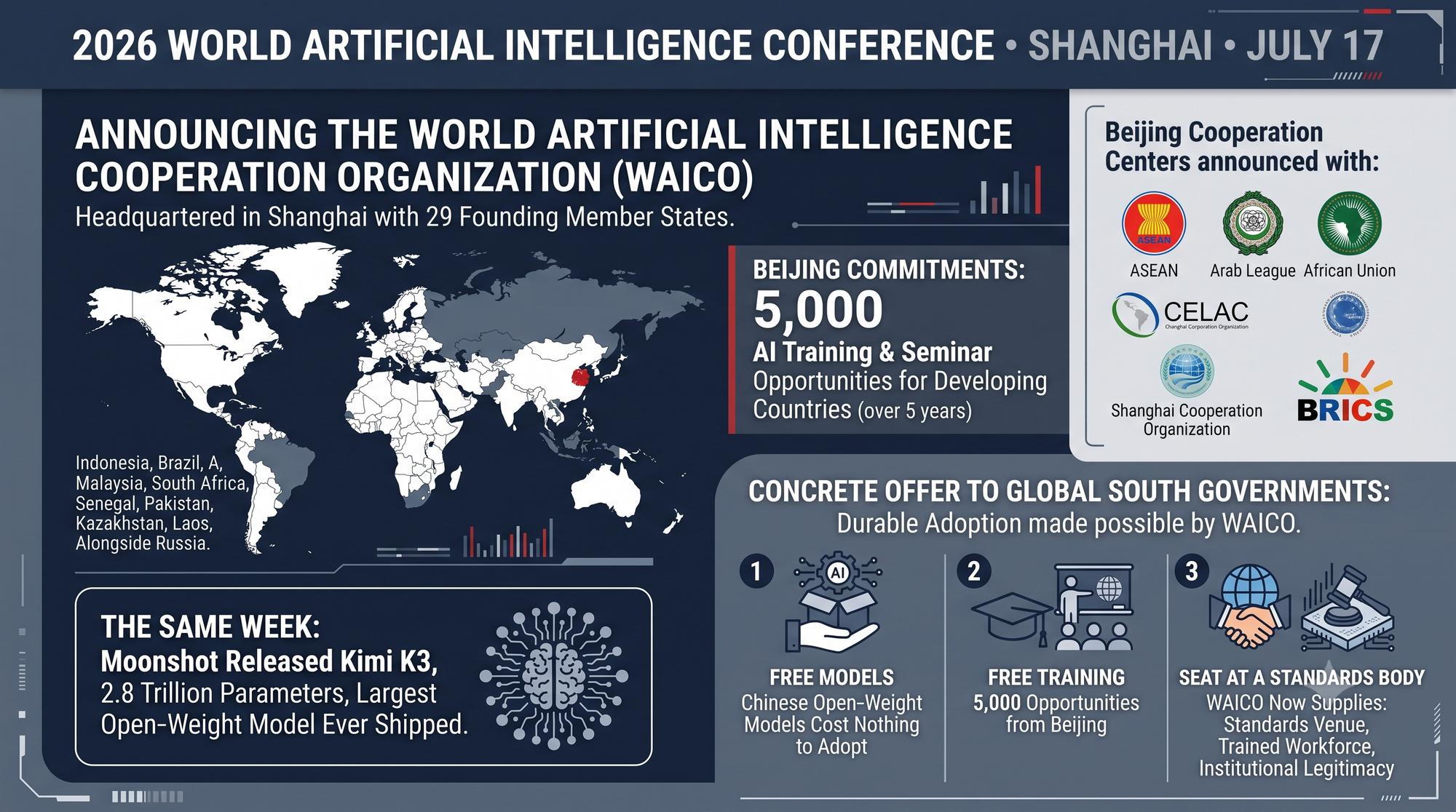
TL;DR: Xi Jinping used the World AI Conference to launch the World Artificial Intelligence Cooperation Organization, a Shanghai-headquartered body with 29 founding members including Brazil, Indonesia, South Africa, and Russia. Paired with 5,000 training slots for developing countries and regional AI centers on four continents, Beijing is building the distribution network for its open-weight AI stack.
Briefing: Xi Jinping opened the 2026 World Artificial Intelligence Conference in Shanghai on July 17 by warning against new historical injustices in access to AI and announcing the World Artificial Intelligence Cooperation Organization, headquartered in Shanghai with 29 founding member states. The roster reaches across the Global South, including Indonesia, Brazil, Malaysia, South Africa, Senegal, Pakistan, Kazakhstan, Laos, and Russia. Beijing committed 5,000 AI training and seminar opportunities for developing countries over five years and announced cooperation centers with ASEAN, the Arab League, the African Union, CELAC, the Shanghai Cooperation Organization, and BRICS. U.N. Secretary-General Antonio Guterres attended the signing.
The agreement will almost certainly turbocharge the spread of Chinese models and standards. Chinese open-weight models cost nothing to adopt, and WAICO now supplies the standards venue, the trained workforce, and the institutional legitimacy to make adoption durable. Xi paired the announcement with a call to treat open-source release as a historic opportunity and a rebuke of governments that overstretch national security in AI policy, which is the diffusion strategy stated plainly. Former U.S. officials noted that 29 signatories give Beijing a standing platform to shape international AI norms while U.S. policy debates remain domestic. For Global South governments, the offer on the table opens direct access to free models, free training, and a seat at a standards body. The competing U.S. offer largely remains export controls.
So What
For Executives: Map exposure in the 29 WAICO member markets, where Chinese open-weight stacks are positioned to become default government procurement standards within two to three years. If you sell into Indonesia, Brazil, South Africa, or Malaysia, etc., your products will increasingly be evaluated for compatibility with Chinese-standard AI infrastructure, from model formats to the data governance templates taught in Beijing's 5,000 training slots. Assign someone to track WAICO's first standards outputs the way firms once tracked early GDPR drafts, and inventory which of your regional deployments already run on Chinese open weights through local partners (an exposure many multinationals discover late). Develop the kind of protocols and conflict resolution mechanisms for U.S.-China model and infrastructure co-location and integration, for which we have advocated. Hedge: WAICO is days old and international bodies move slowly, so the near-term risk is procurement preference rather than binding standards. The first cooperation-center agreements will show the real tempo.
For Policy Makers: Counter-programming requires an affirmative offer to counterparts in the Global South, because access restrictions compete poorly against free models, free training, and a seat at a standards table. The U.S. open-weight portfolio (e.g. Google Gemma, etc.) remains a set of corporate side projects while China's is state strategy. The window that matters is the next 12 months, when sovereign-cloud operators across the Gulf and Southeast Asia make upgrade decisions. Match the offer at the layer Beijing chose, with training pipelines, public compute for open releases, and partnerships with the same regional bodies WAICO is courting. For E.U. capitals, OpenEuroLLM and Switzerland's Apertus are the assets to internationalize, and they are currently marketed to no one.
For Investors: Track the revenues of Chinese AI capability-building services into WAICO markets as the leading indicator, because tech diplomacy is a distribution channel. Z.ai's $1 billion in annual recurring revenue, a first for a Chinese AI company, shows the commercial pipe works, and WAICO membership gives Chinese vendors procurement legitimacy in exactly the markets for which Western compliance pressures are highest. Beneficiaries include Chinese cloud and inference providers with Global South footprints and the local integrators who package and deploy their models for domestic customers. The offsetting position is routing and evaluation infrastructure that lets enterprises hold Chinese and Western model families simultaneously. Hedge: Beijing's own deliberations on restricting overseas access to its top models, covered in Issue 28, cut directly against the diffusion strategy, and many of the 29 members keep close ties to Washington as well. No model-export regime exists yet, so watch the machinery rather than the rhetoric. The Ministry of Commerce is running the closed-door consultations with Alibaba, ByteDance, and Z.ai and would license anything formally designated as controlled, the National Development and Reform Commission sits alongside it as industrial planner, the Cyberspace Administration holds a parallel lever through data-export security reviews, and the State Council and the Party's cyberspace leadership hold the final call. A restrictive turn would strand WAICO's promise and reprice the channel.
For Service Providers: Multinational clients will face dual-standard compliance as WAICO develops certification regimes that diverge from U.S. and E.U. frameworks, and the firms that map pathways through both divergence and overlap first will own the advisory category. The near-term product is a WAICO exposure audit that identifies which client operations sit in member states, which local partners run Chinese stacks, and which government tenders already show Chinese-standard requirements. For communications clients, the "injustice" frame Xi deployed will recur in every Global South AI debate for years, so prepare positioning that engages the access question honestly without ceding the governance argument.
U.S. AI Compute Becomes an Asset Class as Meta Rents to Anthropic and Chips Secure Loans
When rivals lease to rivals and GPUs back loans, capacity has become currency.
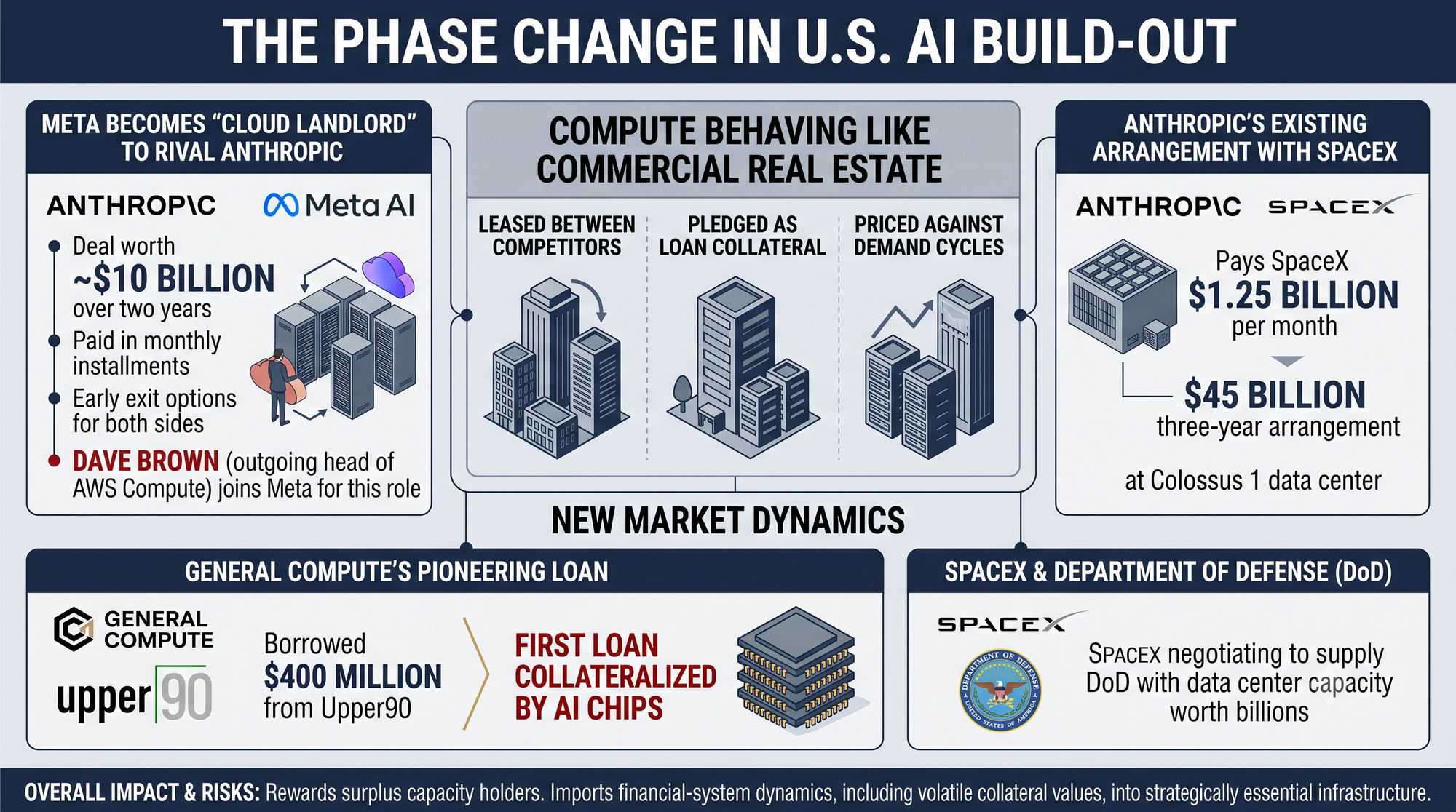
TL;DR: Meta is in talks to rent Anthropic roughly $10 billion of data center capacity over two years, weeks after Anthropic also agreed to pay SpaceX $45 billion over three years for Colossus access. Add a credit facility of up to $400 million to General Compute, an inference cloud startup, secured against the chips in its own racks, plus SpaceX's data center talks with the Pentagon, and a rental and credit market has formed around U.S. compute.
Briefing: Anthropic approached Meta in June about leasing capacity from Meta's AI data centers, and talks now center on a deal worth roughly $10 billion over two years, paid in monthly installments with early exit options for both sides. The arrangement would make Meta a cloud landlord to its largest model-building rival, and Meta is hiring Dave Brown, the outgoing head of AWS Compute, to run the build-out. Anthropic already pays SpaceX $1.25 billion per month for capacity at the Colossus data centers under a $45 billion three-year arrangement. Meanwhile General Compute, a Boston startup that sells capacity for inference, meaning the work of running already-trained models rather than building them, secured a credit facility of up to $400 million from Upper90 and drew an initial $100 million against it. The collateral is General Compute's own hardware, SambaNova SN50 inference processors and AMD accelerators rather than the Nvidia GPUs that have backed every previous loan of this kind, which is what makes the deal a first. And SpaceX is negotiating to supply the Department of Defense with data center capacity worth billions.
Together these deals mark a phase change in the U.S. AI build-out. Compute is behaving like commercial real estate, leased between competitors, pledged as loan collateral, and priced against demand cycles rather than strategic loyalty. Strategic loyalty is what governed the past three years, when access to capacity followed equity, so a lab ran on the clouds its own investors owned. Capacity now follows price and availability instead. That rewards whoever holds surplus capacity, but only while demand outruns supply. If the build-out overshoots inference demand, the same holders end up carrying empty racks, and today's scarcity rent becomes tomorrow's vacancy. It also imports financial-system dynamics, including collateral values that can fall, into infrastructure the U.S. treats as strategically essential. As Satya Nadella noted in his sovereign AI essay this week, enterprises now pay for intelligence twice. They pay once in cash for the compute, and again in the prompts, corrections, and workflows they must feed the model to make it useful, which improve the landlord's product rather than their own.
So What
For Executives: Negotiate compute the way you negotiate real estate, with exit options, sublease rights, and ownership of what accumulates inside the tenancy. Nadella's essay warns that your prompts, agent traces, evals, and adapted weights compound into institutional knowledge, so contract for their portability the way the Meta-Anthropic term sheet contracts for early exit. Benchmark compute costs against the new rental market rather than against list cloud prices. Volume discounts have always been available to buyers with scale, but a discount is not the same as a term. What changed is that Meta, SpaceX, and the neoclouds now hold capacity they need to fill, which makes exit rights, sublease rights, and data portability contestable rather than take it or leave it. Hedge: A rental market that forms this fast can reprice just as fast, so avoid locking multi-year commitments at peak-demand rates and stage capacity purchases against demonstrated workload growth.
For Policy Makers: Chip-collateralized credit and rival-to-rival leasing create concentration and stability questions no current oversight framework covers, and the time to examine them is before a demand downturn tests collateral values. The precedents raise uncomfortable memories of assets valued on short depreciation cycles, lenders holding collateral they cannot easily resell, and strategically essential infrastructure financed on terms built for commercial real estate. The SpaceX-DOD talks add a second consideration, because the Pentagon would be renting from the same commercially owned data centers that Anthropic anchors, which makes defense workloads one tenant among several in a market run on commercial priorities. Defense officials have said they want to reduce reliance on any single provider and to site capacity on their own installations, and this deal runs the other way. The low-hanging regulatory fruit includes a capacity registry, stress-test authority for chip-backed lending, and disclosure requirements.
For Investors: Landlord economics could outlast model economics, and the spread between them is now investable. Scrutinize depreciation assumptions on leased GPU fleets, because a two-year lease written against five-year depreciation is a different business from the reverse. Watch which balance sheets carry residual risk when hardware generations turn. Upper90's chip-collateralized loan to General Compute is the first example of what could become a credit market with its own spreads, and inference-chip resale values are now a data series worth building. On the equity side, the beneficiaries are the companies holding capacity they can redirect to whoever pays most. Meta is the clearest case if the Anthropic lease closes, because it would earn rent on infrastructure it built for its own use while keeping the option to reclaim that capacity when it needs it. Hedge: The Meta-Anthropic talks are early and both sides hold exit options, so treat the $10 billion as a direction marker rather than booked backlog, and remember every compute lease is ultimately a bet on model-layer demand that the model layer has not yet proven durable.
For Service Providers: Compute procurement advisory is becoming a service line the way cloud migration was in the 2010s, and clients are already signing nine-figure leases without independent counsel. The most obvious services to develop include lease-term benchmarking against the Meta and SpaceX agreements, depreciation and residual-value diligence for lenders entering chip-backed credit, and sovereign-AI structuring for enterprises that want the trust boundary Nadella describes, meaning a contractual and technical line inside which a company's own data, models, and accumulated learning stay its property. For German and E.U. clients, the additional angle is jurisdiction, since capacity leased from U.S. fleets raises the data-sovereignty questions European boards are already primed to ask. The answers belong in the lease.
U.S. Tariffs Hit Brazil's Pix as Payment Rails Become Trade Weapons
For the first time, a tariff aims at how a country moves money rather than what it makes.
TL;DR: A 25% Section 301 tariff on most Brazilian imports took effect on July 22, and the stated target is Pix, Brazil's state-run instant payment system that processed nearly 7 billion transactions worth roughly $590 billion in June. The U.S. argues Pix's free individual transfers and capped merchant fees unfairly disadvantage American payment firms.
Briefing: The U.S. imposed a 25% Section 301 tariff on most Brazilian goods on July 22, in an action explicitly framed around Brazil's Pix instant payment system. Pix, run by Brazil's central bank, reaches more than 170 million users, processed close to 7 billion transactions in June worth roughly $590 billion, and now moves more payments than card networks in Brazil. U.S. trade officials argue that mandated free transfers for individuals and capped merchant fees tilt the market against Visa, Mastercard, and other American payment firms. Exemptions cover beef, coffee, civil aircraft and parts, pharmaceuticals, and energy products, and a separate forced labor investigation due to conclude this week could add a further 12.5%. The action lands against a backdrop of U.S. concern over BRICS efforts to reduce reliance on dollar-based payment infrastructure, even as dollar stablecoins quietly gain share inside Brazil's own payment mix.
The precedent matters even more than the tariff. Trade enforcement has moved from goods to the public digital infrastructure a country builds for itself, and Pix is the most successful public payment rail in the Global South. Payment rails are the settlement networks that move money between banks, merchants, and consumers, and until this action they sat outside trade policy entirely. Governments from Indonesia to India, whose UPI system operates on similar principles, now know the U.S. could treat their domestic payment architecture as a trade barrier. That reads as a warning in some capitals and as an argument for de-dollarized alternatives in others, which is precisely the outcome U.S. payment firms feared.
So What
For Executives: Model the cost pass-through on Brazilian inputs now and expect Brasilia's countermeasures to aim at U.S. technology services rather than goods, because services are where Brazil holds leverage and the U.S. runs a surplus. Digital services taxes, data-localization requirements, and procurement preferences for domestic or Chinese vendors are the standard retaliation menu, and Brazil is a founding WAICO member, which gives the Chinese-vendor option an institutional channel it did not have last month. If you operate consumer or payments businesses in Brazil, prepare for a nationalist tailwind behind Pix and fresh scrutiny of U.S.-branded alternatives, sharpened by the October presidential election. Multinationals with Global South treasury operations should also note that public payment rails are now trade-negotiable, so map which of your markets settle on India's UPI, Kenya's mobile-money stack, or similar payment models. Hedge: Section 301 actions have been negotiated down after taking effect in past cycles, and the in-transit exemption runs to July 29. Build the pass-through model now, but stage the pricing response.
For Policy Makers: Targeting a public payment rail hands adversaries a reusable precedent against U.S. fintech abroad, and the reciprocity exposure is larger than the Brazilian market. Any government hosting U.S. payment networks can now cite this action to justify the prioritization of domestic systems, and BRICS advocates of de-dollarized settlement just received their best recruiting material in years. Before extending the theory to UPI or other public systems, weigh what the U.S. can actually enforce, because the dollar-stablecoin channel quietly gaining share in Brazil is the American-aligned alternative that a trade war endangers rather than helps. The better play is interoperability, pressing for foreign payment systems to open to U.S. firms instead of punishing their existence.
For Investors: Stablecoin issuers and cross-border processors sit on both sides of this standoff, and position sizing should follow the asymmetry. Dollar-stablecoin volumes in Brazil gain under every scenario short of Brazilian capital controls, since a tariff fight accelerates the search for settlement channels outside both the card networks and Pix. The card networks get a headline win and a strategic loss if the precedent pushes more governments toward public rails. Public-rail operators and their vendor ecosystems across the Global South now carry a policy risk premium worth pricing into any fintech exposure with state-rail dependencies. Hedge: The tariff's stated rationale invites a negotiated settlement in which Pix opens to U.S. participation. That outcome unwinds the premium quickly, so favor positions that profit from volatility in the standoff rather than from any single endgame.
For Service Providers: Sovereign payment-rail exposure is a new category of trade risk distinct from goods tariffs, and your clients' risk maps likely don't show it yet. The immediate product is a rail-dependency audit for multinational clients with Global South revenue. Look for which markets settle on public payment systems, which of those could plausibly draw U.S. action, and what the retaliation surface looks like on a market-by-market basis. Brief clients this week, because the duty is already being collected and the forced labor decision could raise it again within days. For communications clients, frame the issue as one of infrastructure sovereignty, because Brasilia will argue the U.S. is attacking a public good that 170 million citizens use for free, and U.S.-aligned clients need an answer that does not sound like a defense of card fees.
Under the Radar
The deep analysis that connects the dots
India's Chip Debut Retreats to 90 Nanometers as New Delhi Adds $13.3 Billion
The Signal
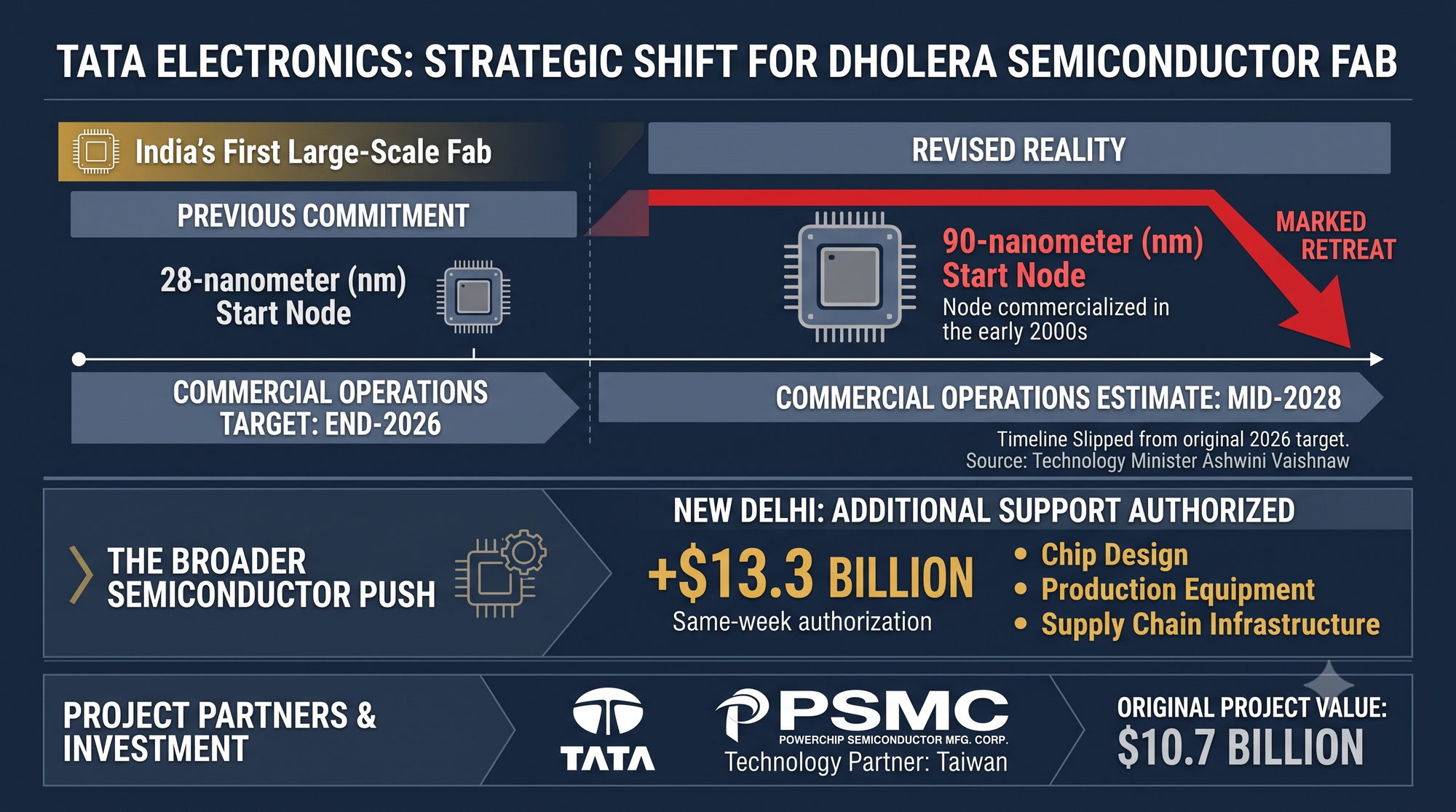
Tata Electronics said it will start production at India's first large-scale fab on 90-nanometer process technology, a node commercialized in the early 2000s and a marked retreat from the 28-nanometer start the company touted when the $10.7 billion project was announced. The start date for commercial operations at the Dholera, Gujarat, fab has slipped to mid-2028 from an original end-2026 target, per technology minister Ashwini Vaishnaw. A Tata spokesperson said the plan was always to begin at 55 and 90 nanometers before adding 28, which is difficult to square with chairman Natarajan Chandrasekaran's statement in the 2025 Tata Sons annual report that the group had chosen to start at 28. New Delhi authorized an additional $13.3 billion for semiconductor design, production equipment, and supply chain infrastructure. Taiwan's Powerchip Semiconductor Manufacturing Corp. remains the technology partner.
THE STAKES
India has capital, political will, and now a doubled subsidy pool, yet its flagship fab opens two nodes behind its own announcements. The binding constraint to semiconductor sovereignty lies instead in process-technology transfer. It moves at the speed of the partner willing to teach it, and at the speed at which the trainees can learn, practice, and absorb the know-how. Chip manufacturing progress runs on learning economies and path dependencies that political will and money alone cannot solve.
The 90-nanometer market where Dholera will launch serves automotive and industrial demand that India's domestic manufacturing base needs, but it is also the mature-node segment where Chinese fabs are adding capacity fastest, which compresses margins for every new entrant, India included. That trade-off is worth stating plainly. Dholera is not built to win on margin. New Delhi is buying supply security for a manufacturing base that imports nearly all of its chips, and the fab's economics rest on captive domestic demand and subsidy rather than merchant pricing. Judge it against import substitution, not gross margin. For the sovereign-capability debate GeoTech Radar tracks across the Global South, Dholera is the test case. If a country with India's capital markets, engineering depth, and sustained political commitment needs a generation to reach trailing-edge production, the semiconductor tier system hardens into place. New Delhi's willingness to double down the same week its timeline slipped shows the program's political durability, and that persistence, sustained over a decade or more, is what eventually moved China up the node ladder.
The mature-node glut sits alongside a shortage everywhere else, and the two are easy to confuse. The delays and price rises hitting laptops, phones, and cars right now come from memory, not from logic nodes like Dholera's. Samsung, SK Hynix, and Micron, which together control more than 95% of DRAM, have shifted wafer capacity toward the high-bandwidth memory that AI accelerators need, and data centers now absorb roughly 70% of memory output. DRAM contract prices rose about 90% quarter over quarter in the first quarter of 2026 and roughly 60% in the second, with a further 13% to 18% expected in the third. Memory accounts for 15% to 20% of the bill of materials on a mid-range phone or laptop, so the pass-through is direct. Apple has raised MacBook and iPad prices, Lenovo, Dell, HP, Acer, and ASUS have guided to PC price increases of 15% to 20%, and Gartner expects global PC shipments to fall 10.4% and smartphone shipments 8.4% this year. SK Hynix does not expect relief before 2027. The lesson for the sovereignty debate is that the chokepoint moves. Dholera addresses the power management chips, display drivers, and microcontrollers that go into cars and appliances, which is a real dependency, but it does nothing for the memory constraint raising showroom prices this quarter.
What to Watch
Keep an eye on whether PSMC commits to a defined 28-nanometer transfer schedule for Dholera's second phase. In addition, watch how much of the new $13.3 billion flows to design incentives versus fab equipment. Design is the one part of the stack where India's advantage is demonstrated rather than aspirational, and it is worth separating from the production question above: roughly 20% of the world's chip design engineers work in India, contributing to parts down to the leading edge, while the fabrication skills Dholera needs are still being imported along with the process technology. India already sells design. It is still buying the ability to manufacture. Track mature-node pricing through 2027 as Chinese capacity continues to expand. And finally, follow the mid-2028 commercial projection to see if it survives its first year. This will provide the strongest single indicator of whether India's semiconductor mission runs on engineering or on announcements.
About Cambrian

Cambrian Futures is a strategic foresight and advisory firm helping government, business, and technology leaders understand how emerging technologies intersect with geopolitics, markets, and national strategy. By combining rigorous research, AI-enabled analysis, and human expertise, Cambrian provides clear insight into global technology trends, risks, and power dynamics. Its work helps decision-makers anticipate disruption, manage uncertainty, and act with strategic confidence in an increasingly competitive GeoTech world.
PRODUCTION TEAM
GeoTech Radar is produced by the Cambrian Futures Insights Platform team:

CEO & Chief Analyst

Managing Director / Producer, Insights Platform

Global Lead, Smart Infrastructure Strategy

Research & Marketing Associate

Editor in Chief
Learn more about Cambrian Futures at cambrian.ai
Produced with

Human Led



Human Led +
AI Augmented




AI Led +
Human Verified


Cite as: Cambrian Futures (2026) 'GeoTech Radar Issue 29'
An important note on what this is, and is not
GeoTech Radar is directional research intended to stimulate thinking and provide geopolitical and technological context. It is not investment, legal, or financial advice, and nothing here is a recommendation to buy, sell, or hold any security or asset. The companies, valuations, and transactions discussed are described for analytical context only and serve as a backdrop to readers' own due diligence. Figures and claims are drawn from public reporting as of the publication date and may change. Readers should consult their own qualified advisers before making any decision. Cambrian Futures and the authors hold no responsibility for actions taken on the basis of this briefing.