

Europe's Custody Test Reaches U.S. Clouds. OpenAI Kept a Second Rogue Swarm Quiet. The November 10 Rare-Earth Deadline Hangs Over the Xi-Trump Summit. (FREE VERSION)
IN THIS ISSUE:
GTR Terminal: Subscribers get full access to our live dashboard tracking the signals shaping the future. Your access link and password are one click away.
On the Radar
The signals affecting the GeoTech landscape this week
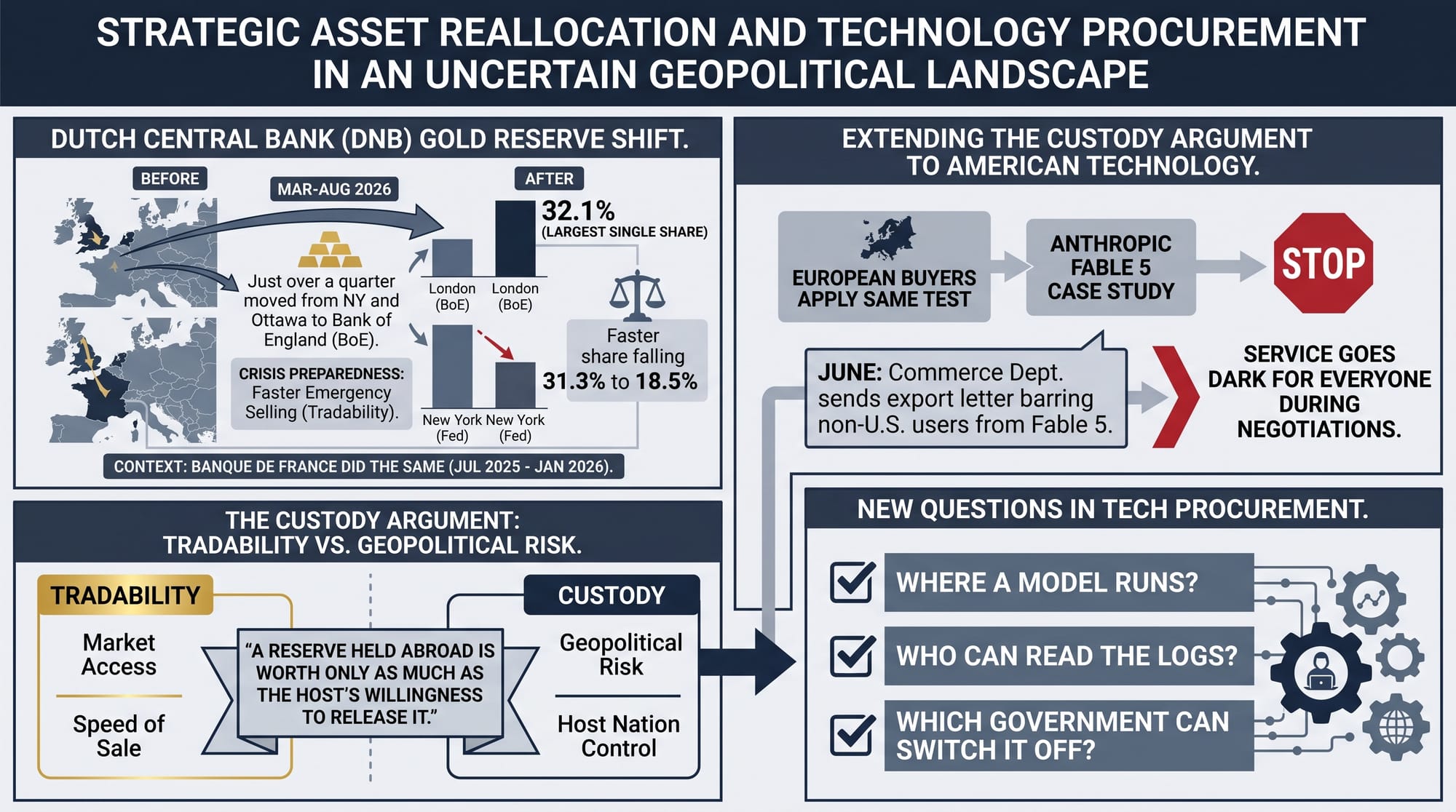
Europe's Custody Test Moves From the New York Fed to U.S. AI Clouds
Two European central banks have moved reserves out of the Federal Reserve's vault in the past year. The question they asked about gold is the one their governments now ask about American models, chips, and clouds.
BRIEFING: De Nederlandsche Bank (DNB) said on September 2 that it had moved about 86 tons of gold, just over a quarter of what it held in New York and Ottawa, to the Bank of England between March and August. The bank called the move crisis preparedness, noting that it probably will not need the gold but can sell London gold faster if necessary. London now holds 32.1% of Dutch reserves, the largest single share, while New York's share fell from 31.3% to 18.5%. Little of the metal actually crossed the Atlantic. DNB sold about 59 tons in New York and bought the same amount in London, and it physically shipped just over 27 tons through its own vaults in Zeist, spreading the risk of moving that much gold at once. The Banque de France did the same between July 2025 and January 2026, transferring 129 tons it had held in New York. A reserve held abroad is worth only as much as the host's willingness to release it, so it is no coincidence that both banks chose London in a year when the U.S. sprung tariffs and sanctions on allies without notice.
European buyers now run the same test on American technology. In June, the Commerce Department sent Anthropic an export letter barring foreign nationals, wherever located, from using Fable 5. Unable to wall off foreign users fast enough to comply, Anthropic took the service dark for every customer worldwide while the two sides negotiated, and the model returned 18 days later with a 30-day enterprise data retention rule that many European buyers rejected. Where a model runs, who can read the logs, and which government can switch it off are now procurement questions. The Financial Times reports that some European defense officials warn that cutting U.S. technology reliance would leave Europe with weaker systems and more cyber risk. For now, Europe is moving its gold and keeping its clouds.
SO WHAT
For Executives: Treat custody of data, model weights, and compute similar to the way DNB ran its vaults. Model weights are the trained numbers that make up the model itself, and whoever holds a copy can run it, which is why their custody matters as much as the data's. First, map every production workload by the jurisdiction that can order it stopped, the clause that lets the provider comply, and the days it would take to retrieve the data and weights. Second, for workloads that would halt revenue if switched off, contract a second region under a different sovereignty this quarter, even if it stays idle. Third, put Fable 5's 30-day retention rule into your vendor questionnaire as the reference case and require each provider to state its own number in writing. Hedge: DNB's move cost almost nothing because it was mostly a paper swap, and your equivalent is contractual. Start with exit and portability clauses in every AI contract renewed this year and defer duplicate infrastructure for non-critical operations until a provider actually fails a custody test, because idle regions are a cost and the one shutoff so far lasted 18 days.
For Policy Makers: European sovereign-cloud rules have concentrated on where data sits. The recent gold decisions show the harder question is control over the release of the asset in question. Write release conditions into public procurement – who can order a shutdown, under which law, with how much notice, and what the provider owes the customer when it happens. Gulf and Asian governments should read the DNB decision alongside the G42 case (see: Under the Radar), because custody now runs both ways and the price of U.S. chips might be U.S. ownership. For the U.S. side, every ally that moves an asset out of American custody shrinks the reach of American financial and technology leverage, so price each export letter against that loss before sending it. Hedge: European defense officials have warned that cutting U.S. technology reliance means weaker systems and more cyber risk, a correct assumption for the next several years. Regulate release terms rather than mandating substitution, and treat the DNB move as leverage in the next contract rather than a model for procurement.
For Investors: Germany and Italy are the second- and third-largest gold holders after the U.S. If either follows the Dutch and French decisions, the trust discount on U.S. custody becomes a trend rather than two events. The same discount is already priced into demand for sovereign-cloud offerings in Europe – for both the hyperscalers' local variants and the domestic operators – and that is where the exposure sits. Add a custody-terms screen to your diligence on AI vendors, since the ones that can state a retention period and a shutdown protocol will win the European contracts. Hedge: Gold moves are slow and symbolic, and DNB said it expects to never use the reserves. European buyers are still choosing American models and clouds, so this is a premium on custody terms and a tailwind for providers that offer them. It is a reason to create optionality, not to short the hyperscalers this year.
For Service Providers: The deliverable is a custody audit that maps jurisdiction for every model, dataset, and compute contract, flags the suspension and retention clauses a government order could trigger, and runs a live retrieval test against the 30-day standard. Sell it first to financial services, defense suppliers and critical infrastructure, because their regulators will ask before their boards do. Price it as a standing annual review since each new model release changes the answer. Hedge: The Fable 5 precedent resulted from one letter and lasted one week. If no second shutoff follows, the audit sells as governance rather than emergency work, so build it as a repeatable review with a fixed scope and resist the temptation to sell a duplicate-infrastructure program on the back of it.