

Compute Gets a Futures Price. The Pentagon’s Blacklist Meets Its Judges. Beijing’s Labs Get a New Landlord. (FREE VERSION)
IN THIS ISSUE:
On the Radar
The signals affecting the GeoTech landscape this week
The Department of War’s Blacklist Loses in Court
A federal judge voided the Pentagon’s supply chain risk designation on Anthropic on August 27. A day later China’s largest memory maker sued the same department in a D.C. court over its military-company list.
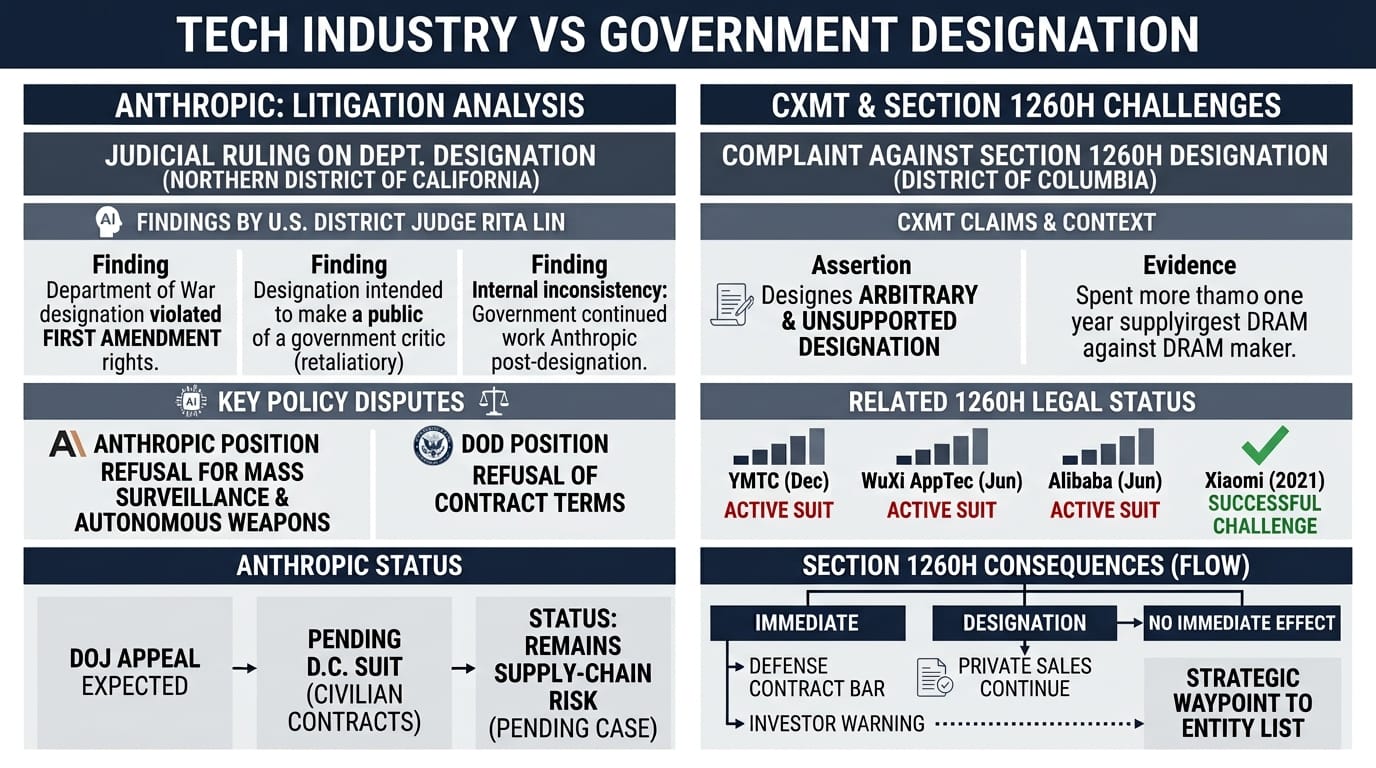
BRIEFING: On August 27, U.S. District Judge Rita Lin issued a 59-page order in San Francisco finding that the Department of War violated the First Amendment when Secretary Pete Hegseth designated Anthropic a national security supply-chain risk earlier this year. The designation followed Anthropic’s refusal to let the military use its Claude models for mass domestic surveillance or fully autonomous weapons. Lin found the department acted to make a public example of a government critic, and she noted that the government kept working with Anthropic after publicly calling it a threat. The Justice Department argued the designation stemmed from Anthropic’s refusal of contract terms, and the government is expected to appeal. (A second Anthropic suit over a separate designation that could exclude it from civilian contracts is pending in the District of Columbia, so the company technically remains a supply-chain risk until that case resolves.)
One day after Lin’s ruling, ChangXin Memory Technologies (CXMT), the world’s fourth-largest maker of dynamic random-access memory (DRAM), sued the same department in the D.C. federal court, arguing against the listing of the company as a partner with the Chinese military. CXMT was first listed in January 2025 under the Biden administration, was told in February 2026 it would be removed in a notice retracted the same day, and was put back on the list on June 8. The suit follows court action by YMTC in December, WuXi AppTec and Alibaba in June, and Xiaomi’s successful 2021 challenge. The Pentagon’s 1260H listing bars defense contracts and warns investors without restricting private sales, and it is widely read as a waypoint to the Commerce Department’s Entity List, which restricts trade outright.
SO WHAT
For Executives: Treat every U.S. designation list as litigable, because the companies on them set the precedent. If you supply, buy from, or invest alongside a listed entity, map which list it sits on, because each carries different legal consequences and different odds of surviving in court. Add a designation-reversal clause to procurement and investment agreements so that a listing or a delisting triggers renegotiation rather than default. For memory buyers, the CXMT case is the one that matters. CXMT, whose first-half revenue rose 874% from a small base and which is now suing in a U.S. court, intends to sell into the U.S. market eventually. On the supply side, the U.S. DRAM landscape is widening beyond imports from Micron, Samsung and SK Hynix: SK Hynix broke ground on August 27 on a $4 billion advanced-packaging plant in Indiana, the first U.S. production site for high-bandwidth memory (HBM), though it will not ship product until the second half of 2029. Lock multi-year memory contracts now on the Korean side and, pending appropriate cybersecurity checks, consider keeping a qualified Chinese alternative on paper for markets where U.S. lists do not apply or are likely to change. Hedge: Lin’s order is a district-court ruling that the government will appeal, and the D.C. cases are years from resolution. Plan for the lists to remain in force through 2027 and price the possibility that Congress rewrites the statutes to remove the procedural openings these lawsuits exploit.
For Policy Makers: The U.S. designation system was designed on the assumption that targets would not sue in U.S. courts. Xiaomi disproved that in 2021, and CXMT, YMTC, WuXi, and Alibaba have now turned litigation into standard practice. Now, every listing decision needs an evidentiary file that can survive the Administrative Procedure Act. For allied governments building their own lists, the lesson is to build the record first, designate second, and then keep the designation power for foreign adversaries separate from any tool that could be turned on domestic critics. In the U.S., Lin’s ruling will be cited by every company that resists a government demand for unrestricted use of its technology, and it establishes that a national-security label applied to punish speech will not hold. Write the standard into statute before a court writes it for you. Hedge: A ruling that constrains executive designation power also constrains its legitimate uses. If the appeal courts extend Lin’s logic, the department might respond by reclassifying its reasoning rather than changing its behavior, which would leave the lists in use and make them less transparent.
For Investors: Two prices moved this week for reasons that have nothing to do with technology per se. The discount that the risk of lost government contracts had placed on Anthropic’s IPO narrowed, and CXMT’s Shanghai valuation now carries a litigation option on U.S. market access. Meanwhile, the price and supply of high-bandwidth memory remain in flux. HBM is sold out through 2026, TrendForce estimated that conventional DRAM contract prices rose 90% to 95% in the first quarter, SK Hynix will not package HBM in the U.S. until 2029, and CXMT has begun mass production while suing for the right to compete. Own the Korean incumbents for the duration of the shortage and watch the CXMT docket as the earliest signal of whether Chinese memory reaches Western handsets and servers, whether through the courts, a manufacturing or political deal, or during President Xi’s visit to the White House on September 24. Hedge: CXMT’s 874% growth figure is off a small base and comes from a company that listed five weeks ago. Discount it until the first full-year audited results, and remember that a removal from U.S. restricted lists would not remove the export-control restrictions on the chipmaking equipment CXMT needs to produce leading-edge DRAM and HBM.
For Service Providers: The current environment opens two practice areas. The first is designation defense and designation due diligence. Clients need a standing assessment of every counterparty’s list status, the legal basis for each listing, and the probability that litigation changes it, with a template for the reversal clauses described above. The second is the speech-and-security boundary Lin drew. Tech companies with government contracts need a documented policy on which uses they will refuse, drafted so that a refusal reads as a contractual position rather than a political one. Deliver both as a single package for boards, because the Anthropic and CXMT cases will be cited together in every risk committee this autumn. Hedge: Advisory built on a district-court ruling can be undone by an appeals panel. Frame the deliverable around the litigation trend, which is durable, rather than the specific legal decision.