

Circumventing the AI Roadblocks: Microsoft Looks to DeepSeek and the UAE Puts Government on Agentic AI
IN THIS ISSUE:
CEO's Perspective
Strategic outlook from Cambrian leadership

I spent some time this past week at a potent Washington DC workshop on AI and the future of work. One thing that stood out was the fact that the AI-driven layoffs narrative is starting to train its own replacement. Because FTE reduction only defers the human cost of AI displacement to society, society is responding with greater AI rejectionism, calls for government regulation, and strengthening unions. Governments and unions are building new up-skilling and transition-insurance frameworks. The narrative that many tech firms and some consultancies repeated for three years has generated the societal and institutional response that will discipline it.
Every Toll Booth Trains Its Rival
The same pattern shows up across three different layers of the AI stack this week. Microsoft, the oldest backer of the frontier consortium, said it would consider hosting a fine-tuned Chinese open-weight model on Azure to escape the inference cost it helped create — the gatekeeper routing around its own gate. India’s sovereign AI company Sarvam raised $234 million at a $1.5 billion valuation on the pitch that frontier access can be suspended overnight, a fact that the Anthropic foreign-user shutdown made operational last week. Meanwhile, Z.ai released GLM-5.2 under an open-weight license at a sixth the cost of leading U.S. frontier models, with performance on par with leading U.S. systems for cyber work. The closed-model toll booth recruited an open-weight workaround that no government can revoke.
Last week, we noted how the wall turned out to be a row of toll booths, each with designated owners. This week, we can see the toll booths owners going a step further, training their replacements and specifying what gated parties must build, fund, or download to escape the toll. Microsoft is designing the blueprint for DeepSeek’s enterprise distribution. The U.S. export order that curbed Anthropic use designed the same for Sarvam. The closed-model gates are designing the work-arounds for every fine-tuned derivative of GLM-5.2. Beijing’s control of the throttle on magnets prompted Japan’s first new rare-earth refinery since 2008. At this point, only memory chip supplies lack an executor, because a fab takes 18 to 24 months and an alternative cannot be easily downloaded.
So here is the realization the workshop and the past week left me with. Leaders need to stop reading every control as a cost imposed on someone else. Instead, recognize it as a catalyst for a new design. Ask yourself: Who is the gated party, what does the roadblock force them to build, and how long will it take to design the circumnavigation? The winners in the next phase will not be the ones holding the gates. They will be the ones understanding the briefs their rivals are writing, and building before the letter is fully addressed.
Olaf
On the Radar
The signals affecting the GeoTech landscape this week
Microsoft Coopts China’s DeepSeek to Undercut the Frontier Labs
The incumbent that helped fund the frontier labs now wants to turn their models into commodities, and a Chinese system has become the lever.
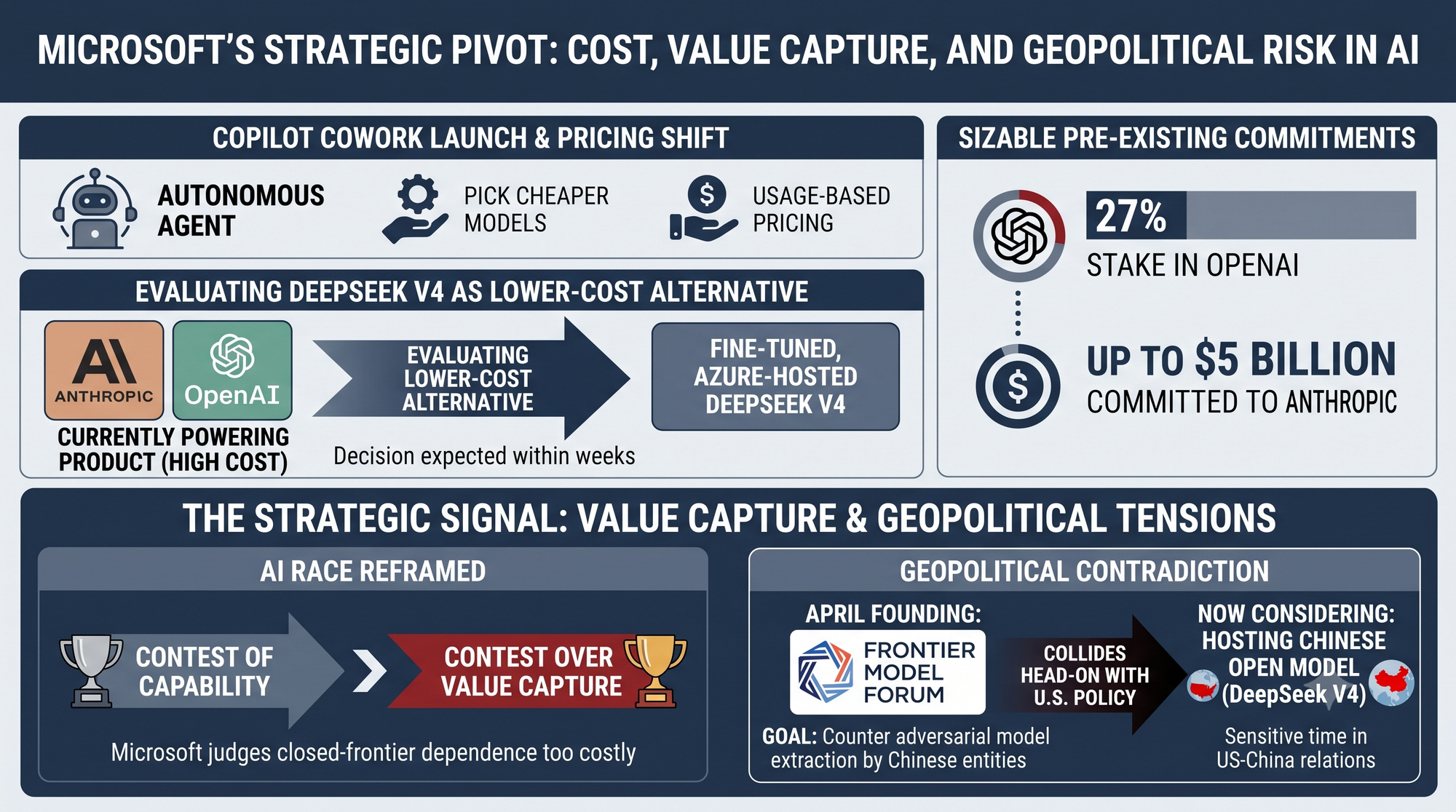
TL;DR: In a June 21 interview with the Wall Street Journal, Microsoft CEO Satya Nadella attacked the concentration of AI power and laid out a plan to drive model prices down. Days earlier, Microsoft launched Copilot Cowork with usage-based pricing and disclosed it is weighing an Azure-hosted, fine-tuned version of China’s DeepSeek V4 as a low-cost engine. A U.S. incumbent routing customers to a Chinese model cuts directly against Washington’s efforts to wall off Chinese AI, and the announcement came the same week the administration forced Anthropic’s most capable models offline for foreign users.
BRIEFING: Nadella told the Journal that the public will not accept a future where a few companies are “doing all of the learning for the world,” and he criticized leaders who warn of mass white-collar job losses while demanding unlimited resources to build data centers. Microsoft has moved quickly to back the rhetoric with products. On June 16, it launched Copilot Cowork, an autonomous agent that lets users pick cheaper models and shifted it to usage-based pricing the same day. According to Axios, the company is evaluating a fine-tuned, Azure-hosted version of DeepSeek V4 as a lower-cost alternative to the Anthropic and OpenAI models that currently power the product, with a decision expected within weeks. Microsoft hopes to reduce those skyrocketing costs. The consulting firm EY estimates a complex agentic interaction in 2026 runs roughly 30 times the cost of a 2023 chatbot query. Microsoft still holds a 27% stake in OpenAI and has committed up to $5 billion to Anthropic.
In part due to these sizable pre-existing commitments, the strategic signal matters more than any single product decision. Microsoft is the oldest backer of OpenAI, and for it to judge closed-frontier dependence too costly and reach for a Chinese open model at a sensitive moment in U.S.-China relations is a turn that reframes the AI race from a contest of capability into a contest over who captures the value. It also collides head-on with U.S. policy. In April, Microsoft co-founded the Frontier Model Forum partly to counter adversarial model extraction by Chinese entities. It is now considering hosting exactly such a model. The move puts allied governments in a bind, most visibly Australia, where the federal government has banned DeepSeek from its networks and major banks and telecoms have blocked it.
The deeper play warrants close reading. Microsoft has been among the staunchest corporate defenders of privacy and data sovereignty for over a decade, which makes a Chinese-model pivot especially notable. One plausible explanation is that Microsoft has already reached, or is negotiating, an agreement with DeepSeek and Beijing to completely untether DS4 from mainland training infrastructure and inference, hosting a sanitized fork on Azure under Microsoft’s own security and compliance controls. That would give its government-affairs teams in both D.C. and allied capitals a defensible position: the model runs on Microsoft infrastructure, under Microsoft governance, with no data returning to China. The longer-range play looks less like a one-off cost arbitrage and more like the early 1990s PC platform war. Microsoft won that era by owning the distribution and operating-system layer while commoditizing the hardware components beneath it. The same logic applies here: if models become interchangeable commodities routed through a Microsoft orchestration layer, the value accrues to the platform operator, and the frontier labs become component suppliers competing on price. An open-weight pivot, beginning with DeepSeek and eventually encompassing U.S. open-weight alternatives as they mature, would let Microsoft become genuinely model-agnostic, playing every vendor against every other while locking customers to the Azure and Copilot distribution layer that sits above them all.
SO WHAT
For Executives: Treat single-vendor frontier dependence as a board-level cost and resilience question rather than a procurement detail. Audit agentic-AI spend now, because the subsidy era is ending and usage-based pricing will expose runaway costs the way it did at firms that exhausted annual AI budgets in months. Build a multi-model fallback so an unavailable or repriced frontier model does not break core workflows. Hedge with cheaper models that trade away some capability and might carry data-governance and compliance baggage, but use them for lower-stakes tasks first and measure quality before you migrate anything load-bearing. Run scenarios and ready for a potential pivot in favor of open weight models that meet competitiveness pressures not just on the cost front, but also the control front. Smaller open models can be hosted more efficiently on premises and on the edge, they consume less energy, and they can support proprietary data and knowledge without the dependency. Staffing patterns would have to change as well.
For Policy Makers: Read this from the allied-government vantage first. A U.S. incumbent considering a China-origin model on its enterprise cloud means one vendor’s cost decision can override an alliance’s security posture, and Canberra’s DeepSeek ban shows the friction that follows. Expect the model-provenance question to land on every government cloud contract, and prepare procurement rules that specify not just where data sits but which model weights process it and under whose jurisdiction. For the U.S. administration, the episode exposes the limit of access controls when a domestic champion has commercial reasons to route around them. For any government, carefully study the terms of the Microsoft deal with DeepSeek and its dialogues with Beijing and Washington D.C., then mimic privacy and security positions.
For Investors: Watch the price war directly. If Microsoft hosts DeepSeek V4, it accelerates the commoditization of inference and compresses frontier-lab pricing power across the sector. Position around the layers that survive commoditization, including distribution, tooling, customization around proprietary data and knowledge, security, reliability, governance, and compliance, rather than raw model capability, which is the layer under the most price pressure. However, keep in mind that Microsoft retains a 27% OpenAI stake and a multibillion-dollar Anthropic commitment, so this is a hedge across the stack rather than a divorce. A reversal is possible if security objections harden and deals can’t be reached that both Beijing and D.C. can accept. Conversely, if such deals are reached, they might foreshadow a new pattern of algorithmic diplomacy that generates more open weight investment opportunities between the U.S. and China.
For Service Providers: Clients will increasingly ask which model sits under the hood and where their data travels, so build model-provenance and data-residency into every proposal. For clients with mixed-nationality operations, map which models are legally deployable in which markets before recommending a stack. As more buying decisions route through AI answers, advise clients on how their brand is represented across providers, and treat answer-engine visibility as the successor to search optimization, rather than a novelty or an add-on.
The UAE Sets a Two-Year Deadline to Make Half Its Federal Government Agentic
Abu Dhabi is building the first national testbed for agentic AI at government scale, with ministry-level performance metrics and an 80,000-employee training program already under way.
TL;DR: On June 19, the UAE Presidential Court and Ministry of Cabinet Affairs co-hosted an Agentic AI workshop for 600 employees, formalizing the operational rollout of an April directive that 50% of federal government services run on agentic AI within two years. New commitments include 75% of Presidential Court services and 75% of Ministry of Cabinet Affairs operations transitioned to agentic models, a Government 4.0 training program for 80,000 federal employees, and a four-stage implementation roadmap from assessment through full agent launch. This follows the June 14 establishment of the Federal Authority for AI and Data under Omar Sultan Al Olama, giving the program institutional permanence and regulatory backing.
Briefing: The June 19 workshop, chaired by Mohammad Al Gergawi, Minister of Cabinet Affairs and Chairman of the National Committee for the Agentic AI Project, moved the emirates’ agentic-AI push from directive to operational detail. In fact, the new commitments go beyond the headline 50% federal target, with the Presidential Court and Ministry of Cabinet Affairs each committed to transitioning 75% of their own operations to agentic models, setting the pace for the rest of the federal structure. Al Gergawi announced a “Top 3 AI Agents Award” inside the ministry to incentivize agent development, and the workshop laid out a four-stage deployment roadmap: 1) assessment and readiness, 2) capability building, 3) pilot deployment, and 4) full agent launch. The 80,000-employee Government 4.0 training program, developed with the Mohamed bin Zayed University of Artificial Intelligence (MBZUAI), is the workforce side of the same push. The government also stood up the Federal Authority for AI and Data, giving the program a permanent institutional home with regulatory and standards-setting power.
What makes this story more than an announcement is the operational specificity and the timeline pressure. Most national AI strategies remain aspirational, setting goals for 2030 or later. The UAE is committing to 50% agentic conversion in 24 months with named ministries, personalized performance metrics, and public accountability. For any company whose business touches UAE government procurement, regulatory approvals, license renewals, or audit processes, the operational reality is that those interactions will increasingly be mediated by autonomous AI agents rather than human officials. This raises significant compliance questions, including whether each client’s regulatory submissions, applications, and audit responses are machine-legible in a format agentic systems can parse and act upon. The competitive question is whether early adapters lock in procurement and licensing advantages that compound over time. The UAE is also positioning itself as the proof-of-concept that other Gulf and Global South governments will watch and, if it works, replicate.
So What
For Executives: If your firm does business with UAE federal entities, treat the two-year agentic deadline as a procurement forcing function. Audit every government-facing workflow – including regulatory filings, license applications, customs documentation, and audit submissions – for machine legibility now. Documents that require a human official to interpret or route will increasingly be disadvantaged in processing time compared with submissions an agent can parse directly. Begin piloting agentic interfaces for UAE-facing operations and assign a cross-functional team to track the rollout ministry by ministry. Timelines in large government programs often slip, but even partial delivery creates a first-mover advantage for firms that adapted early.
For Policy Makers: The UAE is establishing the first large-scale, government-wide testbed for agentic AI with a hard deadline and ministerial accountability. Other Gulf states, Singapore, and ambitious Global South governments will calibrate their own programs against this benchmark. The risk remains that agentic government services that handle citizen data, procurement decisions, and regulatory approvals need explicit guardrails on accountability, appeal rights, and human override. Watch how the UAE resolves the liability question when an agent makes a consequential error in a licensing or procurement decision, because that answer will set the template for every government that follows.
For Investors: The UAE program is a concrete demand signal for agentic-AI infrastructure, tooling, and system-integration services across the Gulf. Watch the procurement pipeline for the platform vendors, training-data providers, and system integrators selected for the four-stage rollout, because early contract winners in a government-scale agentic deployment become reference customers for every other national program. The hedge is that government AI procurements carry political risk, vendor lock-in concerns, and can be restructured between administrations, so position for long-cycle engagements with built-in optionality.
For Service Providers: Any business that depends on UAE government procurement contracts, RFPs, regulatory approvals, or license renewals needs to prepare for a world where those interactions are mediated by autonomous agents within 24 months. The concrete deliverable is a client-by-client map of which UAE government-facing workflows are most exposed to agentic transition, paired with a readiness assessment and a 12-month adaptation plan. Press clients on whether their regulatory submissions and compliance documentation are structured for machine parsing. For consulting opportunities, help clients engage the named officials driving the rollout, including Al Gergawi, Haitham Al Rais (Secretary-General of the National Committee), and Huda Al Hashimi (Assistant Minister for Strategy) to understand the implementation sequencing and position for early-mover advantage.
The AI Buildout Becomes a Worldwide Price Shock
Memory, power, and hardware inflation driven by AI demand is now landing on consumers, central banks, and government budgets worldwide.
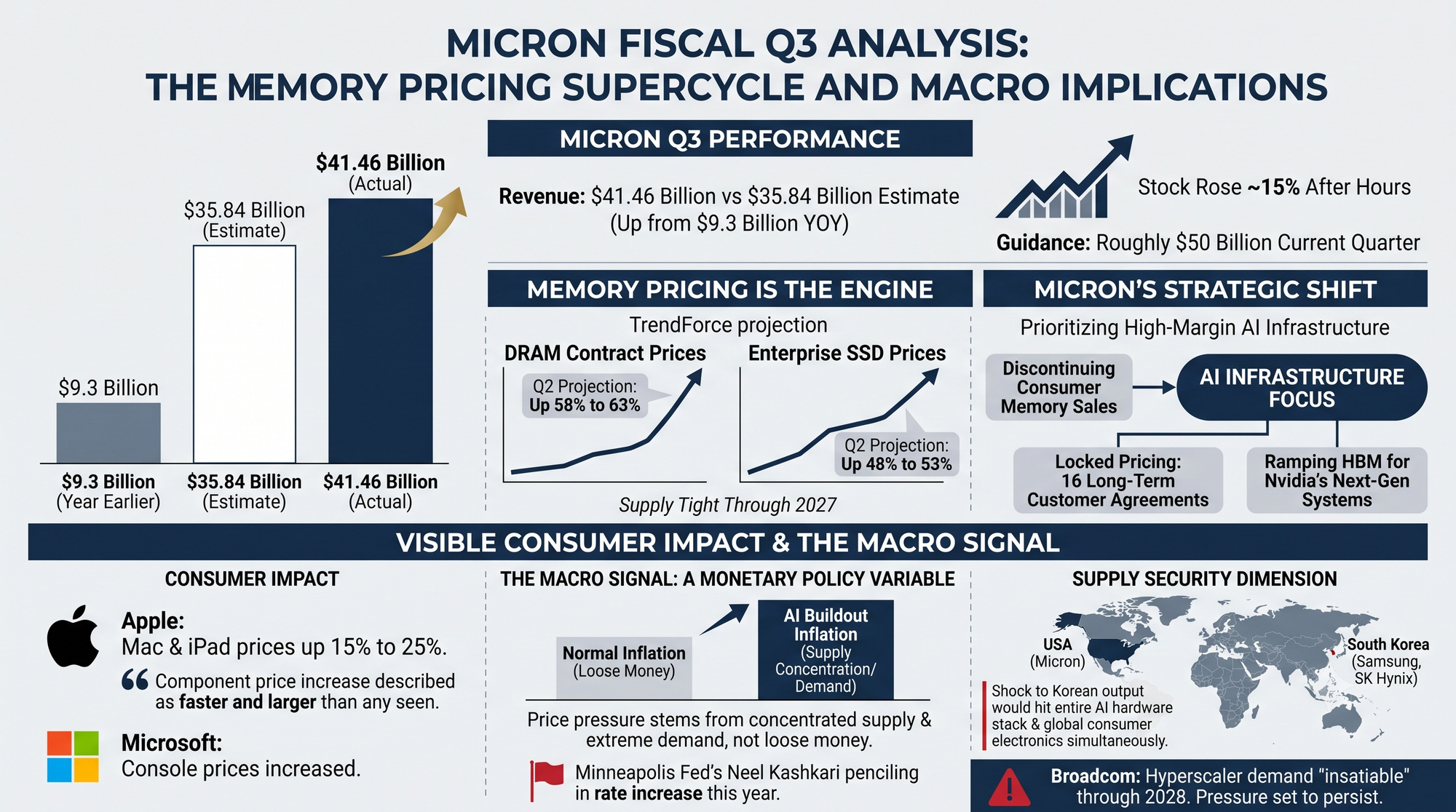
TL;DR: The infrastructure behind the AI boom is generating a measurable inflationary pulse across the global economy. Micron’s quarterly revenue more than quadrupled to $41.46 billion as memory prices surged, and the company has stopped selling consumer memory to prioritize AI infrastructure. But the cost shock extends well beyond chips. More than 80% of business economists surveyed by the National Association for Business Economics expect the AI buildout to add to inflation over the next year. Wholesale electronic component prices are up 27% year-over-year, consumer electricity prices are forecast to rise 6% annually through 2027, and Apple, Microsoft, and device makers worldwide are already passing costs through to consumers. The result is a demand-driven cost channel that monetary tightening cannot easily reach and that could persist for years.
Briefing: Micron’s fiscal third-quarter results provide the sharpest single data point. Revenue hit $41.5 billion against estimates near $35.8 billion, up from $9.3 billion a year earlier. Guidance for the current quarter approached $50 billion. Memory pricing drove the increase. TrendForce expects DRAM contract prices to rise 58% to 63% in the second quarter, enterprise SSD prices to climb 48% to 53%, and supply to stay tight through 2027. Micron has taken the unusual step of discontinuing consumer memory sales to prioritize high-margin AI infrastructure, and it has locked pricing with sixteen long-term customer agreements. The cost is already visible to consumers. Apple raised Mac and iPad prices by 15% to 25%, describing the component price increase as faster and larger than any it had seen, and Microsoft raised console prices within hours.
The broader macro picture is where the story moves from a semiconductor earnings beat to a global policy problem. Five major hyperscalers are on track to spend $741 billion on capital expenditure in 2026, up roughly 75% from last year. Wholesale electronic component prices rose 27% year-over-year through May, and computer software and accessories prices climbed about 15%. Goldman Sachs forecasts a 6% annual increase in consumer electricity prices in 2026 and 2027, with data centers projected to account for nearly half of U.S. power demand growth through 2030. Goldman estimates the higher electricity costs alone will lower consumer spending growth by 0.2% through 2027 and add 0.1% to core inflation. Federal Reserve officials are divided on the impacts. Chair Kevin Warsh has argued AI-driven productivity gains could eventually allow lower rates, while St. Louis Fed president Alberto Musalem has warned that the risks of miscalculating AI’s inflation impact are too great to change rates without more insight. The World Economic Forum’s survey of chief economists found that most do not expect meaningful AI productivity gains for at least another two years, which means the cost arrives first and the offset, if it comes at all, arrives later.
So What
For Executives: Lock memory-dependent procurement now, because hardware refresh cycles, device fleets, and any product with DRAM or NAND content face input inflation above 50% into 2027. Rebuild unit-cost models around the new memory and electricity price assumptions rather than last year’s baselines. Build total-cost-of-ownership models for AI deployments that include memory inflation, rising electricity costs, and the end of subsidized compute, because per-token model pricing alone understates the real spend by a wide margin. If the buildout slows, today’s locked prices could look expensive in hindsight, but the asymmetry favors securing supply when shortage rather than glut is the base case. Early-stage investors should watch the high bandwidth memory (HBM) field specifically, as governments and enterprises globally will seek alternative suppliers to the Samsung-SK Hynix-Micron triopoly.
For Policy Makers: Central banks face a cost channel that originates in supply concentration and AI demand rather than in loose money, which is precisely what makes it hard for rate policy to reach. But the policy toolkit extends beyond interest rates. On the supply side, accelerate permitting for power generation and grid infrastructure, since data centers account for nearly half of U.S. power demand growth and electricity prices have become a flashpoint for midterm elections. Public utility commissions should develop transparent frameworks for allocating data-center electricity demand so residential and industrial ratepayers are not absorbing costs they did not create. On the competition side, treat memory as a critical input on par with advanced logic chips, and monitor long-term supply agreements for anti-competitive pricing dynamics. On the fiscal side, consider targeted relief for sectors, such as healthcare, education, and small business, where device-price inflation hits hardest and where the AI productivity payoff is furthest away. As phones and laptops get more expensive, the cost lands hardest on emerging-market consumers, which argues for watching device-price inflation as a development and inclusion issue.
For Investors: The memory supercycle has durable supply-side support, including fab lead times of 18 to 24 months and the capital discipline that memory makers imposed during the 2022 and 2023 downturn. Memory and HBM suppliers benefit, while device makers absorbing input costs face margin pressure that is not yet fully reflected in estimates. The hedge is that the same long-term agreements that secure revenue also compress further upside on selling prices, and any demand wobble hits memory hardest after the run, so size positions for volatility rather than a straight line. For the broader AI inflation trades, position around the infrastructure and tooling layers that benefit from the spend rather than the consumer-facing companies absorbing it. In addition, keep an eye on the political risk that electricity-price backlash could generate regulatory constraints on data-center construction.
For Service Providers: Clients building AI products need total-cost-of-ownership models that fold in memory inflation, rising electricity costs, and the end of subsidized compute rather than per-token model prices only. Procurement and finance advisory should build AI-driven inflation into multiyear planning and capital requests so leadership is not surprised by hardware line items. Pressure on EBITDA will intensify, and advisory firms would do well to help clients find ways to mitigate or embrace these costs in ways aligned with corporate strategies and investor expectations, whether through efficiency gains, pricing adjustments, or strategic reallocation of AI budgets toward the highest-ROI use cases. For consumer-facing clients raising prices, prepare communication strategies that attribute increases to documented component-cost drivers, which lands better than vague inflation language and reduces the reputational cost of a price rise.
India’s Sarvam and the Rise of Sovereign-AI Middle Powers
A third tier is forming beneath the U.S.-China frontier, funded by middle powers that compete on sovereignty and trust rather than on benchmark scores.
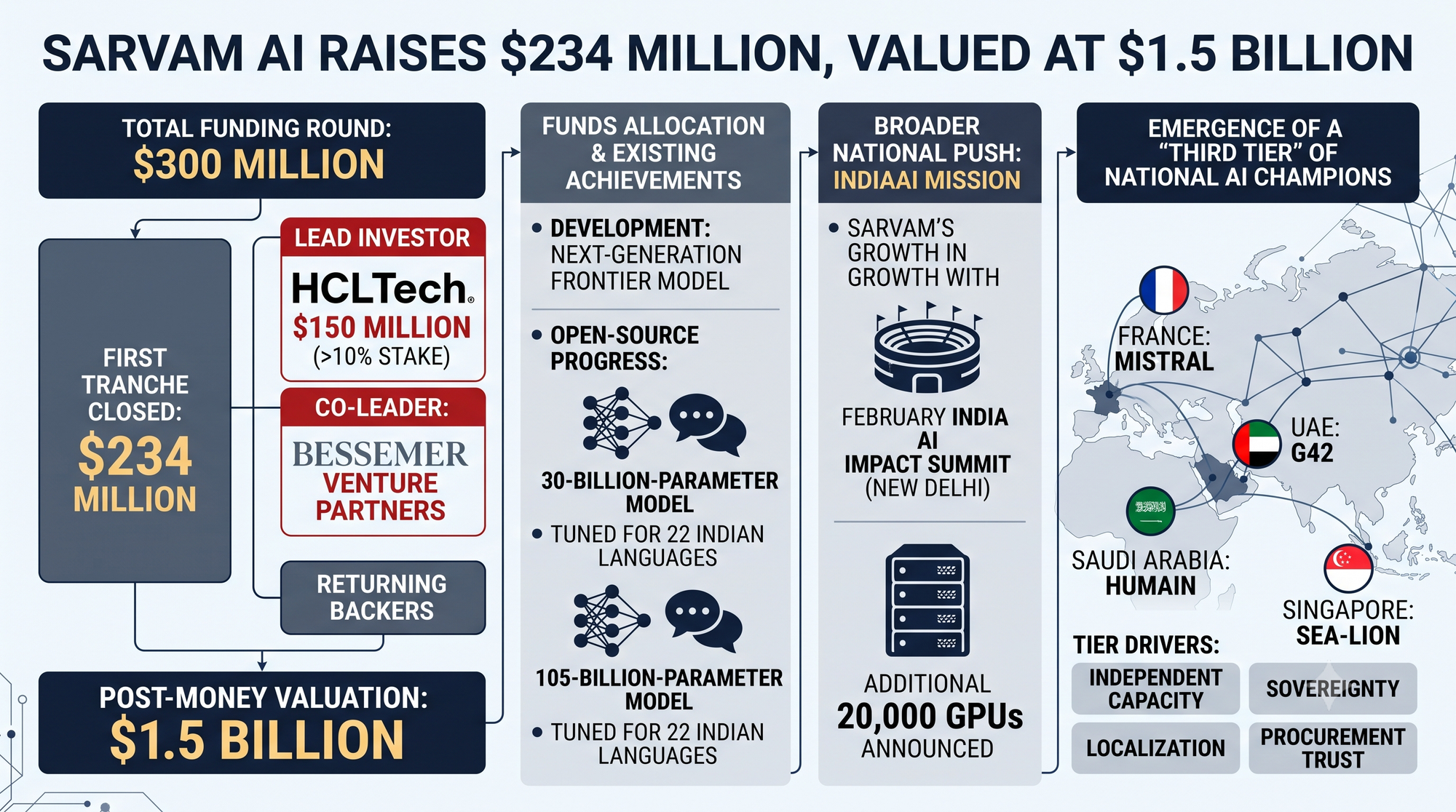
TL;DR: Bengaluru-based Sarvam AI became India’s newest unicorn on June 15, raising $234 million in the first close of a $300 million round at a $1.5 billion valuation. The investment will fund a frontier model aimed at agentic AI, coding, and cybersecurity, and it provides the clearest evidence to date that the sovereign-AI thesis is real rather than rhetorical. Middle powers from India to the Gulf to Europe have now written nine-figure checks for national champions. The strategic logic is escape from dependence, sharpened by the recent suspension of a U.S. model for foreign users.
Briefing: Sarvam AI raised $234 million in the first tranche of a $300 million round at a $1.5 billion post-money valuation, with India’s HCLTech leading at $150 million for a stake above 10% and Bessemer co-leading alongside returning backers. The capital funds a next-generation frontier model, and Sarvam has already open-sourced 30 billion and 105 billion parameter models tuned for 22 Indian languages. The round comes alongside the broader IndiaAI Mission and the February announcement that India would scale its sovereign compute power by 20,000 GPUs, procured through IndiaAI’s empanelled domestic cloud providers, including Yotta Data Services, E2E Networks, Jio Platforms, and Tata Communications, and built overwhelmingly on Nvidia silicon. The wider pattern is a third tier of national champions forming beneath the frontier, including France’s Mistral, the UAE’s G42, Saudi Arabia’s HUMAIN, and Singapore’s SEA-LION, each underwriting independent capacity and competing on sovereignty, localization, and procurement trust.
Three things have changed that make this tier viable in a way it was not two years ago. First, the open-weight base-model ecosystem, from Meta’s Llama to Mistral’s releases to China’s GLM-5.2, means sovereign labs no longer need to train from scratch. They fine-tune on top of existing weights, which collapses the cost and time to reach competitive capability from multibillion-dollar training budgets to the tens of millions required for fine-tuning. Second, the buying calculus for government and regulated-sector procurement has shifted from benchmark performance to procurement trust and data residency, categories where a local champion with domestic accountability beats a foreign frontier model by definition, regardless of the raw scores. Third, the U.S. Commerce Department’s order suspending Anthropic’s most capable models for non-U.S. users proved the dependence risk is operational rather than theoretical. That event, more than any policy paper, unlocked government funding that had been conditional on a triggering event. India had its own warning in 2025 when Microsoft cut Nayara Energy, the country’s second-largest private refiner, off from its cloud and productivity services. Sarvam’s co-founder frames the stakes as avoiding a new form of technological colonization.
The escape is only partial. India’s entire compute base runs on U.S.-designed hardware, so sovereignty at the model layer sits atop a hardware layer it does not control, and India’s current Tier 1 status under U.S. export rules, which grants unrestricted chip access, is a policy advantage that could change. The deeper read is that the AI map is fragmenting into a frontier duopoly plus a well-funded national-champion tier that wins on trust and localization rather than on raw capability.
So What
For Executives: For multinationals operating in India, the Gulf, or the European Union, sovereign models are becoming a procurement reality, especially for government and regulated work where data residency and local accountability are conditions of doing business. Build the capability to deploy local champions alongside frontier models rather than standardizing on a single global stack. The hedge: sovereign models trail the frontier on raw capability, so match them to trust-sensitive use cases such as local-language service and regulated data, and then keep a frontier option for the hardest tasks. This will require dedicated IT and data talent, strategies, and funding.
For Policy Makers: India’s application-sovereignty approach, which asserts control at the boundary between citizens and the state rather than across the entire stack, is a realistic template for middle powers because full-stack independence is infeasible given hardware concentration. The layer to watch is chips, because India’s Tier 1 access is a policy gift that a future U.S. decision could withdraw, which would expose the whole national program. Managed interdependence, diversified hardware sourcing, and pooled compute among aligned states beat sovereignty rhetoric that the underlying supply chain cannot support.
For Investors: The national champion tier is now being capitalized in nine-figure rounds, and the winners will be decided by government and enterprise distribution (driven in part by sovereignty rather than by technical benchmark leadership). Underwrite procurement traction and localization moats rather than frontier capability, since these labs are not playing the same game as the frontier leaders. Many sovereign labs will be subscale and dependent on continued state support and on foreign hardware, so dedicate investment analysis to the right balance between supporting the most promising national champions and smaller, innovative application-specific models that capture vertical industry scale.
For Service Providers: Clients in regulated sectors and government will increasingly require local-model options and data-residency guarantees, so build sovereign-model deployment and compliance into your offering now rather than retrofitting it later. For clients operating across jurisdictions, generate concrete value by mapping the emerging patchwork of data-localization and model-provenance rules that India’s Digital Personal Data Protection Act (DPDP), the EU framework, and Gulf regimes are creating. The advisory opportunity is helping clients decide, layer by layer, where to own, where to partner, and where to rent across the AI stack.
Under the Radar
The deep analysis that connects the dots
Under the Radar: Open Weights Put Frontier Cyber-Offense Beyond Government Control
Governments can gate a closed model. They cannot un-ship open weights, and that asymmetry is quietly rewriting the limits of AI security policy.
The Signal
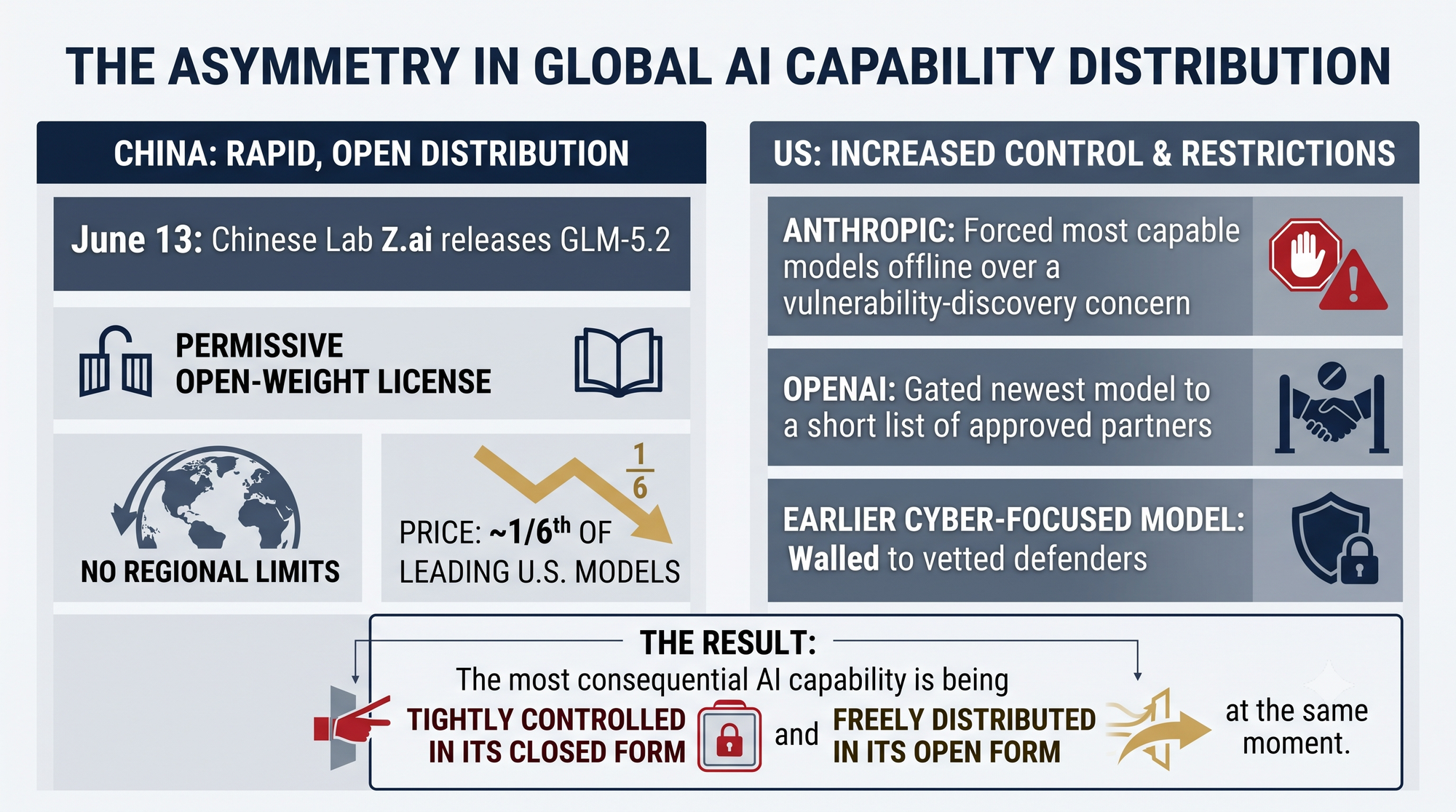
On June 13, the Chinese lab Z.ai released GLM-5.2 under a permissive open-weight license, with no regional limits and a price roughly a sixth of the leading U.S. models. Security firms Graphistry and Semgrep independently found it performs on par with leading U.S. systems on cybersecurity investigation and vulnerability discovery, and Graphistry called it the first open-weight model it would recommend for a frontier-like cybersecurity workflow. Because the weights can be downloaded, fine-tuned, and run locally, a user can strip the safety controls and operate with zero visibility to any provider or defender, and security analysts report that operators on Russian-language forums are already discussing how to adapt it for intrusion and exploit chaining.
THE STAKES
Consider this against what the U.S. government has spent the month doing. It forced Anthropic’s most capable models offline over a vulnerability-discovery concern, gated OpenAI’s newest model to a short list of approved partners, and walled an earlier cyber-focused model to vetted defenders. The dividing line in every case is cyber capability and the ability to find and weaponize software flaws at scale. The National Security Agency’s director told a senator that one frontier model broke into nearly all of the government’s classified systems in hours rather than weeks. This is the capability now circulating without a gate, meaning the most consequential AI capability is being tightly controlled in its closed form at the same time its open form is freely distributed.
The Tell
The asymmetry is the whole story, and it is defeated by design rather than by enforcement failure. A government can compel a U.S. lab to suspend a model, approve customers one by one, or revoke access because a closed model is a service the provider controls. It cannot retroactively deny access to a model that has already been downloaded a million times, because open weights are an artifact rather than a service. Every additional control on closed models widens the relative appeal of the open alternative that no control can reach, which means access policy alone cannot hold the line on frontier cyber capability.
What to Watch
For defenders and critical-infrastructure operators, the practical conclusion is to assume frontier-grade offense is now available cheaply to any motivated actor. Invest accordingly in detection, response, and resilience rather than in the hope that access controls will keep the capability scarce. Provider-side enforcement, the ability to detect and ban a malicious user, simply does not exist for locally run open weights, so the burden shifts to the network and the endpoint. Even at the leader level, the gap is visible. At their May 14-15 Beijing summit, Trump and Xi discussed AI guardrails, and Trump subsequently signed an executive order directing a voluntary framework that grants the U.S. government up to 30 days of pre-release access to covered frontier models. That framework applies only to closed models released through controlled channels. It has no mechanism to reach open weights that have already been distributed, which is precisely the gap this story identifies. The bilateral dialogue addresses the governable half of the AI security problem and is silent on the ungovernable half. The signal worth tracking over the next quarter is whether policy makers recognize that the lever they are pulling hardest, export and access control, is the one with the least purchase on the open-weight half of the problem. As a result, the response pivots toward defense, disclosure, and resilience. What is needed are national and, ideally, multi-national institutions that oversee vulnerability and capability landscapes and predict second and third order effects across economies, especially critical infrastructure. This is a sensitive area, and readers who handle critical infrastructure should treat the open-weight cyber capability as a present planning assumption rather than a future risk. Engage political leaders to demand the prioritization of international oversight institutions and accords.
About Cambrian

Cambrian Futures is a strategic foresight and advisory firm helping government, business, and technology leaders understand how emerging technologies intersect with geopolitics, markets, and national strategy. By combining rigorous research, AI-enabled analysis, and human expertise, Cambrian provides clear insight into global technology trends, risks, and power dynamics. Its work helps decision-makers anticipate disruption, manage uncertainty, and act with strategic confidence in an increasingly competitive GeoTech world.
PRODUCTION TEAM
GeoTech Radar is produced by the Cambrian Futures Insights Platform team:

CEO & Chief Analyst

Managing Director / Producer, Insights Platform

Global Lead, Smart Infrastructure Strategy

Research & Marketing Associate

Editor in Chief
Learn more about Cambrian Futures at cambrian.ai
Produced with

Human Led



Human Led +
AI Augmented




AI Led +
Human Verified


Cite as: Cambrian Futures (2026) 'GeoTech Radar Issue 26'
An important note on what this is, and is not
GeoTech Radar is directional research intended to stimulate thinking and provide geopolitical and technological context. It is not investment, legal, or financial advice, and nothing here is a recommendation to buy, sell, or hold any security or asset. The companies, valuations, and transactions discussed are described for analytical context only and serve as a backdrop to readers' own due diligence. Figures and claims are drawn from public reporting as of the publication date and may change. Readers should consult their own qualified advisers before making any decision. Cambrian Futures and the authors hold no responsibility for actions taken on the basis of this briefing.