
Beijing's Own Chips Get Dearer Before the Summit. Zagreb Runs Chinese Robotaxis With No One at the Wheel. Claude Turns Up in Yemen's Missile Code. (FREE VERSION)
IN THIS ISSUE:
GTR Terminal: Subscribers get full access to our live dashboard tracking the signals shaping the future. Your access link and password are one click away.
On the Radar
The signals affecting the GeoTech landscape this week
What Is Actually on the Table When Xi Meets Trump on September 24
Twelve days out, the likeliest outcome is a one-year extension of the October 2025 trade truce. The AI safety dialogue meant to precede the summit has slipped, and the U.S. side arrives with a joint intelligence advisory that names six Chinese labs.
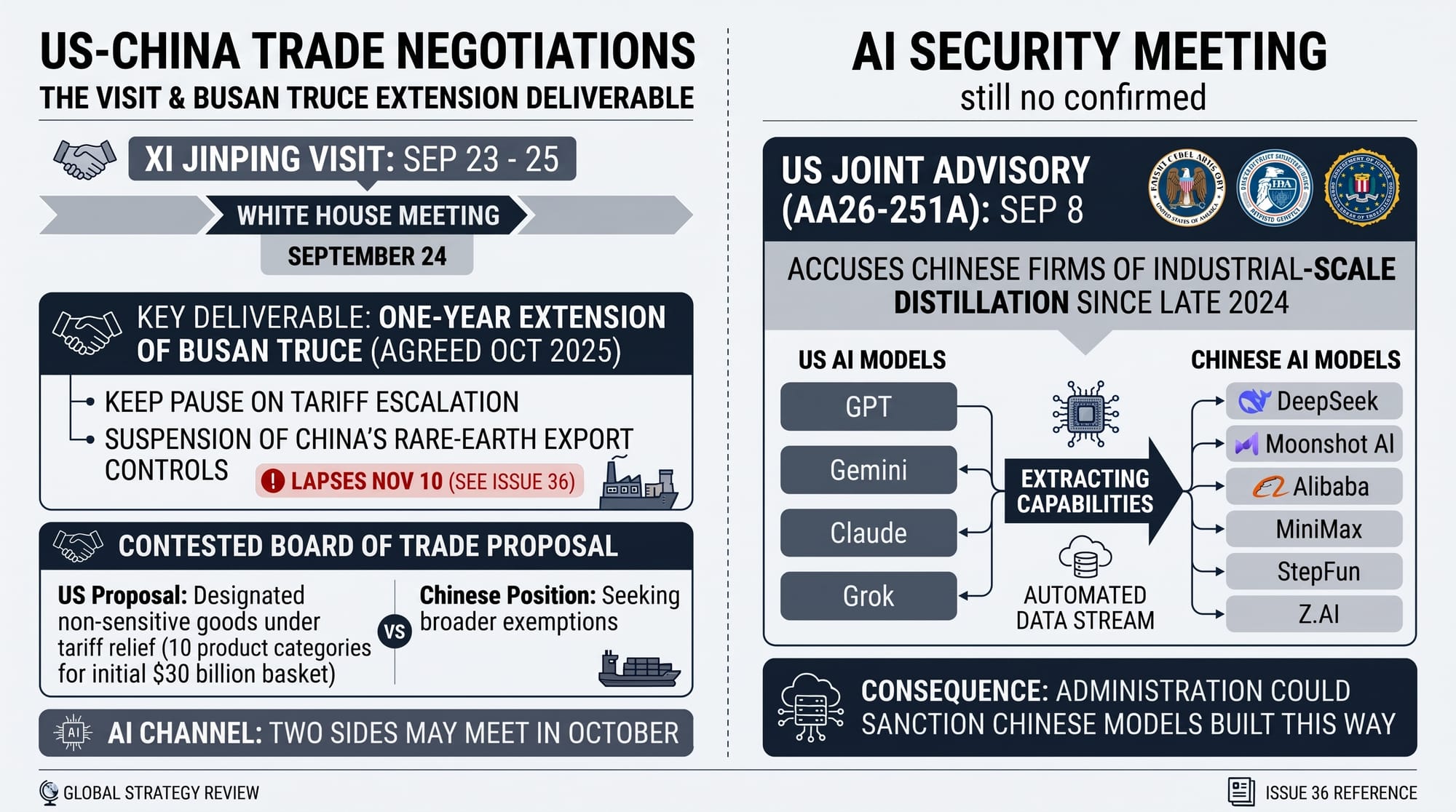
BRIEFING: Xi Jinping's visit is now scheduled for September 23 to 25, with the White House meeting on September 24, and the deliverable both sides are converging on is a one-year extension of the Busan truce agreed in October 2025. That extension would keep the pause on tariff escalation and, most consequentially, the suspension of China's rare-earth export controls, which otherwise lapses on November 10 (see Issue 36). The minerals question is narrower than the headline suggests. Beijing's April 2025 licensing regime on seven medium and heavy rare earths, samarium, gadolinium, terbium, dysprosium, lutetium, scandium and yttrium, was never suspended and still runs license by license. What the truce paused was the October 2025 expansion: five more elements and a rule that reached any foreign-made magnet containing 0.1 percent Chinese rare-earth content. Dysprosium and terbium are the ones that matter most, because they go into the heat-resistant magnets in electric-vehicle motors, wind turbines, drones and guided munitions, and exports of those two, plus yttrium, have run about half their pre-control levels even under the truce. On chips, the item a handshake could move is Nvidia's H200, which Washington authorized for sale to China in December 2025 with a 25 percent cut for the U.S. government and which Beijing has blocked its own companies from buying since April. Beijing's pending import quota is reported to fall short of 200,000 units, reserved for training rather than everyday use, and (see Story 4) the domestic alternative has grown more expensive while the approval sat. The trade mechanism is the U.S.-China Board of Trade, a joint body agreed at the May Beijing summit and run by the U.S. Trade Representative and China's Ministry of Commerce, under which each side would move about $30 billion of "non-sensitive" goods into lower tariffs. Which goods qualify is still contested: about ten product categories are under discussion for the initial basket, and Chinese negotiators want broader exemptions. Treasury Secretary Scott Bessent confirmed on September 15, in testimony to the House Financial Services Committee, that he will meet Vice Premier He Lifeng this weekend for the final preparatory talks. He framed the meeting around financial pressure on Iran, and the South China Morning Post reports it will also cover the summit's economic outcomes and preparatory discussion of AI safety. Beijing has not yet officially confirmed the visit.
The AI channel has moved less than either side hoped. Reuters reported on September 4 that a Bessent-led AI safety dialogue was planned for mid-September, the first bilateral talks devoted to AI since President Trump returned to office. Location, participants and agenda were unsettled at the time, a White House official said no AI meeting was planned, and Beijing set two preconditions, the first being agreement on what "AI safety" means before substantive talks begin. As of this writing the talks have not been held. A Treasury spokesperson told Reuters the two sides "may meet in October," which places the first dedicated AI session after the summit rather than before it, and the Bessent-He meeting this weekend is now described as preparatory. Into that gap the U.S. side dropped its strongest card: on September 8 the NSA, the Cybersecurity and Infrastructure Security Agency (CISA) and the FBI issued a joint advisory, numbered AA26-251A, accusing DeepSeek, Moonshot AI, Alibaba, MiniMax, StepFun and Z.AI of extracting capabilities from Claude, GPT, Gemini and Grok since late 2024 through what the agencies call industrial-scale distillation. Distillation is a legitimate training method in which a smaller model learns from a larger model's outputs, and the agencies' claim is that these six firms used it as their core development strategy, in violation of the American labs' terms of use, likely with the Chinese government's awareness. The advisory maps specific Chinese models to specific American ones, including Moonshot's Kimi K3 to Claude Fable 5. Bessent had already said in July that the administration could sanction Chinese models built this way. Anthropic's own threat report, published September 10, adds that operators linked to Alibaba ran more than 151 million exchanges with Claude between May and July (Story 3). And on September 10, speaking to reporters in Dallas, President Trump dismissed AI extinction warnings and said the United States leads China by about a year, a framing that makes any pause proposal at the summit unlikely from the U.S. side. The industry moved the other way over the same weekend. Sam Altman told OpenAI staff the company is open to slowing frontier development and OpenAI separately asked members of Congress whether an industry-wide slowdown would survive antitrust law. On September 12 Anthropic's Dario Amodei published an essay, "We Must Pace the Frontier," arguing that the industry should deliberately slow capability growth while still pursuing what he described as AI's benefits in medicine and growth, and committing Anthropic on its own to give outside evaluators permanent, employee-level access. Altman endorsed the proposal within hours, and Amodei said in interviews that competition with China is the hardest objection to any slowdown.
SO WHAT
For Executives: Run two calendars against your exposure this week. The first is the truce: a one-year extension is the base case, so model November 10 as a date that most likely moves to late 2027, and price the smaller probability that it does not. The second is the advisory: if your engineering teams run models from any of the six named labs, whether through an API or as open weights on your own servers, ask your general counsel now whether U.S. sanctions on those developers, which Bessent has said are available, would reach your deployment. Sanctions on a model developer do not automatically bar use of downloaded weights, but the answer depends on how the designation is written, and you want the memo in hand before any designation is issued. For companies outside the U.S. and China, the question is whether your government follows the advisory with its own restriction, which is the pattern export controls have followed. Hedge: Advisories are not sanctions, and no designation has been issued. Do not pull Chinese open-weight models from production on the advisory alone. Document where they run, what they touch and how fast you could swap them, then hold.
For Policy Makers: The advisory converts a commercial grievance into a national-security finding, and that changes what allied governments can do with it. Brussels, Tokyo and Seoul now have a U.S. intelligence document to cite when they write their own rules on model provenance, and they should decide before the summit whether they want to be inside or outside whatever framework the U.S. side proposes. For the AI dialogue itself, the slip to October, after the summit, could be an opportunity. A meeting held after the leaders have met can be technical rather than performative, and the deliverable that survives Beijing's precondition is the one Issue 36 identified: a shared incident-reporting channel for AI-directed cyberattacks and loss-of-control events, which both governments have publicly said they fear. Distillation belongs in a separate track with trade officials, because it is an intellectual-property dispute and the remedies are commercial. Hedge: If the AI talks do not happen at all this autumn, the summit communique will still carry an AI paragraph, and it will be aspirational. Read it for whether it names a working group with a date, and treat anything less as a placeholder.