
Beijing Puts Export Controls on Its Own AI, Congo Polices Its Copper Belt and Regulators Audit Without Law (Free Version)
INSIDE ISSUE 42:
GTR Terminal: Subscribers get full access to our live dashboard tracking the signals shaping the future. Your access link and password are one click away.
On the Radar
The signals affecting the GeoTech landscape this week
China Puts Export Controls on Its Own AI
China’s draft rule would license exports of the country’s largest AI models and advanced chip designs, and the initial cost would hit U.S. clouds that host Chinese weights.
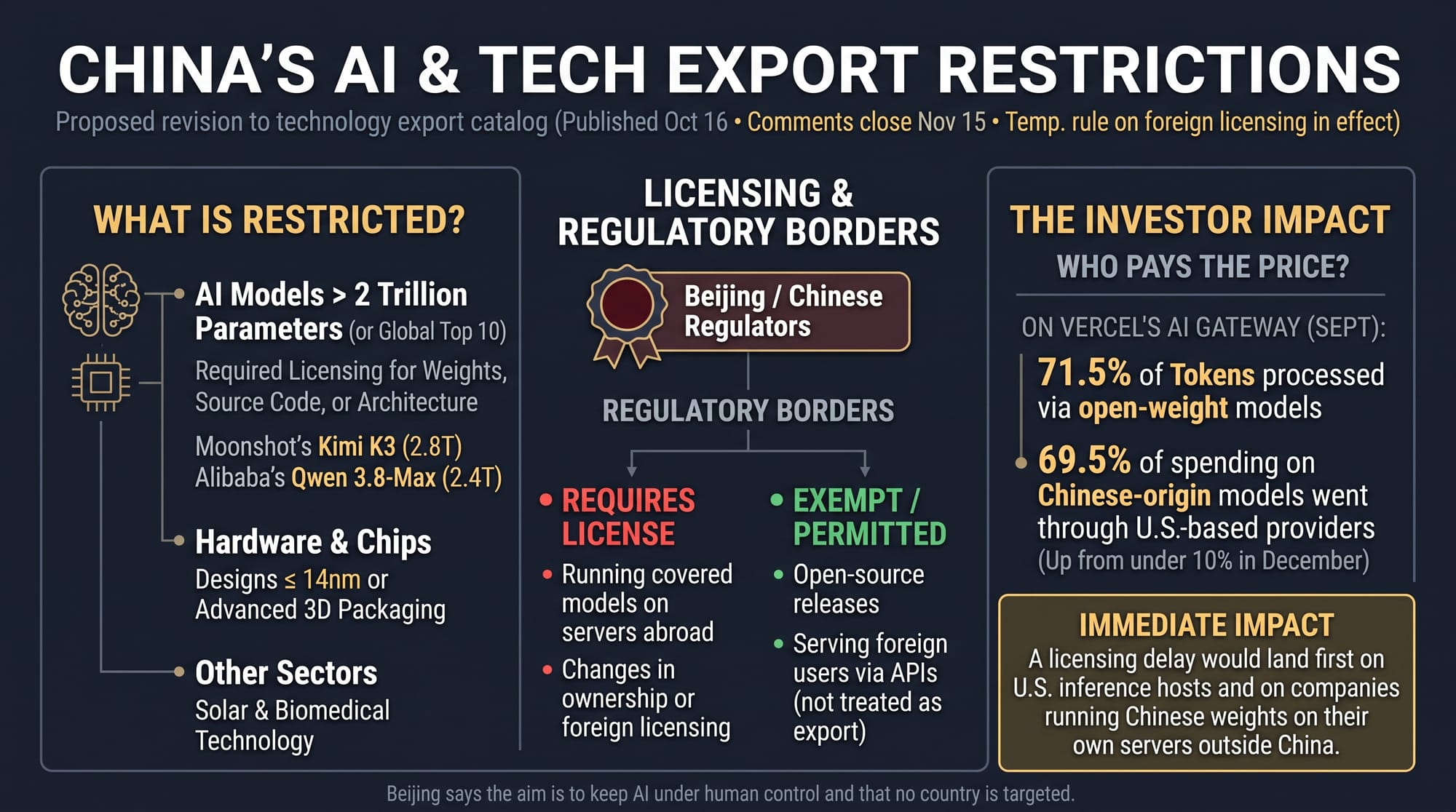
BRIEFING: China's commerce and science ministries on October 16 published a draft revision of the country's catalog of technologies restricted from export, adding 23 AI items alongside solar and biomedical technology. Per Bloomberg's reading of the draft, exporting the weights, source code, or architecture of models above 2 trillion parameters would need a license. Models at that scale, reportedly including Moonshot's Kimi K3 and Alibaba's Qwen 3.8-Max, would rank in the global top 10. Chip designs that need 14-nanometer or finer manufacturing or advanced 3D packaging are covered too. Comments close November 15, but a temporary registration rule for foreign licensing and ownership changes took effect the day the draft was published. Open-source releases are exempt, and serving foreign users through an API is not treated as an export, though running a covered model on servers abroad would be.
Last week’s GTR newsletter covered Tencent’s renting of U.S. chips through a gap in U.S. rules. This draft runs the other way, with Beijing as the controller and its own models as the controlled goods. So, who pays if and when the draft rules go into effect? On Vercel's AI Gateway in September, open-weight models processed 71.5% of tokens, and 69.5% of spending on Chinese-origin models went through U.S.-based providers, up from under a 10% in December. So a licensing delay would land first on U.S. inference hosts and on companies running Chinese weights on their own servers outside China. Beijing says the aim is to keep AI under human control and that the rule did not target any particular country.
Strategy & Portfolio Implications
The exposure sits with U.S. and European inference clouds whose revenue mix leans on Chinese weights, and with any enterprise or sovereign buyer that runs Kimi or Qwen on its own infrastructure abroad, since that deployment would count as an export. The open-source carve-out means different risks for different hosts. MIT- and Apache-licensed releases, such as DeepSeek's, are the least exposed, and custom-licensed frontier weights are the most exposed. Hosts with broad model menus can absorb a swap, and U.S. open-weight builders (e.g. Meta, Nvidia's Nemotron, and Reflection AI's Beam) stand to gain as substitute options, though the capability gap means substitution will be partial for a year or more. In diligence, ask portfolio companies which Chinese models run in production, under which license, on whose servers, and how fast they can switch. The first catalyst is November 15 and the final annex that fixes thresholds. The second is a potential U.S. response on Chinese models hosted at home, which the Council on Foreign Relations' Chris McGuire is already urging.
Macro-Economic Implications
Projected a year out, the first-order bill is a higher unit cost of inference outside China. Chinese open weights set the price floor for hosted models. If new frontier weights from Moonshot or Alibaba arrive late, hosts swap in U.S. open models or closed APIs that cost more per token, and the fall in AI unit costs that enterprise budgets count on slows. The capital that fills the gap is hyperscaler capex, now debt-funded at a pace Bank of America puts at $140 billion a year, and a firmer per-token price improves the return math on that debt while raising the cost of adoption for price-sensitive buyers outside the U.S. China pays second: its labs keep API revenue, since serving foreign users is not an export, but lose the distribution that made their weights a global default, which hands pricing power back to closed U.S. labs. Net over twelve months: U.S. AI capex and bond issuance up, global AI cost deflation slower, Chinese software reach abroad down. Hedge: The thresholds come from press reports about an annex not yet published in full, and draft catalogs often narrow before adoption. Plan for a licensing delay instead of a cutoff.