

Anthropic Watermarks Claude While a Strip-the-Mark Economy Forms, Apple and TikTok Pay the Belonging Toll, and China's Labs Reprice the Cost of Intelligence (FREE VERSION)
IN THIS ISSUE:
On the Radar
The signals affecting the GeoTech landscape this week
Anthropic Watermarks Claude While the Tools to Strip Marks Circulate Freely
The first frontier lab to comply with Europe's new transparency mandate is embedding provenance markers in its outputs, but the issuer itself concedes the marks are fragile, and the incentive to remove them arrived before the rule did.
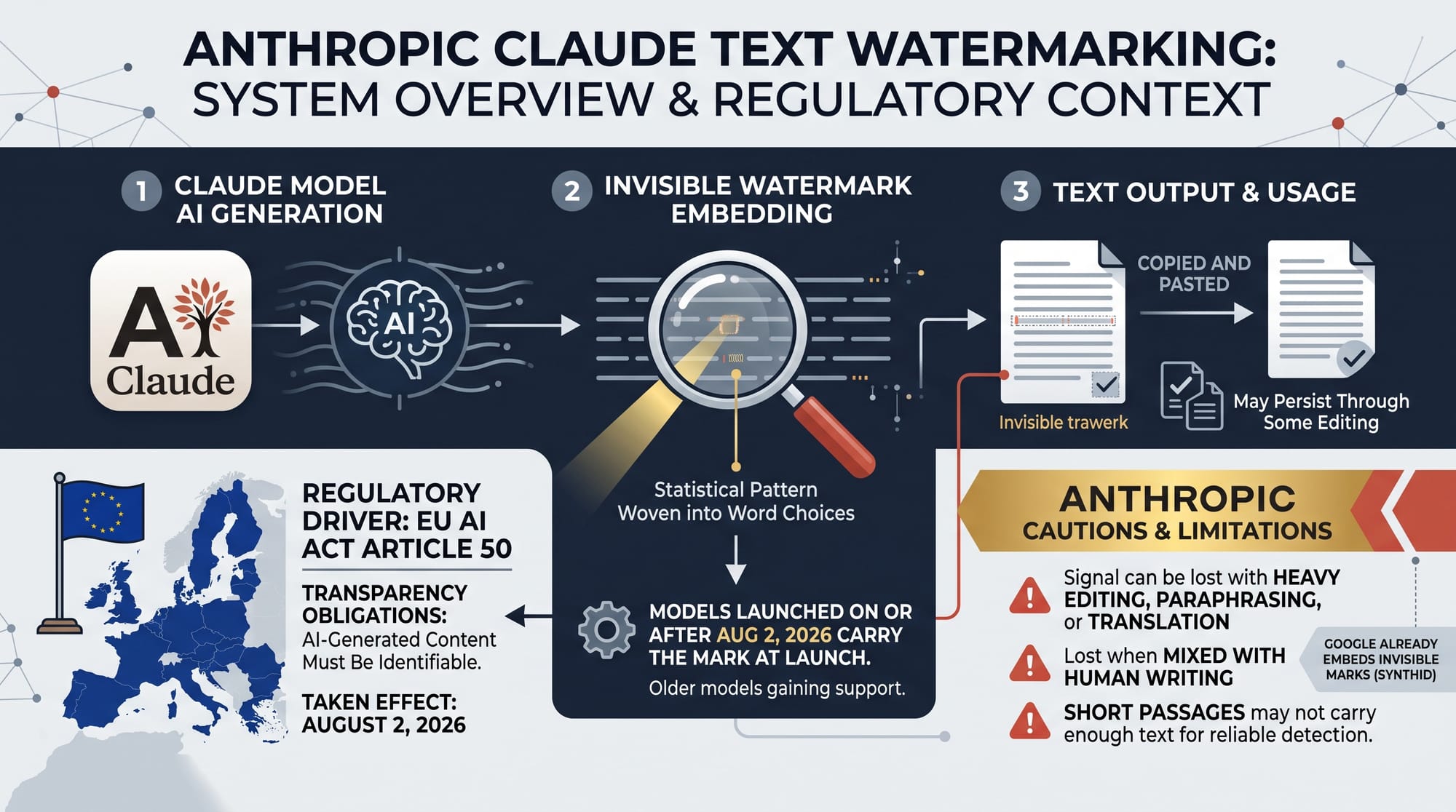
BRIEFING: Anthropic confirmed on August 11 that its Claude models will embed an invisible statistical watermark in generated text. The company said a pattern woven into word choices will travel with the text when it is copied and pasted, and it could persist through some editing. Models launched on or after August 2 carry the mark at launch, with support being extended to older models. Files such as images and SVGs are marked with signed provenance metadata under the C2PA open standard, the framework backed by Adobe, Microsoft, and major camera manufacturers. The driver is the EU AI Act's Article 50 transparency obligations, which took effect on August 2 and require that AI-generated content be identifiable as such. Anthropic is not the first to watermark text, since Google already embeds invisible marks in AI-generated text, but it is the first of the newly obligated frontier labs to switch on marking at the model level, across every product and surface, with detection tooling promised but not yet shipped.
Anthropic cautions that the watermark can be lost when text is heavily edited, paraphrased, translated, or mixed with human writing, and that short passages might not carry enough text for reliable detection. The company also notes that the absence of a detected mark does not prove content was human-made. That concession matters because the counter-economy is already in place. Open repositories hosting paraphrasing and watermark-evasion tools predate the mandate, and the academic literature on paraphrase attacks against statistical watermarks is well developed. The actors with the strongest financial incentive to defeat provenance – chief among them fraudsters using AI-generated content to impersonate real people – depend entirely on machine text passing as human.
SO WHAT
For Executives: If your organization produces AI-assisted content in marketing, client communications, analyst reports, or code, you face a labeling question that regulation will answer for you if you do not answer it first. The smarter move is to adopt a disclosure position before the mandate reaches your jurisdiction, because the first company in your sector to voluntarily label content starts to create a norm that makes every competitor’s silence conspicuous. Audit where AI-generated material touches clients, partners, and regulators. The watermark itself is not your risk. The risk is having no position when someone asks whether your work is human or machine. Hedge: Watermarking is technically immature, Anthropic concedes it can be washed out, and no jurisdiction has yet enforced the EU mandate’s penalty structure. Build the policy now and defer infrastructure spending until detection technology and the enforcement regime stabilize.