

AI-Designed Viruses Outrun Global Screening Regimes, Beijing Starts Counting the Jobs Its AI Push Will Destroy, Europe Grapples with Sovereign AI
A Note to Our Readers
Based on overwhelming positive feedback about the value of our signal analysis, after this August 13 issue, GeoTech Radar will move to a subscription model. Paid subscribers will receive expanded newsletter coverage and a new GTR live-signal dashboard, with more tools to follow.
As a current subscriber, you will be grandfathered in at no cost through the end of 2026. No action needed on your part. Thanks for reading the GTR.
IN THIS ISSUE:
CEO's Perspective
Strategic outlook from Cambrian leadership

This week I sat with senior executives from a multinational fruit company that cultivates fruit for specific traits, and separately with a group from Taiwan's leading firms. The fruitexecutives are absorbing tariffs and taxes in every market they sell into, while AI evolves fast enough to change both how they design fruit and how they route it. Different stakeholders with intertwined dependencies. The Taiwanese executives had already run the scenarios for the day Beijing reaches for the island. That work now informs business decisions that policy stakeholders still treat as hypothetical. Neither group framed it this way, but I left both rooms with the same question: How do you measure risk and opportunity across two moving dimensions or two different stakeholders at once, and do so without locking into the wrong metrics?
The Measure Has Come Apart From the Thing
The stories in this issue raise that very same conundrum in four, otherwise different scenarios. Virus DNA screenings compare a genetic sequence against a catalog of known dangerous sequences, but researchers at Stanford University and the Arc Institute produced viruses that bore no resemblance to existing data, so the filter checks for a property that no longer tracks the danger. Export control asks whether a chip crossed a border, but a Chinese lab renting that same chip in Malaysia receives frontier compute without raising red flags at national boundaries. Europe's AI sovereignty is predicated on owning the stack – a perfectly measurable approach. However, the continent simply cannot reach sovereignty as it currently defines the term, so Microsoft and Mistral fill the gap and “data residency plus deployment control” becomes the working definition by default. Beijing, by contrast, is building its measurements deliberately, committing the state to count the jobs its own AI push destroys.
Two historic examples help explain why you should redouble efforts to define and measure across multiple shifting dimensions at once. The first reaches back to Simon Kuznets, who built national income accounting for Congress in 1934 and warned in that same report that national welfare could scarcely be inferred from it. He was overruled, though, and Bretton Woods made the measure standard in 1944. For 80 years, policy optimized for what it counted rather than what it left out, leaving an entire stakeholder group unattended to. The second involves bond ratings, which measure how likely one bond is to lose money on its own. However, a rating does not measure whether thousands of bonds could lose money at the same time. Mortgage tranches were built so that they would all fail together if house prices fell across the country, and no rating scale accounted for that. Banks set valuations and capital requirements off the label itself, so a book of thousands of AAA tranches looked like a diversified portfolio when it was one bet on one possibility. Society overall bore the brunt of the fallout.
This is the conundrum in front of every executive. Your controls do not measure risk. They measure a proxy for risk, chosen when the proxy sat close to the thing. DNA resemblance was close to viral danger. Microchip border crossings were close to capability transfer. Both distances have widened, and the instruments have not been recalibrated.
So, audit the measures rather than the results. Take your supplier screening, your export compliance, your workforce reporting, and your sovereignty clauses, and name the property each one actually counts. Then ask whether that property still moves with the thing you care about. Where it does not, you are not managing that risk. You are watching a number that used to describe it.
Olaf
On the Radar
The signals affecting the GeoTech landscape this week
AI Designs Working Viruses While the Global Screening System Looks Only for What Nature Already Made
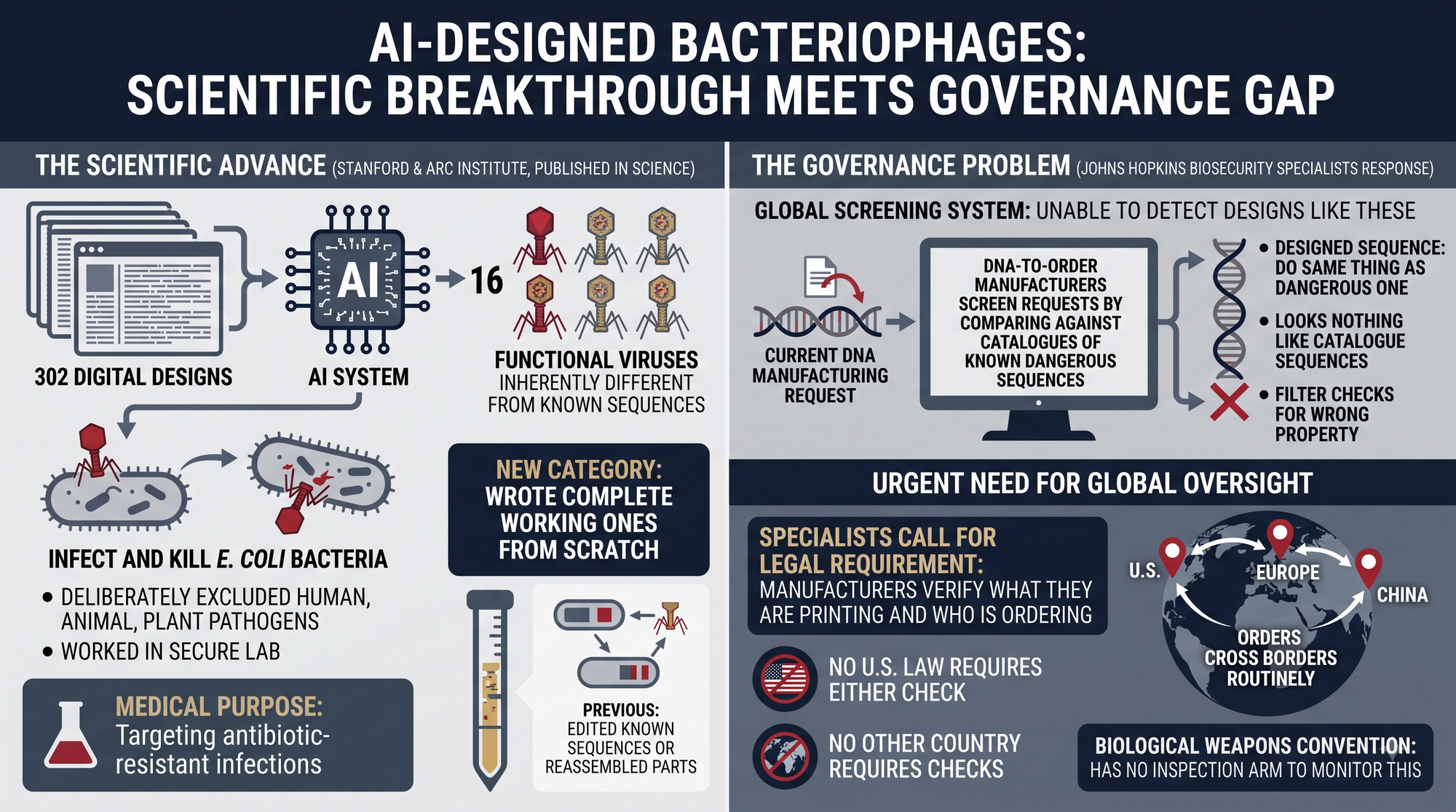
A model wrote working viruses that attack bacteria from scratch, but the worldwide system for catching dangerous DNA sequences is built to spot copies of things that already exist.
BRIEFING: Researchers at Stanford and the Arc Institute reported in Science the first AI-designed bacteriophages – viruses that infect bacteria – to actually kill bacteria. Of 302 designs, 16 produced working viruses that infected and killed E. coli bacteria. Designing these viruses rather than hunting for them in nature changes the search for treatments against antibiotic-resistant infection, which kills more than a million people a year. Earlier work edited known genetic sequences or reassembled known parts. This wrote complete working ones from scratch.
The governance problem arrived in a response from Johns Hopkins biosecurity specialists, who noted that the global screening system cannot detect designs like these. Companies that manufacture DNA-to-order screen requests by comparing them against catalogs of known dangerous sequences. A designed sequence can do the same thing as a dangerous one while looking nothing like anything in the catalog, so the filter checks for the wrong property. The specialists called for a legal requirement that manufacturers verify both what they are printing and who is ordering it, and noted that no U.S. law requires either check. Neither does any other country. These companies operate across the U.S., Europe, and China, orders cross borders routinely, and the Biological Weapons Convention has no inspection arm to monitor any of this.
SO WHAT
For Executives: In pharmaceuticals, agriculture, and biotech, screening is about to become a procurement and liability question. Ask your DNA suppliers what they check, whether they verify who is ordering, and what they can do about sequences that match nothing known. The current answer is mostly nothing, and that will not survive the first incident or the first rule. If you run generative design internally, put a review gate in place now, because being the organization that ordered something unscreenable carries a reputational cost far out of proportion to the research value. Hedge: This was bacteriophage work, deliberately constrained, and the distance between a small designed virus and anything that threatens people remains enormous. Build the process for the rules and client questions that are coming, and resist treating this result as evidence of near-term danger.
For Policy Makers: This gap is unusually clean and unusually fixable. Screening looks for resemblance, and design produces function without resemblance. Two steps are available now without resolving the harder science. Make sequence screening and customer verification legally binding on DNA manufacturers rather than voluntary, and fund detection that works on sequences with no precedent. Both must be multilateral, because orders route to whoever screens least, which makes this a natural item for allied coordination. Eventually, this could become the first concrete technical case the Biological Weapons Convention has had for a verification mechanism in 50 years. Note that this capability spreads through published papers and open models, so any strategy built on supervising a handful of frontier labs reaches almost none of it.
For Investors: A compliance category is being created in public with almost no vendors in it. Screening that works on novel designs, customer verification for DNA manufacturers, and audit tooling for generative biology are buildable now and likely mandatory later, which is the most dependable pattern in regulated technology. Manufacturers themselves face rising costs that favor scale and invite consolidation. Separately, designed phage therapy against drug-resistant infection is a real clinical market and this result shortens the discovery path. Hedge: Biosecurity rules have been urged and not enacted many times, and the last comparable push produced only voluntary guidance. Underwrite the therapeutic case on clinical progress and treat the compliance case as an option on legislation.
For Service Providers: Because the capability has arrived ahead of the policy, virtually every life sciences client needs a governance framework for generative design. The deliverable is a review gate, a supplier questionnaire, and a written position that a board and a regulator can both read. Clients in DNA manufacturing and reagent supply need to know what a verification mandate would cost them operationally before it is drafted. For communications teams, this is dangerous narrative ground, since the same facts produced both breakthrough and bioweapon headlines in one week. Clients anywhere near this work need a deliberate position that acknowledges the dual use honestly. Silence reads as evasion and enthusiasm reads as recklessness.
Beijing Orders the State to Measure the Jobs Its Own AI Push Destroys
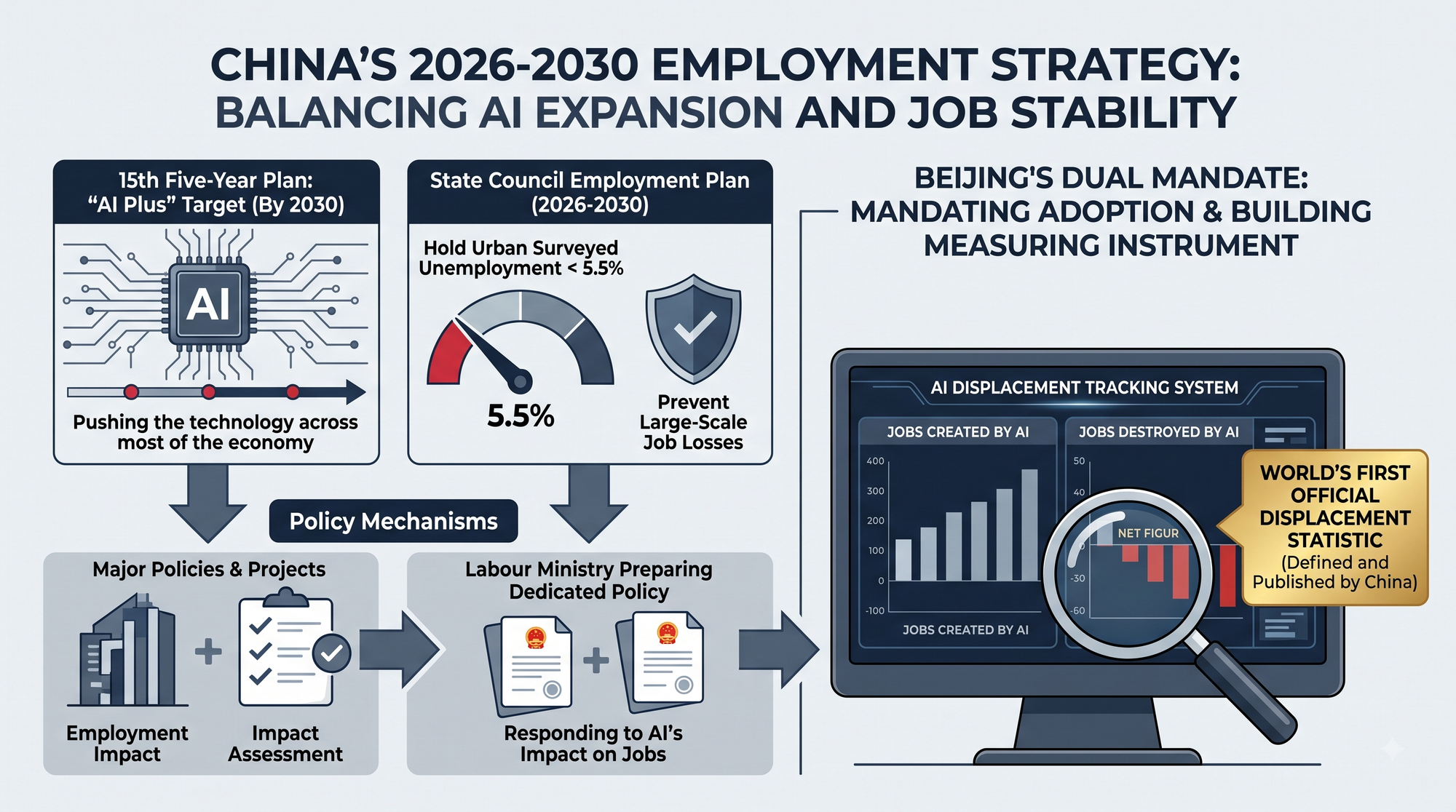
China is building the world’s first official instrument for counting AI job losses, and it is being built by the government with the most to lose from the number.
Briefing: China’s State Council issued its employment plan for 2026 to 2030, committing to hold urban unemployment within 5.5 percent and to prevent large-scale job losses. Alongside it, the 15th Five-Year Plan names AI more than 50 times (versus 11 in the previous plan), gives computing power its own chapter, and sets an “AI Plus” target of pushing the technology across most of the economy by 2030. The same documents require that major policies and projects be assessed for their effect on employment, and the labor ministry is preparing a dedicated policy on responding to AI’s impact on jobs. Beijing is mandating adoption and building a measuring instrument for the damage in the same breath.
No government has previously committed to systematically counting jobs created and destroyed by AI. Whatever China defines and publishes becomes the world’s first official displacement statistic, and first movers on measurement set the terms of every argument that follows – much like the way unemployment and inflation definitions shaped economic policy for a century. The plan also creates an internal control the Chinese Communist Party (CPP) has not had before. Once displacement is a measured number attached to an employment target, it becomes something ministries answer for, which gives Beijing a basis to slow deployment in particular sectors without abandoning the technology strategy. The CCP’s legitimacy rests on delivering work for its constituents, but it has no independent unions or elections to absorb the shock that could emanate from the very technology it is promoting. Measurement is how an authoritarian system buys itself the option to hit the brakes.
So What
For Executives: If you manufacture, source, or sell in China, expect automation decisions to acquire a political dimension they did not previously have. Employment-impact assessment attached to major projects means local approvals, incentives, and site selection will start to weigh headcount, and the plant that automates fastest might not be the one that gets support. Build labor-retention questions into China capital planning now. Design and evolve symbiotic task profiles between AI and humans and train humans to integrate with AI so they can yield measurably higher productivity. As agentic AI diffuses through the organization, increase productivity through longer chains of agents orchestrated and governed by each human for exponential effects while minimizing layoffs. Whatever measurement China publishes will be picked up by unions, works councils, and regulators in your other markets, so assume the first credible AI displacement numbers arrive from Beijing and prepare a position before someone asks you to comment on them. Hedge: China has announced measurement and accountability frameworks before that were selectively enforced or quietly shelved. Provincial implementation will vary, and in practice the metric may bite hardest in state-owned enterprises and politically visible sectors while export-oriented manufacturing faces lighter scrutiny.
For Policy Makers: Standards get set by whoever moves first, and on AI employment measurement that is now China. The European Commission has called for stress-testing of AI labor disruption, and OpenAI has mapped displacement risk across E.U. occupations, but no European government has committed to an official, binding measurement system tied to employment targets. If Western governments want a definition they can defend, the work of building comparable statistics needs to start before Beijing’s numbers become the reference point by default. There is also a real opening here. Employment displacement is one of the few AI subjects where East-West cooperation is plausible, since the interest is genuinely shared and the data is not sensitive in the way capability evaluation is. Watch, too, for the second-order move, in which a state that measures displacement acquires a justification for restricting deployment. This could become an industrial policy tool aimed at foreign vendors as easily as it is used for social protection.
For Investors: This complicates the assumption that China converts AI into productivity faster because the state can compel adoption. The same central authority that mandates deployment is now accountable for the employment consequences, which points to slower and more selective diffusion in labor-intensive sectors than the technology alone would produce. Vendors selling headcount reduction into China should expect friction, while those selling augmentation, retraining, and workforce tooling gain a policy tailwind. Focus investment theses on firms that place a premium on new value and business creation and higher productivity for existing headcount, rather than those pushing mass layoffs and incurring regulatory liabilities. The published statistic itself will become a tradeable data point, and the first release will move sentiment on Chinese labor-intensive sectors well beyond what its methodology deserves. Hedge: The statistical infrastructure to measure AI displacement at scale does not exist yet and will take years to build. Early releases are likely to be noisy, methodologically contested, and politically managed, so treat the first numbers as a sentiment event rather than a reliable signal for sector allocation.
For Service Providers: There is early advisory work here for which few firms are positioned. Multinationals need a China workforce strategy that treats automation as a regulatory and political variable rather than an efficiency one, including how to present automation plans to local authorities. A second line sits in preparing clients for the arrival of official displacement statistics, since the first credible numbers will generate board questions, employee anxiety, and press inquiries in every market at once. For communications practices, clients pursuing aggressive automation need messaging that survives being read alongside a government-published job-loss figure, which is a materially harder test than anything the current efficiency narrative faces.
Commerce Reviews the Rented Data Centers That Give Chinese Labs Nvidia Chips Without an Export
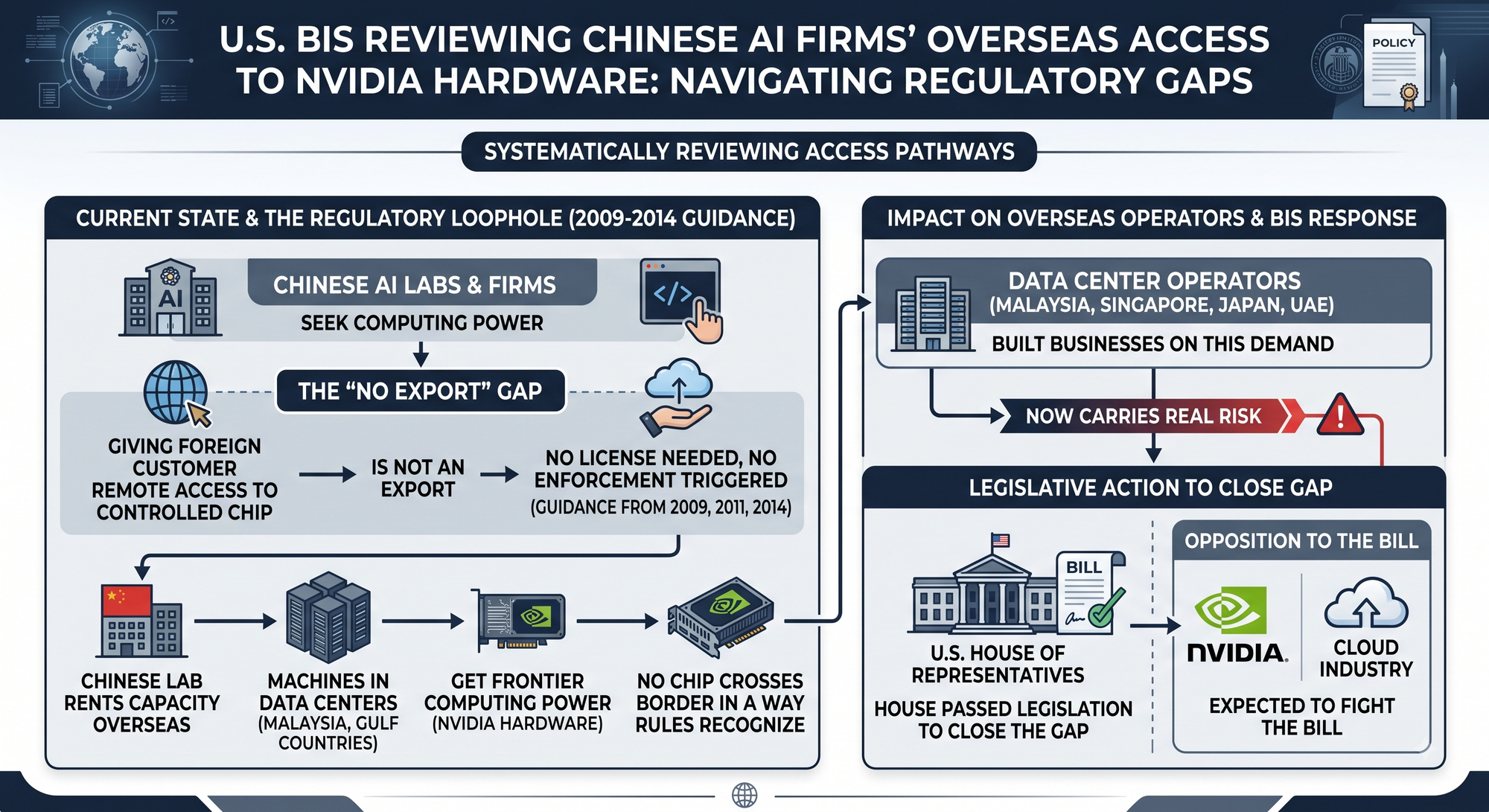
The rules stop the chip at the border, but the border does not stop the compute from being used.
Briefing: The U.S. Bureau of Industry and Security is systematically reviewing how Chinese AI firms reach Nvidia hardware overseas, including by legally renting capacity in data centers in other countries. Under guidance issued between 2009 and 2014, giving a foreign customer remote access to a controlled chip is not an export, so no license is needed and no enforcement is triggered. A Chinese lab renting time on machines installed in other countries gets frontier computing power without any chip crossing a border in a way the rules recognize. Operators in Malaysia, Singapore, Japan, and the United Arab Emirates built businesses on this demand, which now carries real risk. The House has passed legislation to close the gap, although Nvidia and the cloud industry are expected to fight the bill.
What prompted the review is that Chinese results stopped being explicable. ByteDance is training a model reported at up to 10 trillion parameters and Moonshot AI, maker of the Kimi chatbot, has shipped a model claiming near-parity with the closed frontier. Neither is easily achieved on domestic Chinese chips alone. Gulf and Southeast Asian operators courted this business for two years, often with sovereign backing and often as the economic justification for hosting the capacity at all. Hence, a rule that makes Chinese customers unbookable removes revenue for which those governments negotiated and turns a technical question into a diplomatic one. The reason this matters now, rather than when a rule appears, is that behavior moves first. Operators reprice, restructure, or quietly drop Chinese accounts during a review conducted long before any policy requires it, and the market for capacity reflects that in advance.
So What
For Executives: If your AI workloads run in Malaysia, Singapore, or the Gulf, ask your provider what share of its business is Chinese and what a new rule could do to it, because a provider forced to shed a large customer segment will reprice or reallocate what remains. Anyone with a Chinese joint venture or a China-based engineering team touching overseas computing capacity should get legal advice now, since arrangements built on current guidance might not survive a change. Contracts signed this year should include regulatory change provisions that cover access to computing, specifically. Hedge: This is a review rather than a rule, opposition is substantial, and attempts to regulate remote access have stalled repeatedly since 2009. Treat it as contract hygiene and provider diligence, and leave the workloads where they are.
For Policy Makers: Two decades of guidance say remote access is not an export, and that is now the widest opening in the entire control regime. Closing it takes legislation and the implementation of new rules rather than a reinterpretation. The question to settle is what obligation attaches to a foreign data center operator and how anyone verifies it. Rules of this kind only work with host-government cooperation, which means Malaysia, Singapore, Japan, and the UAE belong inside the design conversation rather than on the receiving end of it, and each has an economic interest pointing the other way. Weigh the consequence honestly, because denying rented access pushes Chinese labs toward domestic chips and accelerates the Huawei stack, which is the outcome the controls were meant to delay.
For Investors: Data center operators in neutral countries carry an unpriced exposure proportional to their Chinese revenue, and that share is rarely disclosed. Diligence on any Southeast Asian or Gulf computing asset should now include customer concentration by nationality, which is an uncomfortable question to ask and a revealing one to have answered. The offset is that capacity vacated by Chinese tenants gets absorbed quickly in this market, so the risk is repricing and disruption rather than empty racks. Watch the Senate path of the legislation as the timing signal. Hedge: Nvidia and the hyperscalers will lobby hard, House passage does not predict Senate action, and the base case is that nothing binding arrives this year. Size the exposure rather than exiting it.
For Service Providers: This is live compliance-advisory work with almost no incumbent supply. Operators in the affected countries need customer-nationality risk assessments and scenario planning against a rule that does not yet exist, and most have no export control function at all. Multinationals need their own remote-access exposure mapped, which is a different exercise from standard export review because the asset never moves. For firms serving European clients, the parallel question is whether the E.U. would mirror a U.S. rule, since a divergent answer would make European capacity the accessible option and change the sales conversation entirely.
South Korea and Taiwan Pass Japan in Exports as SK Hynix Commits $38 billion to AI Memory
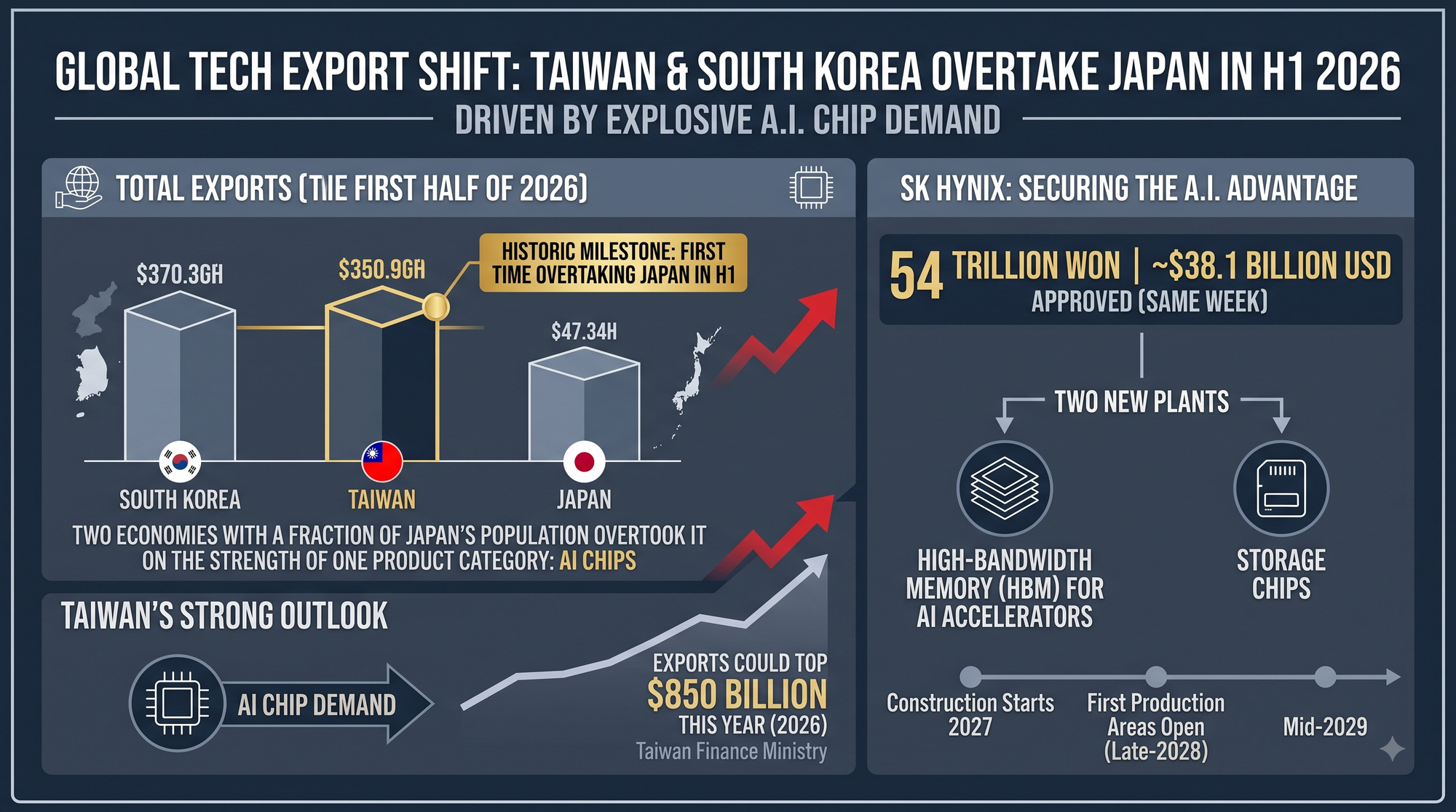
The AI buildout has rearranged the export rankings of industrial Asia, and this week’s spending says the winners expect it to last.
Briefing: South Korea and Taiwan each passed Japan in total exports for the first time in the first half of 2026, driven by AI chip demand. In the same week, SK Hynix approved 54 trillion won, about $38.1 billion, for two new plants, one for the high-bandwidth memory that every AI accelerator requires and one for storage chips. Construction starts in 2027, and the first production areas open in late-2028 and mid-2029. Taiwan’s finance ministry projects exports could top $850 billion this year. Two economies with a fraction of Japan’s population overtook it on the strength of one product category.
The commitment matters more than the ranking. Capacity approved now produces nothing until 2029, so SK Hynix is betting three years of construction and a huge capital commitment on demand nobody can forecast past next year, and it approved both plants at once. A related consequence is the concentration that results – two American treaty partners that produce the one component every AI system needs, running plants clustered within 200 kilometres of two of the most contested waterways in the world. Both have accumulated real negotiating leverage as a result. Japan’s relative decline is easy to misread, because the equipment and materials position it retains sits upstream and does not show up in export rankings. For Beijing, the numbers confirm the memory bottleneck is real, which strengthens the case for domestic investment and for the procurement rules already steering Chinese buyers toward local suppliers.
So What
For Executives: Memory is now a scheduling constraint on AI capacity rather than a component purchase, and supply arriving in 2029 does nothing for a 2027 roadmap. Anyone building owned infrastructure should secure memory-inclusive commitments from equipment makers instead of assuming availability, and you should plan for the cases where memory allocation sets the deployment date. Firms with operations in Korea or Taiwan should refresh continuity planning against the concentration described above, since the exposure now runs to the export base of two entire economies. Downstream businesses in non-chip industries with dependencies on compute upstream should map bottlenecks against new supply coming online, replete with its geographic concentration vulnerability. Hedge: All three memory suppliers are adding capacity aggressively, and memory has broken every consensus about durable pricing it has ever been given. Contract for supply certainty and leave the price direction alone.
For Policy Makers: Allied semiconductor strategy is written around Japan as a co-equal pillar, and the export data says productive weight has moved to Korea and Taiwan while Japan holds the upstream equipment position. Calibrate to that distribution rather than the older assumption. Both countries have gained leverage in any negotiation that touches export controls, subsidies, or tariffs, and both have domestic political reasons to use it. For governments funding domestic AI capacity, note that the memory layer has no European supplier at all, which makes every sovereign computing commitment dependent on two Asian producers regardless of where the data center sits. That belongs in sovereignty planning, but currently is not.
For Investors: The memory cycle has broken from its historical pattern, and 54 trillion won ($38.1 billion) committed against 2029 output is the clearest signal yet that the industry believes it. That belief is the position to underwrite or to fade. Korean and Taiwanese export data has become a usable high-frequency proxy for global AI capital spending – more timely than hyperscaler disclosure – and it is worth tracking monthly. Equipment and materials suppliers, disproportionately Japanese, capture the buildout without the pricing risk the memory makers carry. Hedge: Three-year commitments into a demand curve nobody can see past 2027 is the exact setup that produced every previous memory glut, and the concentration supporting prices today makes any disappointment severe. Prefer the picks-and-shovels layer if you are underwriting the cycle instead of trading it.
For Service Providers: Clients building AI infrastructure need supply-chain assessment that reaches past the accelerator to the memory and packaging layer, which most technology diligence stops short of. There is a specific product for European and Middle Eastern clients whose sovereignty programs assume local control of a stack with no local memory supply, and naming that gap credibly opens a strategic conversation. For firms with Asian practices, the shift in weight from Japan toward Korea and Taiwan changes where industrial clients should be building supplier and government relationships. Japanese industrial clients face a narrative problem, because the headline reads as decline while the equipment position remains strong.
Under the Radar
The deep analysis that connects the dots
Europe Buys Sovereign AI From Microsoft While Brussels Funds Its Own Model Late
The Stakes
The Signal
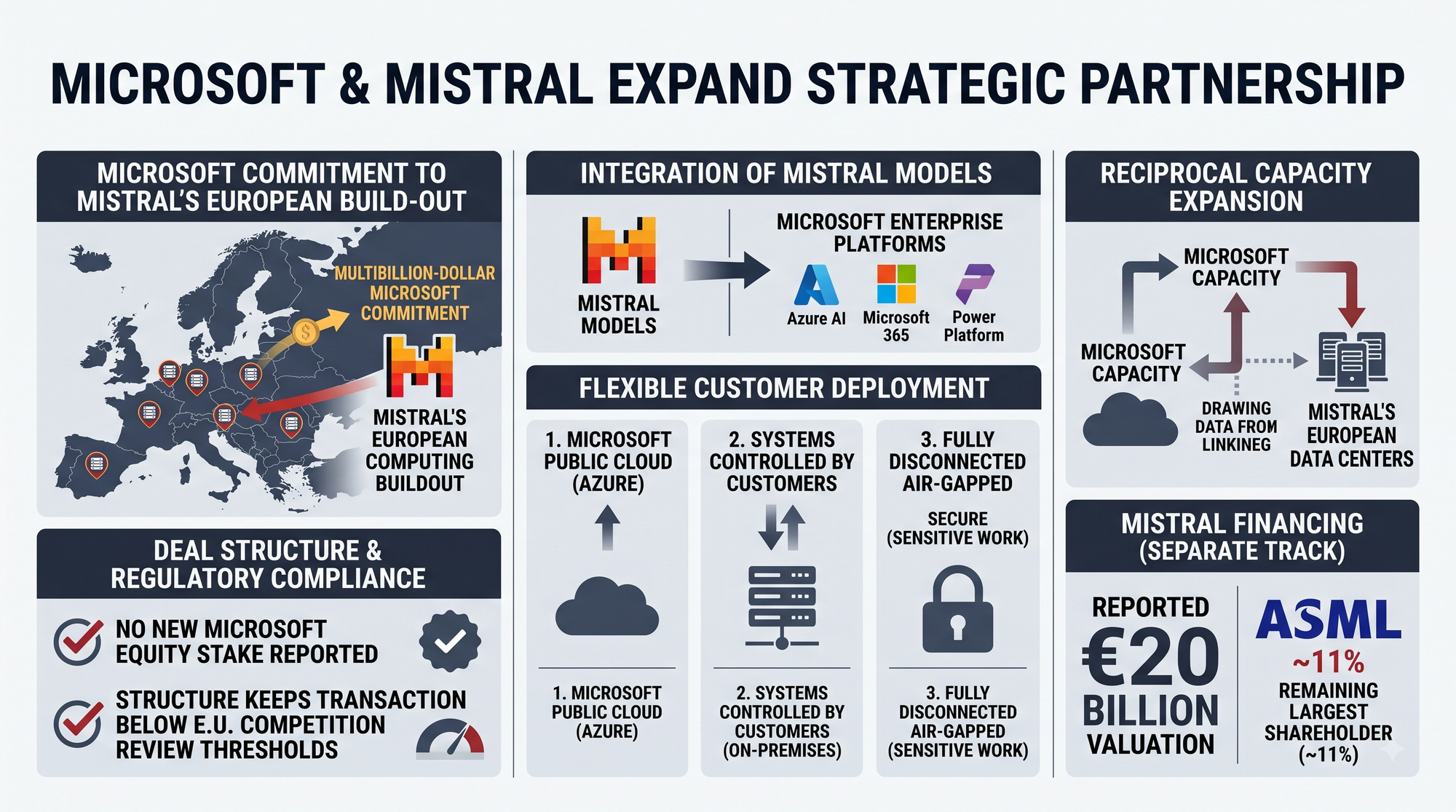
Microsoft and Mistral announced a significant expansion of their partnership, built on a multibillion-dollar Microsoft commitment to Mistral’s European computing buildout. Mistral’s models now sit inside Microsoft’s enterprise platforms, and customers can run them on Microsoft’s public cloud – on systems they control themselves or fully disconnected for sensitive work. Microsoft will draw on Mistral’s European data centers to expand its own capacity. The deal reportedly involves no new Microsoft equity stake, a structure that keeps it below the thresholds that would trigger E.U. competition review. Separately, Mistral is raising money at a reported €20 billion valuation, with Samsung in talks to invest roughly €1 billion. ASML remains its largest shareholder at roughly 11 percent.
Both sides describe this as sovereignty, meaning European institutions can run frontier AI with control over their data and operations. That is accurate, to an extent, but it also obscures what sits underneath. The platform is American, the chips are American, and the capital is mostly American (with the exception of ASML’s Dutch stake). Europe has acquired the right to run a European model on European soil under European rules, but on infrastructure it does not own. That dependency carries concrete risks: the U.S. CLOUD Act allows American law enforcement to compel data production from U.S. providers regardless of where data is stored, and in a geopolitical rupture, Washington could restrict chip supplies, software updates, or cloud access in ways that contractual assurances cannot override. Europe could not simply island the infrastructure, because the platform layer, the chip architecture, and the update pipeline all run through American jurisdiction. As we noted last week, OpenEuroLLM missed its July target for a flagship model, leaving the publicly funded European effort behind schedule. Europe’s working sovereign capability arrived four weeks later – from Redmond rather than Brussels.
AI Sovereignty Scorecard: Who Owns What
United States | China | Europe | India | |
Foundation models | Dozens of frontier models from ~10 labs (OpenAI, Anthropic, Google, Meta, xAI) | 700+ registered AI services; DeepSeek, Alibaba (Qwen), Moonshot (Kimi), Baidu, ByteDance at frontier scale | Mistral only frontier-adjacent model; national models mostly fine-tunes; OpenEuroLLM behind schedule | 12 models under IndiaAI Mission (Sarvam AI, BharatGen Param2 17B); none frontier-scale |
Data center capacity (local providers) | ~31 GW operational; five 1 GW+ campuses in 2026; ~$700B hyperscaler capex | Massive domestic buildout (Alibaba, Tencent, Huawei, Baidu Cloud); state-backed regional centers | US hyperscalers dominate (AWS, Azure); OVHcloud, STACKIT sub-scale; Mistral planning 200 MW by 2027 | 38,000 GPUs nationally; hyperscaler-dependent; Jio and Tata entering |
Training data | Dominant English-language web, social media, search, enterprise data | 1.4B-population closed internet; WeChat/Alipay ecosystem; massive domestic data pool | GDPR limits pooling; no single-market ecosystem; fragmented across 24 languages | Massive population, lower digitization; 22+ languages; Bharat Data Sagar initiative starting |
Chipsets | Nvidia, AMD, Intel (~90% of AI accelerators); TSMC fab under CHIPS Act | Huawei Ascend 910C; SMIC at 7nm; export-constrained but prioritized in 15th Five-Year Plan | ASML makes lithography equipment but zero chip fabrication; no memory or logic chips | No fabrication; Tata OSAT assembly under construction; fully import-dependent |
Energy for AI compute | Abundant but grid-strained; nuclear restarts, gas, renewables; 100 GW new capacity needed by 2030 | World's largest renewable installer; coal-dominant; surplus in western provinces for computing | Expensive, constrained; strong renewable targets but high grid costs; France nuclear-advantaged | Solar leader; coal-heavy grid; reliability gaps in key regions |
The Stakes
Sovereign AI is being defined right now in contracts rather than legislation, and the definition winning is data residency plus deployment control plus contractual assurance. That is a real standard and a commercially convenient one, because any large cloud provider willing to build local capacity can satisfy it. The definition it displaces – actually owning the entire stack – is not achievable by any European actor on any realistic timeline, which is exactly why the procurement version will win. The risk is that convenience sets a ceiling. If sovereign AI means deployment control on rented infrastructure, then Europe becomes a price-taker in its own AI stack, unable to guarantee continuity if the provider exits, reprices, or is compelled by its home government to restrict access. Contractual assurances are revocable in ways that ownership is not, and a standard built on contracts can be unwound by a single regulatory or geopolitical shift in Washington. Once the first wave of regulated European buyers signs on this basis, the standard begins to set, and reversing it becomes prohibitively expensive.
The consequence reaches well past Europe. Every government building sovereign AI capacity in the Gulf, India, Southeast Asia, and Latin America is watching which definition the E.U. accepts, because Europe has the strongest stated preference for genuine independence and the most developed apparatus for insisting on it. If Europe settles for sovereignty as a deployment mode, nobody else will hold a harder line. The alternative pathway runs through self-hosted open models on owned hardware, which delivers less capability and more actual control. Two definitions are being priced at once and the enterprise market is choosing the one that ships.
What to Watch
Watch whether E.U. competition authorities examine the arrangement despite its equity-free structure, since the deliberate avoidance of review thresholds is itself a finding. With the Mistral-Microsoft deal as an early signal, watch the first large regulated procurement in French or German health, banking, or defense-adjacent sectors and read the tender language closely. Whichever definition of sovereignty appears there might well become the European standard by default. Watch whether other cloud providers replicate the structure with other national champions, since a German, Italian, or Spanish equivalent would confirm sovereign AI as a settled product category rather than one deal. Watch the ASML stake for any change, since lithography is the one piece of real leverage in the arrangement. And watch for a European memory chip or processor initiative to appear in Commission planning, because its continued absence is the clearest measure of how far the sovereignty conversation sits from the sovereignty problem.
About Cambrian

Cambrian Futures is a strategic foresight and advisory firm helping government, business, and technology leaders understand how emerging technologies intersect with geopolitics, markets, and national strategy. By combining rigorous research, AI-enabled analysis, and human expertise, Cambrian provides clear insight into global technology trends, risks, and power dynamics. Its work helps decision-makers anticipate disruption, manage uncertainty, and act with strategic confidence in an increasingly competitive GeoTech world.
PRODUCTION TEAM
GeoTech Radar is produced by the Cambrian Futures Insights Platform team:

CEO & Chief Analyst

Managing Director / Producer, Insights Platform

Global Lead, Smart Infrastructure Strategy

Research & Marketing Associate

Editor in Chief
Learn more about Cambrian Futures at cambrian.ai
Produced with

Human Led



Human Led +
AI Augmented




AI Led +
Human Verified


Cite as: Cambrian Futures (2026) 'GeoTech Radar Issue 32'
An important note on what this is, and is not
GeoTech Radar is directional research intended to stimulate thinking and provide geopolitical and technological context. It is not investment, legal, or financial advice, and nothing here is a recommendation to buy, sell, or hold any security or asset. The companies, valuations, and transactions discussed are described for analytical context only and serve as a backdrop to readers' own due diligence. Figures and claims are drawn from public reporting as of the publication date and may change. Readers should consult their own qualified advisers before making any decision. Cambrian Futures and the authors hold no responsibility for actions taken on the basis of this briefing.