
AI Breaks the Web, Beijing Licenses DeepSeek While the U.S. Purges It, and Europe Finds No Off Switch for Palantir (FREE VERSION)
INSIDE ISSUE 43:
GTR Terminal: Subscribers get full access to our live dashboard tracking the signals shaping the future. Your access link and password are one click away.
On the Radar
The signals affecting the GeoTech landscape this week
Beijing Licenses DeepSeek Abroad While the U.S. Purges It at Home
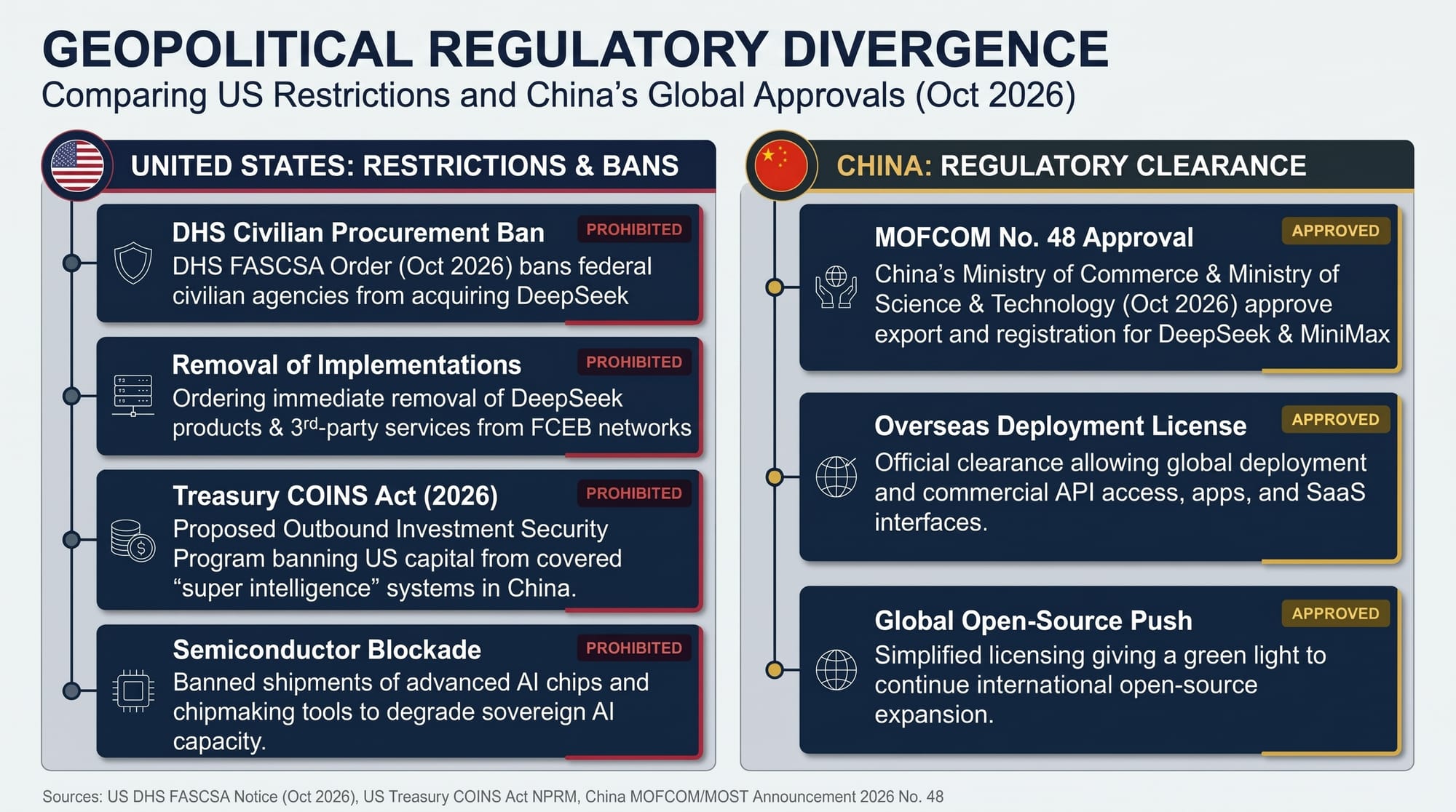
In the same week, Beijing cleared DeepSeek to ship its models abroad, the U.S. ordered them off every civilian agency computer, and the Treasury Department moved to bar U.S. money from frontier Chinese AI while DeepSeek raised $15 billion at home.
BRIEFING: Last week, the Federal Register published a July 24 Department of Homeland Security order that bars DeepSeek’s products from civilian procurement and orderes the removal of DeepSeek models and any third-party product "developed using DeepSeek implementations." Agencies had 60 days from issuance to seek exceptions, a window that by our calculation closed on September 22, four weeks before the public saw the order. Two days later the Treasury proposed rules under the COINS Act, passed in December's defense bill, that would make any "super intelligence system" developed by a covered person in China, Russia, Iran, North Korea, or Cuba a prohibited investment for U.S. capital. It would also end the previously used notification tier AI deals and add high-bandwidth memory, photonic chips, and supercomputers to the banned list. The $50,000 figure in the headlines is the floor below which a deal need not be notified. The fact sheet applies the prohibitions at any size.
Beijing moved the other way. A state-broadcaster account, Yuyuan Tantian, said on October 22 that DeepSeek and MiniMax had completed the registration required to move ahead with open-source releases and overseas licensing. No ministry notice names the approving body, and Bloomberg reported the same day that DeepSeek had closed a round of about $15 billion, with battery maker CATL and Tencent the largest investors, ahead of a Shanghai listing planned for 2027. Moonshot's Kimi K3.1 Pro, released October 23 with open weights promised by November 4, falls under the same licensing terms, and no registration for it has been reported as of this writing. November 4 is the first test of whether the catalog bites. If the weights ship on schedule with no registration notice, the rule is not yet being enforced. If they slip, it is.
Strategy & Portfolio Implications
Three groups face the greatest exposure to these developments. The first is U.S. funds that hold Chinese AI, robotics, or memory positions through private vehicles (listed securities remain exempt, so CATL and Tencent are still investable). Non-U.S. vendors whose products embed open-weight DeepSeek models and sell into U.S. civilian agencies are also exposed, as are hosts that serve Chinese weights abroad and now need a Chinese registration to keep doing so. Position for a two-sided licensing regime. Chinese models keep flowing where they are registered, and U.S. capital stops flowing where it is not. In diligence, ask portfolio companies which Chinese models sit in production and under which license, whether any U.S. agency customer runs them, and whether their China exposure runs through a fund the COINS rule would reach. Dated catalysts include November 4 for the Kimi weights, November 15 for the end of China's comment period, and December 7 when COINS comments close.
Macro-Economic Implications
In the first year, the bill lands mainly on U.S. venture and private equity funds, which lose the Chinese AI, robotics, and memory deals the rule prohibits, and on Chinese labs, which lose U.S. dollars. So far, China's labs have replaced the lost dollars. DeepSeek's $15 billion round was led by a battery maker and a games company, and Moonshot is reported to be preparing a Hong Kong listing near $50 billion. Two variables will move. The cost of capital for Chinese AI labs rises as the investor base narrows to domestic strategic buyers, and the unit price of inference outside China rises if registration slows the open-weight supply that set the price floor.
| Net over twelve months: U.S. tech investment in China down, Chinese lab listings up, AI cost deflation slower. |
Hedge: The Treasury rule is a proposal with a final version due in 2027, and the Chinese clearance rests on a state-media post with no ministry notice. Treat both as direction until the Federal Register and the commerce ministry say otherwise.