

Abu Dhabi Drills for Compute. NATO'S $108 Billion Reboot. The Coasean Singularity.
IN THIS ISSUE:
CEO's Perspective
Strategic outlook from Cambrian leadership

A couple weeks ago, I argued that the signals worth acting on increasingly come from institutions other than the ones built to produce them. A guidance memo was doing the work of regulation. A maritime AI platform resolved a Hormuz declaration before any foreign ministry could. The issue was not that the old institutions failed, but that serious leaders had to stop pretending the old signal sources were still the operative ones.
As this week’s issue illustrates, more significant consequences can ripple across institutions once the authoritative signals migrate elsewhere. At that point, the institutions and the trusted instruments inside them can be quietly strained and diluted, exited and fragmented, or rewritten to serve purposes other than the ones for which they were built. The name on the door stays the same, but what goes on behind the door does not.
Instruments strained past their design
The UAE has not flipped OPEC. It has walked away from the constraint while leaving the cartel intact, freeing itself to maximize extraction ahead of an eventual peak in demand. Rather than a betrayal, the UAE’s decision was a rational read of where the next decade actually pays. The White House is doing a related, albeit more self-destructive, thing to NATO in its decision to remain part of the alliance while converting solidarity from a foundation into a transactional lever. Similarly, the United States–Mexico–Canada Agreement (USMCA) is being rewritten in real time, with the "rules of control" paradigm running export-control logic through what was designed as integration architecture. The Coasean Singularity story is the same pattern at firm level. The people who apply the tool now face competition from the tool itself, leading them toward the effective erosion of their own organization.
The pension story is the cleanest version of the inversion. Investment-grade bond funds are the most conservative instrument in a retirement portfolio. They are now the channel through which 15-year data center debt, secured against assets with 12-month obsolescence cycles, reaches 401(k) accounts. The instrument retains its rating and its place in the safe-asset bucket, but what it carries has changed underneath. The people whose retirements depend on it have not been told.
While creative destruction often leads to better outcomes, not every institution under strain should be in that position. Some of these architectures are worth saving, and some of the strain is self-defeat dressed up as decisiveness. OPEC's discipline might have genuinely outlived its usefulness for a producer like the UAE. NATO's solidarity has not. There is a difference between an institution that has earned its decline and one being cracked open by sponsors who will miss it the moment they need it back.
Most of us built our careers and our risk frameworks on the assumption that these institutions would keep doing what they said on the tin. Recognizing that something has changed underneath you is not an analytical exercise. It is a personal one. It means accepting that some of the discipline that made you credible in the last cycle is putting you in the wrong position this time around.
So the work is two-layered now. Which of the institutions, contracts, ratings, or instruments upon which your organization still relies has changed, and is the change a justified decline or hasty reactionism in a moment that calls for constructive evolution? You probably already know which one. The discipline is in saying it out loud, to the people who need to hear it, before the next cycle forces the conversation on terms you do not get to set.
Olaf
On the Radar
The signals affecting the GeoTech landscape this week
Abu Dhabi Drills for Compute
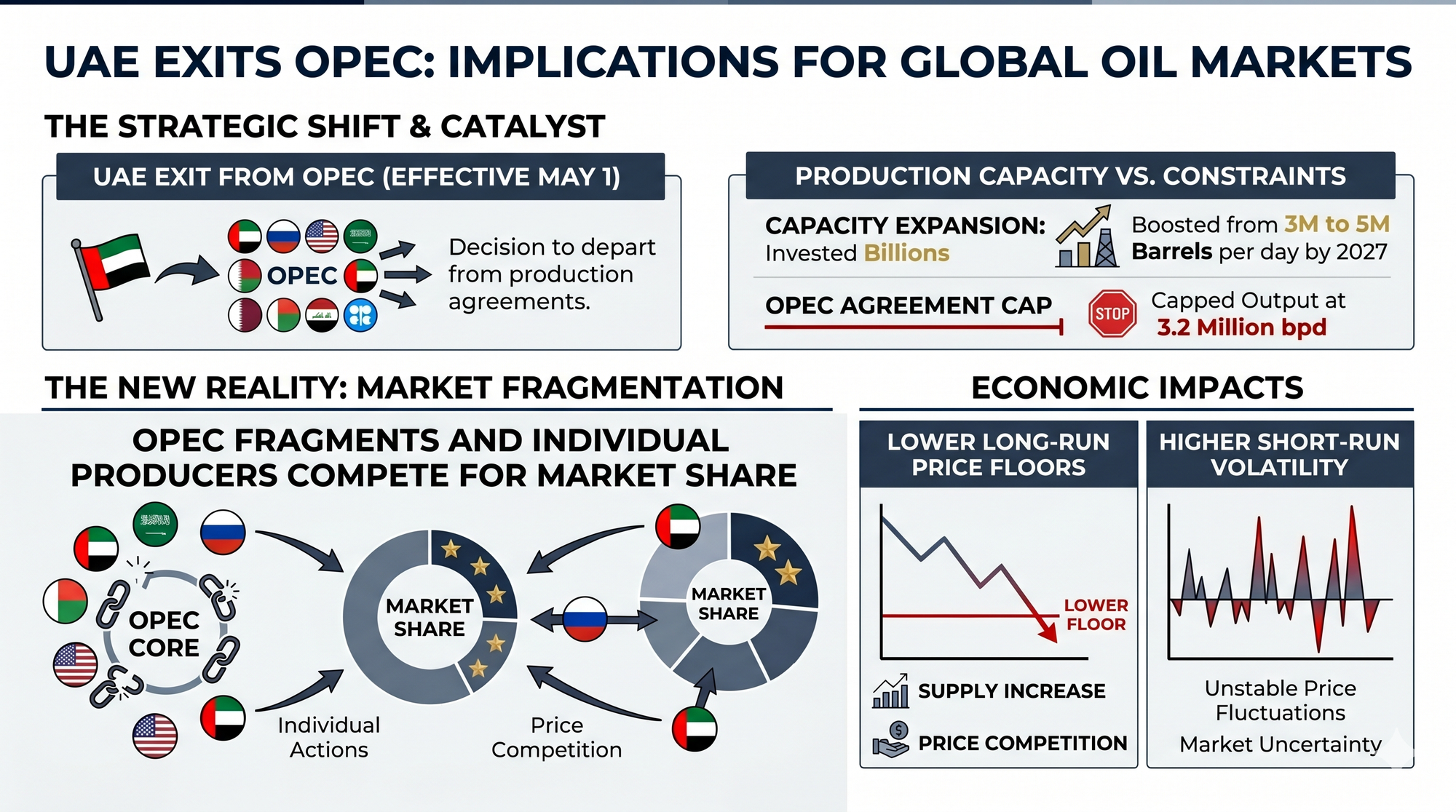
The UAE exited OPEC effective May 1, removing the quota constraint on 4.8 million barrels per day of production capacity. The UAE is not the first departure: Qatar left in 2019, Ecuador in 2020, and Angola in 2024. But the UAE is OPEC’s third-largest producer and the most significant exit since the cartel’s founding. Abu Dhabi built the capacity, OPEC prevented it from reaching the market, and the Iran war provided the exit rationale. For technology executives: cheaper post-war energy reshapes the cost assumptions underlying every major data center buildout on the planet. The cartel-managed supply era is ending. Plan for producer competition, not coordination.
BRIEFING: The UAE announced its withdrawal from OPEC effective May 1, ending nearly six decades of membership. The move comes at a moment when the cost of energy is the single largest variable in the economics of artificial intelligence infrastructure. Hyperscale data center operators, including those funded by Gulf sovereign wealth, are building facilities whose lifetime operating costs are dominated by electricity. UAE Energy Minister Suhail al-Mazrouei described the decision as the result of a long review of national energy strategy. The country invested billions in boosting capacity from 3 million to nearly 5 million barrels per day (bpd) by 2027, but OPEC agreements capped output at 3.2 million. The exit removes that constraint and signals Abu Dhabi’s intent to maximize extraction revenue before global oil demand peaks, channeling proceeds into its own AI and sovereign technology programs.
The timing is inseparable from the Iran war. The UAE suffered Iranian missile strikes during the U.S.-Israel conflict, and the Strait of Hormuz remains effectively closed. Abu Dhabi has partially circumvented the blockade through the Fujairah terminal on the Gulf of Oman, exporting 1.7 million bpd. Analysts at Saxo Bank, the Peterson Institute for International Economics (PIIE), and the Center for a New American Security (CNAS) said the UAE is preparing for a post-war world where oil demand is in decline and OPEC’s power to maintain discipline weakens. CNBC reported that Nigeria, with its Dangote refinery reducing dependence on crude exports, and Venezuela, with output recovering under a friendlier political environment, could follow the UAE out of the cartel. OPEC production fell 27% in March as disruptions removed 7.88 million bpd from supply. Brent crude hit $126.41 before settling. U.S. gasoline prices have nearly doubled since the Iran conflict began.
SO WHAT
For Executives: The planning assumption should shift from "OPEC manages supply" to "OPEC fragments and individual producers compete for market share." That means lower long-run price floors, higher short-run volatility, and a scramble for Strait of Hormuz alternatives. Any organization with energy exposure should be modeling a world where the UAE, Nigeria, and potentially others are producing at capacity outside cartel coordination. The direct technology implication: AI data center operators planning multi-year buildouts have been running cost models based on elevated energy prices sustained by OPEC discipline. If the UAE floods post-war markets with an additional 1.6 million bpd, the resulting downward price pressure could materially reduce operating costs for compute-intensive operations. A feedback loop is forming: higher UAE production revenue funds more sovereign data center investment, which accelerates the energy transition that makes maximizing near-term oil extraction rational.
For Policy Makers: OPEC’s fracture gives Washington a rare opening to reshape Gulf energy architecture for a generation. The UAE exit was partly a response to Iranian attacks on Emirati territory, and Abu Dhabi’s April request for a U.S. currency swap line signaled its desire for closer economic alignment with Washington. A post-conflict framework that secures Strait of Hormuz transit guarantees and rewards UAE alignment with U.S. interests could link Gulf production capacity to bilateral data center energy agreements, locking in strategic advantage. But if Washington treats this as background noise, competing visions in Riyadh and Abu Dhabi will harden into a rift: Saudi Arabia favors production restraint to sustain prices for its $500 billion NEOM diversification, while the UAE favors maximum extraction to fund its own AI and technology transition before demand peaks. For policymakers outside the Middle East: European energy regulators should model scenarios where a weakened OPEC produces lower, more volatile prices that undercut the economic case for renewable investment. Asian policymakers dependent on Gulf supply should diversify procurement to include post-OPEC bilateral arrangements with individual producers.
For Investors: Energy equities priced on the assumption of cartel-managed supply need repricing. The UAE’s plan to reach 5 million bpd by 2027 will add significant volume once the Strait reopens. Look for infrastructure plays that are decoupled from cartel pricing rather than expecting OPEC cohesion as a given. Lower oil prices from a fragmented OPEC improve cost structures for energy-intensive industries, including cloud computing, AI training, and semiconductor fabrication. Watch for a repricing of Gulf sovereign compute infrastructure as the market prices in OPEC’s structural weakening: the same revenue the UAE is racing to extract will fund the sovereign AI buildouts that its leadership has publicly committed to.
For Service Providers: Clients in energy, infrastructure, and politically exposed industries face overlapping risks from OPEC fragmentation and the Hormuz closure. Advisory teams should develop integrated scenario frameworks that model combinations of these factors: a sustained Hormuz blockade with a weakened OPEC produces different outcomes than a reopened strait with competitive production. For clients with Gulf-linked supply chains or investment relationships, the Fujairah bypass creates a new logistics node worth tracking. Any client whose public positioning assumed cartel-managed price stability needs updated stakeholder language. The shift from coordinated supply to competitive behavior changes the narrative from predictability to volatility, and crisis communications plans should reflect that shift.
NATO's $108 Billion Reboot: Europe Arms for Autonomy
The Pentagon ordered 5,000 troops withdrawn from Germany in retaliation for Chancellor Merz's criticism of the Iran war. Trump threatened deeper cuts in Spain and Italy. The withdrawal is punitive, not strategic: it degrades U.S. power-projection infrastructure at a moment when the Hormuz blockade depends on European logistics hubs. But the response is the real story. Germany's defense budget hit a record $108.2 billion, with procurement concentrated in European-made autonomous systems, AI-enabled command platforms, and counter-drone technology. Private investment into European defense-tech startups surged fivefold since 2019 to over $5 billion. The transatlantic bargain cracks, and the replacement is being built in code.
Briefing:
The Pentagon announced on May 2 that approximately 5,000 U.S. troops will be withdrawn from Germany over the next 6 to 12 months. Pentagon spokesman Sean Parnell said the decision followed a thorough review of force posture in Europe. A senior Pentagon official linked the decision directly to German Chancellor Friedrich Merz's public comments that Iran was humiliating the United States at the negotiating table. Trump added that troop presence in Germany will be reduced "a lot further" and threatened to pull back from Spain and Italy, calling NATO "useless" and "cowards" after European allies declined to send warships to help open the Strait of Hormuz. Euronews reported that senior NATO officials received no advance warning and that internal Pentagon documents outlined options to punish allies perceived as insufficiently supportive, including suspending Spain from NATO and reviewing U.S. diplomatic support for Britain's Falkland Islands claim.
The technology response is moving faster than the diplomatic fallout. Germany's 2026 defense budget hit a record $108.2 billion, a 32% increase over 2025, with procurement deliberately concentrated in European-made systems: Eurofighter jets, IRIS-T air defense, and hundreds of Skyranger counter-drone platforms built by Rheinmetall. The Bundeswehr awarded Quantum Systems a contract for up to 750 intelligence, surveillance, and reconnaissance (ISR) drones. Germany signed a production contract with the Auterion Airlogix joint venture for thousands of autonomous strike drones, converting a Munich Security Conference framework into funded production at scale. The Atlantic Council noted that Germany is a European trendsetter for collaborative combat aircraft, aiming to field loyal wingman capability by 2029, with AI and autonomy central to those programs. The European Commission's Defence Industry Transformation Roadmap calls for at least 10% of all European defense procurement to go to disruptive technologies, including AI-enabled drone swarms and autonomous systems, rising to 30% by 2030. Private investment into European defense-tech startups surged to over $5 billion in 2024, a fivefold increase since 2019. A NATO official said this week that outdated policies for sharing AI-generated intelligence across the alliance's 32 members must be replaced to keep pace with commercially generated intelligence capabilities.
So What
For Executives: For any organization operating in European defense, aerospace, or critical infrastructure, the planning assumption should be that the U.S. military footprint in Europe will shrink further. European defense spending will accelerate, with NATO allies committed to 5% of gross domestic product (GDP) at The Hague summit. That creates procurement opportunities concentrated in autonomous systems, AI-enabled command platforms, and counter-drone technology, but also supply chain reconfiguration as European primes absorb work previously done through U.S. systems. Companies with dual-use technology or cross-border defense contracts should map which revenue streams depend on U.S.-European interoperability and which survive a more autonomous European posture. The fact that Berlin's procurement is almost entirely European-made is deliberate: the opportunity is for European technology firms, not American ones.
For Policy Makers: Every month of uncertainty between announcement and execution is a window of vulnerability that Moscow and China will note. The question is whether Europe can build autonomous defense capacity fast enough to deter Russia while the U.S. presence contracts. Increasing European troop numbers is only a partial answer. Ukraine demonstrated that autonomous systems can provide the kind of leverage for existing troop contingents that transforms battlefield effectiveness. Germany's investment in AI-enabled drones, counter-drone platforms, and autonomous strike systems reflects this lesson. Policymakers should focus on two gaps: first, the NATO intelligence-sharing architecture is not built for AI-generated commercial intelligence at the speed allied forces now require; second, European defense procurement still fragments across 27 national markets when the technology demands interoperability and scale. U.S. midterm elections are approaching, and the transatlantic posture could adjust afterward, but European defense autonomy is now a structural trend that will outlast any single election cycle.
For Investors: European defense equities are the direct beneficiary. Germany's rearmament, combined with broader NATO spending commitments, creates a multi-year procurement cycle for European defense-tech, dual-use technology, and cybersecurity firms. Near-term disruption from relocation costs and capability gaps creates volatility, but the medium-term trend favors Rheinmetall, Thales, Leonardo, and the emerging European defense-tech startup ecosystem. Investors should push portfolio companies toward AI, data, and automated platform development, and toward interoperability with U.S. technologies to safeguard scale. The fivefold surge in European defense-tech venture capital since 2019 signals that the startup layer is maturing fast enough to absorb procurement demand.
For Service Providers: Clients in defense, aerospace, and regulated industries with transatlantic operations face immediate stakeholder management challenges. European media will frame the drawdown as evidence of American unreliability, creating reputational spillover for any client perceived as closely aligned with U.S. policy or procurement. But U.S. midterm elections are approaching, and postures could adjust afterward. Communications teams should prepare for intensified government engagement across European capitals as procurement cycles accelerate. The political sensitivity requires precise messaging: this is a European sovereignty and technology leadership story, not an anti-American one. Clients operating across the transatlantic divide need consistent language that works in both Washington and Berlin.
The USMCA Countdown
North America’s $2 trillion trade corridor faces a July 1 decision. A clean renewal is now unlikely. Washington launched bilateral talks with Mexico without Canada. The review has expanded well beyond traditional trade issues: AI governance provisions, semiconductor rules of origin, critical minerals coordination, and digital trade disciplines are now at the center of negotiations that will determine how technology supply chains are structured across the continent. A possible shift from "rules of origin" to "rules of control" would restructure supply chains based on who owns the firm, not where it manufactures.
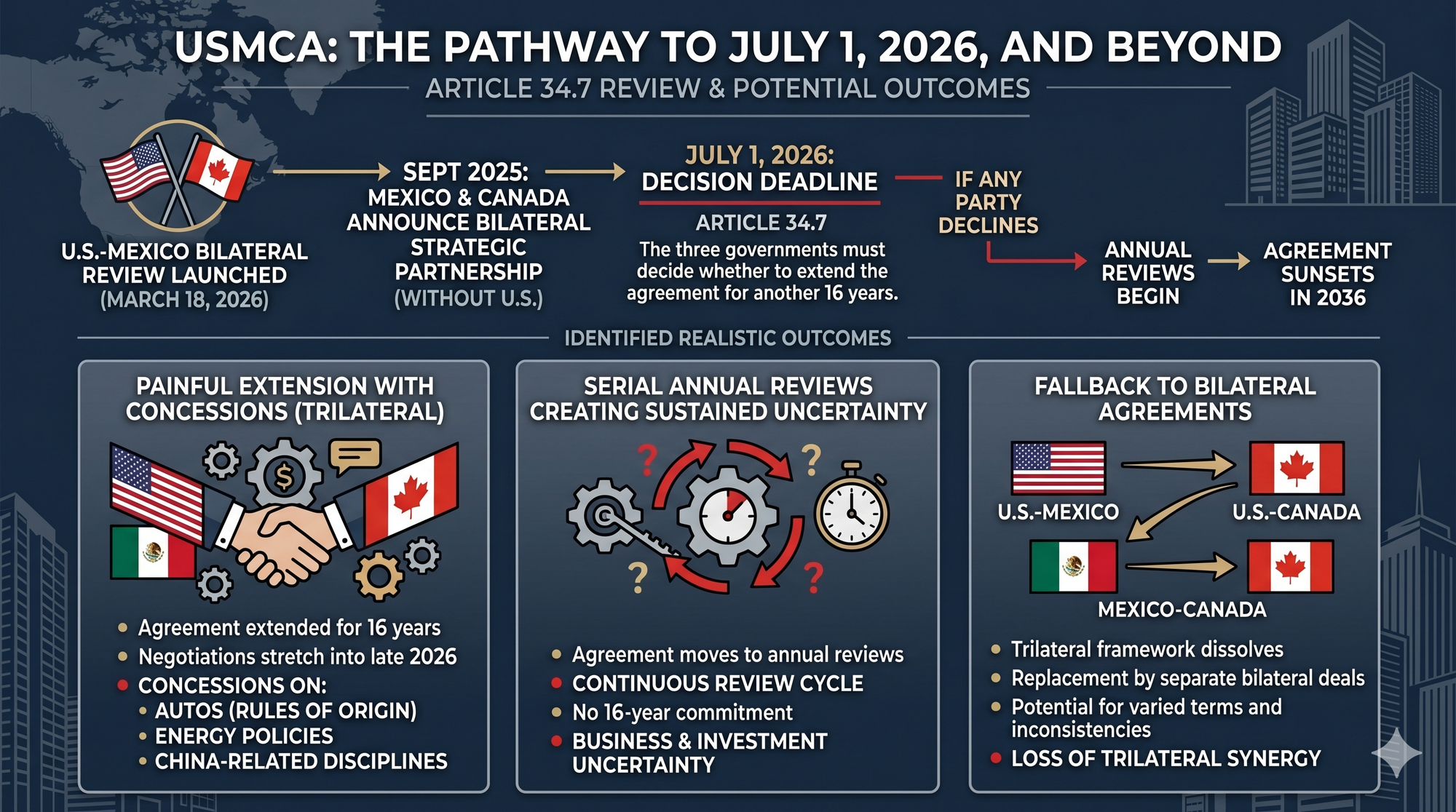
Briefing: Under Article 34.7 of the USMCA, the three governments must decide by July 1 whether to extend the agreement for another 16 years. If any party declines, annual reviews begin and the agreement sunsets in 2036. What distinguishes this review from a routine trade checkpoint is the technology agenda that has been layered onto it. The Center for Strategic and International Studies (CSIS) identified AI governance standards, digital trade rules covering cross-border data flows and cybersecurity, and critical minerals coordination as priority areas for modernization. The USTR’s 2026 Trade Policy Agenda calls for reinforced rules of origin in strategic sectors including semiconductors and advanced computing, and enforceable provisions against transshipment and production offshoring. A U.S.-Mexico bilateral review launched March 18, without Canada, focused on increasing regional production and limiting non-market inputs into North American supply chains.
U.S. Trade Representative Jamieson Greer told Congress that only two countries have retaliated economically against the United States in the past year: China and Canada. Deputy USTR Rick Switzer said at a Council on Foreign Relations (CFR) event that Mexico intends to come to an agreement, adding that there is not "a grown-up in Canada in charge." Canadian Prime Minister Mark Carney and Mexican President Claudia Sheinbaum announced a bilateral Comprehensive Strategic Partnership in September 2025 to hedge against Washington. Oren Cass, executive director of American Compass, a conservative economic policy organization whose proposals have influenced the Trump administration’s trade posture, has proposed shifting from a rules-of-origin framework to a "rules of control" paradigm. Under this approach, the United States would impose restrictions on products from Chinese-owned firms regardless of where they manufacture. While this has not been adopted as official U.S. negotiating policy, it signals the direction of debate. CSIS analysts identified three realistic outcomes: a painful extension with concessions stretching into late 2026; serial annual reviews creating sustained uncertainty; or a fallback to bilateral agreements replacing the trilateral framework. CSIS separately analyzed the convergence of technology, trade, and national security in the review, noting that USMCA is increasingly functioning as a vehicle for operationalizing North American security integration.
So What
For Executives: If the review fails to produce consensus, serial annual reviews create sustained uncertainty that suppresses long-term capital expenditure under the USMCA framework. Plan for a minimum of 12 to 18 months of ambiguity. Any company with supply chain nodes that cross U.S.-Mexico or U.S.-Canada borders should stress-test procurement, logistics, and compliance against all three CSIS scenarios. The rules-of-control concept, if adopted, could be less disruptive than full reshoring because it allows production to remain in Mexico and Canada as long as Chinese ownership is excluded. But it would still force companies to restructure supplier relationships based on ownership rather than manufacturing location, requiring deeper due diligence into the corporate control chains behind every component.
For Policy Makers: The bilateral launch with Mexico on March 18 does not override the USMCA’s trilateral treaty requirements. The administration is building bilateral momentum to present terms to Canada from a position of strength. Policymakers should push for AI governance side letters that avoid reopening the core agreement text, which could trigger a full renegotiation requiring Trade Promotion Authority that does not currently exist. Use the review to establish common semiconductor and critical minerals disciplines across all three countries. Prepare for the annual review scenario with contingency investment frameworks that give businesses planning certainty even if the political process stalls. The risk of a decade of rolling uncertainty is a silent tax on North American competitiveness at exactly the moment when the continent needs to present a unified technology supply chain alternative to China.
For Investors: Automotive, electronics, and energy face the highest compliance exposure. Any equity position in firms with significant Mexico-to-U.S. or Canada-to-U.S. supply chain exposure should be stress-tested against a scenario where USMCA enters annual review cycles through 2036. The private sector paused investment during the original North American Free Trade Agreement (NAFTA)-to-USMCA renegotiation in 2018. Expect the same pattern. Critical minerals and electric vehicle supply chains are the sectors where rules-of-origin changes would hit hardest because they have the highest proportion of Chinese-origin content in their North American supply chains, meaning any tightening would force the most supplier substitution and the highest compliance costs.
For Service Providers: Clients with North American manufacturing, distribution, or regulatory exposure need immediate scenario planning. The primary advisory challenge is for clients with U.S.-Mexico operations, where the bilateral negotiation track creates near-term uncertainty about tariff schedules, rules of origin, and investment protection. For clients with Canadian operations, the "Canada first" patriotism that Carney has channeled constrains what Ottawa’s negotiators can agree to and creates a separate set of stakeholder communications challenges. Communications teams should prepare client-ready analyses mapping which product lines and supply chains face the highest exposure, particularly in automotive, electronics, and critical minerals. The USMCA story will generate sustained media attention through July and beyond, requiring ongoing narrative management rather than a single response.
The Coasean Singularity
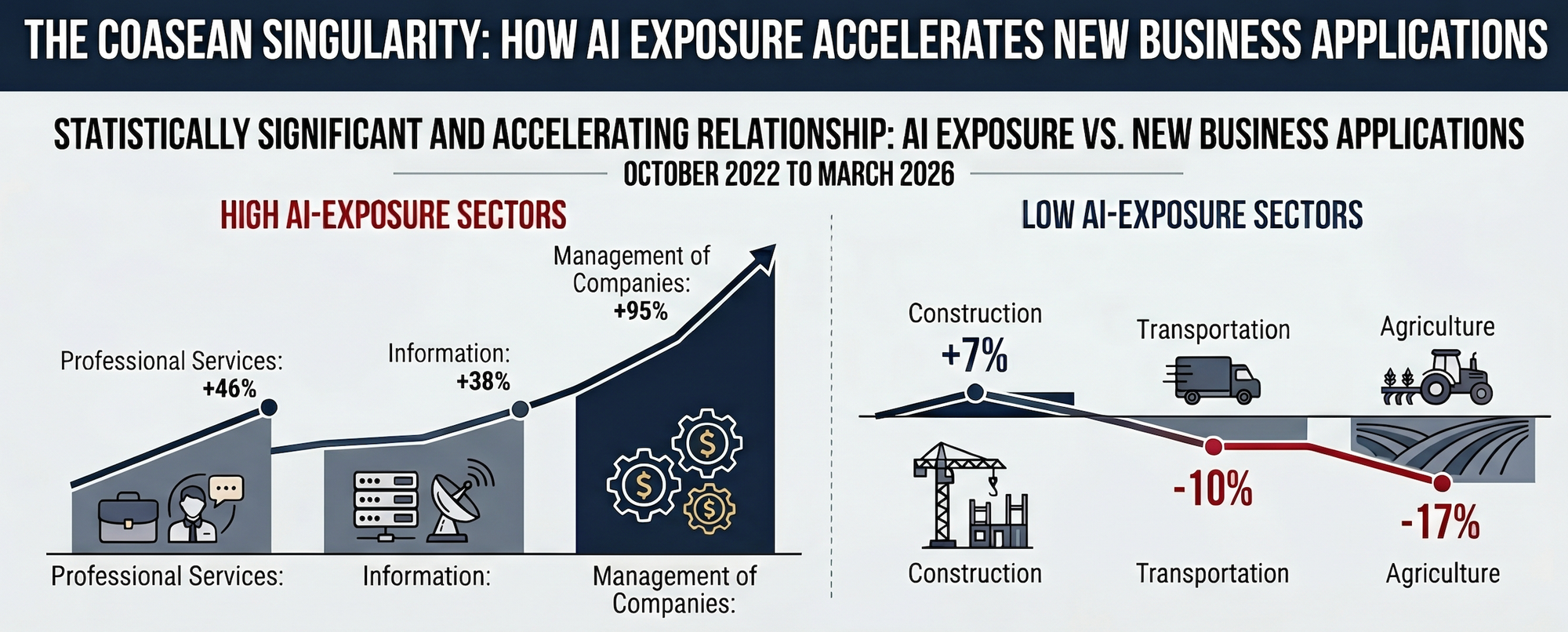
AI is not just automating jobs. It is spawning firms. Census Bureau data shows new business applications, filings with the Internal Revenue Service (IRS) that signal intent to create a new business, in AI-exposed sectors surged 46% in Professional Services and 95% in Management of Companies since ChatGPT’s launch, while Construction and Agriculture barely moved. New research documents a statistically significant and accelerating relationship between a sector’s AI exposure and its rate of new firm creation. The competitive landscape your organization planned around may not exist in 18 months.
Briefing: New research by Guillermo Gallacher, using Census Bureau Business Formation Statistics through March 2026, reveals a statistically significant and accelerating relationship between a sector’s AI exposure and the rate of new business applications. The effect emerged tentatively in early 2023, faded through early 2024, and then re-emerged persistently and has grown through the end of the sample. Professional Services saw business applications increase 46% from October 2022 to March 2026. Management of Companies surged 95%. Information grew 38%. Sectors with low AI exposure, on the other hand, contracted or barely moved. Construction rose just 7%, Agriculture fell 17%, and Transportation declined 10%.
The mechanism maps directly onto what Howard Yu at IMD called the "Coasean Singularity." Ronald Coase’s 1937 theory held that firms exist because coordinating work across market boundaries is expensive. He essentially posited the rationale for the existence of firms was to lower transaction costs. These days, however, AI agents collapse those coordination costs in ways the internet never could. An agent can draft a contract, source a supplier, negotiate terms, and monitor delivery. When coordination gets cheap and demand gets specific, more businesses can exist at smaller scale. Software and services stocks shed roughly $830 billion in market value over six trading days in February 2026 when the market realized that workflow lock-in dissolves once AI agents coordinate across tools without anyone agreeing on a standard. McKinsey CEO Bob Sternfels disclosed that McKinsey now operates with 40,000 humans and 25,000 AI agents, up from 3,000 agents 18 months ago. McKinsey Global Institute research finds more than 70% of today’s workplace skills are shared between humans and AI, with job postings requiring AI fluency rising sevenfold in two years.
So What
For Executives: The Gallacher data shows that AI is sharply lowering the cost of firm creation in Professional Services, Management, Information, and Education. Incumbents in those sectors, including established firms with deep client relationships and regulatory expertise, now face a competitive set that is expanding rather than contracting. New entrants are leaner, AI-native, and operating with cost structures that legacy organizations cannot match without restructuring. The strategic question is not whether to adopt AI internally, but whether your organizational architecture still makes sense when coordination costs approach zero. Audit which functions currently stay inside the firm because external coordination was historically too expensive. If AI has made that coordination cheap, those functions are candidates for restructuring or displacement by new entrants. Additionally, design new strategies to compete with agent-first firms. For AI-native firms deploying new business agents, ask yourself how you will amass market power in a bloody red ocean of too many businesses with low defensibility. Where is your moat?
For Policy Makers: The Gallacher findings add a dimension that most AI policy frameworks miss: firm entry. Current debates focus on worker displacement and incumbent productivity. However, if AI is spawning firms at differential rates across sectors, the macroeconomic impact operates through competitive dynamics, not just task automation. Labor market policy designed for a world where AI replaces workers inside existing firms will miss the structural shift in which AI enables new firms that compete with and displace existing ones. Regulatory frameworks for AI should account for the possibility that the primary economic effect of the technology is not automation within firms but restructuring of the firm itself and competition with agentic-AI-first firms.
For Investors: The $830 billion February software selloff was the market catching up to the Coasean Singularity. As sectors with the highest AI exposure generate the fastest business formation rates, the margins in Professional Services, Information, and Management Consulting compress. However, data moats and deep client relationships remain defensible in sectors where trust, regulatory knowledge, and institutional relationships cannot be replicated by AI agents. The companies best positioned are those that combine AI-native efficiency with the relationship capital that new entrants lack. Look for platforms that enable the new entrants (cloud infrastructure, AI-native tooling, payment rails for micro-enterprises), and be wary of incumbents whose competitive moats depend on the types of coordination complexity that AI dissolves rather than on accumulated trust and domain expertise.
For Service Providers: The accelerating rate of firm creation in AI-exposed sectors means your client base is fragmenting and coming under tremendous competitive and cost reduction pressures. Large incumbents in professional services, information, and management are watching their competitive landscape expand. Clients need communications strategies that position them as leaders in AI-enabled transformation rather than targets of AI-native disruption. The Coasean framing is useful for client advisory because it reframes AI as a force that can expand business and that changes who competes and how in your client’s market. For any client preparing annual reports, investor communications, or workforce strategy announcements, the firm-entry data provides a sharper narrative than generic "AI transformation" language. The data make the story specific, empirical, and unavoidable.
Under the Radar
The deep analysis that connects the dots
The AI Data Center Trap for Pension Funds
AI data center debt is being channeled into retirement accounts through 144A securities and bond index funds. Rating agencies have rated $100 billion in data center construction loans as investment-grade. Pension funds have committed billions. The maturity mismatch between 15-year financing assumptions and the 4-to-6-year economic useful life of AI accelerator hardware is the risk nobody is pricing. Frontier-tier performance may last only 12 to 24 months before the next generation renders current chips non-competitive for cutting-edge workloads. Most pension beneficiaries have no idea they are financing the AI buildout.
THE BRIEFING
The AI data center buildout is the largest peacetime infrastructure investment in history, and it is increasingly financed with retirement savings. Public pension funds have poured billions into digital infrastructure funds. CPP Investments, Canada’s $790.7 billion pension plan manager, deployed $2.2 billion over the past decade into digital infrastructure funds. The Teachers’ Retirement System of New York City committed $3.5 billion across 50 funds with digital infrastructure exposure. California State Teachers’ Retirement System (CalSTRS) Chief Investment Officer (CIO) Scott Chan told the fund’s board that AI is one of the largest opportunity sets but acknowledged the overbuilding risk, noting that market valuations are stretched.
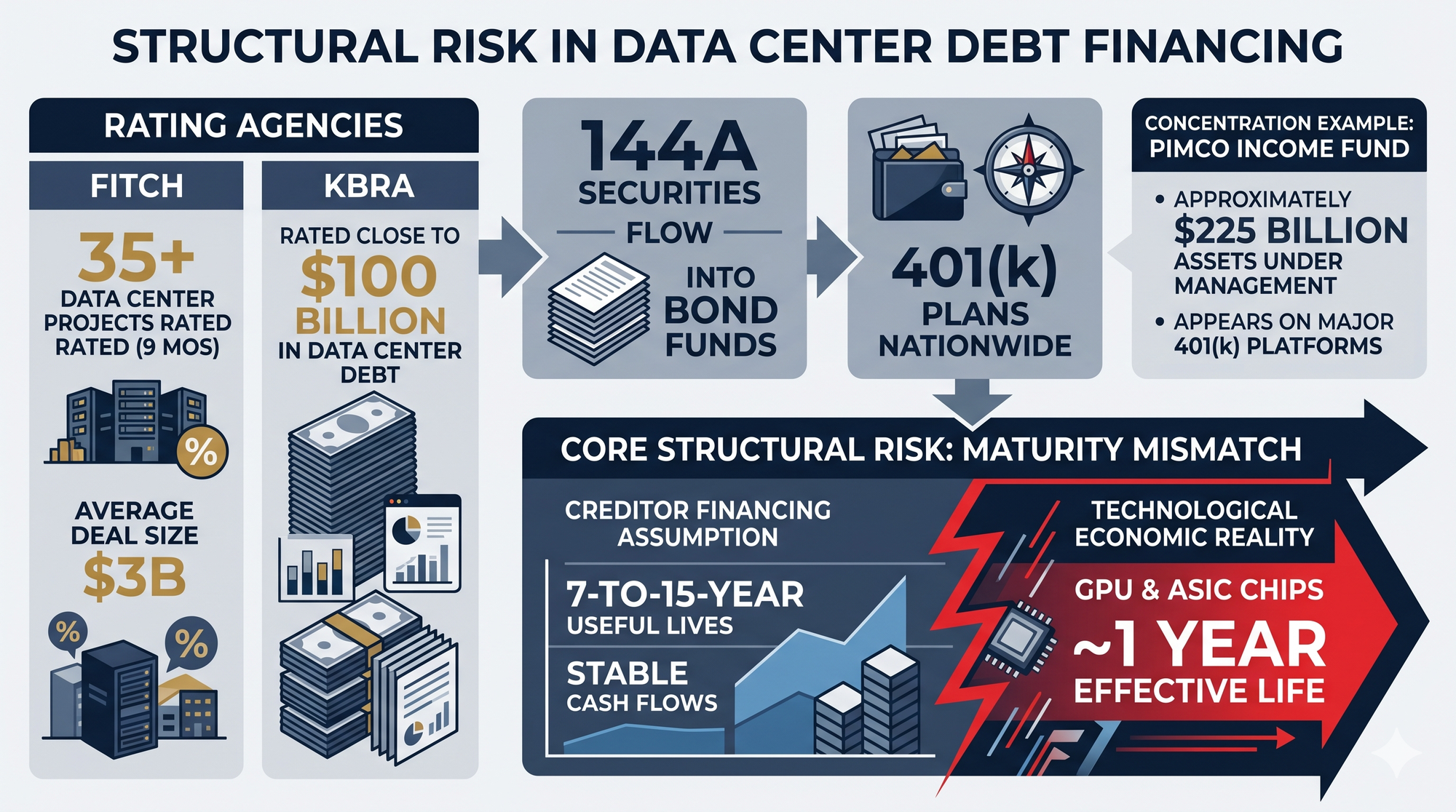
Rating agencies have handed investment-grade ratings to construction loans for data centers that have not broken ground. Fitch rated more than 35 data center projects in nine months, with an average deal size of approximately $3 billion. KBRA provides ratings for close to $100 billion in data center debt. These bonds are structured as 144A securities, which allow qualified institutional buyers to trade restricted securities without a public, Securities and Exchange Commission (SEC)-monitored offering, and they are channeled into bond funds that appear in 401(k) plans across the country. With Oracle’s Michigan data center project ballooning to $16 billion, as much as $14 billion in debt could come from PIMCO, which manages approximately $225 billion in assets and appears on most major 401(k) platforms. Ordinary Americans are financing AI infrastructure through the most conservative corners of their portfolios without knowing it.
The risk is a maturity mismatch. Creditors finance these projects assuming 7- to 15-year useful lives with stable cash flows. But the economic useful life of GPU and application-specific integrated circuit (ASIC) hardware is far shorter than the financing terms suggest. Goldman Sachs Global Institute estimates a useful life of four to six years for AI accelerators, bounded by physical degradation on one side and economic obsolescence on the other, as each new generation delivers step-change improvements in performance. Frontier-tier performance, however, may last only 12 to 24 months before the next generation renders current chips non-competitive for cutting-edge workloads. The gap between the financing assumption (7 to 15 years) and the economic useful life (4 to 6 years, with frontier relevance potentially shorter) is the mismatch that pension fund beneficiaries are not being told about. Man Group’s research unit found that risk is migrating away from tech company balance sheets and into institutions, such as utilities, insurers, data center operators, private credit funds, and pension funds, that do not see themselves as betting on GPU cycles. DeepSeek’s latest models claim to be cheaper and more efficient than their predecessors, undermining the demand assumptions that underpin the infrastructure buildout. Howard Marks of Oaktree Capital wrote that adoption today might have nothing to do with adoption tomorrow because the technology’s capabilities change by orders of magnitude in 12 to 24 months. Morgan Stanley projects cumulative data center capital expenditure (capex) of $3 trillion between 2025 and 2029.
Pension funds face a double exposure. If AI underperforms expectations, the data center debt underperforms and the fund’s returns suffer directly. If AI overperforms and accelerates workforce automation, the workers whose retirements the fund supports face displacement, reducing the contribution base that funds future payouts. Either scenario weakens the pension fund’s long-term position. When pensions miss their return targets, their funded ratio takes a hit. State and local governments must allocate larger budget shares to compensate for unfunded liabilities, taking money from public projects and adding to public debt. From 2008 to 2022, unfunded pension liabilities increased by 22.6 percentage points as a share of state revenue, according to Pew research. Goldman Sachs estimated that 300 million jobs globally face automation, displacing 6 to 7% of the workforce over the next decade.
SO WHAT
For Executives: If your organization operates defined benefit pension plans or has significant exposure to public pension fund solvency, the AI data center debt pipeline represents a new, concentrated, technology-specific risk inside what most people think of as conservative fixed-income allocations. Audit whether your pension fund advisers have explicitly disclosed digital infrastructure exposure and stress-tested it against demand scenarios that include DeepSeek-style efficiency breakthroughs. The CoreWeave concentration risk (62% of revenue from a single customer) is the canary. If any major hyperscaler renegotiates or exits a long-term lease, the downstream impact cascades through the credit structure.
For Policy Makers: Pension regulators should require explicit disclosure of digital infrastructure and AI data center exposure within pension fund portfolios. Current reporting frameworks do not distinguish between traditional infrastructure (roads, utilities) and speculative technology infrastructure (GPU clusters with 4-to-6-year economic useful lives and frontier relevance measured in months). State legislatures should require stress testing of pension fund AI infrastructure allocations against demand scenarios that include efficiency breakthroughs reducing compute requirements. Without that transparency, pension fund beneficiaries cannot assess whether their retirement savings are exposed to the AI cycle.
For Investors: Audit bond fund exposures. If you hold funds benchmarked to the Bloomberg Global Aggregate Index, you likely have indirect exposure to AI data center debt through 144A securities. Look for pension funds that have explicitly disclosed their digital infrastructure allocation and stress-tested it against demand scenarios. Those that have not are carrying risk they might not be measuring. The IEA projects data center electricity consumption to increase 96% from 2025 to 2030, but algorithmic efficiency gains could dramatically reduce compute-per-query requirements, leaving purpose-built training facilities stranded.
For Service Providers: This is a reputational risk story in formation. Any client with significant pension fund exposure, public sector relationships, or large employer status should be briefed on the mechanics of how AI data center debt reaches retirement accounts. The narrative that pension funds are passively financing a potential AI bubble will reach mainstream media, and when it does, clients in technology, financial services, and energy will face pointed questions. Prepare proactive messaging that acknowledges the risk concentration without being alarmist. The double exposure angle, that pension funds might be financing technology that eliminates the jobs of the workers whose retirements they fund, is the dimension that advocacy groups and media will surface. Crisis preparedness plans should include statements that address this tension directly.
Cambrian Partner By Invitation
Expert analysis from our global network
Elon Musk v. OpenAI: A Mano-Y-Mano Joust for AI Supremacy
The trial of Elon Musk v. OpenAI has commenced in Oakland and the spectacle will consume several weeks. It’s a personal battle between Elon and OpenAI CEO Sam Altman, who together co-founded OpenAI more than 10 years ago. OpenAI sprouted as a nonprofit, but later branched into a for-profit subsidiary structure where Microsoft has invested tens of billions of dollars. Elon, who invested $38 million in OpenAI before he left that glade, proclaims that OpenAI has strayed from its non-profit purpose — “To ensure that artificial general intelligence (AGI)…benefits all of humanity” — and should be pruned.
Briefing
Elon departed OpenAI in 2018 in the aftermath of a “power struggle” in which he “reportedly tried and failed to take over OpenAI”. In 2023 Mr. Musk founded xAI, his own artificial intelligence company, now a subsidiary of his aerospace company SpaceX. To no one’s surprise, xAI is a competitor to OpenAI. Elon filed the lawsuit in 2024.
It’s legitimate for nonprofit corporations to create for-profit subsidiaries and this is widely done. The community benefit standard of the nonprofit must triumph over any duty to maximize profits, though. Altman counters that the for-profit subsidiaries were required to handle the immense cost of AI development (think data centers), which were much too great for a nonprofit to bear.
Perhaps the most likely outcome is settlement; maybe Elon retrieves his $38 million plus interest and OpenAI provides minor structural or disclosure changes. Second most probable is that OpenAI triumphs. Third most possible is a limited win for Elon, with governance changes for OpenAI and greater separation between the nonprofit mission and for-profit activity. Still, this would be “unlikely to fully unwind” the for-profit structure or remove management. A ruling against OpenAI is least anticipated but could have a major impact: Sam Altman could be dethroned and OpenAI ordered to be fully non-profit, as Musk has advocated in his complaint.
So What
For Executives:
It’s yet again time to consider how your company employs AI. Rather than AI making workers, say 10 times more productive, productivity gains are “15 to 30 percent in field experiments”. Your mileage may differ, of course. Still, you might want to consider, for example, freezing new hiring as opposed to laying off a large percentage of your workers. Also, AI introduction is spurring unionization. Among other things, workers want human review for major employment decisions, especially discipline or firing, and want limits on replacing humans with AI, or at least advance “notice, retraining, and severance”. Consider sprinting ahead of the curve by making these company policies now.
For Policy Makers:
Only 17% of Americans believe AI will have a positive impact on the U.S., and “seventy-four percent” of Americans think the government is not doing enough to regulate AI. In the interest of truth, consider laws that require AI companies to place an AI legend on all AI-generated photos and videos. More than 1,200 bills regarding AI were introduced in the 50 states last year, and the European Union has already enacted the world’s first comprehensive AI law. With no U.S. federal AI legislation regarding the workplace, states and cities are filling the vacuum, primarily concerned that “It is well settled that AI systems have the potential to create discriminatory results”. If you are a federal policy maker, push for an acceptable and uniform nationwide rule. If you are a state or city policy maker, consider what your various stakeholders may demand and how you can reconcile those into an acceptable system.
For Investors:
It’s unlikely any investment you have in Microsoft or SpaceX will be affected by the Musk v. OpenAI outcome, although it is possible. More likely, the case will bring additional scrutiny to AI, accelerating further government regulation of AI and worker demands regarding it. While that won’t kill AI, it could mean slower adoption or resistance due to “pessimism” and swifter restrictions on commercialization of AI, leading to lower profits. Combined with the increasing costs of AI, it may be time to consider hedging AI investments.
About our partner
Bruce E. Methven is graduate of U.C. Berkeley Law School, where he was a member of the Law Review. He is a business-law attorney with many years of experience and with a specialization in securities law, helping private companies including start-ups raise money. He has served for many years as an arbitrator with the American Arbitration Association. You can reach him at bmethven@methvenlaw.com
About Cambrian

Cambrian Futures is a strategic foresight and advisory firm helping government, business, and technology leaders understand how emerging technologies intersect with geopolitics, markets, and national strategy. By combining rigorous research, AI-enabled analysis, and human expertise, Cambrian provides clear insight into global technology trends, risks, and power dynamics. Its work helps decision-makers anticipate disruption, manage uncertainty, and act with strategic confidence in an increasingly competitive GeoTech world.
PRODUCTION TEAM
GeoTech Radar is produced by the Cambrian Futures Insights Platform team:

CEO & Chief Analyst

Managing Director / Producer, Insights Platform

Global Lead, Smart Infrastructure Strategy

Research & Marketing Associate

Editor in Chief
Learn more about Cambrian Futures at cambrian.ai
Produced with

Human Led



Human Led +
AI Augmented




AI Led +
Human Verified


Cite as: Cambrian Futures (2026) 'GeoTech Radar Issue 18'