

A Spy in Nvidia's Chip Channel Gets Personal, a Meta Robot Gets Built in Shanghai, a $6 Billion Crypto Heist Beats Sanctions (FREE VERSION)
INSIDE ISSUE 44:
On the Radar
The signals affecting the GeoTech landscape this week
Chip-Smuggling Surveillance Caught Nvidia's Chief in a Chinese Intelligence Net
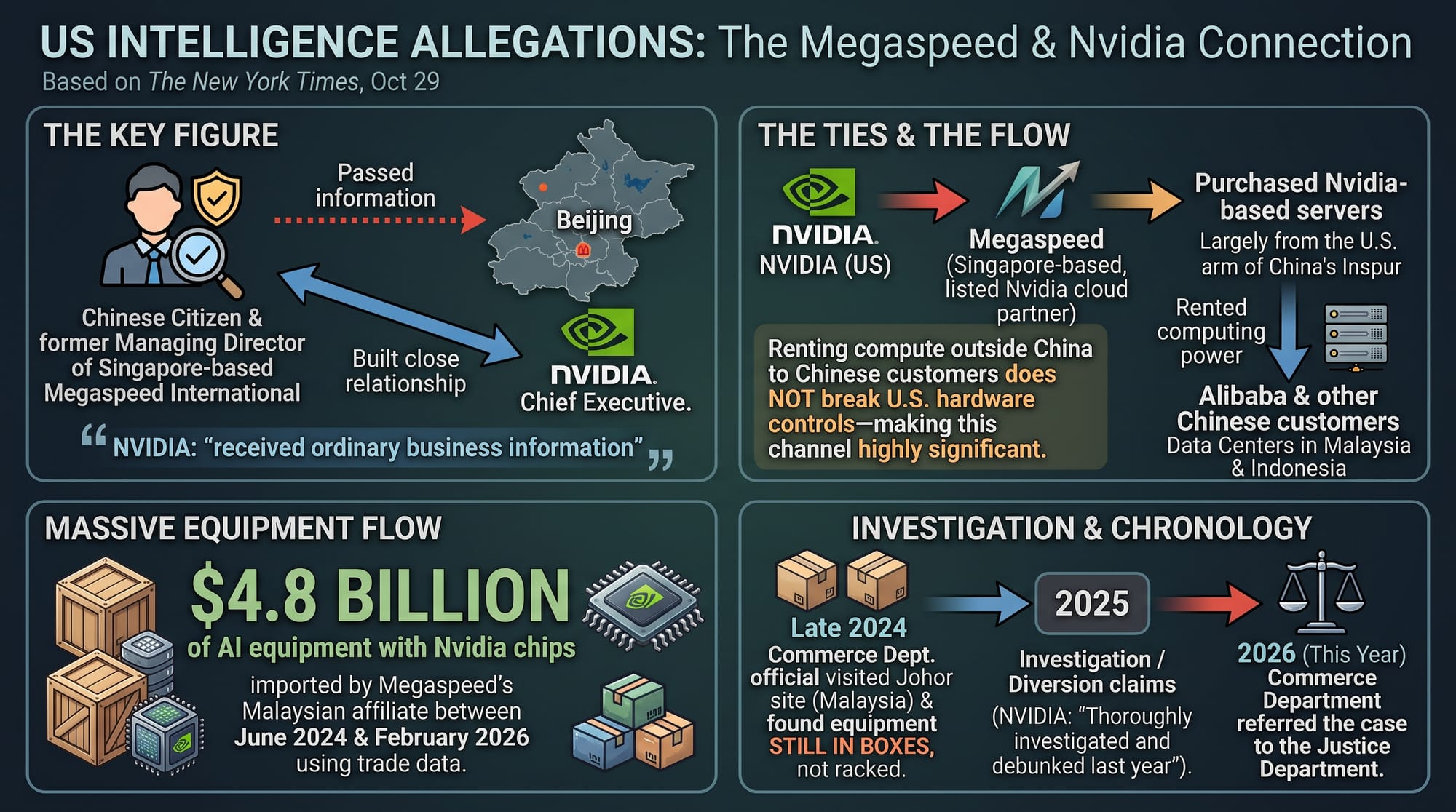
U.S. counterintelligence concluded that a Singapore executive who rented Nvidia-based compute to Alibaba was reporting to Beijing while cultivating Jensen Huang. The spy story rests on anonymous officials. The trade trail does not, and it runs through a channel export controls never covered.
BRIEFING: On October 29 The New York Times reported that U.S. intelligence agencies concluded Alice Huang, a Chinese citizen and former managing director of Singapore-based Megaspeed International, was passing information to Beijing while building a close relationship with Nvidia chief executive Jensen Huang. Trump was briefed about a year ago and chose not to act, and Jensen Huang has had no defensive briefing, the warning U.S. agencies give a citizen targeted by a foreign service. Those conclusions rest on unnamed officials describing classified material. The checkable part is the business. Megaspeed describes itself as an Nvidia partner. It bought Nvidia-based servers largely from the U.S. arm of Inspur, a Chinese server maker whose parent is on the U.S. Entity List and whose American arm is not, and rented the computing power to Alibaba and other Chinese customers from data centers in Malaysia and Indonesia. ImportGenius trade records cited by the Times show a Malaysian sister company imported at least $4.8 billion of AI equipment containing Nvidia chips between June 2024 and February 2026. A U.S. Commerce Department export-control official who visited the site in Malaysia's Johor state in September 2024 found the equipment still boxed rather than installed in server racks, and Commerce handed the case to the U.S. Justice Department this year.
Renting compute outside China to a Chinese customer does not break U.S. controls on hardware, a point Nvidia itself makes, which is why the channel matters more than the person. Nvidia said its regional cloud customers receive "ordinary business information," that the diversion claims were "thoroughly investigated and debunked last year," and Jensen Huang told Bloomberg the dealings were "normal and not unusual" and that Nvidia has "counted every one" of Megaspeed's GPUs. China's foreign ministry spokesman Guo Jiakun called the report "nothing but smears." Megaspeed's current leadership has retained outside counsel and says it is cooperating. The Times reported that Singapore questioned Alice Huang in 2025 and released her. Singapore's Ministry of Home Affairs said on October 31, answering a Wall Street Journal report, that it never investigated her, while its police force said investigations into Megaspeed are ongoing. Malaysia has required permits for transshipment of U.S. AI chips since July 2025 and had not commented by Sunday. Senator Elizabeth Warren, the Senate Banking Committee's senior Democrat, invited Huang to testify in June and was declined, and on October 29 called for bipartisan legislation. No charge, rule or hearing had followed by Sunday. Nvidia closed October 29 down 0.8 percent at $213.66, then fell 4.2 percent on Friday as Intel's results drove the Philadelphia Semiconductor Index, the main U.S. chip-stock index, down 7.2 percent.
In the first year the cost falls mainly on Malaysia and Singapore, whose data-center build-out priced in Chinese demand for rented compute, and on Nvidia's Southeast Asian order book if cloud-partner status becomes conditional. The macro variable is the price of compute available to Chinese buyers. If offshore leasing narrows, Chinese inference costs rise and orders for domestic accelerators from Huawei and Cambricon rise with them, which feeds Chinese capex. Who pays: Malaysian grid and property investors with capacity built for tenants who can no longer sign, and U.S. chip revenue from the region. Who collects: Chinese accelerator makers and onshore Chinese clouds, which absorb the demand the offshore channel loses.
| Net over twelve months: compute rents for Chinese buyers up, Malaysian data-center leasing to Chinese tenants down, Chinese domestic chip orders up. |
Hedge: The intelligence finding rests on anonymous sources, Singapore disputes part of it, and no enforcement action exists. Trade on the paper trail, the $4.8 billion import record and the 2026 referral, rather than the spy headline, and give any cloud-channel rule a 2027 timeline.
Strategy & Portfolio Implications
The holdings most at risk are Nvidia and the Southeast Asian data-center owners and lenders whose tenants resell compute to Chinese firms. Bain Capital's Bridge Data Centres told lenders in February that Megaspeed's 68.4 megawatts at its Malaysian hub had been replaced by Zenlayer, with a $2.8 billion loan behind the site, and gave no reason. Position for the next control to land on the cloud channel rather than the chip: offshore compute leases to Chinese customers are the open seam, and a condition written into Nvidia's cloud-partner program is the plausible instrument. In diligence, ask any Nvidia reseller or Asian colocation holding what share of its GPU capacity is contracted to Chinese end users, where the servers physically sit, and whether the partner agreement requires end-use reporting. Dated catalysts: Nvidia earnings on November 17, any Justice Department filing against Megaspeed, and the new Congress in January, since Tuesday's midterm handed Democrats both chambers and puts Warren in line to chair Senate Banking with subpoena power.